

Summary
Time management skills are your ability to prioritize work, plan it and deliver it on schedule. Employers ask for them across roles, often alongside communication and organizational skills, yet "excellent time management" proves nothing on its own. Show it with three facts in one bullet: how much work you handled, the deadline or pace involved, and the result. Put that proof in your experience section and use the posting's exact wording in your skills list.
The best way to show time management skills on a resume is to pair a workload with a deadline and a result. "Processed 300 invoices a week with a 100% on-time close" proves more than "strong time management" ever could.
Employers have reason to care. Microsoft's 2025 Work Trend Index found workers are interrupted every two minutes during core hours, about 275 times a day. Anyone who still ships on time in that environment has a skill worth proving.
This guide explains which time management skills employers mean, a simple formula for proving them, and copy-ready examples by job.
What are time management skills on a resume?
Time management skills are the abilities to prioritize tasks, plan and schedule work, protect focus and deliver on deadlines, for yourself and often for others. On a resume, they appear as throughput and reliability: how much work you handled, how fast, and how consistently it landed on time, especially under competing demands.
O*NET, the US Department of Labor's occupational database, defines time management as "managing one's own time and the time of others." That second half matters. The occupations rating it most important include chief executives, construction managers, HR managers and supply chain managers.
Time management is about the clock. Organizational skills are about structure, such as records, systems and spaces. A coordinator who builds a new filing system shows organization. The same coordinator closing month-end two days early shows time management. For the structure side, see our guide to organizational skills for your resume.
Which time management skills matter most to employers?
Employers focus on prioritization, planning and scheduling, meeting deadlines, handling volume, delegating and staying focused under interruptions. In one sample of 23,042 job posts, about 4.5% named time management, and a third of those also asked for organizational skills. The Bureau of Labor Statistics calls time management essential for roles with tight project deadlines.
Postings tend to bundle time management with other skills. Among postings that named it, 39% also asked for communication, 33% for organizational skills and 25% for problem-solving, based on 1,044 of 23,042 sampled job posts. Employers marked it required far more often than preferred.
Some roles put it front and center. The Bureau of Labor Statistics says project management specialists "often work under tight deadlines and must use their time efficiently to complete projects on schedule." NACE's career readiness framework lists the ability to "prioritize and complete tasks to accomplish organizational goals" as a core professional behavior.
These are the specific skills that sit under the label:
- Prioritization. Deciding what matters most when everything feels urgent.
- Planning and scheduling. Breaking work into steps and sequencing them ahead of the deadline.
- Deadline reliability. Delivering on time, every time, not just once.
- Throughput. Handling high volume at a steady pace.
- Delegation. Assigning work so the team, not just you, finishes on time.
- Focus. Protecting deep work from constant pings and meetings.
How do you show time management skills on a resume?
Use a three-part formula in each bullet: volume, deadline and result. State how much work you handled, the time pressure or pace involved, and the outcome, such as an on-time rate, a shortened cycle or a deadline beaten. The reader sees time management in action without the phrase ever appearing.
A recruiter can't watch you work. So your bullet has to show the pressure and how you handled it.
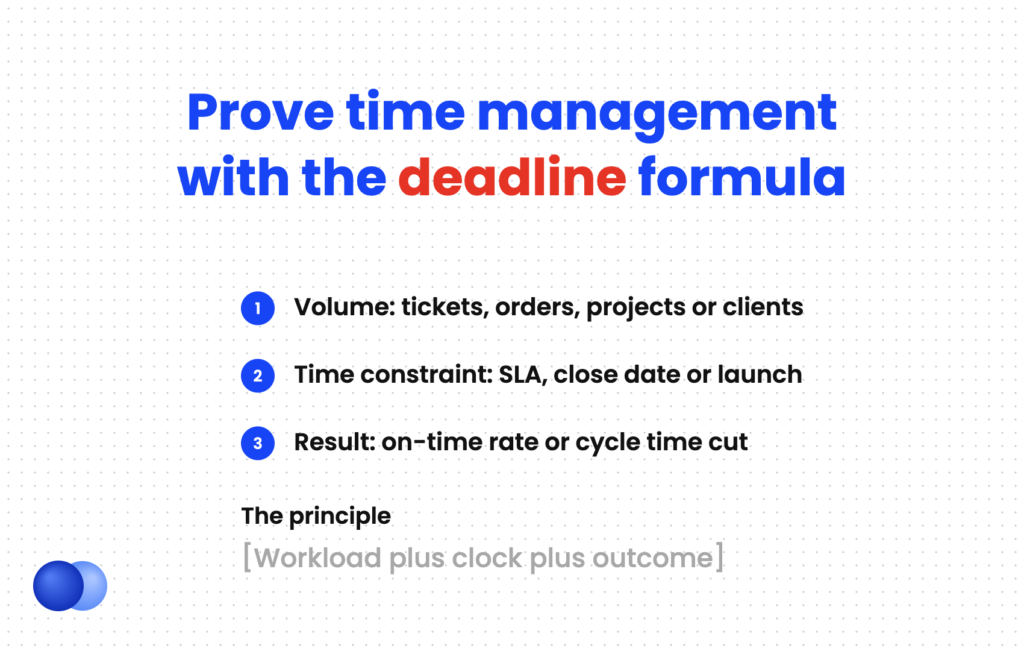
The deadline formula: volume + time constraint + result.
- Volume. Tickets, orders, projects, accounts, clients or shifts.
- Time constraint. A weekly close, a 24-hour SLA, a launch date or a peak season.
- Result. On-time rate, cycle time cut, backlog cleared or a deadline beaten.
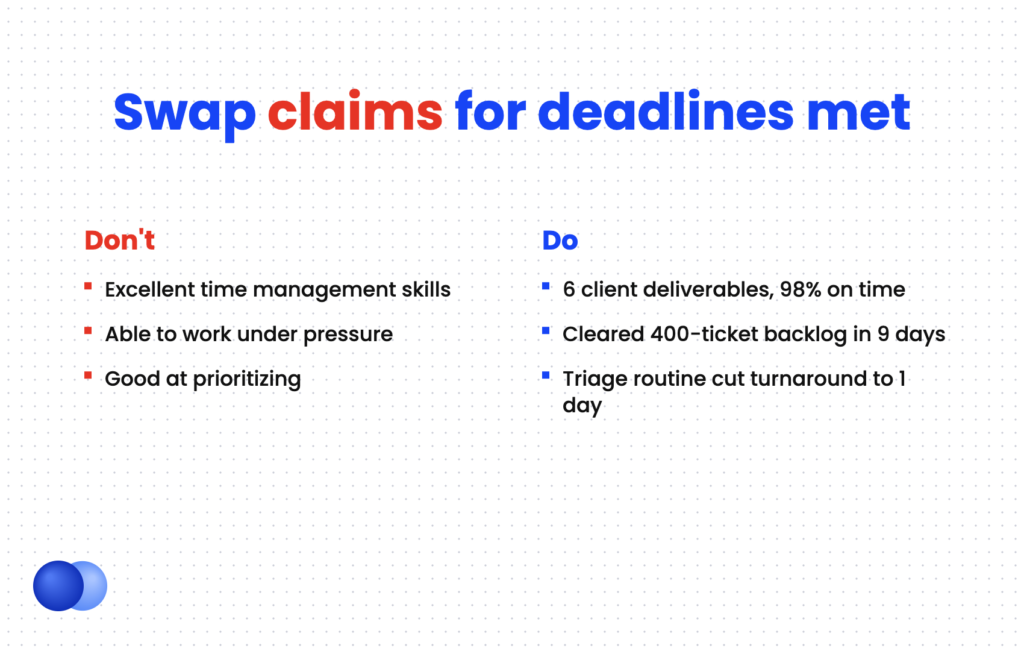
Before: Excellent time management skills After: Managed 6 concurrent client deliverables on weekly deadlines, shipping 98% on time across 2025
Before: Able to work under pressure After: Cleared a 400-ticket support backlog in 9 business days while holding the 24-hour response SLA for new requests
Before: Good at prioritizing After: Built a daily triage routine for 40+ incoming requests, cutting average turnaround from 3 days to 1
Notice that each bullet has a number for volume, a time frame and an outcome. For more ways to add figures, read how to quantify your resume, and for line structure, see our guide to writing resume bullet points.
Use time units as your metric
If you lack revenue or percentage figures, measure in time. Days saved, hours per week, turnaround time and on-time rate are all credible numbers. "Cut report prep from 6 hours to 2" proves time management with a metric nobody else on your team can claim.
Where should time management skills go on a resume?
Prove time management skills in your experience bullets, mention one deadline result in your summary, and list the posting's exact phrase, such as "deadline management" or "prioritization," in your skills section. Pair the soft label with the planning tools you use so applicant tracking systems find the keyword and readers see substance.
Each section plays a role:
- Experience. Two or three deadline bullets in your most relevant job carry most of the weight.
- Summary. Name one time-pressure result rather than an adjective. Our guide to the resume summary covers the structure.
- Skills. Mirror the wording of the posting and add tools, for example "Project scheduling (Asana, MS Project)."
Summary: Marketing coordinator with 3 years running content calendars for 4 product lines. Delivered 120+ campaign assets a quarter with a 97% on-time rate while supporting two launches.
Skills: Deadline management · Prioritization · Project scheduling (Asana) · Content calendar planning · Stakeholder updates
In an interview, expect follow-up questions on any deadline claim. The STAR method helps you tell the full story behind the bullet.
Time management skills examples by job
Match your proof to how time pressure shows up in the role. Nurses manage patient loads per shift, accountants manage close deadlines, customer service reps manage response times, and project managers manage milestones. Choose the metric that matters most in that job and build your bullet around it.
Every job has a different clock. Use this table to find the right metric for yours.
| Job | Where time pressure shows up | Proof bullet idea |
|---|---|---|
| Registered nurse | Patient load per shift | Managed care for 6 patients per 12-hour shift, completing all charting before handoff |
| Staff accountant | Month-end close | Shortened monthly close from 8 days to 5 by resequencing reconciliations |
| Customer service rep | Response and resolution time | Resolved 60+ tickets per day while keeping first response under 2 hours |
| Project manager | Milestones and launch dates | Delivered 3 concurrent software releases on schedule with no scope cuts |
| Teacher | Grading and lesson prep | Returned graded essays for 140 students within 5 school days all year |
| Retail shift lead | Peak periods | Scheduled 12 associates for Black Friday, cutting average checkout wait to 4 minutes |
| Student | Classes plus work | Worked 20 hours a week while completing 15 credits a term with a 3.6 GPA |
If you are moving fields, deadline reliability is one of the easiest transferable skills to carry over. It also pairs naturally with problem-solving skills when a bullet shows how you rescued a slipping timeline.
What time management claims should you avoid?
Avoid generic phrases like "excellent time management," "works well under pressure" and "multitasker" with no proof. Skip claims about personal productivity apps unless the job uses them. Never claim deadline reliability on a resume sent late or with errors. Replace each vague claim with a bullet showing volume, timing and results.
Write "Closed 300 invoices weekly with a 100% on-time rate"
Write "Excellent time management skills" do: Show the deadline, SLA or cycle time you worked against dont: Claim "works well under pressure" with no example do: Name the scheduling tools the posting mentions dont: List personal productivity apps nobody asked for do: Show a pattern, such as on-time across a full year dont: Build a bullet on one late night that saved one project
Your application is a time management test too. Applying soon after a posting goes live, following instructions and sending a clean file all back up what your bullets say.
Before you submit, run your draft through the Rezoom ATS resume checker to confirm the posting's time management keywords appear where a recruiter will see them.

Frequently asked questions
What are examples of time management skills for a resume?
Common examples include prioritization, planning, scheduling, deadline management, delegation and handling high volume. Pick the ones the posting names and prove each with a bullet that shows a workload, a deadline and a result.
How do I say I have good time management on a resume?
Show it instead of saying it. "Delivered 40 client reports a month, all on deadline" proves the skill more convincingly than "good time management."
Is time management a hard or soft skill?
It is a soft skill. The planning and scheduling tools you use, such as Asana, Jira or MS Project, are hard skills you can list separately.
Is multitasking a time management skill?
Employers often group them, but the word "multitasker" is weak on its own. Show it as handling several concurrent projects or requests while still hitting deadlines.
How do I show time management skills as a student?
Use your schedule as evidence. Balancing part-time work hours with a full course load, or meeting deadlines on a group project, shows time management without a full-time job.
How do I talk about time management in an interview?
Prepare one specific story about competing deadlines. Explain how you prioritized, what you delivered and how it turned out, using the STAR structure.



Comments