

Summary
Multitasking on a resume works best when you frame it as handling competing priorities, not doing two things at once. Research shows people switch between tasks rather than doing them simultaneously, and interruptions carry real costs. Employers still want people who can juggle many demands, so show volume, triage decisions and results in your bullets. Reserve the word itself for roles, like dispatch or reception, where postings explicitly ask for it.
The best way to show multitasking on a resume is to describe competing priorities you handled and what you delivered. Listing "multitasking" as a skill is weak, because recruiters can't verify it and many know the research against it.
That research is consistent. A Stanford study found heavy media multitaskers performed worse on attention, memory and task-switching tests than light multitaskers. Yet postings still ask for people who can "juggle multiple tasks." Both things are true.
This guide explains how to square them: what employers actually mean, how to frame the skill honestly, and copy-ready lines for different jobs.
Should you put multitasking on your resume?
Use the word only when the posting does, and back it with evidence. For most roles, phrases like "managed competing priorities" or "handled high-volume requests" are stronger, because they describe outcomes rather than a habit research questions. Show the number of demands, how you decided what came first, and the result.
The word is not banned. Many postings for front-desk, dispatch, healthcare and operations roles name it directly. If yours does, matching the term helps both applicant tracking systems and human readers.
But a bare skills-list entry proves nothing. And some hiring managers read it as a flag. A Baylor business school dean put it bluntly in a piece titled "Three Myths of Multitasking – And Why You Don't Want To List It On Your Resume".
Use this rule: name it if the posting names it, then prove it with a bullet. Otherwise, describe the priorities you managed.
What does the research say about multitasking?
Research shows people rarely do two thinking tasks at once. They switch between them, and each switch costs time and accuracy. Stanford researchers found heavy media multitaskers did worse at filtering distractions and switching tasks. UC Irvine's Gloria Mark found interrupted work took about 23 minutes to resume on average.
Three findings are worth knowing before you write a single bullet:
- Attention is serial. Baylor's Anne Grinols explains that "conscious mental activity happens one activity at a time." What feels like multitasking is rapid switching.
- Heavy multitaskers filter worse. The 2009 Stanford study of about 100 students found heavy media multitaskers struggled to ignore irrelevant information. One researcher said, "We kept looking for what they're better at, and we didn't find it."
- Interruptions are expensive. Gloria Mark's workplace research, reported by Gallup, found interrupted work took an average of 23 minutes and 15 seconds to resume.
None of this means employers are wrong to want the skill. It means the skill is not doing everything at once. It is deciding what to do next, switching cleanly, and nothing falling through the cracks.
What employers mean by juggling multiple tasks
Employers usually mean handling a high volume of concurrent demands without dropping any: answering calls while greeting visitors, tracking several projects, or triaging patients. The real skills underneath are prioritization, organization, composure under interruption and follow-through. Your bullets should show those, with numbers for volume and results.
Some jobs genuinely require rapid switching. O*NET calls this ability "Time Sharing," defined as shifting back and forth between two or more activities or sources of information. Air traffic controllers rate highest.
The Bureau of Labor Statistics lists multitasking as an important quality for public safety telecommunicators. They must simultaneously answer calls, collect vital information, coordinate responders and monitor multiple displays.
For most office roles, though, the request is broader. It means your workload has many open threads, and you keep them all moving.
Multitasking vs. time management
These overlap but are not the same. Time management is planning: how you schedule your own work across days and deadlines. Multitasking, in resume terms, is real-time triage: handling interruptions and simultaneous demands as they arrive.
If your strength is planning and meeting deadlines, our guide to time management skills for your resume is the better fit. If it is keeping many plates spinning in a busy environment, read on.
How to describe multitasking on a resume
Use the competing-priorities formula: number of concurrent demands + how you prioritized or organized them + a result. "Supported 4 executives and 2 board committees, triaging 80+ weekly requests with zero missed deadlines" shows the skill honestly. The verb carries the meaning, so the word "multitasking" becomes optional.
Strong bullets answer three questions:
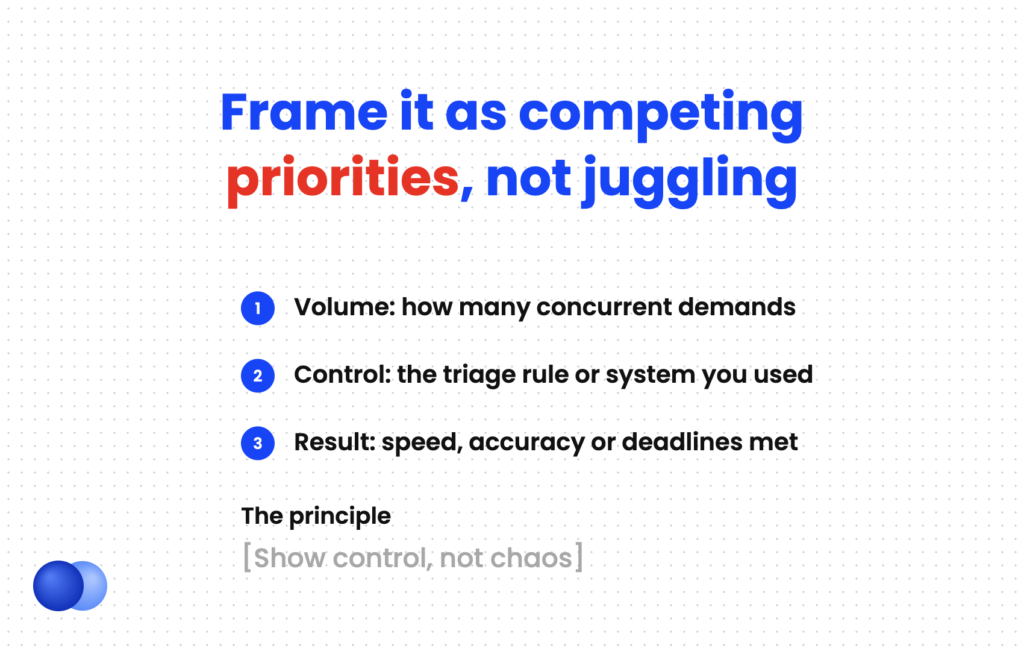
- How many demands? Phones, patients, projects, clients, tickets or stakeholders.
- How did you keep control? A system, a triage rule, a tool or a handoff process.
- What was the result? Speed, accuracy, satisfaction scores or deadlines met.
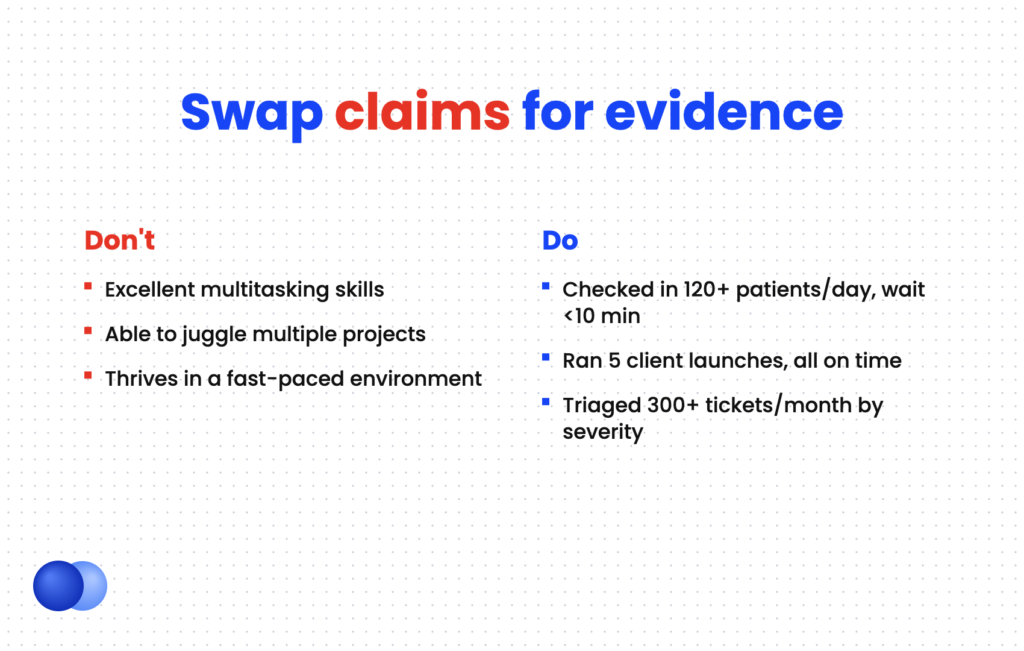
Before: Excellent multitasking skills After: Managed a 6-line phone system while checking in 120+ patients per day, keeping average wait under 10 minutes
Before: Able to juggle multiple projects After: Ran 5 concurrent client launches using a shared priority board, delivering all on time and under budget
Before: Thrives in a fast-paced environment After: Triaged 300+ IT tickets per month by severity, cutting critical-issue response time from 4 hours to 45 minutes
The best verbs imply control, not chaos: "triaged," "prioritized," "coordinated," "balanced" and "managed." For more ways to add numbers, see how to quantify your resume and our guide to resume bullet points.
Show the system, not the scramble
Mention the method that kept you on track: a triage rule, a shared tracker, batching email at set times. This answers the research-savvy reader's real worry, which is dropped balls. A line like "batched non-urgent requests into two daily blocks" signals you understand switching costs and manage them.
Where to show it on your resume
Put the proof in experience bullets, where volume and results fit naturally. Mention it in your summary only with a number attached. Add the exact term to your skills section only if the posting uses it. Tools that support juggling work, such as ticketing systems or project boards, belong in skills too.
Each section does a different job:
- Experience. Volume, triage and results. This is where the proof lives.
- Summary. One phrase about high-volume or multi-priority work, plus a number. Our resume summary guide covers structure.
- Skills. "Multitasking" or "prioritization" only when the posting uses it, plus tools like Zendesk, Asana or Epic.
Medical office coordinator with 4 years in a 9-provider practice. Balance front-desk check-in, insurance verification and scheduling for 100+ patients daily while keeping claim errors under 2%. Known for calm triage during peak hours and clean handoffs between shifts.
Notice the summary never claims to do everything at once. It shows a heavy load handled accurately.
Better phrases to use, by job
Match the phrase to the role. Receptionists and dispatchers can use the word directly because postings do. Project and operations roles fit "managed competing priorities." Customer service fits "handled high-volume requests." Healthcare fits "triaged." Pick the term your posting uses, then prove it with numbers.
| Job | Stronger phrase | Proof bullet idea |
|---|---|---|
| Receptionist or front desk | Multitasking in a high-volume office | Answered 80+ calls daily while greeting visitors and booking rooms |
| 911 dispatcher | Coordinated simultaneous emergency calls | Handled 60+ calls per shift while dispatching units across 3 agencies |
| Project coordinator | Managed competing priorities | Tracked 7 concurrent projects, flagging risks a week ahead |
| Customer service rep | Handled high-volume requests | Resolved 50+ chats and emails daily at 94% CSAT |
| Nurse or medical assistant | Triaged patient needs | Prioritized care for 6 patients per shift during peak census |
| Executive assistant | Balanced multiple executives' calendars | Supported 4 executives, resolving 20+ weekly scheduling conflicts |
Closely related skills strengthen these lines. See our guides to organizational skills for your resume and, for structured project work, project management skills for your resume.
Common multitasking mistakes on a resume
Avoid listing the bare word alone in a skills section, describing chaos instead of control, and using "fast-paced environment" as a substitute for evidence. Also avoid claiming you do everything simultaneously, since informed readers know that's not how attention works. Show volume, method and results instead.
Write "Triaged 120+ daily requests by urgency with zero missed deadlines"
List "Multitasking" as a lone skill with no proof anywhere do: Name the system that kept you organized dont: Brag about doing ten things at once do: Use the posting's exact phrase if it names the skill dont: Lean on "thrives in a fast-paced environment" as evidence do: Show accuracy alongside volume dont: Describe a workload so chaotic it sounds unmanaged
When your draft is ready, run it through the Rezoom ATS resume checker to confirm your phrasing matches the terms in the posting.

Frequently asked questions
Is multitasking a good skill to put on a resume?
It can be, if the posting asks for it and you prove it with numbers. For most roles, "managed competing priorities" reads stronger.
What is a better word for multitasking on a resume?
Try "managed competing priorities," "triaged," "coordinated," "balanced" or "handled high-volume requests." Choose the phrase closest to your target posting.
Is it a hard skill or a soft skill?
It is a soft skill. That is why it needs proof in a bullet rather than a spot in a list. Our [soft skills guide](https://rezoom.io/soft-skills-for-resume/) covers the approach.
Is multitasking really bad for productivity?
Research shows switching between thinking tasks costs time and accuracy. Handling many demands well depends on prioritizing and switching cleanly, not doing everything at once.
How do I show I can juggle tasks with no work experience?
Use school, clubs, sports or volunteer roles. "Balanced 15 credit hours with a 20-hour-per-week job and a club treasurer role" proves it plainly.
How do I answer an interview question about juggling tasks?
Describe one busy stretch, how you decided what came first, and the result. The [STAR method](https://rezoom.io/star-method-interview/) keeps the story focused.



Comments