

Summary
List awards on a resume when they prove a skill or result the job needs. Put a single job-related award inside the matching experience or education entry, and use a separate "Honors and Awards" section only when you have three or more. Write each one with the award name, the issuer, the date and one line on why you won or how selective it was. Cut anything older than ten years unless it is still well known.
Listed well, awards on a resume work as third-party proof: someone else judged your work and ranked it above your peers. Put them where they support the claim they prove, and add one line that explains the scale of the win.
Most guides stop at "list the name and the date." That leaves a recruiter guessing whether "President's Circle" meant top 1% or everyone who hit quota. The difference between a weak and a strong award line is almost always context.
This guide gives you a placement rule, a four-part format, a test for which awards to cut, and copy-ready lines for students, professionals and career changers.
Should you put awards on a resume?
Yes, when the award proves a skill, result or standard of work the target job values. Awards are external validation, so they carry more weight than self-described strengths. Skip awards that are routine, very old, unrelated to the role, or that would push stronger experience bullets off the page.
Employers increasingly screen on evidence of skills rather than credentials alone. In NACE's Job Outlook 2026 survey, 70% of employers reported using skills-based hiring, up from 65% the year before. An award tied to a skill gives a recruiter that evidence in one line.
Before adding an award, run it through three checks:
- Is it merit-based? It should reflect selection, judging or ranking, not attendance or participation.
- Does it connect to the job? It should show a skill, result or quality the posting asks for.
- Is it recent or still recognized? Most awards older than ten years should go, unless the name still carries weight.
If an award passes all three, it earns space. If it fails one, it probably belongs in your interview stories instead.
Where do awards go on a resume?
Put awards where they support a claim. A sales award goes under the job where you earned it. Academic honors go in the education section. Create a separate "Honors and Awards" section only when you have three or more relevant awards, and place it after experience and education.
Use this placement rule based on how many awards you have and where they came from.
| Your situation | Where to put the award | Why |
|---|---|---|
| One award earned at a specific job | Bullet under that job | Ties the recognition to the result |
| Academic honors (Dean's List, scholarships, Latin honors) | Education section | Keeps academic proof together |
| Three or more relevant awards from different areas | Separate "Honors and Awards" section | Prevents scattered lines |
| One major industry award | Summary line plus full entry below | Gets seen in the first scan |
| Military decorations | Military experience entry or separate section | Keeps service context intact |
The University of Nebraska–Lincoln career guide notes that academic-based honors can be listed within your education section instead of a standalone category. For specific academic honors, see our guides on how to put Dean's List on a resume and how to list Latin honors on a resume.
Placement matters because recruiters move fast. The Ladders eye-tracking study found recruiters spend about 7.4 seconds on an initial resume scan. An award buried in a section at the bottom may never be seen. The same award inside the job entry it came from gets read with the result it proves.
How do you format awards on a resume?
Write each award with four parts: the award name, the organization that gave it, the month and year, and one line on why you won or how selective it was. Selectivity, such as "1 of 12 selected from 400 staff," is the detail most candidates leave out and the one recruiters need most.
The four parts:
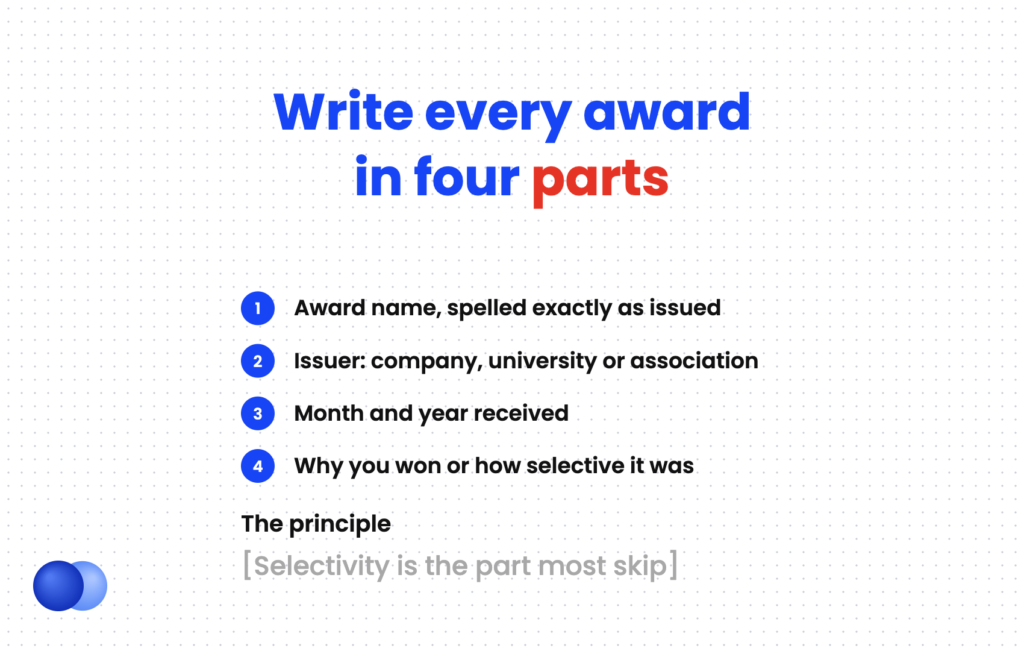
- Award name, spelled exactly as issued.
- Issuer, such as the company, university or association.
- Date, as month and year. Valparaiso University's career guide recommends listing awards in reverse chronological order with the full name and the month and year received.
- Context, meaning why you won or how many people competed.
The fourth part is what separates a strong line from a forgettable one. Internal company awards are the biggest problem, because outsiders do not know what "Eagle Award" or "Q3 Spotlight" means. UNL's guide advises adding a brief description when an award name is unclear.
Translate internal awards into a rank, a ratio or a result:
Before: Eagle Award, 2025 After: Eagle Award, Northwind Logistics (Mar 2025) – 1 of 6 recipients from 900 employees, for cutting carrier costs 14%
Before: President's Club After: President's Club, Brightline Software (2024) – top 5% of 220 account executives; closed 138% of $1.2M quota
Before: Teaching award After: Outstanding Teaching Assistant Award, University of Iowa (May 2025) – selected from 85 graduate TAs based on student evaluations
Before: Hackathon winner After: First Place, HackMidwest (Oct 2025) – 1st of 42 teams; built a shift-scheduling app in 36 hours
If you know the numbers behind the award, use them. Our guide on how to quantify your resume shows how to find figures even when your company did not publish them.
Which awards should you leave off a resume?
Leave off participation certificates, awards older than ten years that nobody outside your old employer would recognize, high school awards once you have a college degree or work history, and awards that reveal religion, politics or other protected traits. Also skip awards for doing the basic job, such as perfect attendance.
Not every recognition belongs on the page. Cut an award if it fits any of these patterns:
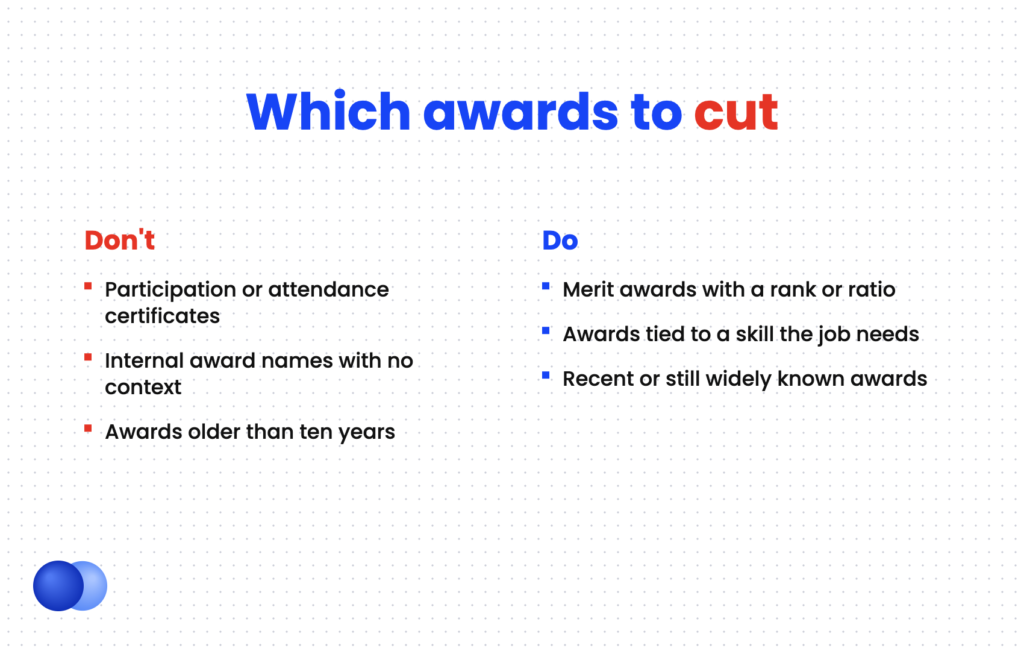
- Participation, not selection. "Certificate of completion" or "attendee" is not an award.
- Too old to matter. A 2012 sales award rarely helps a 2026 director application.
- Outgrown. High school honors drop off once you have college or work entries. Our sibling guide on whether to put high school on your resume covers the cutoff.
- Basic duties. Perfect attendance or "met all deadlines" sets a low bar.
- Sensitive signals. An award from a religious or political group can invite bias. If the skill matters, describe the skill rather than the group.
Add the selection ratio or rank when you know it
List internal award names with no explanation do: Place a job award under the job where you earned it dont: Build a separate section for a single award do: Keep the five most relevant awards when you have many dont: List every Employee of the Month from the past decade do: Mention a nationally known award in your summary dont: Include participation certificates or attendance awards
How do awards on a resume differ by career stage?
Students can list academic, athletic and scholarship awards, since they have less work history to show. Mid-career professionals should list only work and industry awards tied to results. Career changers should choose awards that prove transferable skills, and senior candidates should keep only major, recent or well-known recognition.
Awards on a resume shift in purpose as your career grows.
Students and new grads. Cast a wider net. Scholarships, honor societies, competition wins and athletic honors all count. Leadership honors, such as an Eagle Scout award, show responsibility early. If you have thin work history, see our college student resume guide.
Mid-career professionals. Keep work and industry awards. Drop most academic honors except Latin honors or a major fellowship.
Career changers. Choose awards that prove a skill the new field uses. A teacher's curriculum award can show training design for an L&D role.
Senior candidates. Keep two or three major, recent awards. Put the most recognizable one in your summary.
NEW GRAD (marketing analyst) HONORS AND AWARDS • Dean's List, Ohio State University – 6 of 8 semesters • First Place, AMA Collegiate Case Competition (Apr 2026) – 1st of 30 teams nationwide • Merit Scholarship, Fisher College of Business (2022–2026) – $8,000/year, top 3% of admits
MID-CAREER (operations manager) HONORS AND AWARDS • Operational Excellence Award, Northwind Logistics (2025) – 1 of 6 from 900 staff • 40 Under 40, Kansas City Business Journal (2024)
CAREER CHANGER (teacher to instructional designer) HONORS AND AWARDS • District Innovation in Curriculum Award, Lakeview School District (2025) – designed a blended unit adopted by 14 schools
Can awards replace accomplishments on a resume?
No. Awards confirm results, but they do not explain them. Each award should sit beside the accomplishment that earned it, so the recruiter sees both the result and the recognition. An award with no matching result looks thin, while a result with a matching award looks verified.
Think of an award as a stamp on a result. The bullet "Cut onboarding time 30% across four sites" is strong. Add "earning the 2025 Process Excellence Award" and it becomes verified.
That pairing also helps ATS screening. If the award name includes a keyword from the posting, such as "safety" or "customer experience," it adds a relevant term in context. See our resume accomplishments examples for result-first bullets you can pair with awards.
Ask for the numbers before you leave
Most people cannot add selectivity because they never asked. When you receive an award, ask your manager or HR how many people were eligible and how many won. Write it down with the date. That single ratio turns a vague honor into a credible line years later.
When your draft is ready, the Rezoom AI resume builder can help you rewrite award lines with context and place them in the right section.

Frequently asked questions
Should I put awards on my resume if they are not related to the job?
Usually no. Include an unrelated award only if you have room and it shows a transferable quality, such as discipline or leadership, that the role values.
How many awards should I list on a resume?
Three to five is a good ceiling. Choose the most selective and most relevant ones, and move the rest to your LinkedIn profile.
Should I put Employee of the Month on my resume?
Yes, if it is recent and you add context. Note how many employees were eligible or how many times you won it.
Can I list scholarships as awards on a resume?
Yes. Merit scholarships belong in the education section or in an Honors and Awards section. Add the selection rate or criteria when the name does not explain them.
What is the difference between honors and awards on a resume?
Honors usually recognize academic standing, such as Dean's List or cum laude. Awards recognize a specific achievement or competition win. Both can share one "Honors and Awards" section.
Should I put awards on my resume from more than ten years ago?
Only if the award is still widely recognized in your field, such as a national industry prize. Otherwise, older awards take space from recent results.



Comments