

Summary
A college student resume without internships is not an empty page. In NACE's ranking of what decides between otherwise equal candidates, general work experience, leadership roles and extracurricular activities all scored above GPA, and the share of employers screening by GPA fell from 73% in 2019 to 42% in 2026. So build one page, education first, then projects, part-time work and club roles written as evidence of the skills a posting names.
A college student resume without an internship tempts you into one of two moves: lead with your GPA, or fill the space with a list of skills. Both feel safe, and the data suggests both miss what employers actually rank.
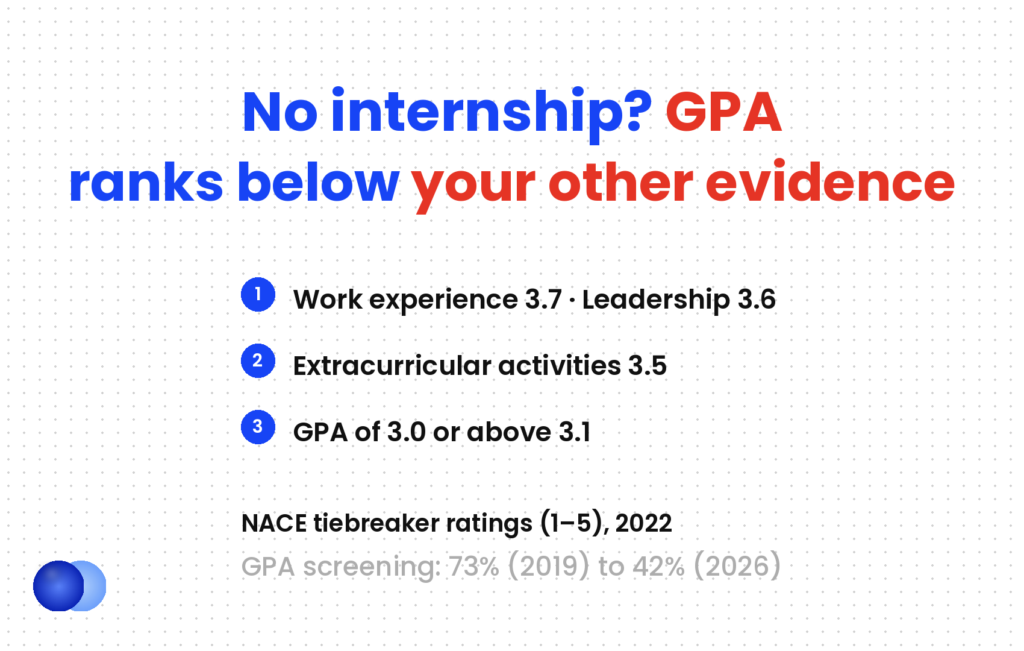
When NACE asked employers what tips the decision between two otherwise equal candidates, internships came first. But the next tier matters more to you if you have none: general work experience, leadership positions and extracurricular activities all scored higher than a GPA of 3.0 or above. The part-time job you consider irrelevant sits above the number you consider your best asset.
That reframes the task. You are not compensating for a missing internship. You are writing up evidence you already have, in a form a recruiter can read in a few seconds.
What goes on a college student resume with no internships?
Education at the top, then a Projects section built from coursework, then dated experience from part-time jobs, then clubs and leadership. Each entry names a skill the posting asks for and shows it in use. One page, single column, month-and-year dates, and no objective statement or references line.
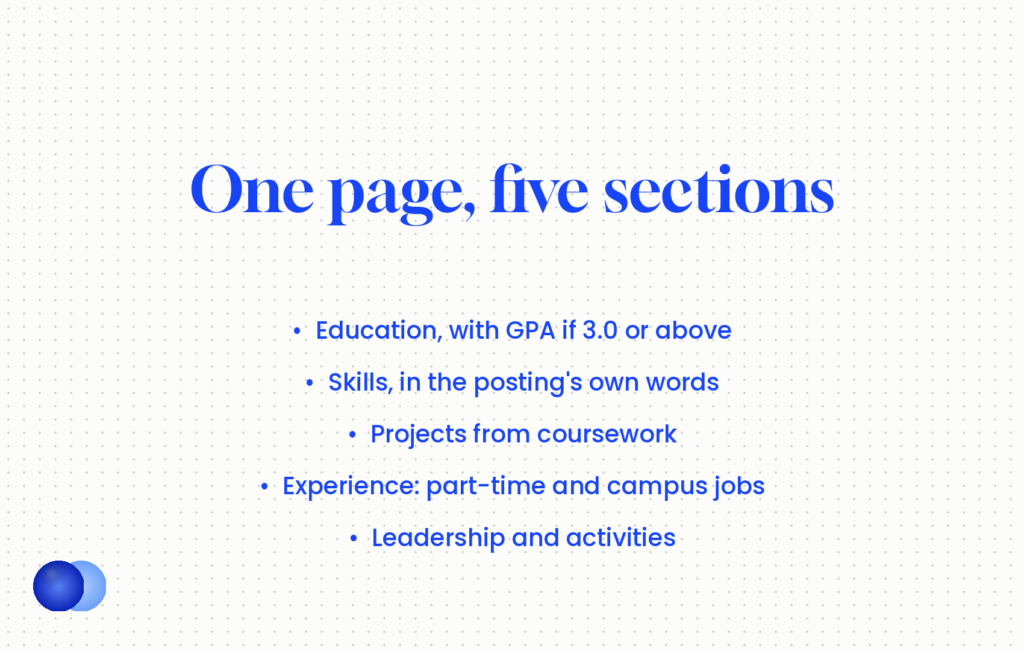
Five sections, in this order for most students:
1. Education. University, degree, major, expected graduation month and year, GPA if it is 3.0 or above, and honours. The UNC resume guide for students puts education at the top for current students and recent graduates, and only includes high school details for first- and second-year students. If you are not in college yet, a high school resume follows its own rules, with education leading and coursework carrying more weight.
2. Skills. A short block of hard skills and tools, written with the exact terms the posting uses. Keep it to two or three lines. This is the "summary" half of a hybrid layout, and it only earns its place if the entries below prove it.
3. Projects. Coursework, capstones, hackathons, personal builds. Title, context, date and two bullets each. Lab or faculty-supervised work follows its own rules, so check how to put research experience on a resume before you decide which section it belongs in.
4. Experience. Part-time jobs, campus jobs, summer work, freelance gigs. Dated, reverse chronological.
5. Leadership and activities. Club roles, society committees, sports captaincy, volunteering with real responsibility.
What do employers weigh when you have no internship?
Evidence of skills in use. NACE data ranks general work experience, leadership and extracurriculars above GPA when candidates are otherwise equal, and 70% of employers now use skills-based hiring. GPA screening fell from 73% of employers in 2019 to 42% in 2026.
Two NACE datasets explain the shift, and they point the same way.
The first is the tiebreaker table. In the Job Outlook 2022 survey, employers rated how much each factor influences a choice between two equally qualified candidates, on a scale where 5 means extreme influence:
| Factor | Influence (1–5), 2022 | Influence, 2020 |
|---|---|---|
| Internship with the organisation | 4.4 | 4.6 |
| Internship in the industry | 4.3 | 4.4 |
| Major | 3.8 | 3.9 |
| General work experience | 3.7 | 3.6 |
| Leadership position | 3.6 | 3.9 |
| Extracurricular activities | 3.5 | 3.6 |
| GPA of 3.0 or above | 3.1 | 3.5 |
| Volunteer work | 2.7 | 2.7 |
NACE's tiebreaker data is four years old, so treat the exact scores as directional. The ordering is the useful part: of the eight factors, only volunteer work sits below GPA, and GPA lost more ground between 2020 and 2022 than anything else on the list.
The second dataset is newer and confirms the trend. NACE's Job Outlook 2026 found 70% of employers use skills-based hiring, up from 65% a year earlier. In 2019, 73% of employers screened candidates by GPA. In 2026, 42% do.
So GPA still matters to a large minority, which is why you include it when it clears 3.0. It just no longer does the work students expect. What NACE's 2026 skills report stresses instead is that listing a skill is not enough; employers want to see examples of it.
Which experience counts on a college student resume?
More than most students think. Part-time and campus jobs count as general work experience, coursework projects show technical skills, and club roles show leadership. Over 40% of employers in NACE's 2026 survey said they seek on-campus student work experience specifically.
The instinct to leave off a café job because it "has nothing to do with marketing" is an expensive mistake on a college student resume. NACE's 2026 outlook found more than 40% of employers seek candidates with on-campus student work experience, and general work experience outscored GPA in the tiebreaker table. A job is evidence of reliability, customer contact and time management before it is evidence of anything industry-specific.
Part-time and campus jobs
Keep them, date them with month and year, and write bullets about the transferable part. A library assistant handled requests, systems and deadlines. A retail associate handled volume, cash, complaints and targets. For more on presenting shift-based roles, see resume for part time job.
Coursework projects
This is where the internship gap closes fastest. A semester project with a real brief, a team, a deliverable and a grade is structurally similar to an internship assignment. Give it a title, the course code or name, the date, and two bullets on what you built and what came of it. The UNC guide recommends a projects or relevant coursework section precisely for students who are newer to the field.
Clubs, societies and leadership
Leadership position scored 3.6 in the tiebreaker table. A treasurer who managed a budget, an events lead who ran a speaker series, a captain who organised training: each is a role with scope, and scope is what a bullet should quantify. If you only attended, one line under Activities is enough.
Mirror the posting’s skill words
Take the three skills a posting mentions most, and make sure each one appears in your Skills block and in at least one bullet as evidence. If the posting says "data analysis" and your bullet says "crunched numbers in Excel", a recruiter searching the applicant tracking system for the posting's phrase may never find you. Use their words, then prove them with your project or job. The bullet carries the skill; the Skills block only makes it searchable.
How do you write bullets without an internship?
Action, scope, result, in one line each. Name what you did, how big it was, and what changed. Numbers from a part-time job or class project are as legitimate as numbers from an internship, and they read the same way to a recruiter scanning for evidence.
Every bullet should answer one question a recruiter has: can this person do the thing we need? Three parts do that:
Action. A specific verb: built, analysed, trained, organised, reduced. Not "helped with" or "responsible for".
Scope. Team size, budget, number of customers, hours per week, size of the dataset.
Result. What changed, measured if possible: a grade, a time saved, a number of attendees, a target met.
Before (Experience): "Barista, campus café. Made drinks and served customers. Worked on a team."
After: "Barista, Campus Grounds Café · Sep 2024 – Present · 15 hrs/week. Served 200+ customers per shift during exam-period peaks; trained four new starters on the till and opening checklist."
Before (Projects): "Relevant coursework: Marketing Research, Statistics II, Consumer Behaviour."
After: "Pricing survey, MKT 310 · Jan 2026 – Apr 2026. Designed and ran a 312-response survey for a local gym in a team of four; our recommendation of an off-peak tier was adopted for the summer term."
Both "after" versions describe the same student. They now show volume, training, research design, teamwork and a client outcome, which are the skills an entry-level marketing posting names.
If a result is modest, state it plainly; an inflated claim collapses at the first follow-up question.
Which resume format should a college student use?
Hybrid: a short skills block on top, then dated entries in reverse chronological order. Never functional. Single column, text-based PDF or Word file, month-and-year dates throughout, 11pt body text and margins of 0.75 to 1 inch.
Students with thin experience often reach for the functional resume, which groups everything under skill headings and hides dates. It is the worst choice available. Functional layouts parse at 70–85%, against 92–97% for chronological and hybrid, and recruiters read them as concealment. A student has nothing to conceal, so the format only costs you. The full comparison sits in resume format types.
The hybrid layout gives you what the functional one promised without the penalty. The Skills block surfaces your keywords at the top, and every entry below carries a date, so a reader and a parser both see a clean timeline.
Three formatting rules matter more than any template choice:
Single column. Two-column layouts scramble extraction in every format.
Month and year dates. "Sep 2024 – Present", never "2024–". Year-only ranges fail on several major parsers.
Contact details in the body. Not in the Word or Docs page header, which some systems skip.
If you would rather skip the layout work, the Rezoom resume builder starts from a single-column, parser-safe structure so your time goes into the bullets.
How long should a college student resume be?
One page. For students this is right, and it does not contradict the evidence that recruiters prefer two pages for experienced candidates. The two-page advantage comes from having years of relevant work to show; a student who stretches to page two dilutes the strongest entries.
The site's position on length has two halves, and they fit together.
For experienced candidates, a ResumeGo study of 482 recruiters found two-page resumes preferred 2.3 times over one-page ones, which is why two page resume advice applies to people with a long relevant history. The same logic runs the other way for students. Page two only helps when it holds evidence that would otherwise be cut. For a student, it holds padding.
The UNC guide puts it directly: one page unless you have extensive relevant experience. Aim for under 600 words; TalentWorks' analysis of 6,000 applications found fewer hires above that length. If you run long, cut the weakest bullet before you shrink the font, and never go below 10pt or 0.5-inch margins. The one page resume guide covers the cutting order.
Put your strongest project or job bullet in the top third of the page, where a six-second scan actually lands.
Pad a thin page with a paragraph-long objective, a list of soft skills with no evidence, or every module you have taken.
What can a college student resume not fix?
It cannot manufacture the internship. It can show a recruiter that you have used the skills an internship would have built, and the rest belongs in the cover letter and interview, where potential and demonstrated interest carry more weight than accomplishments.
NACE's tiebreaker data is honest about this: an internship with the organisation or in the industry still outranks everything else on the list. A well-written college student resume narrows that gap; it does not erase it. Two things help beyond the page.
Apply for internships while you apply for jobs. The top two rows of the tiebreaker table both involve an internship, and NACE's 2026 outlook shows 27% of intern recruiting now happening in spring, so the window is not only in autumn. If you are a second- or third-year student, a single summer internship changes your next resume more than any rewrite.
Carry the argument into the letter. Employers judge student applicants mainly on potential, enthusiasm and relevant coursework, which a resume shows only in outline. The internship cover letter guide covers how to make one specific link between what you studied and what the employer does, which counts for more than stated enthusiasm.
It's important for students to reflect on their academic, experiential, extracurricular, and work experiences to identify the skills they have sharpened and connect them to the jobs.
Your coursework, job and club roles already hold the evidence. The resume's job is to name the skill, show it in use, and put it where a recruiter will see it.
Frequently asked questions
Can I write a college student resume with no internship experience?
Yes. Part-time jobs, coursework projects, and club leadership all count, and NACE's tiebreaker data ranks general work experience, leadership, and extracurriculars above GPA. Write each entry as evidence of a skill the posting names.
Should I put my GPA on my resume?
Include it if it is 3.0 or above. NACE found 42% of employers still screened by GPA in 2026, down from 73% in 2019, so leaving out a good GPA can cost you at a large minority of employers.
Should I include my part-time job if it isn't related to my major?
Yes. General work experience scored above GPA in NACE's tiebreaker ranking, and over 40% of employers seek on-campus student work experience. Write bullets about the transferable part: volume, training, customer contact, and hours alongside study.
How long should a college student resume be?
One page. That fits students and does not contradict the two-page preference for experienced candidates, which comes from having years of relevant work to show.
Should a college student use a functional resume?
No. Functional layouts parse worst and read as concealment. Use a hybrid: a short skills block, then dated entries in reverse chronological order.
Where does education go on a college student resume?
At the top, while you are a student or recent graduate. Include university, degree, major, expected graduation month and year, GPA if 3.0 or higher, and honours.
Should I include high school on my college resume?
Only if you are a first- or second-year student or the experience is highly relevant, according to UNC's career centre. By third year, college projects and jobs should replace it.
Do class projects count as experience?
They belong in their own Projects section rather than under Experience, but they count as evidence. A project with a brief, a team, a deliverable and an outcome shows the same skills an internship assignment would.

Comments