

Summary
Competitive internships draw hundreds of applications from students with near-identical resumes. NACE reports employers judge internship candidates mainly on potential, enthusiasm and relevant coursework rather than accomplishments — which makes the cover letter the only document where those can show. Stated enthusiasm is worthless; demonstrated interest, through one specific connection between what you studied and what they do, is not.
An internship cover letter has a problem to solve that is obvious from the recruiter's side.
Two hundred applications. Similar universities, similar grades, similar coursework, the same two or three extracurriculars. At top firms in finance, tech and media, the count regularly passes 500. The resumes blur together because, at this stage of a career, they genuinely are alike.
That is why an internship cover letter matters more than almost any other. When the resumes cannot separate candidates, the letter is frequently the only document that can.
How is an internship cover letter evaluated?
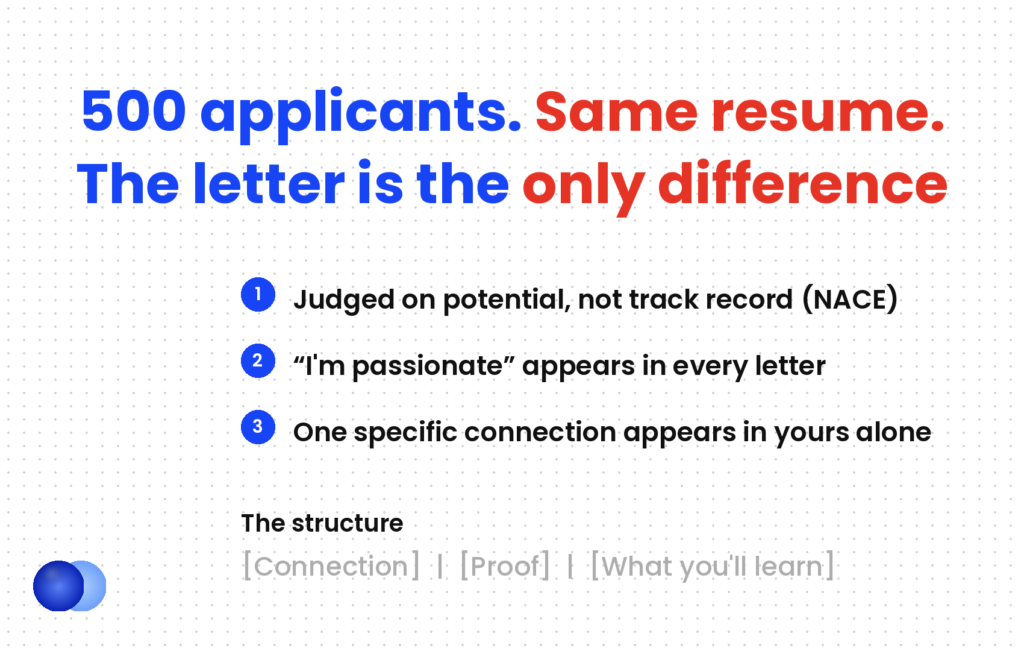
On potential rather than track record. NACE reports that employers evaluate internship candidates primarily on potential, enthusiasm and relevant coursework rather than professional accomplishments — which changes what the letter needs to prove.
This fact separates an internship cover letter from an ordinary one.
A standard cover letter argues that you have done the work. An internship letter cannot, and nobody expects it to. The reviewer is instead estimating what you will be like in a year — and the evidence for that is different.
| What employers weigh | What demonstrates it |
|---|---|
| Potential | A project or result that shows how you think |
| Enthusiasm | Specific research into this company |
| Relevant coursework | A named module connected to their actual work |
| Teamwork, problem-solving, communication | One concrete example of each, not a claim |
NACE's Job Outlook 2026 Spring Update lists teamwork, problem-solving and communication as the skills employers look for most in Class of 2026 candidates. You cannot assert any of them into existence. All of them can be shown in a sentence.
Why is stated enthusiasm worthless?
Because every applicant states it. "I am passionate about marketing" appears in hundreds of letters in the same pile. Enthusiasm only registers when it is demonstrated — through research specific enough that another applicant could not have written it.
NACE lists enthusiasm as an evaluation criterion, and that sends many students in exactly the wrong direction.
Stated enthusiasm. "I am extremely passionate about this opportunity and eager to learn." Every letter in the pile says some version of it, so it carries no information.
Demonstrated enthusiasm. "I first encountered your engineering blog while researching event-driven architectures for my Distributed Systems module." That sentence proves interest, shows initiative, and connects your coursework to their work — in one line.
The difference is the same one that decides an AI cover letter generator's output: since anyone can produce enthusiastic prose in seconds, only specificity still signals anything.
Find the connection before you write a word
Spend twenty minutes on the company's blog, engineering posts, recent announcements or case studies, and find one thing that connects to something you actually studied or built. That single connection becomes your opening sentence. It is the most differentiating thing in the whole letter, because the other 499 applicants did not find the same one — and it proves the two qualities an internship reviewer is actually assessing.
What experience counts?
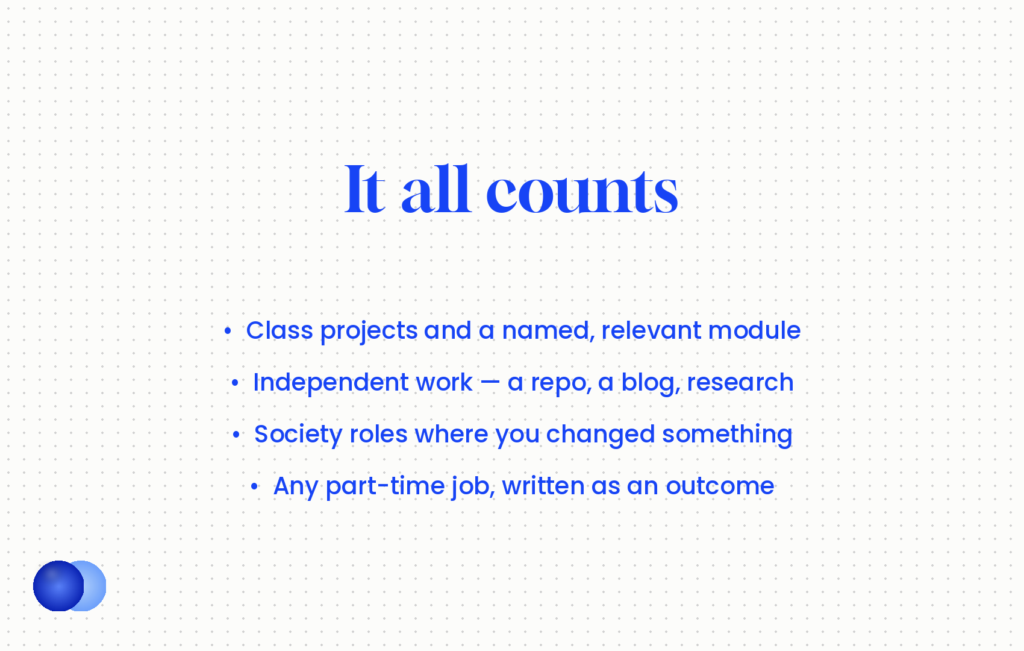
More than most students assume. Class projects, externships, hackathons, independent research, student societies and part-time work all qualify. Employers at firms such as Goldman Sachs, Google and McKinsey regularly hire interns whose strongest experience comes from exactly these.
The blank-page problem is almost always a framing problem.
Most students have relevant experience and fail to see it because it does not look like a job. Five sources worth checking:
Class projects. A capstone, a group project, a dissertation. Especially anything with a result or a finding.
Coursework. A specific module directly related to the role, named.
Independent work. A side project, a repository with real commits, a blog, a piece of research.
Where the rest hides
Student organisations. A committee role where you ran or changed something.
Part-time work. Any job — reliability, deadlines and customer contact transfer everywhere.
For each, write the outcome rather than the activity. A cover letter with no experience covers the technique — replacing claims with results — and it applies here unchanged.
Generic: "I am a junior studying Marketing and I am very excited to apply for your Summer 2026 Marketing Internship. I believe my skills and passion would make me a strong addition to your team."
Specific: "Your campaign rebuilding the checkout flow around first-time buyers caught my attention because it mirrors the segmentation project I led last semester — we found first-purchase drop-off was a trust problem rather than a price problem. I'd like to see how that plays out at your scale."
The first could be sent to any company. The second proves research, shows analytical thinking, and connects coursework to their actual work — in the first two sentences, which are the only ones a skimming reviewer reliably reads.
Name the specific internship programme and season — "your Summer 2026 Analyst Internship" — in the first paragraph. Recruiters often manage several programmes at once, and ambiguity creates work for them.
Recycle one letter across twenty applications with the company name swapped. Hiring managers recognise recycled letters easily, and in a pile where resumes are already indistinguishable, a generic letter removes your only differentiator.
How long should it be?
250 to 400 words, one page. A 2026 Jobvite survey found 250-word letters drew a 53% higher callback rate than letters over 500 words, and reviewers typically spend 30 to 60 seconds per letter.
The length rule for an internship cover letter matches every other kind, and the reason matters more here.
Reviewers moving through several hundred applications in a season read fast. A tight 300 words with one specific opening and one strong result gets read to the end. These short cover letter examples show how tight a letter can get and still land. Reviewers skim a 550-word letter restating the resume and set it down.
How long a cover letter should be covers why the range comes from reading time rather than convention.
What does an internship cover letter look like?
Four short parts — a specific opening connecting your background to their work, one proof paragraph with a result, a line on what you want to learn there, and a confident close. The third part is what distinguishes an internship letter from a job letter.
1. The connection (2–3 sentences). The specific thing you found about them, linked to something you studied or built.
2. The proof (one paragraph). One project or result, written as an outcome with a number where one exists.
3. What you want to learn (1–2 sentences). This is the part unique to internships. Name something specific about how they work that you want to develop in — not a generic "grow my skills."
4. The close (1–2 sentences). A specific next step, stated with confidence.
That third part is honest in a way a job letter cannot be. Internships exist partly to train, and a reviewer reading a clear, specific learning goal sees someone who will use the placement well — which is what "potential" means in practice.
Most internship applicants have similar grades, similar coursework, and similar extracurriculars. Your cover letter is often the only thing that gives you a distinct voice.
Should you send one when it's optional?
Two reasons this matters more for internships than for experienced roles.
It is your only differentiator. An experienced candidate's resume can carry them. An intern's resume usually cannot, because the pile is homogeneous.
Many applicants skip it. Sending a specific, well-researched letter when the field is optional puts you ahead of everyone who did not.
Then check the resume that goes with it. Internship applications pass through the same screening systems as full-time roles, and an AI resume checker against the specific posting shows whether your coursework and projects actually matched its vocabulary.
Frequently asked questions
How do you write a cover letter for an internship?
Open with one specific connection between your studies and the company's work, prove it with a project or result, name something specific you want to learn there, and close with a clear next step. Keep it to 250–400 words.
What do employers look for in internship cover letters?
Potential, enthusiasm and relevant coursework, according to NACE. Employers also weight teamwork, problem-solving and communication — all of which need a concrete example rather than a claim.
What experience should I put in an internship cover letter?
Class projects, relevant coursework, independent research, student society roles, hackathons and part-time work. Write each as an outcome rather than an activity.
How long should an internship cover letter be?
250 to 400 words on one page. A 2026 Jobvite survey found 250-word letters drew a 53% higher callback rate than letters over 500 words.
Should I say I'm passionate about the internship?
Show it instead. Every applicant states enthusiasm, so it carries no information. One specific piece of research about the company demonstrates it in a way nobody else in the pile can match.
Is a cover letter necessary for an internship?
Strongly recommended even when optional. Internship resumes are highly similar, which makes the letter your main way to stand out.
Can I reuse the same internship cover letter?
Not without real customisation. Recruiters recognise recycled letters, and in a pile of near-identical resumes, a generic letter removes the only thing that could separate you.
What should I say about what I want to learn?
Something specific about how the company works — a method, a team, a type of problem — rather than a generic wish to grow. A clear learning goal is how reviewers read potential.



Comments