

Summary
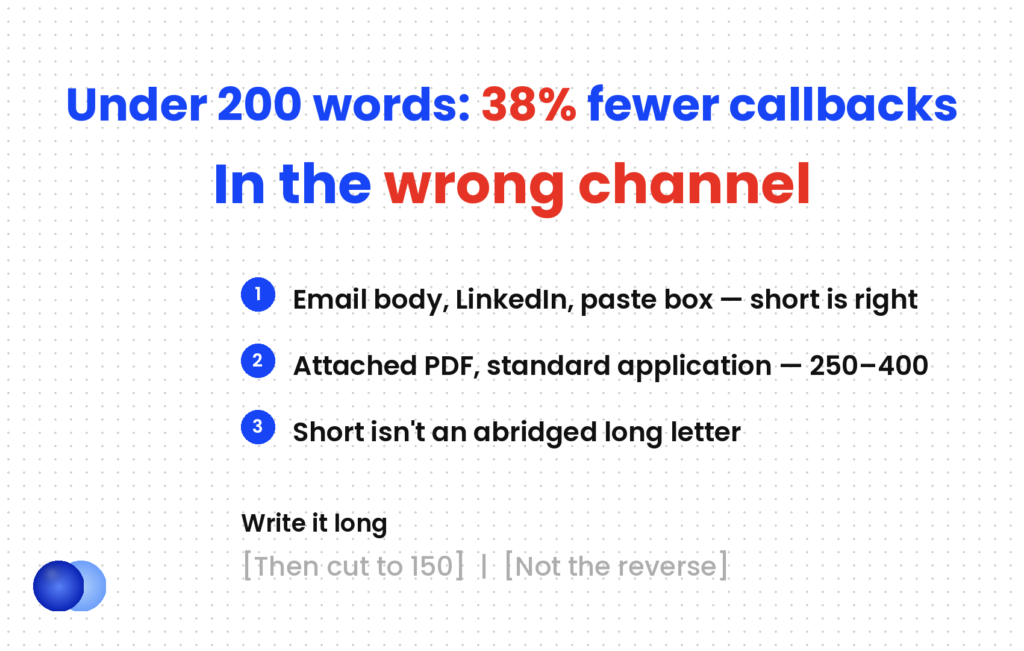
Short cover letters are not better or worse than long ones — they belong to different channels. Research found letters under 200 words receive 38% fewer callbacks when attached to a standard application, yet under 200 is exactly right for an email body, a LinkedIn message or a paste box. The mistake is choosing the length by preference rather than by where it lands.
There is a real contradiction in the advice behind most short cover letter examples, and it is worth resolving before the templates.
One set of sources says brevity wins — 100 to 200 words, recruiters skim, get to the point. Another set has data pointing the other way: letters under 200 words receive 38% fewer callbacks, and recruiters reading a very short letter often fall back on the resume alone.
In practice, both are right about different situations. Short is a channel decision, not a quality decision — and once you see which channel you are writing for, the length stops being a matter of taste.
When is a short cover letter the right choice?
When the channel is short — an email body, a LinkedIn message, a startup job board, a paste box with a character limit, or an application that explicitly asks for brevity. For a PDF attached to a standard application with a full field available, 250 to 400 words performs better.
| Situation | Target length |
|---|---|
| Email body introduction | 100–200 words |
| LinkedIn message or InMail reply | 80–150 words |
| Paste box with a character limit | Whatever fits, structured |
| Startup or small-company board | 150–200 words |
| Posting explicitly asks for brevity | Follow the instruction |
| Attached PDF, standard application | 250–400 words |
| Academic, research, senior executive | 400+ |
Notably, that last group of rows is the part most "write short" advice omits. How long a cover letter should be covers the full-length case and why the 250–400 range comes from reading time rather than convention.
The distinction that makes this usable: a short letter is not an abridged long letter. It is a different document with a different job — introduce, prove one thing, ask. Trying to compress four paragraphs of argument into 150 words produces the vagueness that the callback data is actually measuring.
What goes in 150 words?
Four parts and nothing else — the role named, one quantified proof point, one specific reason for this employer, and a direct close. Anything that is not one of those four is what you cut first.
Every one of the short cover letter examples below uses the same four parts, because there is no room for anything else:
1. The role and a hook. One or two sentences. Never "I am writing to apply."
2. One proof point. With a number. One, not three — three at a third of the depth persuades less than one at full depth.
3. One reason for this company. Something specific enough that it could not appear in another letter.
4. A direct close. A specific next step, in one sentence.
Write it long, then cut to 150
Drafting straight to 150 words produces vagueness, because you start economising before you know what matters. Write the full 300-word version first, then cut. The sentences that survive a 50% reduction are the ones carrying actual information, and the edit surfaces them faster than any outline would. Most people find the cut version is better than the original even when length was never the constraint.
Ten short cover letter examples
Ten openings and closes under 200 words, by situation. Each names the role, carries one specific proof, and ends with a direct ask. Adapt the structure rather than copying the wording — a generic short letter is worse than a generic long one, because there is nowhere for substance to hide.
1. Standard email application
Your posting mentions the warehouse migration slipping twice. I ran that sequence at Wexford in the wrong order, spent six weeks unpicking it, and would start by measuring which reports break before touching the schema. Six years in operations reporting; SQL, Tableau, and a monthly close I cut from twelve days to five. Happy to talk it through any afternoon this week.
2. Referral
Priya Rao suggested I get in touch about the analyst role — we worked together on the reporting migration at Wexford, where I owned the forecasting model three regional teams now plan against. The scope here looks like a larger version of that, which is exactly the direction I want. Free to talk whenever suits.
3. Entry level
I ran the social accounts for my university's marketing society for a year, growing Instagram from 400 to 2,100 by replacing event announcements with short alumni interviews. That taught me what your posting describes — distribution matters more than volume. I'd welcome the chance to bring it to a team doing it at scale.
4. Career change
Six years running clinical operations, now applying that domain knowledge to health-tech analytics. I completed the Google Data Analytics certificate last year and built the dashboard three clinical teams use for weekly capacity planning. The healthcare context is the part most analysts have to learn. I already have it.
5. LinkedIn message
Saw the Senior Backend role — your January refund API rewrite solves the exact problem I spent eighteen months on at Square. Go, Kubernetes, payments at scale; cut p99 latency 40% across sixty services. Worth a conversation?
Situations with a complication
6. Speculative / no posting
I've followed your accessibility work for three years and noticed you have no one leading research. I've run studies with screen reader users at two companies and shipped changes off the back of them. If that role exists or is about to, I'd like to be in the conversation.
7. Returning after a break
Financial analyst, six years in corporate accounting, returning after a two-year caregiving break during which I completed the Advanced Financial Modeling certificate. I cut month-end close from twelve days to five for a 40-person finance team. Ready to do that again — happy to talk this week.
8. Freelance to full-time
Six years independent, most recently rebuilding a stalled paid programme that took cost per lead from $180 to $96. I'm looking to do that inside one company rather than across six. Your growth team is the right size for the work I like.
9. Internal transfer
I've been in support for two years and have spent most of the last six months writing the internal documentation the team now onboards from. The technical writer role is the job I've partly been doing. I'd like to make it official.
10. After being laid off
My role was cut in a restructuring in March. Since then I've finished an SQL certification and delivered two freelance reporting projects. Eight years in operations analytics, and your posting describes the reporting layer work I've done most of. Available immediately. Thanks for reading.
At 340 words: Full greeting, a paragraph on why this company, two proof points with context, a paragraph on cultural fit, a closing paragraph with a call to action.
At 140 words: The strongest proof point, the single most specific company detail, and the ask. The cultural-fit paragraph is gone entirely, because it was the part that would have fitted any letter.
The short version lost nothing that was doing work. That is the test for whether a cut was correct.
Replace an explanation with a link where you can. "I built the booking flow at github.com/name/project" costs eight words and does more than three sentences describing it.
Strip detail until the letter says nothing. "I am confident my skills align well with your requirements" is short and empty, and empty is what the 38% figure is actually measuring.
How do you cut without losing substance?
Delete the announcement opening, cut adjectives about yourself, shorten phrases mechanically, and keep only one proof point. Most 350-word letters lose 40% without losing a single piece of information.
Four cuts turn a long letter into the short cover letter examples above, in order of how much they remove for how little loss:
The announcement. "I am writing to express my interest in the position advertised on your website" spends fifteen words saying nothing the application did not.
Adjectives about yourself. Hard-working, detail-oriented, passionate, results-driven. None is evidence and readers discount all of them.
Phrase-level padding. "I am capable of" becomes "I can". "In order to" becomes "to". Each is small; together they buy you a sentence.
Extra proof points. Keep the strongest. The resume carries the others, and how to write a cover letter covers why one at full depth beats three at a third.
Most people don't know how to be brief without being vague. They strip away detail until the letter says nothing.
Does a short letter hurt you with an ATS?
No. Parsers read content rather than measure length, and a short letter with the posting's vocabulary matches as well as a long one. The length question is entirely about the human reader — which is why it tracks the channel they will read it in.
Finally, worth separating, because people conflate the two concerns constantly.
A parser extracts text and matches vocabulary. Whether that text runs 140 words or 400 makes no difference to the match, as how an ATS works covers in more detail.
What does matter is that a short letter still contains the terms from the posting. Compression tends to strip exactly the specific nouns that do the matching, so check the cut version against the job description before sending — and run the resume it accompanies through an AI resume checker, since that is the document the parser is actually scoring.
Frequently asked questions
How short can a cover letter be?
Around 100 words at the shortest, and only in a channel that suits brevity — an email body, a LinkedIn message, a paste box. For a PDF attached to a standard application, 250 to 400 words performs better.
Do short cover letters work?
In the right channel, yes. Research found letters under 200 words receive 38% fewer callbacks when attached to a standard application, which measures compression in the wrong context rather than brevity itself.
What should a 150-word cover letter include?
Four things: the role named with a hook, one quantified proof point, one specific reason for this employer, and a direct close. Anything outside those four is what you cut.
Is a short cover letter better for email?
Yes. An email body should run 100 to 200 words, because it competes with a full inbox and usually gets opened on a phone.
Will a short cover letter hurt my ATS score?
No. Parsers read content rather than length. The risk is that compression strips the specific nouns from the posting, so check the cut version against the job description.
How do I shorten a cover letter without losing substance?
Delete the announcement opening, cut adjectives about yourself, shorten phrases mechanically, and keep only your strongest proof point. Most letters lose 40% without losing information.
When should I write a longer cover letter?
For academic and research applications, senior executive roles, and any posting that explicitly asks for detailed responses. The employer's instruction always takes priority over a length rule.
Should I write short and expand, or write long and cut?
Write long and cut. Drafting straight to 150 words produces vagueness, because you start economising before you know which sentences carry information.



Comments