Letter of Introduction vs Cover Letter: Which to Send and When
Letter of introduction vs cover letter: when to send each, who gets it, how long it runs, plus a letter of interest table and a teacher letter you can copy.

On this pageWhat is the difference between a letter of introduction vs cover letter?
- What is the difference between a letter of introduction vs cover letter?
- What is a letter of interest, and how is it different?
- When should you send a letter of introduction instead of a cover letter?
- What goes into each letter?
- How does a teacher use a letter of introduction for a teaching job?
- How do you follow up after a letter of introduction?
- FAQ
- Sources
The choice comes down to one question: is there an open job? A cover letter goes with an application for one posted opening and names that job. A letter of introduction opens a door when no job is listed, often through a contact, and asks for advice or a talk. A letter of interest sits in between: it asks a target employer to keep you in mind for future roles. Keep all three to one page.
Letter of introduction vs cover letter comes down to one question: is there an open job? Send a cover letter with an application for one specific opening. Send a letter of introduction when no job is open, to meet someone or ask for advice.
A third letter often gets mixed in. A letter of interest asks one employer to consider you for future roles, so it sits between the two.
Quick answers by situation
| Your situation | What to send | Example line |
|---|---|---|
| You found a posted job you want | Cover letter | "I am applying for the 4th grade teacher role, job ID 2291." |
| A friend says her manager is worth meeting | Letter of introduction | "Dana Ruiz suggested I reach out to you." |
| You want one company, but it has no opening | Letter of interest | "I would like to be considered for future analyst roles." |
| You want to teach at a school with no posting | Letter of introduction to the principal | "I am a certified math teacher moving to Austin in June." |
| You need a student teaching placement | Letter of introduction to the host school | "I am writing to request a student teaching placement." |
What is the difference between a letter of introduction vs cover letter?
A cover letter answers a posted job and asks for an interview for that role. A letter of introduction starts a relationship when there is no posting. It introduces you, often names a mutual contact, and asks for advice or a short talk. Both run one page or less, but the introduction letter is usually shorter.
The University of Montevallo career guide puts the split in one line each. Its cover letter guide1 treats both as types of cover letter, but the trigger is different.
If you are initiating contact with a prospective employer, your cover letter is a letter of introduction.
University of Montevallo, Cover Letters guide
So a letter that answers a posted job is a letter of application, or what most people call a cover letter. The guide also says the introduction letter's tone is more open and exploratory.
Letter of introduction vs letter of interest vs cover letter
Here is the 3-way view most guides skip.
| Question | Letter of introduction | Letter of interest | Cover letter |
|---|---|---|---|
| Is a job posted? | No | No | Yes |
| Goal | Meet someone, get advice or a talk | Get on the list for future roles | Get an interview for one job |
| Who reads it | A contact, a manager or a principal | The person who runs the team you want | The hiring manager or search committee |
| Length | A few short paragraphs | Three to five paragraphs, one page | Three to five paragraphs, one page |
| Names a job title? | No | Names a type of role | Yes, with the job ID |
| Resume attached? | Optional | Yes | Yes |
| Typical close | "Could we talk for 15 minutes?" | "Please keep me in mind for openings." | "I would welcome an interview." |
Who it goes to
A cover letter goes to whoever runs the hiring for that opening. With no name, Colorado Mesa University's teacher cover letter guide7 suggests a search committee or hiring manager. But a letter of introduction goes to one person you chose, often through a shared contact.
How long each one runs
James Madison University says the best cover letters run three to five paragraphs3 and never pass one page. A letter of introduction should be shorter, because it asks for a small favor. For the full layout of the longer letter, see our guide to cover letter format.
What is a letter of interest, and how is it different?
A letter of interest tells one employer you want to work there. It asks them to keep you in mind for future roles, even with no opening. It goes to the person who runs the team you want. Unlike a letter of introduction, it is a job request. Unlike a cover letter, it does not answer one posting.
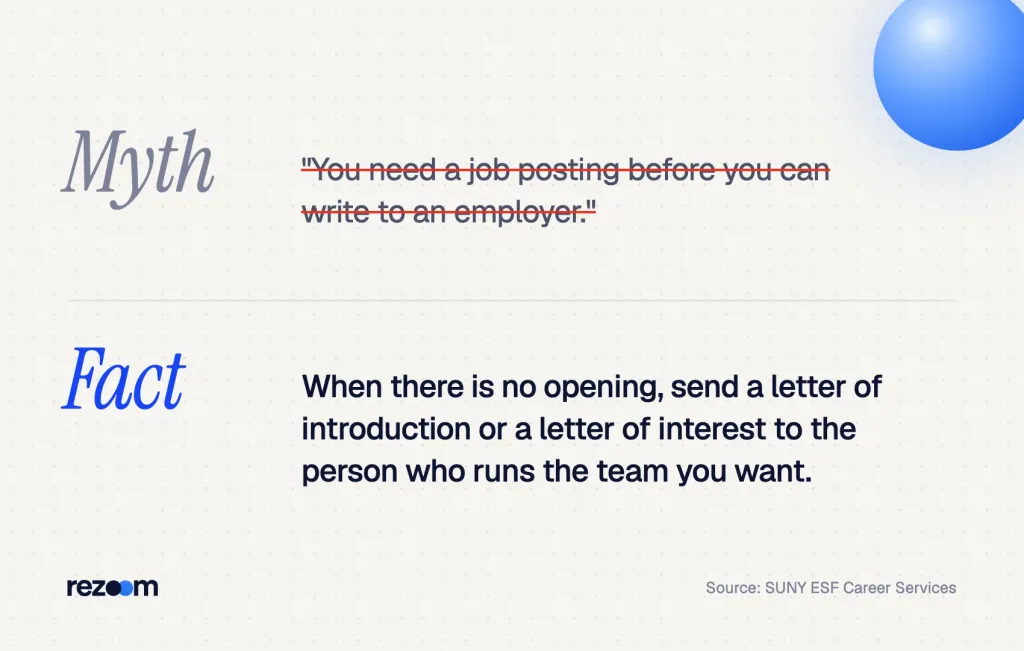
SUNY ESF Career Services says you send a cover letter2 for an existing posting. A letter of interest fits when there is no opening. The same page says to address it to the person who supervises the area where you want to work.
The University of Cincinnati says a cover letter is tailored to a specific job posting4. A letter of interest is more general and shows your enthusiasm for the company. So a letter of interest still asks for a job, just not today's job.
Letter of interest vs letter of introduction
Some career centers use the two names for the same thing. For example, JMU calls it a letter of inquiry3, one that asks about possible openings rather than a posted job. The useful line is the ask:
- Letter of interest. Asks the employer to consider you for a role, now or later.
- Letter of introduction. Asks a person for advice, a referral or a short meeting.
- Cover letter. Asks for an interview for one named opening.
For the full method and samples, read our letter of interest guide.
Letter of interest guide: what it is, why to send one, key parts to include, and a model letter you can adapt. Write a clear, confident letter today.
When should you send a letter of introduction instead of a cover letter?
Send a letter of introduction when no job is open and you want a person, not a job portal. Good cases are a referral, a move, a career change or a school you want to teach at. Send a cover letter whenever you apply to a posted job, even if it says optional.
The letter of introduction vs cover letter choice is easy: if the reader can interview you for an open role, write a cover letter. If they can only talk, advise or pass your name along, write a letter of introduction.
Good times for a letter of introduction
- A mutual contact suggested it. Montevallo says most networking letters start with a shared contact, so name that person first.
- You are moving. A teacher who relocates in June can write to principals in the new district in the spring.
- You want advice first. The UGA School of Law says networking letters seek advice or contacts5. It also warns you not to mention the job.
When a cover letter is the right call
If a posting exists, use the cover letter even when it is optional. Our guide on resume vs cover letter explains what each document does in the same application. Then follow the steps in how to write a cover letter to match the letter to the posting.
Do
- Name the mutual contact in the first line of an introduction letter.
- Ask for one small, clear thing, such as a 15-minute call.
- Name the job title and job ID in a cover letter.
Don’t
- Ask a stranger for a job in a letter of introduction.
- Send a general letter of interest to a posted job.
- Paste your whole resume into the letter.
What goes into each letter?
A cover letter names the job, matches two or three of its needs and asks for an interview. A letter of introduction names your shared link and asks for a short talk. A letter of interest says why that employer, what you offer and which roles fit.
Each letter has the same skeleton: why you are writing, who you are and what you want next. But the middle changes.
Dear Ms. Patel, I am applying for the Grade 4 Teacher role (job ID 2291) at Oak Hill Elementary. At Lincoln Elementary, I led small reading groups for students below grade level, a top need in your posting.
Dear Mr. Chen, Dana Ruiz, who works with you at Brightline, suggested I reach out. I am a project coordinator moving into operations. I would value 15 minutes of your advice. Could we talk by phone in the next two weeks?
How to write a letter of introduction
- Pick one personChoose the one reader who can help, such as a manager, a principal or a contact's colleague.
- Name the linkOpen with the shared contact or the exact reason you chose them.
- Say who you areGive one or two lines on your role, your skills and your goal.
- Make one small askAsk for a short call, a meeting or the right person to contact.
- Close and follow upThank them, give your phone and email, then follow up after a week.
Hamilton College says a networking email should keep it short6: one paragraph and one ask. So an email version runs even shorter.
Dear [Name],
[Contact's name] suggested I write to you because [reason they gave].
I am a [your role] with [one skill or result], and I am exploring [field, team or school].
Would you have [15 minutes] for a call in the next [two weeks]? You can reach me at [phone] or [email].
By email, the subject line does half the work. So put the contact's name first, such as "Dana Ruiz suggested I contact you". Then the reader knows why to open it.
A cover letter tailored to every job post, in minutes.
How does a teacher use a letter of introduction for a teaching job?
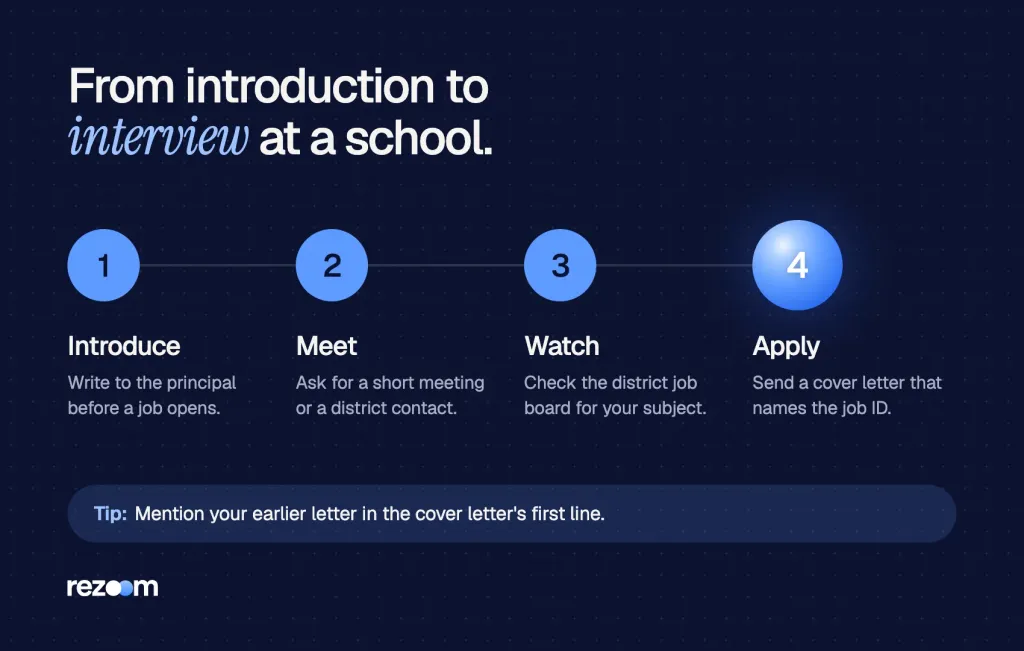
Teachers send a letter of introduction to a principal before a job opens, or to ask for a student teaching placement. It introduces you, names your license and subject, and asks to meet or be kept in mind. Once a job is posted, switch to a cover letter that names the job ID.
A letter to a principal can put your name in front of the school before a posting goes live. WGU's sample teaching introduction letter9 has four parts. They are your reason for writing, your skills, your passion for teaching and a close that points to your resume.
Who to address in a school
Colorado Mesa University says the right reader is usually the principal7 or the school administrator. For student teaching, SUNY Oswego's field placement guide8 addresses the host teacher and principal. It also sets a one-page limit.
Dear Principal Moreno, I am a certified middle school math teacher moving to Austin in June. I am writing to introduce myself to Eastside Middle School. For four years I taught 7th grade math and ran a tutoring club at a Title I school in Tulsa. Could we meet briefly this spring? If a math role opens, I would love to apply. My resume is attached.
Before you send it, compare your resume with our education resume examples. Then copy the layout of the teacher resume examples, which list classroom results, not just duties.
When the school posts the job
Once the job is posted, write a real cover letter. Our education cover letter examples help you match the tone of a school. The teacher cover letter example shows how to name the job ID and match two needs from the posting.
Teacher cover letter example
A one-page teacher letter that names the job, matches the posting and asks for an interview.
For more school samples, read our letter of introduction for a teaching job guide.
Teacher letter of introduction samples for new and veteran teachers, a fill-in template, and how this letter differs from a cover letter. Write yours today.
How do you follow up after a letter of introduction?
Wait about a week, then send one short follow-up that repeats your ask and makes it easy to say yes. If the reader says there is no job, ask for advice or a referral instead. If they invite you to apply, switch to a tailored cover letter for that posting and mention your earlier letter.
A letter of introduction works only if you follow up. Montevallo's sample promises a call within a few days, so set a date when you send it. For email, our cold email to a hiring manager guide has follow-up lines.
What to say if they push back
- "We have no openings right now." Thank them, then ask who else you should talk to.
- "Just apply online." Say you will, then ask which posting fits your background best.
- "Send me your resume." Send it the same day, with a two-line note that repeats your link.
Principal: "Thanks for writing, but we have no math openings for the fall."
"Thank you for letting me know. Could I ask one thing: is there another school in the district you think needs a math teacher?"
Principal: "Try Ridge Middle. I can pass your name to their principal."
"That would help a lot. I will send you a short note you can forward today."
A reply that says "no openings" still gives you a warm contact. So ask for one name, not a job. Then open your next letter with "Your colleague suggested I write," because a named referral beats a cold letter.
Final check before you send
Before you send any of the three letters
Need a fast first draft? Our AI cover letter builder turns a job post into a matched letter. Then edit the first line, because only you know your link to the reader.
Free plan, no card.
Frequently asked questions
What is a letter of interest?
A letter of interest tells one employer you want to work there and asks to be considered for future roles, even with no opening. Send it to the person who runs the team you want and attach your resume.
Is a letter of introduction the same as a cover letter?
No. A cover letter answers a posted job and asks for an interview. A letter of introduction starts contact when no job is open and asks for advice, a talk or a referral.
What is the difference between a letter of interest and a cover letter?
A cover letter names one posted job and its job ID. A letter of interest goes to an employer with no posted opening and asks to be kept in mind for a type of role.
How long should a letter of introduction be?
Keep it shorter than a cover letter: a few short paragraphs on paper, or about one paragraph by email. It should never pass one page.
Do teachers need a letter of introduction?
It helps when you want a school that has not posted a job, or when you need a student teaching placement. Send it to the principal, then switch to a cover letter once a job is posted.
Should I attach a resume to a letter of introduction?
You can, but it is optional, because the goal is a talk, not a job. Always attach a resume to a letter of interest or a cover letter.
Sources
We opened and read each page below. The small numbers in the text point here. Pages that carry no publication date show n.d.
- University of Montevallo2025
A letter that initiates contact with an employer is a letter of introduction, and a letter that answers a posted announcement is a letter of application
- SUNY ESF Career Servicesn.d.
A cover letter answers an existing job posting, while a letter of interest fits when there is no specific opening and goes to the person who supervises that area
- James Madison Universityn.d.
Effective cover letters run three to five paragraphs and no more than one page, and a letter of inquiry asks about possible openings
- University of Cincinnati2026
A cover letter is tailored to a specific job posting, while a letter of interest is more general and shows enthusiasm for the company
- University of Georgia School of Lawn.d.
Networking letters are sent for advice or to build contacts and should not mention the job
- Hamilton College Career Centern.d.
A networking email should be one short paragraph that requests an informational interview
- Colorado Mesa Universityn.d.
Teacher letters run one page and three to five paragraphs and usually go to the principal or school administrator
- SUNY Oswego Field Placement Officen.d.
A student teaching letter of introduction goes to the prospective host teacher and principal and fits on one page
- Western Governors University2022
A teaching introduction letter covers your reason for writing, skills and education, passion for teaching and a close that points to attached materials
Mohammad has spent more than ten years designing consumer products and leads product at Rezoom, deciding what gets built and what gets left out. His guides cover the whole job search, from resume sections and cover letters to interview answers and career moves.
Goodi, M. (2026, November 2). Letter of Introduction vs Cover Letter: Which to Send and When. Rezoom. https://rezoom.io/letter-of-introduction-vs-cover-letter/