

Summary
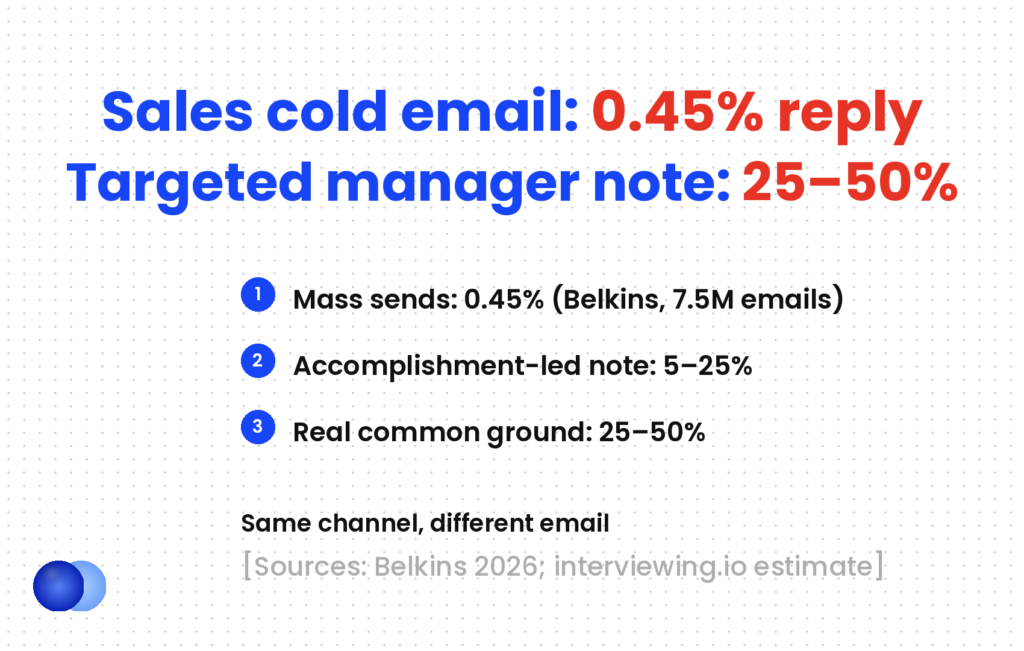
Sales cold email averages a 0.45% reply rate across 7.5 million sends (Belkins, 2026). Interviewing.io estimates 25–50% for a personalised note to a hiring manager that names real common ground, and 5–25% for one that leads with an accomplishment alone. The gap is not wording. It is who you pick and what connects you. Email one manager at a time, ask for a short conversation rather than a job, keep it short enough for a phone screen, and follow up once.
A cold email to a hiring manager has two published reply rates, and they sit about a hundred times apart. That gap tells you more about how to write one than any template does.
Belkins analysed 7.5 million B2B cold emails and found an average reply rate of 0.45%. Interviewing.io, which coaches engineers into top companies, estimates 25–50% for a personalised note to a hiring manager that names genuine common ground. Both numbers are honest. They measure different emails.
The first describes volume. By contrast, the second describes one message to one person with a problem you might solve. Your reply rate depends far more on which of those you send than on your subject line. Still, the three templates below only work once the targeting underneath them is right.
Does a cold email to a hiring manager actually work?
Yes, when it is targeted. Mass sales email replies at under 1%, while a personalised note to the manager who owns an open problem can reply at 25–50% by interviewing.io's estimate. Common ground and a small company push you towards the top of that range; a large company and a generic pitch push you towards the bottom.
The numbers disagree because they count different emails:
| Email type | Reply rate | Source |
|---|---|---|
| B2B sales email, all sends | 0.45% | Belkins, 7.5M emails, 2026 |
| Sales email, companies of 0–10 staff | 0.72% | Belkins, 2026 |
| Sales email, companies of 10,000+ staff | 0.22% | Belkins, 2026 |
| Sales campaigns under 200 prospects | 15–20% | Saleshandy, 53.1M emails, 2026 |
| Hiring manager note, accomplishment-led | 5–25% | Interviewing.io estimate |
| Hiring manager note, real common ground | 25–50% | Interviewing.io estimate |
Overall, two patterns run through every row. Smaller lists reply more, and smaller companies reply more. In fact, Belkins found founders and owners the most responsive seniority group at 0.57%, and companies with ten staff or fewer replied at more than three times the rate of those with 10,000 or more.
The job-search figures come from coaches rather than controlled studies, so treat them as ranges. PitchHired, a job-search tool, suggests planning on 5–15% for well-targeted hiring-manager email, a sensible middle.
Who should you email: the manager, the recruiter or the founder?
The person who will manage you. A hiring manager with an open seat feels the vacancy every day, while a recruiter handles dozens of requisitions and a VP sits too far away. At a company under about 50 people, that person is often a founder, which is where cold email replies best.
Interviewing.io’s Aline Lerner makes the case directly: target the managers, because they are the people struggling to fill seats on their own teams. Recruiters help when they come to you; executives delegate.
Find the right name. First, take the team name from the posting, search LinkedIn for “[team] manager [company]”, and check the company blog or conference talks for whoever owns the work. In other words, the same research that tells you who to address a cover letter to finds your cold email recipient.
Use email, not LinkedIn messages. Lerner’s point is that managers live in their inbox, and work addresses usually follow a pattern such as firstname.lastname@.
One manager per company. Three managers at one firm with the same note reads as a list; besides, managers talk to each other.
Aim at the team that just changed
The best moment to send a cold email to a hiring manager is the week something changes on their team: a funding round, a product launch, a new office, a posting that went up in the last seven days. A change creates work before it creates headcount approval, and a manager in that gap will read a message from someone who already understands the problem. Set news alerts for your target companies and write when one fires.
What goes into a cold email that gets a reply?
Three parts: why this person and why now, one piece of proof that fits their problem, and one easy question. Keep the body short enough to read on a phone without scrolling, and keep the subject line under about 47 characters, because that is roughly what survives on mobile.
The hook: why them, why now. One sentence that could only go to this person: their talk, their launch, a shared former employer. Therefore, if it could go to anyone else, delete it.
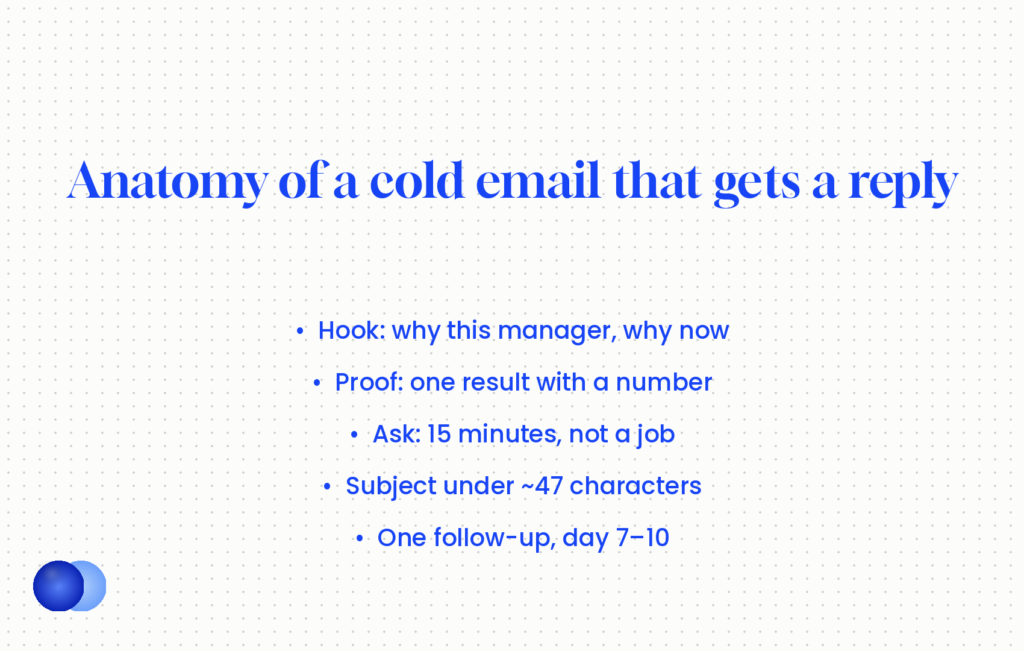
The proof: one result, not a resume. Careery’s guidance puts it bluntly: the fastest way to get ignored is a long email that restates your resume. Instead, pick the single result closest to their current problem and give it a number.
The ask: a conversation, not a job. For that reason, Lerner recommends asking for a short chat and naming a timeframe. “Could we talk for 15 minutes next week?” is easy to accept. “Do you have any openings?” forces the manager to go and check, and most won’t.
Length and subject line
The email cover letter rule applies here too: 150–200 words for an email body, because 67% of recruiters read on mobile first. A cold note carries no attached letter, so it belongs at the short end of that range or just under it. Saleshandy’s analysis of 53.1 million emails found shorter first emails performed best.
For the subject line, only about 47 characters survive on a phone screen. Saleshandy found four-to-five-word subject lines, roughly 36–50 characters, outperformed every other length. Put the hook there.
| Weak subject line | Stronger subject line |
|---|---|
| Job inquiry | Your talk on checkout latency |
| Experienced marketer seeking opportunities | Question about the Leeds launch |
| Resume attached for your review | Ex-Monzo analyst, re: fraud team role |
Which templates get replies?
Three cover most situations: the common-ground note, which replies best; the proof-first note, for when you share nothing with the manager; and the after-applying note, which pairs a cold email with a formal application. Each stays under 150 words and ends with one small question.
Use these as structures, not scripts: a copied sentence is a generic sentence.
Common ground: open with their own work
Subject: Your Rust migration post, and a question Hi Priya, I read your post on moving the payments service from Go to Rust. The section on keeping p99 latency flat during the cut-over was the clearest account of that trade-off I’ve found, and it’s the same problem I spent last year on at Cleo. We migrated our ledger service over nine months without a customer-facing incident, and cut p99 from 340ms to 90ms. I led the rollout plan and wrote the shadow-traffic tooling. I noticed the Senior Backend Engineer role on your team. Before I apply, would you have 15 minutes next week to tell me what the hardest part of the migration still is? I’d like to know whether my experience fits what you actually need. Thanks either way, Sam Ortega linkedin.com/in/samortega · 07700 900123
Proof first: lead with one result
Subject: Cut onboarding churn 22% at a fintech Hi Marcus, Your team posted a Product Manager, Activation role last Tuesday, and your Series B announcement mentioned doubling the SMB customer base this year. That usually makes onboarding the bottleneck. At Tandem, I owned activation for SMB accounts. Over two quarters, we rebuilt the setup flow around the first invoice a customer sends, and 30-day churn fell from 18% to 14%, a 22% drop. I’ve applied through your careers page. Would a 15-minute call this week or next be useful? I’d happily walk you through what we tested, including the two experiments that failed. Best, Aisha Khan [email protected] · 07700 900456
After applying: a note that adds context
Subject: Applied for Data Analyst, one relevant result Hi Tom, I applied for the Data Analyst role on your team this morning (reference DA-2231) and wanted to reach you directly with one piece of context the form didn’t have room for. At Ocado, I built the demand forecast our Leeds site now plans staffing against. It reduced agency overtime by £180,000 in its first year. Your posting mentions forecasting for the new Bristol depot, which sounds like the same problem at an earlier stage. If it would help, I’m glad to share the approach in a short call. Otherwise, I’ll leave it with the application. Kind regards, Leo Marsh 07700 900789
Generic: "I'm a passionate data analyst with five years' experience and I'd love to explore opportunities on your team." Nothing in it names Tom or his problem.
Specific: "Your posting mentions forecasting for the new Bristol depot. At Ocado, I built the forecast our Leeds site plans staffing against, and it cut agency overtime by £180,000." Same candidate, but the fit now shows in two lines on a phone.
Should you apply first or email first?
Apply first when a posting exists, then send the cold email the same day or the next. Going around the process creates friction with recruiting, and many companies cannot interview you without an application in the system. Email first only when no role is posted.
Careery’s guidance treats bypassing the recruiter as the most common way this backfires. Most applicant tracking systems need a record before anyone can schedule you, so a manager who likes your email will usually send you to the portal anyway. As a result, applying first removes that step and lets the email do one job: point to your application.
When no role exists, the common-ground and proof-first templates work as networking notes. The ask stays a conversation, because a manager without an open requisition cannot offer an interview but can remember you when one opens.
Sending a resume rather than a cold note changes the format; therefore the email to send a resume guide covers attachments and body text.
Apply through the portal and then send one short email that points to the application and adds a single result the form had no space for.
Attach your resume to a first cold email with no application behind it; an unrequested attachment reads as mass outreach and gives the manager a document to file rather than a question to answer.
How do you follow up without being a nuisance?
Once, seven to ten days later, in the same thread. One initial email plus one follow-up is the optimal sequence (Belkins, 16.5 million emails), and the follow-up often earns the reply. After that, stop and move on to the next manager on your list.
The site’s position is the same for any job-search email: follow up once, between day 7 and day 10. Roughly four in ten replies come from the follow-up, so skipping it throws away real replies. A third nudge turns a professional into a nuisance. The full timing logic is in how to follow up on a job application.
A good follow-up adds something rather than repeating the ask:
Hi Priya, a quick follow-up on the note below. Since I wrote, I’ve published a short write-up of our shadow-traffic setup (link). Still glad to talk for 15 minutes if the timing works. If not, no problem at all.
Reply in the same thread, so the original shows on their phone. Finally, if the answer is no, or silence, cross them off.
You want the people who are most likely to help, and they're the ones who are struggling to hire for their teams.
What can a cold email to a hiring manager not fix?
A weak fit. A cold email gets your evidence read faster by the right person; it cannot make that evidence stronger. If the proof you can offer does not match the manager's problem, a better template will not rescue it, and more sends will only lower your reply rate further.
Above all, it does not scale. After all, the job-search reply rates only hold for one-to-one messages. As a result, ten researched emails a week beat a hundred templated ones.
Large companies reply least. Belkins found companies of 10,000+ staff replied at 0.22%. At that size, a referral from a current employee usually beats any cold note.
Silence is normal. Even at a 25% reply rate, three in four managers say nothing, usually because of a full inbox. Log each send and follow-up date in your job application tracker alongside portal applications.
A cold email to a hiring manager does one narrow thing well: it puts one specific result in front of the person most motivated to act on it. If you have that result, send the email.
Frequently asked questions
Is it okay to cold email a hiring manager?
Yes, if the note is short, specific and asks for a conversation rather than a job. Apply through the portal first when a role is posted.
What reply rate should I expect from a cold email to a hiring manager?
Interviewing.io estimates 25–50% for notes with real common ground and 5–25% for accomplishment-led ones; PitchHired suggests planning on 5–15%. Both are coaching estimates, not controlled studies, so use them as ranges.
How long should a cold email to a hiring manager be?
Around 150 words, and never past 200. About 67% of recruiters read email on mobile first, so short enough to read without scrolling.
What should the subject line say?
Your hook, in four or five words. Only about 47 characters survive on a phone, so name their project, their role or a shared connection rather than "Job inquiry".
Should I attach my resume to a cold email?
Not to the first one. Link your LinkedIn profile or portfolio instead, and send the resume when the manager asks, or point to the application you already submitted.
How do I find a hiring manager's email address?
Identify the manager from the posting, LinkedIn or the company blog, then follow the company's address pattern, such as firstname.lastname@.
How many times should I follow up?
Once, seven to ten days after the first email, in the same thread. One initial email plus one follow-up is the optimal sequence.
Should I email the hiring manager or the recruiter?
The hiring manager, in most cases. The manager owns the problem, while a recruiter juggles many roles. At small companies, the manager is often a founder.


Comments