Can You Perform the Essential Functions of the Job? How to Answer
Can you perform the essential functions of the job with or without accommodation? See what it means, when to say yes, and what to say with a disability.
On this pageWhat does "essential functions of the job" mean?
- What does "essential functions of the job" mean?
- Is it legal to ask, and do you have to disclose a disability?
- How do you answer the essential functions question yes or no?
- What about lifting 50 lb or standing 8 hours in warehouse and production jobs?
- How do you ask for a reasonable accommodation later?
- What should you check before you submit?
- FAQ
- Sources
Answer yes if you can do the core duties of the role, either on your own or with a reasonable accommodation such as a stool, a lift aid or a schedule change. The question asks about your ability, not your health, so you do not have to name a condition. Answer no only if a core duty is impossible for you even with help, and ask for any accommodation you need later.
When a form asks if you can perform the essential functions of the job with or without reasonable accommodation, answer yes if you can do the core duties, alone or with help. You don't have to name a disability to say yes.
The words "with or without" do the heavy lifting. If a tool, a break or a small change would let you do the work, you can still answer yes.
Quick answers by situation
| Your situation | What to say/do | Example line |
|---|---|---|
| No limits that affect the work | Yes | "Yes" |
| A disability, but you can do it with an accommodation | Yes; ask for the accommodation later | "Yes" (then, after the offer: "I'll need a stool at the line.") |
| You aren't sure what the duties are | Read the posting first; ask HR if it's vague | "Could you share the job's physical requirements?" |
| A core duty you can't do at all, even with help | No, or pick a role that fits better | "No" (and look at roles without that duty) |
| A temporary injury that heals before the start date | Usually yes; mention the timing if asked | "Yes. My wrist will be out of the brace by my start date." |
| A lifting requirement you can meet with a lift aid | Yes; a lift aid can be an accommodation | "Yes, with a cart or a team lift for loads over 40 lb." |
What does "essential functions of the job" mean?
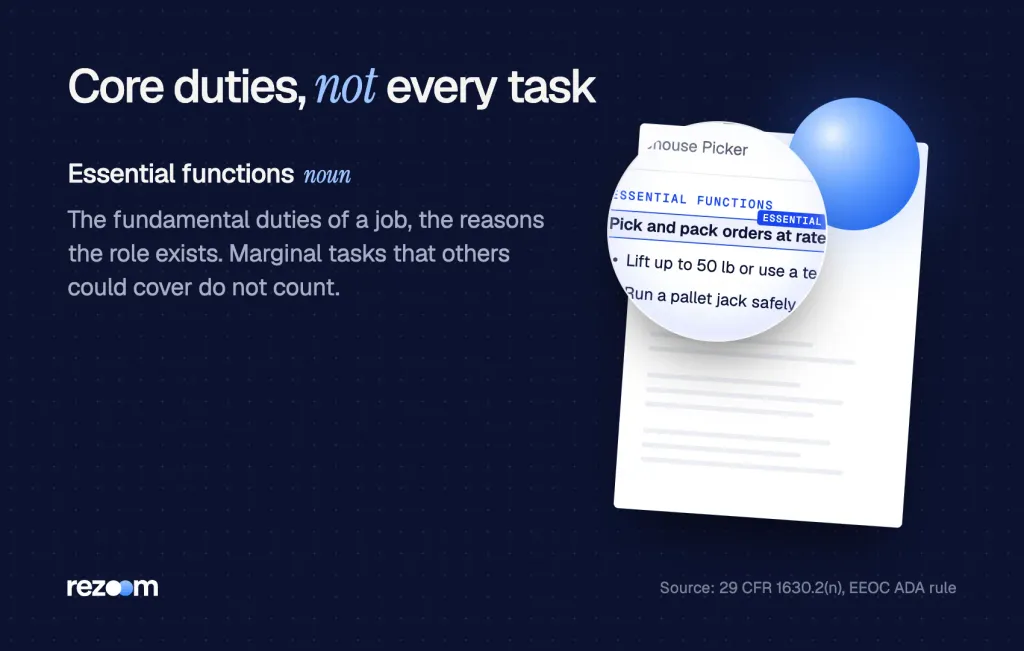
Under the ADA, the essential functions of the job are the core duties, the reasons the role exists. They don't include minor, marginal tasks. An employer decides them using its written job description, the time spent on each duty and what happens if no one does it. If you can do those core duties, with or without help, you meet this test.
The federal rule is short. The EEOC's ADA regulation, 29 CFR 1630.2(n)2, calls them "the fundamental job duties" of the role. It also says the term "does not include the marginal functions of the position."
How an employer decides what counts
A duty is usually essential if the job exists to do it, if few other workers can share it, or if the role needs special skill for it. The same rule lists the proof a court looks at:
- The employer's judgment: what the company says it needs done.
- A written job description: one written before the job went up.
- Time spent: how much of the shift goes to the duty.
- The cost of skipping it: what happens if no one does it.
Essential vs. marginal, by example
| Job | Likely essential | Likely marginal |
|---|---|---|
| Warehouse picker | Picking and moving orders; lifting the stated weight | Restocking the break room |
| Machine operator | Running and checking the machine; meeting quality specs | Sweeping the office area |
| Forklift driver | Driving safely; holding a valid certification | Answering the dock phone |
| Assembly worker | Assembly at line speed; reading work orders | Ordering parts once a month |
This matters for your answer. If you can't do a marginal task, you can still say yes, because the employer can usually shift that task to someone else. The Arizona Center for Disability Law7 makes the same point: marginal duties can go to other workers.
Is it legal to ask, and do you have to disclose a disability?
Yes, the question is usually legal, because it asks what you can do, not what condition you have. Before an offer, the EEOC says employers may ask if you can perform job duties, but not if you have a disability. So you can answer yes or no without naming any diagnosis or sharing medical records.
The EEOC's pre-employment guidance1 says an employer "may ask whether applicants can perform any or all job functions." It may also state a physical need, like lifting a set weight, and ask if you can meet it.
At the pre-offer stage, an employer cannot ask questions that are likely to elicit information about a disability.
EEOC, Enforcement Guidance on Preemployment Disability-Related Questions
What they can and can't ask before an offer
So an employer can ask, "Can you lift 50 pounds?" But it usually can't ask, "Do you have a back problem?" It can also ask all applicants for a job to show how they'd do a task. After an offer, the rules loosen: the employer can ask medical questions, if it asks everyone in that job category.
The ADA's job rules cover employers with 15 or more employees6. Many states have their own laws, too, so check your state's rules if the company is small. This article is general information, not legal advice; for your own case, talk to an employment lawyer or your state's civil rights agency.
This is not the same as the disability form
Don't mix this up with the optional disability form that HR uses for tracking. Our guide on how to answer the disability question on a job application covers that form in detail.
What I do not wish to self identify means on race, veteran and disability forms, who sees your answer, why it can't count against you and the 2026 changes.
How do you answer the essential functions question yes or no?
Read the posting's duties and physical needs first. Then ask yourself: can I do each core duty, alone or with a tool, a break or a small change? If yes, check yes. If one core duty is impossible even with help, check no, and consider a role without that duty.
Most forms give you two boxes, so do the work before you click.
- Find the dutiesRead the "Essential functions" or "Physical requirements" list in the posting. If there isn't one, ask the recruiter for it.
- Sort core from minorMark the duties the job exists for. Skip small tasks someone else could cover.
- Test each core dutyAsk if you can do it alone, or with a tool, a break or a schedule change.
- Check yes or noCheck yes if every core duty works with or without help. Check no only if one can't work at all.
- Plan your requestIf you'll need help, decide what you'll ask for and when.
Are you able to perform the essential functions of this job with or without reasonable accommodation? Yes
Hi [recruiter's name], I'm applying for the [job title] role at [location]. Could you share the essential functions and physical requirements for this job? I want to answer the application accurately. Thank you, [your name]
When "no" is the honest answer
Say no only if a core duty can't work for you in any form. For example, a delivery driver job may need a valid license, and no tool replaces it. So a no is honest there, and you can look for a nearby role, like dispatcher.
A yes means you can do the core duties, not every task in the posting. If one small task is a problem, you can still answer yes. Then raise it after the offer, when you discuss how the role will work.
What about lifting 50 lb or standing 8 hours in warehouse and production jobs?
Warehouse and production postings often list lifting, standing and repetitive work as essential functions of the job. If you can meet them with a lift aid, a team lift, an anti-fatigue mat or a stool, you can usually answer yes. Answer no only if the duty is impossible for you even with a tool or a change.
People with a disability work these jobs too: in 2025, BLS data5 shows 13.8% of employed people with a disability worked in production, transportation and material moving jobs, versus 12.0% of those without one.
How to read the physical requirements
Here's how common lines fit the question.
- "Lift up to 50 lb": Can you move that weight, alone or with a cart, a hoist or a team lift? If yes, check yes.
- "Stand for 8 to 10 hours": Would a stool, a mat or short sit breaks let you finish a shift? If so, yes still works.
- "Repetitive motion": Would a tool grip, job rotation or a split shift help? Then yes is usually fine.
"Yes, I can meet the 50-pound lift. For anything heavier, I use the pallet jack or a team lift, the same as I did at my last job."
Show the proof on your resume
A yes is stronger when your resume backs it up. Our production resume examples show how line workers list pace, quality and safety records. If you pick and pack orders, these warehouse worker resume examples show how to list units per hour and equipment certifications.
Warehouse worker resume example
See how a warehouse resume shows pick rates, safe lifting and forklift certification.
Your letter can carry the same message. These production cover letter examples show how to mention safety, steady output and shift flexibility in a few lines. For interview prep, read our list of warehouse interview questions.
Free ATS score, the text the software extracts and your missing keywords. No sign-up.
How do you ask for a reasonable accommodation later?
Ask when you need it, often after the offer and before your first shift. Use plain words; you don't have to say "ADA" or "reasonable accommodation." Make the request to HR or your manager, in writing if you can. The employer may ask for brief proof if the need isn't obvious, then work out a fix with you.
The EEOC's accommodation guidance3 says you can ask in "plain English." You can ask at any point, during hiring or on the job, and you can ask out loud or in writing.
Most fixes are cheap
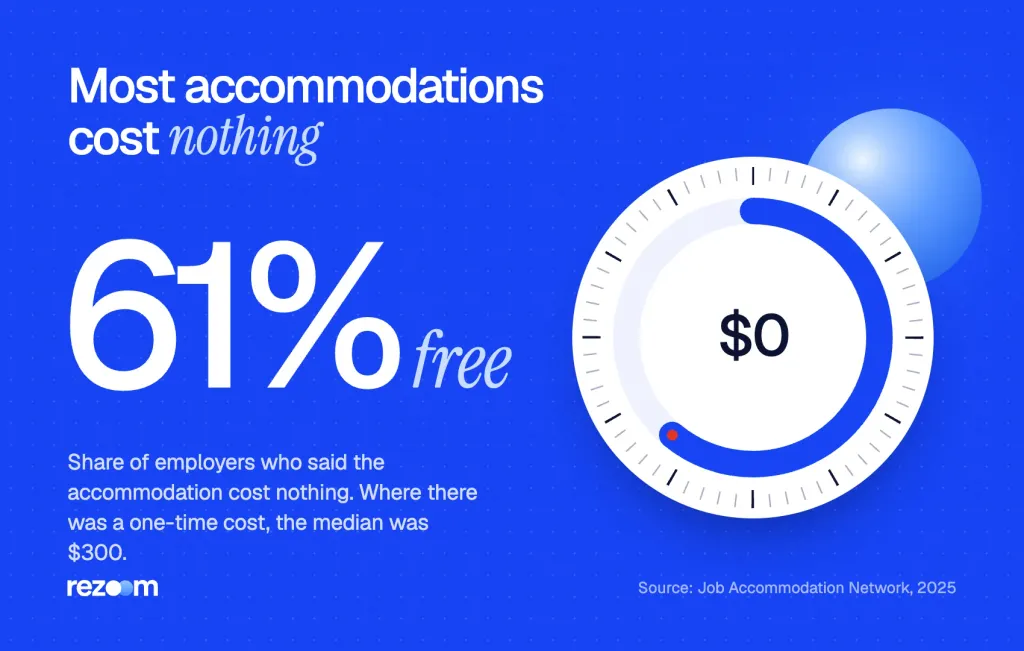
Many people worry that a request will scare off the employer. But in the Job Accommodation Network's 2025 cost report4, 61% of employers said the accommodation cost nothing. For those with a one-time cost, the median was $300.
Hi [HR contact], thank you for the offer for the [job title] role. I can perform the essential functions of the job, and one change will help me do my best work: [a stool at my station / a lift assist for loads over 40 lb / a 10-minute break every two hours]. Can we set this up before my start date on [date]? Thanks, [your name]
What the employer can and can't do
The employer can ask for reasonable proof if the need isn't obvious. But per the EEOC, that proof should cover only the disability and the need, not your full medical file.
The employer doesn't have to drop an essential duty or lower a production standard that applies to everyone. Instead, it should help you meet that standard.
What to say if they push back
- "Why didn't you mention this on the form?" "The form asked if I can do the job, and I can. I'm raising the setup now, before I start."
- "We don't make exceptions." "I'm not asking to skip a duty. I'm asking for a tool that lets me do it at full pace."
- "What's your condition?" "I'd like to keep my health details private. I can share a short note from my doctor confirming the need."
Interviewer: "This role stands for eight hours. Can you do that?"
"Yes. I can work the full shift with a short sit break each hour, which I can schedule around the line."
Interviewer: "Why would you need breaks?"
"I'd rather keep my medical details private. What matters is that I can keep the line at pace for the whole shift."
Send your request by email, even if you also ask in person, and save the reply. A dated email shows when and what you asked.
What should you check before you submit?
Before you submit, confirm you read the duties and physical needs, sorted core duties from minor ones and tested each with or without help. Check yes if they all work. Then plan any accommodation request for after the offer, and make sure your resume shows the physical skills the job needs.
The disability form usually comes up near the same step. Our guide to voluntary self-identification on job applications explains how that optional form differs from this required yes or no question.
Do
- Read the posting's physical requirements before you answer.
- Answer yes if a tool or small change lets you do the core duties.
- Ask for an accommodation in plain words, by email.
- Back up physical skills with numbers on your resume.
Don’t
- Name a diagnosis on the application; it isn't asked.
- Answer no because of one minor task.
- Hide a core duty you truly can't do; it will show up on day one.
- Wait until you struggle on the job to ask for help.
Before you submit
Warehouse interview questions with sample answers: safety, pick rates, forklifts, a customer complaint, the warehouse assessment and questions to ask.
If your resume doesn't show those physical skills yet, our AI resume builder can draft clear bullets for pick rates, lift limits and safety records in a few minutes.
Tailored to the job post, checked against ATS.
Frequently asked questions
What does "with or without reasonable accommodation" mean?
It means you can do the core duties on your own or with a change, like a tool, a schedule shift or a modified workstation. If either way works, you can answer yes.
Should I say yes if I have a disability?
Usually, yes, if you can do the core duties with or without help. A disability alone is not a reason to answer no.
Do I have to tell the employer about my disability?
No. The question asks about ability, not diagnosis. You only need to share some details if you ask for an accommodation, and even then the employer can ask only for what shows the need.
Can an employer reject me for answering no?
It can, if you truly can't do a core duty even with an accommodation. That's why it pays to check what the essential functions of the job actually are before you answer.
When should I ask for an accommodation?
Any time you need it. Many people ask after the offer and before the first shift, so the setup is ready on day one.
Sources
We opened and read each page below. The small numbers in the text point here. Pages that carry no publication date show n.d.
- EEOC1995
Before an offer, employers may ask if applicants can perform job functions, but not questions likely to reveal a disability.
- Cornell Law School LII (29 CFR 1630.2)n.d.
Essential functions are the fundamental job duties of the position and do not include marginal functions.
- EEOC2002
Workers may request accommodation in plain English, at any time, and employers need not drop essential functions or lower production standards.
- Job Accommodation Network2025
61% of employers said the accommodation cost nothing, and the median one-time cost was $300.
- U.S. Bureau of Labor Statistics2026
In 2025, 13.8% of employed people with a disability worked in production, transportation and material moving jobs.
- ADA.gov2020
The ADA's employment rules cover employers with 15 or more employees.
- Arizona Center for Disability Lawn.d.
Marginal duties can be reassigned, so being unable to do one does not make a person unqualified.
Mohammad has spent more than ten years designing consumer products and leads product at Rezoom, deciding what gets built and what gets left out. His guides cover the whole job search, from resume sections and cover letters to interview answers and career moves.
Goodi, M. (2026, November 12). Can You Perform the Essential Functions of the Job? How to Answer. Rezoom. https://rezoom.io/can-you-perform-the-essential-functions-of-the-job/