Will You Require Sponsorship? How to Answer on a Job Application
Will you now or in the future require sponsorship? See the right answer for green card, OPT, STEM OPT, H-1B, TN and EAD holders, plus scripts to explain it.

On this pageWhat does "require sponsorship" mean on a job application?
- What does "require sponsorship" mean on a job application?
- How does "now or in the future" change your answer?
- How should you answer on F-1 OPT, STEM OPT, H-1B or TN?
- Why does an honest answer matter?
- How do you explain sponsorship in a cover letter or interview?
- What should you check before you submit?
- FAQ
- Sources
Answer no only if you can work for any US employer with no end date, such as a US citizen, green card holder, refugee or asylee. Answer yes if you will ever need an employer to file for a work visa, which covers most F-1 OPT, STEM OPT, H-1B and TN workers. "In the future" is the key part, so a temporary work permit today usually still means yes.
If a form asks "will you now or in the future require sponsorship," answer yes if you will ever need this employer to file for a work visa. Answer no only if you can work here with no end date, like a citizen or green card holder.
Most people get stuck on the words "in the future." A work permit that runs out in a year or two still counts. So many F-1 students on OPT must answer yes, even though they can start work today.
This guide is general information, not legal advice. Your school's international office or an immigration lawyer can confirm your case.
Quick answers by situation
| Your situation | What to say/do | Example line |
|---|---|---|
| US citizen or US national | No | "No. I'm a US citizen." |
| Green card holder (permanent or conditional) | No | "No. I'm a permanent resident." |
| Refugee or asylee | No; your status lets you work | "No. I can work for any US employer." |
| H-4 or L-2 spouse with an EAD | Usually yes; your permit depends on your spouse's visa | "Yes. I have an EAD now, but my status may need support later." |
| F-1 on OPT | Yes, in most cases | "Yes. OPT covers me until June 2027." |
| F-1 on STEM OPT | Yes | "Yes. STEM OPT covers me until May 2028." |
| H-1B holder | Yes; a new employer must file a petition | "Yes. I need an H-1B transfer, not a new lottery." |
| TN (Canada or Mexico) | Usually yes, with a note | "Yes. I qualify for TN status, so no H-1B lottery." |
What does "require sponsorship" mean on a job application?
To require sponsorship means you need the employer to file paperwork with the government so you can work for it. On US forms this usually means a work visa, like an H-1B, or a green card petition. It asks about your future needs, not only whether you can start on day one.
The Justice Department's Immigrant and Employee Rights Section (IER) calls this one of two "appropriate" screening questions. Its 2022 guidance letter1 gives the exact wording many forms copy.
Will you now or in the future require sponsorship for employment visa status (e.g., H-1B visa status)?
US Department of Justice, IER, 2022
The other question on that list asks if you can legally work in the US. We cover it in our guide to the work authorization question. The two go together, so a typical form puts them back to back.
Why employers ask
Sponsorship costs time and money, and some employers don't offer it at all. The Department of Labor says H-1B employers must file a Labor Condition Application3 before they petition. And the yearly cap is 65,000 visas, plus 20,000 more for people with a US master's degree or higher.
The IER also says employers may generally ask about sponsorship. But its FAQ2 calls it a best practice not to ask for more detail about your citizenship status than they need.
Common ways forms word it
- "Will you now or in the future require sponsorship?" The full version, with a Yes/No box.
- "Do you require sponsorship?" Workday lists this as a sample eligibility question4.
- "Will you require visa sponsorship, yes or no?" Same meaning; answer the same way.
How does "now or in the future" change your answer?
The question has two parts, and a yes to either one makes the whole answer yes. If you can work today but your permit ends, you will need sponsorship later. So F-1 OPT and STEM OPT workers usually answer yes. You answer no only if you never need an employer to file for you.
Try a simple test. Ask, "If I stayed in this job for five years, would this company ever need to file for me?" If the answer is yes, then your form answer is yes.
- Check your status todayLook at your card, I-94 or EAD and note the end date, if there is one.
- Ask if it has an end dateA green card or asylee status has none. OPT, STEM OPT, H-1B, TN and dependent EADs all do.
- Ask who renews itIf a future employer must file to keep you working, you require sponsorship.
- Answer and add contextPick Yes or No, then use a notes box or cover letter to give your dates.
Why the "future" part matters most
Many people read only "now," but employers want the long-term cost. A yes today with a clear end date is far better than a no that turns into a yes in month eight.
The employer is asking, "Will we ever pay to keep this person?" Answer that question honestly, then use your cover letter to show you're worth it. A clear date and visa type make the yes feel small.
How should you answer on F-1 OPT, STEM OPT, H-1B or TN?
F-1 OPT and STEM OPT workers usually answer yes, because both permits end and a work visa comes next. H-1B holders answer yes, since a new employer must file a petition. TN workers often answer yes with a note. Add your end date and visa type so the reader sees the real ask.
| Status | How long it lasts | What comes next |
|---|---|---|
| F-1 OPT | Up to 12 months per degree level | STEM OPT or an H-1B petition |
| F-1 STEM OPT | One-time 24-month extension | An H-1B petition |
| H-1B | Generally up to 6 years | Transfer petition or green card |
| TN | Up to 3 years at a time | New TN support from each employer |
| H-4 EAD | Tied to the H-1B spouse's status | Depends on the spouse's case |
F-1 OPT
OPT lets you work after school with no job offer needed to apply. MIT's OPT guide5 says students may get up to 12 months per degree level. That clock runs out, so most OPT workers require sponsorship in the future.
STEM OPT
STEM grads can add a one-time 24-month extension, but it asks more of the employer. DHS's Study in the States6 says the employer must use E-Verify, and you need a signed Form I-983 training plan. So answer yes, and name the extension.
H-1B holders
If you hold an H-1B today, you still require sponsorship from a new employer. USCIS's H-1B FAQ7 says you can start once the new employer properly files a new petition. It adds that the stay is generally capped at six years.
There is good news for transfers. A September 2025 proclamation added a $100,000 payment on some new H-1B petitions. But an Ogletree summary of USCIS guidance8 says it generally does not apply to approved transfers, extensions or changes of status inside the US.
F-1 students who need a new H-1B
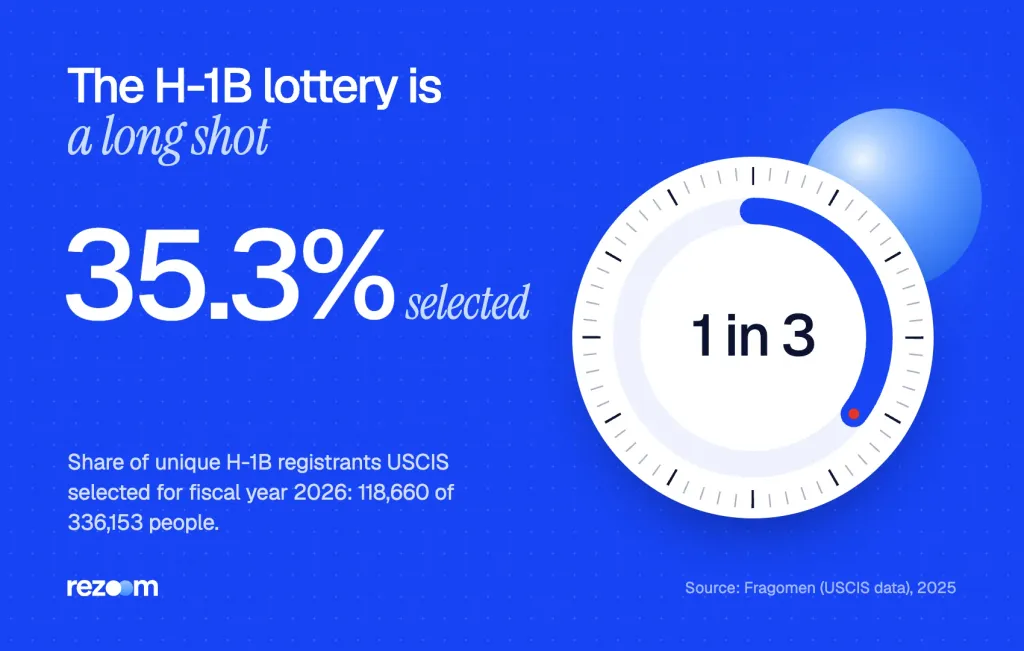
The lottery is the hard part. For fiscal year 2026, USCIS picked 118,660 of 336,153 people, about 35.3%, per Fragomen's report9. So an employer that sponsors you takes a real chance, and it helps to show you know that.
TN workers
TN status is for citizens of Canada and Mexico. Northwestern's TN guide10 says it comes in steps of up to 3 years, and your I-94 names your employer. Because a new employer must support it, many TN workers answer yes and add "TN, no lottery."
Spouses with an EAD and asylees
H-4 spouses with an EAD can work for any employer. But the American Immigration Council's H-4 fact sheet11 notes the permit depends on the H-1B spouse keeping status, and L-2 spouses face a similar link. So "in the future" may still mean yes; check your own case.
Asylees are different: USCIS's asylum page12 says a person granted asylum can work right away. The IER letter also lists refugees and asylees among the groups protected from citizenship status bias, so asylees and refugees answer no.
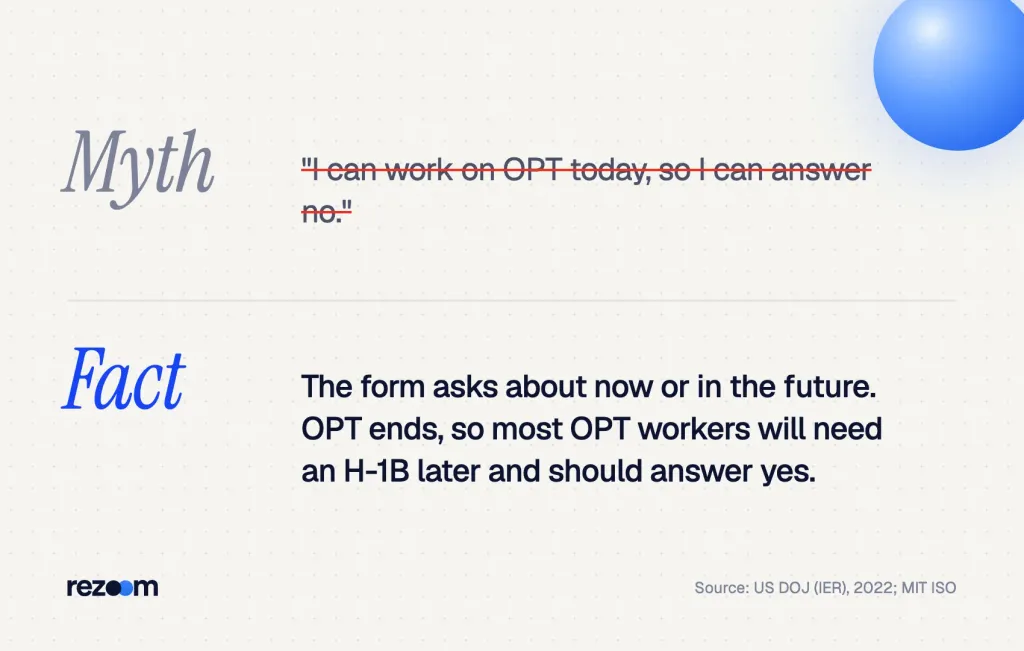
Yes. I am on [OPT / STEM OPT / H-1B / TN] status, which lets me work through [month, year]. After that, I would need [an H-1B petition / an H-1B transfer / TN support] to continue.
Yes. I hold H-1B status with my current employer. I need a transfer petition, not a new lottery entry.
Recruiters may not know visa terms, but they all read dates. Write "I can work for you through May 2028" before you name STEM OPT. Then the visa name feels like a detail.
Legally authorized to work in the US? See how to answer both job-application questions by status, from green card to OPT, H-1B, H-4 EAD and DACA.
Why does an honest answer matter?
Many ATS tools use this question as a knockout filter, so a yes may end some applications. But a false no can cost you more. The truth comes out in the I-9 and visa steps, and the employer can pull your offer or let you go. An honest yes keeps every door you can truly use open.
It's often a knockout question
Employers can screen on this answer: a Greenhouse team member wrote in a G2 thread13 that many customers ask about sponsorship on the application. She added that firms can "use automation rules" to find those candidates. Our guide to ATS knockout questions explains how these filters work.
A false no fails later, not sooner
Say you answer no on OPT and get the job. When your OPT ends, HR finds out you need an H-1B. Then the firm may refuse to file and treat your form answer as false. Duke's career center puts it plainly14: "don't provide false information on job applications."
Do
- Answer yes if you will ever need an employer to file for you.
- Add your visa type and end date in a notes box.
- Target employers that sponsor in your field.
- Ask your school's DSO or a lawyer if your case is unclear.
Don’t
- Answer no to get past the filter.
- Read only the word "now" and skip "in the future."
- Write a long immigration story in the form.
- Assume an EAD always means no.
Free ATS score, the text the software extracts and your missing keywords. No sign-up.
How do you explain sponsorship in a cover letter or interview?
Keep it short and lead with value. Name your status, your end date and what you need, in one or two sentences. Then move to the skills you bring. Point out anything that cuts cost or risk, like STEM OPT time, an H-1B transfer or TN eligibility.
You don't need to bring up sponsorship in every letter. But if the form asked, a single line shows you understand the ask. Many sponsors hire in tech, so browse our IT resume examples to see how strong applicants lead with projects and results.
If you're a coder on OPT, start with our software engineer resume examples. Put your degree, tech stack and shipped work up top, because those points make the cost of sponsorship look small.
Software engineer resume example
See how a software engineer resume puts skills and shipped projects first, which matters most when you need sponsorship.
Then add one calm line about status near the end of your letter. Our software engineer cover letter example shows how to keep the focus on your work.
Software engineer cover letter example
Use this letter as a model, and add your one-line status note before the closing.
I am on STEM OPT, which lets me work for you through May 2028 with E-Verify. That gives us nearly three years before any H-1B step.
What to say if they push back
- "We don't sponsor." Ask once, then accept it: "I understand. Would you keep me in mind if that changes?"
- "How long can you work for us now?" Give the exact date: "Through June 2027 on OPT, then I'd need an H-1B."
- "Isn't the H-1B fee $100,000 now?" Explain if it fits your case: "For a transfer inside the US, guidance says that payment generally doesn't apply."
- "Why should we take the risk?" Name your value: "I already know your stack, and I can start in two weeks."
Interviewer: "Your form says you need sponsorship. What does that involve?"
"I hold an H-1B now. You'd file a transfer petition, and I can start once you file it."
Interviewer: "Do we have to enter the lottery?"
"Usually not. My first H-1B already counted toward the cap, so a transfer skips the lottery."
What are knockout questions in recruitment? See common ATS knockout question examples, how to answer each one without an auto-rejection and which are legal.
What should you check before you submit?
Before you submit, confirm you read both "now" and "in the future." Check your status end date, your answer and your note all match. Make sure your resume shows the skills that make sponsorship worth it, then run it through an ATS check so it passes the screens you can control.
Before you submit
You can't change the sponsorship filter, but you can control the rest. Scan your draft with our ATS resume checker to catch format and keyword gaps. And if you studied abroad, our guide to the international resume format shows how to fit US norms.
Tailored to the job post, checked against ATS.
Frequently asked questions
Do green card holders require sponsorship?
No. A green card lets you live and work here with no employer filing for you. Answer no, even if your card is conditional.
Should I say yes if I'm on OPT?
In most cases, yes. OPT ends, and you will likely need an H-1B or other visa to stay with the employer after that.
Can employers ask if I require sponsorship?
Generally, yes. The Justice Department lists the sponsorship question as an appropriate one to ask applicants. Check your state's rules if you think a form went too far.
What if I have an H-1B already?
Answer yes. A new employer must file a petition for you, though it is a transfer and not a new lottery entry.
Do TN visa holders need sponsorship?
Often yes, because a new employer must support your TN status. Add a note that TN does not go through the H-1B lottery.
Will answering yes get me rejected?
It may at some firms that never sponsor. But a false no can lead to a pulled offer or job loss later, so target employers that sponsor instead.
Sources
We opened and read each page below. The small numbers in the text point here. Pages that carry no publication date show n.d.
- US Department of Justice, IER2022
The IER names the sponsorship question as an appropriate screening question and lists refugees and asylees as protected from citizenship status bias.
- US Department of Justice, IERn.d.
Employers can generally ask if applicants will need sponsorship for an employment visa.
- US Department of Laborn.d.
H-1B employers must file a Labor Condition Application, and the cap is 65,000 plus 20,000 for advanced degrees.
- Workdayn.d.
Workday lists "Do you require sponsorship?" as a sample eligibility question.
- MIT International Students Officen.d.
F-1 students can get up to 12 months of OPT per degree level, and no job offer is needed to apply.
- DHS Study in the Statesn.d.
STEM OPT is a one-time 24-month extension that needs an E-Verify employer and a Form I-983 plan.
- USCISn.d.
H-1B workers can start with a new employer once it properly files a petition, and the stay is generally capped at six years.
- Ogletree Deakins2025
The $100,000 H-1B payment generally does not apply to approved changes of status, extensions or amendments inside the US.
- Fragomen2025
USCIS selected 118,660 of 336,153 unique H-1B registrants for FY 2026, about 35.3%.
- Northwestern Universityn.d.
TN status is for Canadian and Mexican citizens and comes in steps of up to 3 years.
- American Immigration Counciln.d.
Eligible H-4 spouses have unrestricted work permits that depend on the H-1B spouse keeping status.
- G2 (Greenhouse community)n.d.
A Greenhouse rep says many customers ask about sponsorship on applications and use automation rules to find those candidates.
- Duke University Career Center2025
Duke advises applicants to answer the sponsorship question honestly and not give false information.
Mohammad has spent more than ten years designing consumer products and leads product at Rezoom, deciding what gets built and what gets left out. His guides cover the whole job search, from resume sections and cover letters to interview answers and career moves.
Goodi, M. (2026, November 12). Will You Require Sponsorship? How to Answer on a Job Application. Rezoom. https://rezoom.io/will-you-require-sponsorship-on-job-application/