

Summary
No single international resume format exists. Europass is the EU's official template, yet Germany's own government portal says companies there usually prefer an individual design. What changes between countries is a short list: length, photo, personal details and referees. What never changes is the core: single column, month-and-year dates, measurable results. Build one strong base file, then adjust four settings for the country and the employer you are applying to.
Search for an international resume format and you will find templates promising to work everywhere. None of them does, because the reader changes at every border while the template stays the same.
The clearest evidence comes from Germany. The EU's Europass editor is the closest thing to an official European CV, and Germany's government portal for skilled workers points applicants to it — then adds, in the same paragraph, that companies in Germany usually appreciate an individual design and that you should adjust the template to your own style.
So the useful question is which settings change for this country and employer. The answer is short: four settings move, and the rest of a good resume travels unchanged.
Is there an international resume format?
No. There is a shared core that works almost everywhere — single column, reverse chronological or hybrid, month-and-year dates, measurable results — and four settings that change by country: length, photo, personal details and referees. Build the core once and adjust the settings per application.
The word changes first. The UK, Ireland, Australia and most of Europe say CV for what North Americans call a resume; in the US and Canada, a "CV" usually means a long academic record. Use the local word in your file name and subject line.
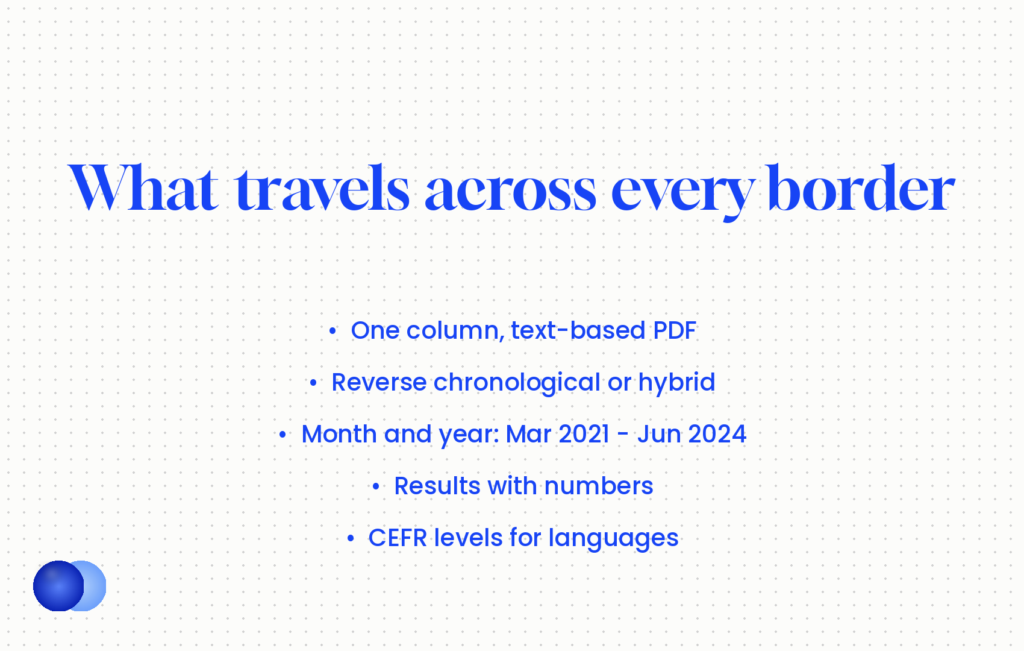
The shared core looks like this:
Single column, text-based file. Two-column layouts scramble extraction in every country's applicant tracking systems. How ATS works covers the mechanics.
Reverse chronological or hybrid. Germany's portal describes the standard CV as "antichronologically — most recent job first", which matches the North American norm. A functional layout parses worst in every market; resume format types explains why hybrid is the safer choice for gaps and career changes.
Results with numbers. A revenue figure reads the same in Toronto and Dubai.
Month-and-year dates. Covered below.
Everything else depends on where you are applying.
How do resume rules differ by country?
Canada, the UK and Australia strip out personal details and photos. Germany often expects a photo, though practice varies by industry. The UAE expects nationality, visa status and usually a photo. Length runs from two pages in Canada and the UK to up to three in Australia.
The table sets the international resume format settings side by side, using the most authoritative source we found for each market.
| Market | Usual length | Photo | Personal details | Dates |
|---|---|---|---|---|
| US | 1–2 pages | No | Contact details only | Month + year |
| Canada | Up to 2 pages (Job Bank) | No — "not the norm in Canada" | Leave out age, marital status, religion; never your SIN | Month + year |
| UK | Two sides of A4 | No | Leave out age, date of birth, marital status, nationality (National Careers Service) | Month + year |
| Australia | 2–3 pages (CareerBldr, citing a Seek employer survey) | No | Leave out date of birth, marital status, nationality, religion, gender | Month + year |
| Germany | Tabular and concise | Often expected; varies by industry | Name, address, contact details | Month + year, often numeric (03/2021) |
| EU institutions (Europass) | As the template sets it | Optional field | Template fields; fill only what the posting needs | Month + year |
| UAE / Gulf | 1–2 pages (Bayt) | Commonly included | Nationality and visa status at the top; date of birth optional | Month + year |
How to read the table
Canada is the most explicit. The federal Job Bank guide says to limit the resume to two pages, to leave out "age, weight, height, marital status, religious preference, political views", and never to include your Social Insurance Number. On photos it is blunt: "Although in some countries it may be acceptable to include a photo, it is not the norm in Canada."
The UK follows the same logic. The National Careers Service says you should not include "your age, your date of birth, whether you're married or your nationality".
Australia allows more length: CareerBldr, citing a Seek employer survey, puts the standard at two to three pages. Treat three as a ceiling and keep page one able to stand alone, as the two page resume guide explains.
When should you use the Europass CV?
When the reader expects it: EU institutions and agencies, publicly funded research, Erasmus+ and similar mobility programmes. For private employers, even Germany's government portal recommends treating Europass as a guide and adapting it to an individual design.
Europass is large: the European Commission reported nine million Europass CVs downloaded in 2023 alone. That scale is both its strength and its weakness.
The strength is recognition. An EU agency reviewer knows exactly where to find your language levels, qualifications and mobility history.
The weakness is sameness. Millions of files share the same headings and order, so a Europass CV blends into a private-sector pile. The German portal's advice — use it "as a guide and then adjust it to your individual style" — is the balanced position.
For a company, move your Europass content into your own single-column international resume format. Whichever you send, paste the exported PDF into a plain text editor: if the sections come out jumbled, an applicant tracking system will jumble them too.
Keep the CEFR levels, drop the template
The most portable part of Europass is its language grid (CEFR levels A1 to C2), not its layout. Write "German — B2 (CEFR)" rather than "good German", because a recruiter in Munich or Madrid can match the level against the posting instantly. If you hold a certificate such as Goethe B2 or DELF B2, name it beside the level.
Should you put a photo on an international resume?
Decide in this order: the posting's instruction, then the company's headquarters policy, then the industry, and only then the country. Most international resume format guides start with the country, which is why they get the multinational cases wrong.
Apply four rules in order and stop at the first one that gives an answer:
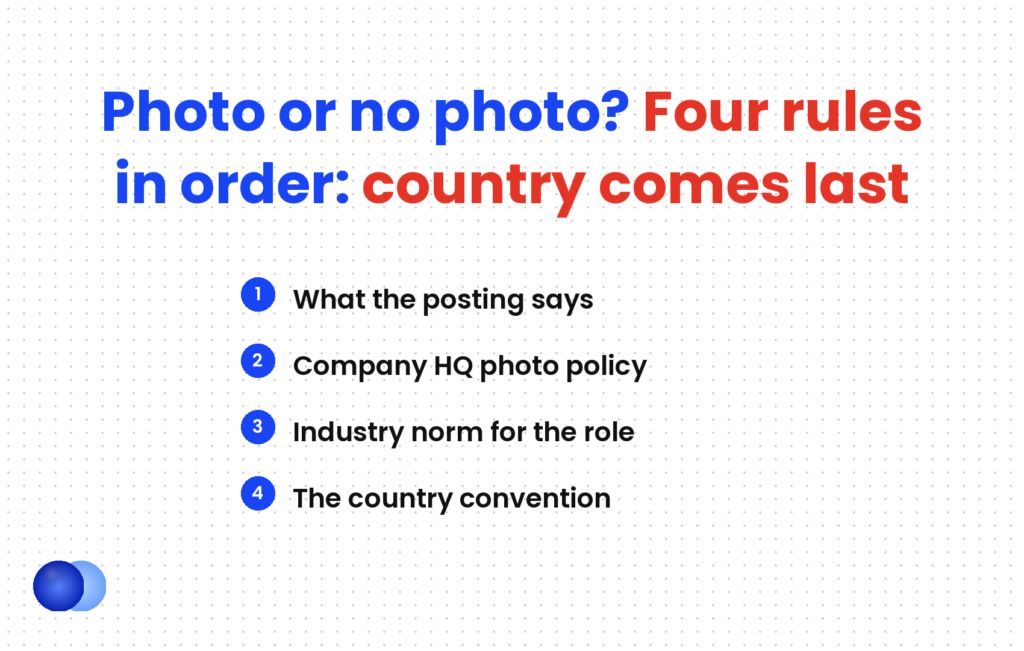
1. The posting. If the advert asks for a photo, include one; if it says not to, leave it out.
2. Company headquarters policy. A US, UK or Canadian multinational hiring in Frankfurt or Dubai may run one global hiring policy that screens photos out. The parent company's rules outrank the office's location.
3. Industry. Germany's own portal flags this directly — see the quote below.
4. Country. Only now does the table apply. Canada, the UK, Australia and the US: no. Germany and the Gulf: commonly yes.
The full reasoning sits in the guide to photo on resume.
In Germany, applicants are often expected to include a photo in their CV – however, there are major differences between professional industries in this regard.
Application A: a sales role at a family-owned manufacturer in Stuttgart. The posting is silent, the company is German-headquartered, the role is client-facing. The country decides: include a professional headshot.
Application B: a data engineering role at the Berlin office of a US software company whose careers page says it removes photos to reduce bias. Rule two decides it: no photo, even in Germany.
What personal details and work authorisation should you include?
Include what the local reader needs to act, and nothing that invites bias. Canada, the UK and Australia want contact details only. The UAE expects nationality and visa status. Everywhere, state your work authorisation plainly if you are applying from abroad.
General information rather than legal advice — immigration rules change, so check the official government source for your destination.
Canada, the UK, Australia, the US. Name, city, phone, email, LinkedIn. Leave out date of birth, marital status, religion and nationality.
Germany. Make it in Germany lists name, address and contact details as the personal data to include. Leave out date of birth and marital status unless the posting asks.
UAE and the Gulf. The Middle East job site Bayt lists nationality and visa status (UAE resident, visit visa or overseas applicant) as a "standard expectation in the UAE", with date of birth "optional but common". Omitting them costs you rather than protects you.
Stating work authorisation
A recruiter's first question about an overseas applicant is whether they can hire you without months of delay. Answer it in one line under your contact details:
- "Eligible to work in the EU (Irish citizen)"
- "Holds Canadian permanent residence"
- "Requires employer sponsorship; available from March 2027"
Never overstate your status; employers check it before any offer becomes final. Applicants who already hold the right to work in the US face the mirror question of whether to put US citizen on a resume at all.
State your work authorisation in one factual line under your contact details, so the recruiter never has to guess.
Paste your passport number, national ID or Social Insurance Number onto a resume in any country — no employer needs it at the application stage.
How should you write dates on an international resume?
Month and year, every time, with the month written as a word or a two-digit number: "Mar 2021 – Jun 2024" or "03/2021 – 06/2024". Never year-only ranges, and never full day-month-year dates, which read differently in the US than everywhere else.
Dates are where an international resume format goes wrong quietly.
Year-only ranges. "2021–2024" looks clean, but year-only ranges fail on at least three of eight major parsers, and a recruiter who checks LinkedIn reads the compression as concealment.
Day-month order. 04/05/2023 means 4 May in London and April 5 in Chicago. Drop the day: "May 2023" is unambiguous everywhere.
Local language. A German-language Lebenslauf uses "März 2021" or "03/2021"; an English-language CV uses "Mar 2021".
The references line
Australian guides expect two to three referees on the resume itself; North American practice keeps them off. In every market, delete references available upon request — it wastes a line. Where names aren't expected, prepare a separate resume reference page.
What can an international resume not fix?
Work authorisation, recognition of qualifications and language level. A perfect international resume format gets you read, but a recruiter who cannot sponsor a visa, cannot verify a degree or needs fluent German will still say no. Solve those problems before you apply.
Three barriers sit outside the document.
Sponsorship. Filter postings for sponsorship before you tailor anything.
Qualification recognition. Regulated professions such as nursing, teaching and law often require formal recognition of a foreign qualification. Germany's portal runs a recognition service; start early.
Language. State your CEFR level honestly; inflating it ends in the first interview.
What the document can do is remove every presentation reason to reject you. Build one base version in a clean international resume format and adjust the four country settings per application. The Rezoom resume builder keeps that base layout fixed while you swap the country-specific details, so each version stays parser-safe.
Frequently asked questions
Is there a standard international resume format?
No. A shared core works almost everywhere, but length, photo, personal details and referees change by country and employer.
Should I use Europass to apply for jobs in Europe?
Use it for EU institutions and publicly funded programmes. For private companies, adapt it into your own design.
Should I include a photo on my CV for Germany?
Often, but check the posting, the company's headquarters policy and the industry before the country.
How long should a resume be for Canada?
No more than two pages, according to the federal Job Bank guide. Never include your Social Insurance Number.
What personal details go on a UK CV?
Contact details only. The National Careers Service says not to include your age, date of birth, marital status or nationality.
Why do UAE CVs include nationality and visa status?
Bayt describes both as a standard expectation in the UAE. Date of birth is optional there.
How should I write dates on an international resume?
Month and year, such as "Mar 2021 – Jun 2024". Never year-only ranges, which fail on several major parsers.
Should I list referees on my resume?
In Australia, yes. Elsewhere, use a separate page, and never write "references available upon request".

Comments