
Summary
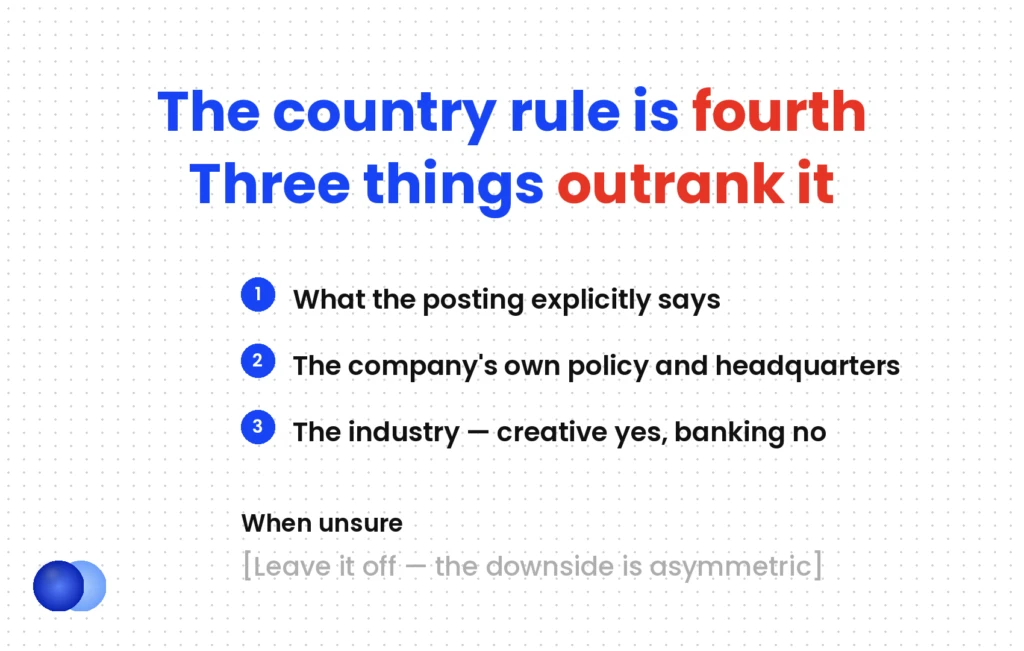
Whether to put a photo on a resume is a country question with three overrides. Germany, Japan, Korea and much of Southern Europe and Latin America expect one; the US, UK, Canada, Australia and the Netherlands discourage it. But an explicit instruction in the posting, the company's own headquarters policy, and the industry convention all outrank the country the role sits in.
Most advice on whether to put a photo on a resume gives you a country list and stops there. The list is correct and it is only the fourth-most important input.
A role based in Munich at a US-headquartered company, screened by a recruiter sitting in London, does not follow German convention. A creative role in New York often does expect a headshot despite the American norm. And any posting that says "anonymous CV" overrides everything.
So here is the hierarchy, in the order that actually decides it.
What are the four rules, in order?
The posting's explicit instruction first, then the company's own policy and headquarters, then the industry convention, then the country where the role is based. Each level overrides the ones below it, and most people only consult the last.
| Priority | Rule | Example |
|---|---|---|
| 1 | What the posting says | "Anonymous CV", "no photographs", or a request for one |
| 2 | The company's policy and HQ | US-headquartered firm hiring in Berlin screens to US norms |
| 3 | The industry convention | Creative expects photos; law and banking discourage them |
| 4 | The country the role is based in | The default when the first three are silent |
That second row is the one people miss. A large US or UK company applies its own hiring policy across every office it has, and the recruiter screening a German role may well sit in London, working to global standards.
The practical test: check who posted the job and where the company sits, not just where the desk is.
Which countries expect a photo?
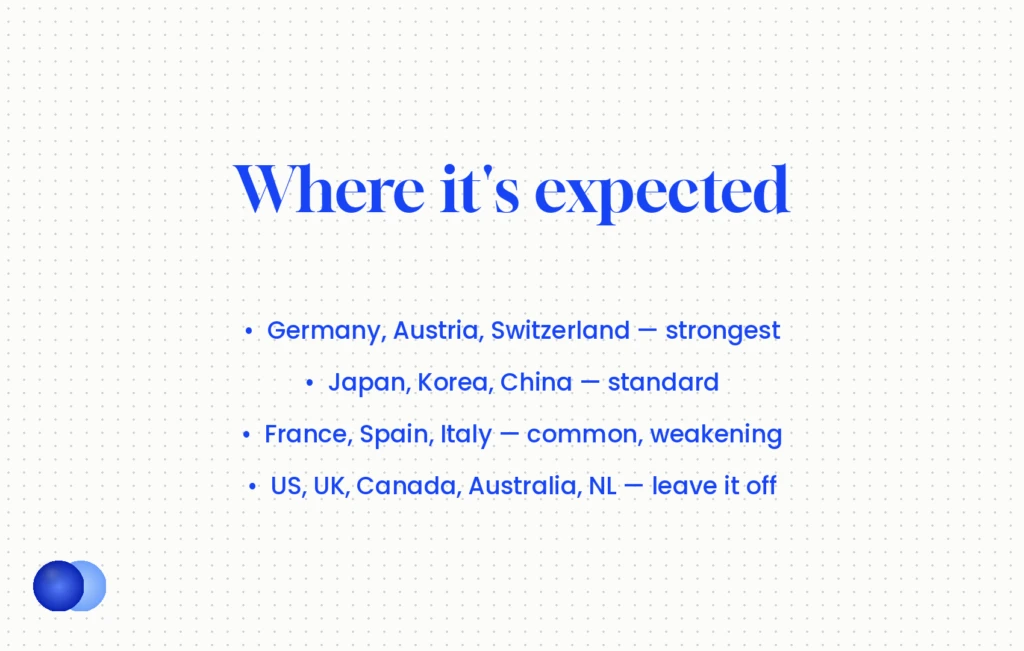
Germany, Austria and Switzerland most strongly, along with Japan, South Korea and China, much of Central and Eastern Europe, and most of Latin America. Southern Europe — France, Spain, Italy, Portugal — uses them commonly but not universally, and the practice is weakening there.
| Region | Convention |
|---|---|
| Germany, Austria, Switzerland | Expected. A CV without one reads as incomplete |
| Japan, South Korea, China | Standard. Japan's rirekisho has a designated photo box |
| Central and Eastern Europe | Widely included — Poland, Czechia, Hungary, Romania |
| France, Spain, Italy, Portugal | Common but weakening, especially in tech and at large firms |
| Most of Latin America | Generally expected, though Brazil and Argentina are shifting |
| US, Canada, UK, Ireland | Do not include |
| Australia, New Zealand | Do not include |
| Netherlands, Sweden | Do not include |
| India | Not required; text resume is standard |
One principle underlies the whole table: follow the convention of the market you are applying into, not the one you come from. A US applicant adding a photo because it is "more European" has misread both systems.
Why do the no-photo countries discourage them?
Anti-discrimination exposure. In the US, UK, Canada and Australia, employers avoid photos to limit claims based on age, race, gender or disability — so some screening processes discard resumes carrying one rather than risk the record.
In practice, the mechanism is worth understanding, because it explains why the rule is firmer than a preference.
A photo makes protected characteristics visible at the screening stage. In jurisdictions with strong equality legislation, that creates a documentary trail an employer would rather not have. The result is not usually a rule against candidates — it is a process that removes the photo, or removes the resume.
Which means the cost of including one in those markets is asymmetric. It rarely helps, and occasionally it removes you from a process before anyone reads a line.
Keep two versions and label them clearly
If you apply across markets, maintain Firstname-Lastname-Resume.pdf and Firstname-Lastname-Resume-DE.pdf — one without a photo, one with. Trying to remember which convention applies while building a file under time pressure is how the wrong version gets sent. Two files, clearly labelled, costs nothing and removes the decision from the moment you are least able to make it. The same resume file name conventions applies to both.
When does the industry override the country?
In both directions. Creative fields — design, fashion, advertising, media — often expect a photo even in no-photo countries. Law, banking, accounting and government often discourage one even in photo countries. And some roles require a headshot regardless of location.
Broadly, three patterns — and the third is absolute:
Creative industries. A designer's CV without a photo can read as unfinished in markets that otherwise discourage them.
Conservative industries. Law, finance, accounting and public sector roles lean formal and impersonal, even in Germany or Spain.
Appearance-relevant roles. Acting and modelling require a headshot everywhere, because appearance is the instrument. In several markets, hospitality, cabin crew, luxury retail and front-of-house roles sit in the same category.
For that last group the photo is usually a separate professional headshot rather than an inset on the resume — which is also the convention that keeps the document parseable.
Does a photo break ATS parsing?
It can. An image placed in a header region, or a resume exported as an image, causes real extraction problems — and the photo is often embedded in exactly the kind of layout that parses worst. The photo itself is not read; what surrounds it is the risk.
Two distinct failures here, and neither concerns the image itself.
Header placement. Many systems do not read the header region at all, and a photo placed there frequently sits alongside contact details that then go missing. How an ATS works covers that gap.
Layout by association. Templates built around a photo tend to use text boxes, sidebars and two-column layouts — the formatting that scrambles extraction regardless of what image sits inside it.
So in a photo-expected market, the safe construction is a plain single-column resume with the image placed top-right as a simple inline element, not a designed panel. Then check the result rather than assume it — an AI resume checker shows what the parser extracted, which is the only test that applies to your actual file.
What should the photo look like?
A professional headshot — business attire, neutral light grey or off-white background, good even lighting, slight smile, head and shoulders only. German CVs use roughly 3.5 × 4.5 cm at 300 DPI, placed top-right on page one.
| Element | Standard |
|---|---|
| Size | ~3.5 × 4.5 cm (passport size) |
| Resolution | 300 DPI minimum for print, sharp on screen |
| Placement | Top-right of page one, occasionally top-left |
| Background | Light grey or off-white; plain, non-distracting |
| Framing | Head and shoulders; never full body |
| Attire | What you would wear to the interview |
| Expression | Neutral to slight smile, looking at the camera |
What to avoid: cropped group photos, selfies, holiday backgrounds, filters, sunglasses, and anything more than a couple of years old. The photo should look like the person who will walk into the interview.
Applying to a Berlin engineering firm: Single-column resume, 3.5 × 4.5 cm headshot top-right of page one, neutral grey background, business attire. Standard German convention, and its absence would read as an incomplete application.
Applying to the same company's New York office: Identical resume, photo removed. Same content, same layout, one element gone.
Two files, one decision made in advance rather than at the upload screen.
Follow an explicit instruction over every other rule. "Anonymous CV" or "please do not include photographs" is a policy decision the employer has already made, and ignoring it is the one genuinely costly error here.
Reuse your LinkedIn headshot without checking it. Resume photos follow a more formal standard — smaller, plainer background, more conservative expression — where LinkedIn tolerates more personality.
A photo that helps in Munich hurts in Manhattan.
What if you are unsure?
Leave it off. In a market that expects one, its absence is a minor oddity a recruiter will overlook. In a market that discourages one, its presence can remove you from the process. The downside is asymmetric, so the default when genuinely uncertain is no photo.
Finally, that asymmetry answers every edge case.
Missing where expected: your application looks slightly unfinished and gets read anyway.
Present where discouraged: some processes discard it before a human reads the content.
One is a small cost and the other is a total one, so when the four rules leave you genuinely unsure — an international company, an ambiguous posting, a market you do not know — omit it and put the effort into the content.
Frequently asked questions
Should you put a photo on a resume?
It depends on four things in order: what the posting says, the company's own policy and headquarters, the industry convention, and the country the role is based in. Most people only consult the last.
Which countries expect a photo on a resume?
Germany, Austria and Switzerland most strongly, plus Japan, South Korea, China, much of Central and Eastern Europe, and most of Latin America. France, Spain, Italy and Portugal use them commonly but less universally.
Should I include a photo on a US or UK resume?
No. Employers in the US, UK, Canada, Australia and the Netherlands avoid photos to limit discrimination exposure, and some screening processes discard resumes carrying one.
Does the country of the company matter more than the country of the job?
Often, yes. A US or UK headquartered company applies its own hiring policy across every office, and the recruiter screening a German role may be based in London working to global standards.
Does a photo break ATS parsing?
The image itself is not read, but photos are usually placed in header regions or inside two-column templates — both of which cause real extraction failures. A plain single-column layout with an inline image is the safe construction.
What size should a resume photo be?
Roughly 3.5 × 4.5 cm, passport sized, at 300 DPI or better, placed top-right on page one with a light grey or off-white background.
Can I use my LinkedIn photo on my resume?
Usually not without adjustment. Resume photos follow a more formal standard — smaller, plainer background, more conservative expression — where LinkedIn tolerates warmth and varied backgrounds.
What should I do if I'm not sure?
Leave it off. Missing a photo where one is expected is a minor oddity; including one where it is discouraged can remove you from the process entirely.

Comments