

Summary
What goes in the body of an email to send a resume depends on a single question: is a cover letter attached? If yes, the body is a three-line transmittal note. If no, the body becomes the cover letter. Four situations change the rest — applying to a posting, replying to a recruiter, following a referral, and cold outreach each need a different length and ask.
You have written the email to send a resume a hundred times in your head and the cursor is still blinking. Most advice hands you one template and hopes it fits.
It does not, because the body length depends on one question: is a cover letter attached? Answer that and the rest follows — including whether you are writing three lines or three paragraphs.
Then four situations change the shape again, and they are genuinely different from each other.
What determines the length?
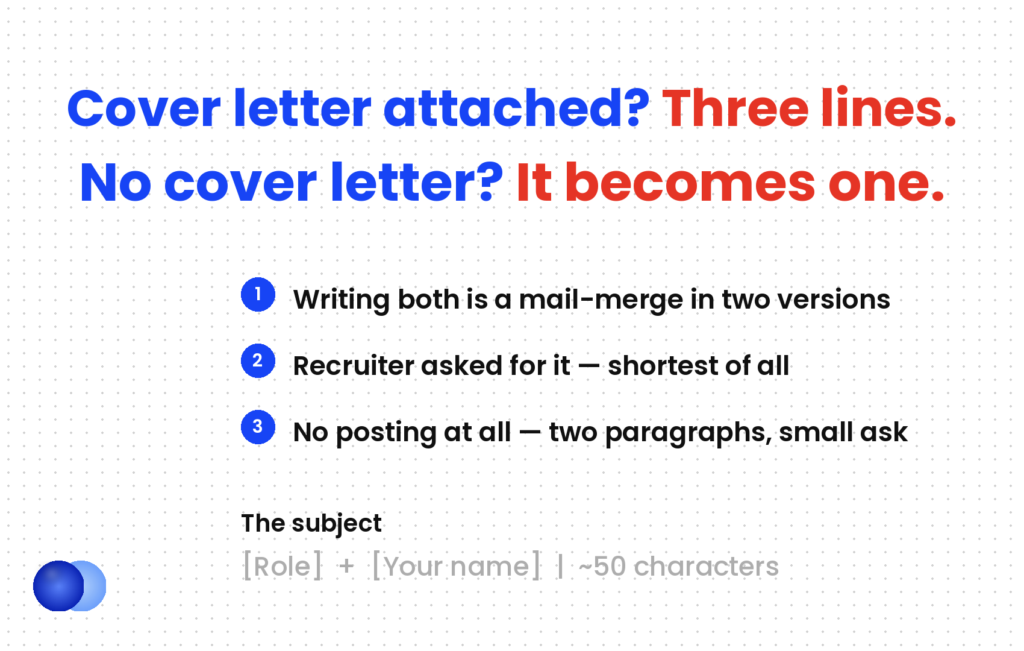
Whether a cover letter is attached. With one attached, the body is a three-to-four-line transmittal note pointing at the documents. Without one, the body becomes the cover letter and runs 150 to 200 words.
This fork resolves most of the confusion in the topic.
| Situation | Body length | What it does |
|---|---|---|
| Cover letter attached as a PDF | 3–4 lines | Names the role, points at the attachments, closes |
| No cover letter attached | 150–200 words | Becomes the pitch itself |
| Recruiter asked for your resume | 2–3 lines | They already know who you are |
| Cold, no posting exists | 2 short paragraphs | Introduction plus a low-pressure ask |
The mistake that costs most is writing a full pitch in the body and attaching a cover letter saying the same thing. Duplication reads as a mail-merge, and the reader now has two versions of one argument to reconcile.
If you are writing the letter into the body rather than attaching it, the email cover letter covers that case in full, including why 67% of recruiters open these on a phone first.
What should the subject line say?
The role and your name, front-loaded, in about 50 to 60 characters. "Application for Senior Data Analyst — Sam Rivera". Add a job ID or a referral name where you have one. Never just "Resume" or "Job Application".
Four subject formats for an email to send a resume:
` Application for Senior Data Analyst — Sam Rivera Senior Data Analyst (Req 4471) — Sam Rivera Referral from Priya Rao: Senior Data Analyst — Sam Rivera Resume as requested — Sam Rivera, Senior Data Analyst `
In practice, two rules behind them. Front-load, because mobile clients truncate from the right and roughly 47 characters survive on a phone. And always include both the role and your name — a subject reading "Resume" is indistinguishable from thirty others in the same inbox.
The posting’s instructions are a screening tool
If a posting says to include reference JB-2026-0412 in the subject, include it exactly. If it says to send to [email protected] rather than to individual managers, do that. Some employers use these requirements deliberately — a candidate who cannot follow a simple written instruction in an application email has answered a question about attention to detail before anyone opens the attachment. Instructions always override every convention on this page.
What goes in the body?
With a cover letter attached — the role, one line of relevance, a pointer to the attachments, and a close. Without one — the same structure expanded to a hook, one proof point with a number, and a specific next step.
With a cover letter attached (3–4 lines):
Hi Priya, I'm applying for the Senior Data Analyst role. My resume and cover letter are attached — six years in operations reporting, most recently owning the monthly close for four regional teams. Happy to talk any afternoon this week. Best, Sam Rivera
Without a cover letter (150–200 words):
Hi Priya, Your posting mentions the warehouse migration slipping twice. I ran that sequence at Wexford in the wrong order, spent six weeks unpicking it, and would start by measuring which reports actually break before touching the schema. Six years in operations reporting — SQL, Tableau, and a monthly close I took from twelve days to five across four regional teams. My resume is attached with the detail. I'd welcome a short call about how you're approaching the sequencing. Available any afternoon this week. Best, Sam Rivera
Same candidate, same attachment. The first assumes the reader will open a document; the second assumes they might not.
How do the four situations differ?
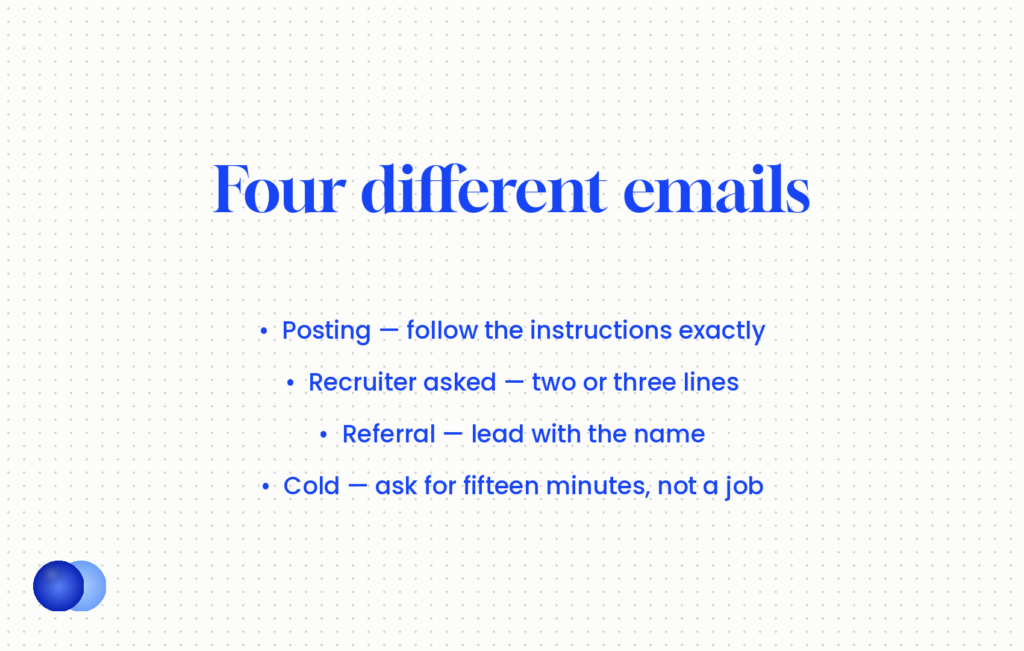
Applying to a posting follows the instructions exactly. Replying to a recruiter is the shortest, since they already know who you are. A referral leads with the person's name. Cold outreach runs two short paragraphs and ends with a small ask rather than a request to be hired.
1. Applying to a posting. Follow every stated instruction. Subject format, address, file format, requested documents. This is the one situation where convention loses to compliance.
2. A recruiter asked for your resume. Two or three lines. They initiated this, so re-pitching yourself wastes their time:
Hi Marcus, Good to speak earlier — resume attached as promised. The platform migration we discussed is under the Wexford role. Let me know if you need anything else.
When there is no posting
3. Referral or after a networking conversation. Lead with the name, because it is the strongest thing in the email:
Hi Priya, Sam Okafor suggested I get in touch about the analyst role — we worked together on the reporting migration at Wexford. Resume attached. Free to talk whenever suits.
4. Cold, speculative, no posting. Two short paragraphs: who you are and the kind of role, then why this company specifically. Close with a small ask — fifteen minutes rather than a job:
Hi Priya, I've followed your accessibility work for three years and noticed you have no one leading research. I've run studies with screen reader users at two companies and shipped changes off the back of them. Resume attached. If that role exists or is about to, I'd welcome fifteen minutes.
Weak: "Resume"
Strong: "Application for Senior Data Analyst — Sam Rivera"
The first is unsearchable, indistinguishable, and tells a recruiter nothing before they open it. The second survives truncation on a phone, sorts usefully in a full inbox, and is findable three weeks later when someone searches for the role.
Send yourself a test email first, opened on your phone. It catches the truncated subject, the attachment you forgot, and the signature block that collapsed into a wall of text.
CC multiple people at the same company. It reads as a broadcast rather than an application, and it puts each recipient in a position where they assume someone else is handling it.
What about the attachments?
PDF by default, named properly, and checked before you send. Attach the resume and the cover letter as separate files rather than combining them, and confirm the attachment is actually there before hitting send.
Four mechanical points about what you attach to an email to send a resume:
1. PDF unless asked otherwise. It renders identically everywhere. If the posting requests Word, send Word — whether to send a resume as PDF or Word covers when each applies.
2. Name the files. Sam-Rivera-Resume.pdf and Sam-Rivera-Cover-Letter.pdf. A file called resume.pdf can be overwritten in a recruiter's download folder, which resume file name conventions covers.
3. Separate files. One combined PDF forces a recruiter to scroll past your letter to reach your resume, or the reverse.
4. Check it is attached. Saying "my resume is attached" and then not attaching it is common enough to be a cliché and still happens weekly.
When should you follow up?
After five to seven business days, once, in under five sentences. Reference the original date, restate your interest, and ask if anything else is needed. One follow-up is professional; two starts to push.
The timing matches any other application, and the response window drives it rather than politeness — how long to hear back after applying covers why day seven to ten is when silence starts to mean something.
Broadly, two constraints worth holding:
One follow-up. Analysis of large email datasets found one initial contact plus one follow-up produces the highest reply rate, with additional messages reducing response. How to follow up on a job application covers what the message should contain.
Email, not a phone call. Unless the posting invites one. A call after a few days reads as pressure rather than enthusiasm.
Some companies use these requirements as a deliberate screening tool. If you cannot follow simple directions in an application email, what does that say about your attention to detail on the job?
Finally, one note on where the effort belongs. The email is a container — it gets your resume opened, and nothing more. The document inside it faces a parser and then a human, and an AI resume checker against the specific posting is a better use of ten minutes than a fifth rewrite of three lines.
Frequently asked questions
What should you write in an email when sending a resume?
It depends on whether a cover letter is attached. With one attached, three to four lines naming the role and pointing at the documents. Without one, 150 to 200 words that function as the cover letter.
What is the best subject line for sending a resume?
The role and your name, front-loaded — "Application for Senior Data Analyst — Sam Rivera". Add a job ID or referral name where you have one, and keep it around 50 to 60 characters.
Should I attach a cover letter or write it in the email?
Either, but not both. Writing a full pitch in the body while attaching a letter saying the same thing reads as a mail-merge and leaves the reader reconciling two versions.
What do I write when a recruiter asks for my resume?
Two or three lines. They initiated the conversation and already know who you are, so re-pitching yourself wastes their time. Confirm the attachment and offer to send anything else.
Should I send my resume as PDF or Word?
PDF by default, since it renders identically everywhere. Send Word when the posting asks for it — instructions always override the convention.
How do I email a resume when there's no job posting?
Two short paragraphs: who you are and the kind of role you want, then why this company specifically. Close with a small ask like fifteen minutes rather than a request to be hired.
How long should I wait before following up?
Five to seven business days, once, in under five sentences. One follow-up is professional; two starts to push, and additional messages reduce your reply rate.
Should I CC other people at the company?
No. It reads as a broadcast rather than an application, and each recipient assumes someone else is handling it.



Comments