

Summary
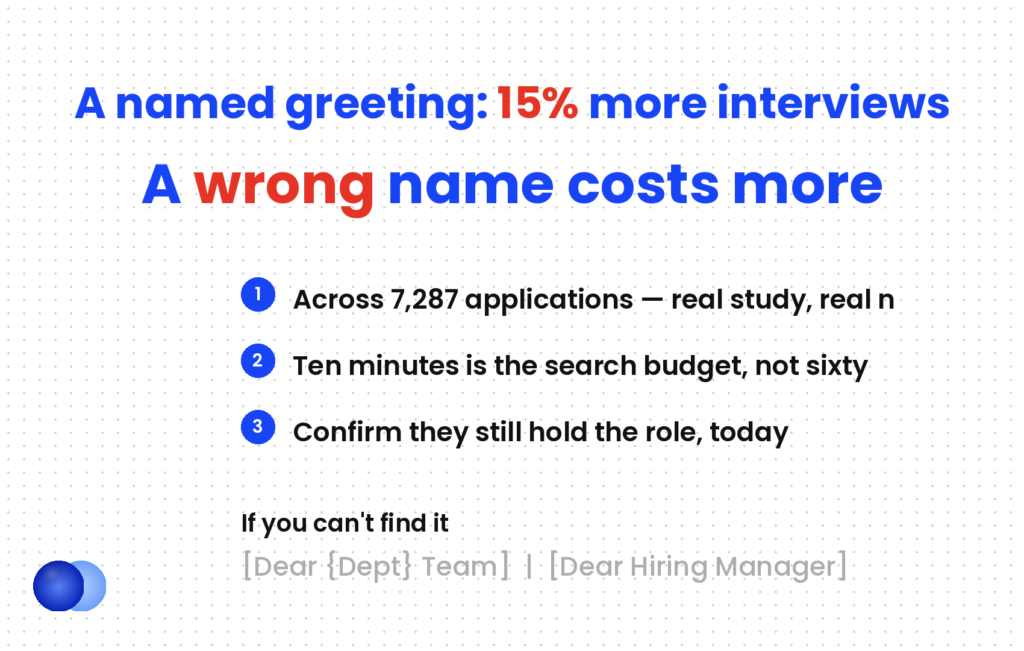
ResumeGo's study of 7,287 applications found letters addressed to a specific hiring manager were 15% more likely to earn an interview than "Dear Hiring Manager". That makes ten minutes of searching worth it. The risk nobody covers is the other side: a wrong name, an outdated title or a guessed honorific costs more than the generic greeting would have.
Who to address a cover letter to has a real number attached, which is unusual for advice in this category.
ResumeGo's study of 7,287 applications found that letters addressed to a specific hiring manager were 15% more likely to earn an interview than letters opening with "Dear Hiring Manager." That is a meaningful return on ten minutes of searching.
But the same effort has a downside almost nobody writes about. A wrong name, a stale title or a guessed honorific costs more than the generic greeting would have — so the useful version of this article covers both the search and when to stop searching.
Who should you address a cover letter to?
The hiring manager for the role, by name, if you can find one within about ten minutes. Failing that, the department team. Failing that, "Dear Hiring Manager". Each step down is a small cost; a wrong name is a larger one.
Who to address a cover letter to, best to worst:
| Greeting | When to use it |
|---|---|
| Dear Ms. Chen / Dear Taylor Chen | You have confirmed the name and the current role |
| Dear Analytics Hiring Team | You know the department but not the person |
| Dear [Company] Recruiting Team | Large employer with a dedicated recruiting function |
| Dear Hiring Manager | You searched and found nothing |
| Dear Sir/Madam · To Whom It May Concern | Never, for a job application |
In practice, one clarification worth making early. The hiring manager is usually a better target than the recruiter — department heads make the decision where HR screens — but address whoever actually opens it first, which at a large employer is often the recruiter.
How do you find the name?
Check the posting itself, the company's careers or team page, and LinkedIn's people search filtered by company and department. Ten minutes is the right budget. Beyond that the return drops sharply and the risk of using stale information rises.
Five places to look, roughly in order of how quickly each tends to work:
1. The posting. Some end with "Contact [Name] for more information" or "Send applications to…". Free, and frequently overlooked.
2. The company's team or about page. Small and mid-size companies often list department heads.
3. LinkedIn people search. Filter by company, then search the department or a title like "Head of Analytics" or "Engineering Manager".
4. The recruiter who posted it. LinkedIn job posts often show who posted them. That person may not be the hiring manager, but they are certainly someone who will read applications.
5. The email address. If the posting gives one, the format sometimes reveals a name — [email protected] is a starting point rather than an answer.
Confirm the role, not just the name
Finding a name is the easy half. The mistake that costs people is using one from an outdated source — an org chart from 2023, a press release, a stale team page. Before you write "Dear Ms. Chen", check that Ms. Chen still holds that role, on LinkedIn, today. A letter addressed to someone who left eight months ago says something worse about your research than no name at all would have.
What if you cannot find a name?
Use the most specific alternative available. "Dear Analytics Hiring Team" beats "Dear Hiring Manager", which beats anything beginning "To Whom". Departmental greetings show you understand where the role sits without claiming knowledge you do not have.
Broadly, three fallbacks, in order:
Department team. "Dear Marketing Team", "Dear Engineering Hiring Team". It signals you know the structure of the organisation.
Company recruiting team. "Dear Stripe Recruiting Team". Suits large employers with a dedicated recruiting function, and matches how those applications are actually routed.
Dear Hiring Manager. The standard fallback, and entirely acceptable. It acknowledges that a specific person will read the letter without pretending to know who.
None of these is a failure. They are all professional, and the 15% figure measures the gap between a named greeting and this tier — not the gap between this tier and disaster.
Named: "Dear Ms. Chen, your November post about deprecating the legacy pipeline described the exact migration I ran at Wexford."
Departmental: "Dear Analytics Hiring Team, your posting mentions the warehouse migration slipping twice. I ran that sequence in the wrong order once."
Generic: "Dear Hiring Manager, I cut onboarding from eleven days to three across 4,000 accounts, which is the problem your posting describes."
The greeting varies; the first sentence does the work in all three. A specific opening compensates for a generic salutation far more than the reverse.
What should you never use?
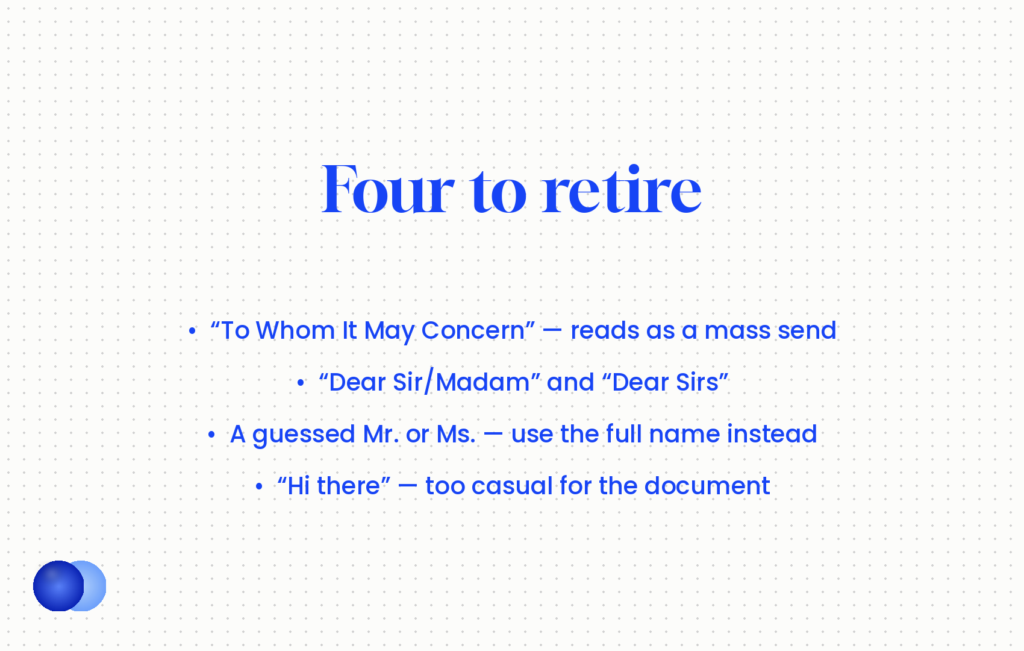
"To Whom It May Concern", "Dear Sir/Madam", "Dear Sirs", and any guessed honorific. The first three read as decades out of date; the fourth risks an error that a generic greeting would have avoided entirely.
Meanwhile, four things to avoid, with different reasoning for each:
"To Whom It May Concern." Announces that this letter went to twenty companies. Reserve it for formal correspondence with an unknown recipient, which a job application is not.
"Dear Sir/Madam" and "Dear Sirs." Dated, and the second is exclusionary on its face.
A guessed honorific. Never infer Mr. or Ms. from a photo, a username or a name you are unsure about. If you have the name but not the preferred title, use the full name: "Dear Taylor Chen" is correct, respectful and carries no assumption.
"Hi there" or "Hello!" Too casual for the document, regardless of how informal the company seems.
Match a company's own branding if it is unconventional. If they style themselves in lowercase, "Dear spotify Recruiting Team" reads as attention rather than error.
Spend an hour hunting. The return on this is real and bounded — ten minutes is the budget, and a well-chosen fallback costs you far less than the time would.
Does the greeting matter more than the letter?
No. The 15% difference is real and it is a modifier on a document that still has to earn attention. A named greeting on a generic letter does not outperform a departmental greeting on a specific one, because only 26% of hiring managers read every cover letter they receive.
Finally, worth keeping proportionate, since this is the kind of detail that absorbs more anxiety than it deserves.
A 2024 ResumeBuilder survey of 948 hiring managers found only 26% read every cover letter. The ones who do read are paying attention to details like the greeting — which is exactly why it is worth ten minutes and not sixty.
What carries far more weight is the sentence after the greeting. How to start a cover letter covers why, and the short version is that your opening writes a claim the rest of the letter has to support. A perfect salutation above "I am writing to express my interest in the position" has not saved anything.
Cover letters addressed to a specific hiring manager were 15% more likely to earn an interview than letters opening with "Dear Hiring Manager."
Where does the greeting go?
On its own line, followed by a blank line before the opening paragraph. Use a comma after the name in most contexts. In an email cover letter the greeting still belongs in the body — the subject line handles context, and the letter should read as complete on its own.
Three mechanical points:
Formatting. Greeting on its own line, comma after it, blank line, then the opening paragraph.
Email versus attachment. The same greeting either way. An email cover letter is still a letter, and the subject line is not a substitute for a salutation.
Reference numbers. These belong in the subject line or the first paragraph, never in the greeting. "Dear Hiring Manager (Ref: 4471)" reads as a form.
For everything that follows the greeting, how to write a cover letter covers the structure, and how to end a cover letter covers the sign-off — which should match the formality of whatever you opened with.
Frequently asked questions
Who should you address a cover letter to?
The hiring manager for the role, by name, if you can find one in about ten minutes. Failing that, the department team, then "Dear Hiring Manager".
Is "Dear Hiring Manager" acceptable in 2026?
Yes. It is the standard fallback when reasonable research turns up no name, and it is professional and widely understood. Use it after searching rather than instead of searching.
Does addressing a cover letter by name actually help?
Measurably. ResumeGo's study of 7,287 applications found letters addressed to a specific hiring manager were 15% more likely to earn an interview.
Should I use "To Whom It May Concern"?
No, not for a job application. It reads as decades out of date and signals that the same letter went to many companies.
What if I don't know the hiring manager's gender?
Use the full name — "Dear Taylor Chen". Never infer an honorific from a photo or a username, since a wrong title is worse than no title.
Should I address it to the recruiter or the hiring manager?
Whoever opens it first, which at a large employer is usually the recruiter. Department heads make the decision, but a letter should be addressed to its actual reader.
What if the company name is styled unusually?
Match their own formatting. If a company brands itself in lowercase, using that in "Dear spotify Recruiting Team" reads as attention to detail.
Where does the greeting go in an email cover letter?
In the body, on its own line, followed by a blank line. The subject line handles context, and the letter itself should read as complete.


Comments