

Summary
For an experienced candidate the resume does the work and the cover letter supports it. With a thin resume that balance inverts, which makes this the one document where you can outcompete a stronger-looking application. Two mistakes cause most failures: opening with a concession, and listing activities instead of proving results. Both are fixable in one editing pass.
A cover letter with no experience has a job the others do not. For a candidate with ten years behind them, the resume carries the application and the letter supports it.
When the resume is thin, that balance inverts. The letter becomes the primary document — which makes a cover letter with no experience the one place where you can genuinely outcompete someone whose resume looks stronger than yours.
Most of them fail the same two ways. They open with a concession, then list activities instead of proving results. Both are fixable, and fixing them is most of the work.
Does a cover letter matter more without experience?
Substantially more. NACE's 2025 survey found 65% of employers said a well-written cover letter influenced their decision to interview an entry-level candidate, and TopResume reported 78% of employers say a strong letter can compensate for a lack of direct experience.
The numbers point the same way, and the reasoning behind them is straightforward.
In practice, an employer posting an entry-level role knows what the applicant pool looks like. They are not comparing you against someone with five years in the field — they are comparing you against other recent graduates, career starters and first-time applicants.
What separates candidates at that level is narrow: whether you can write clearly, whether you researched the company, and whether you can point at something you actually did. All three live in the cover letter rather than the resume.
One honest limit before the tactics. A letter compensates for a thin experience section; it cannot compensate for a resume that never reaches a human. If the file does not parse or the vocabulary does not match, nobody reads either document — which AI resume checker will confirm in two minutes.
What are the two mistakes?
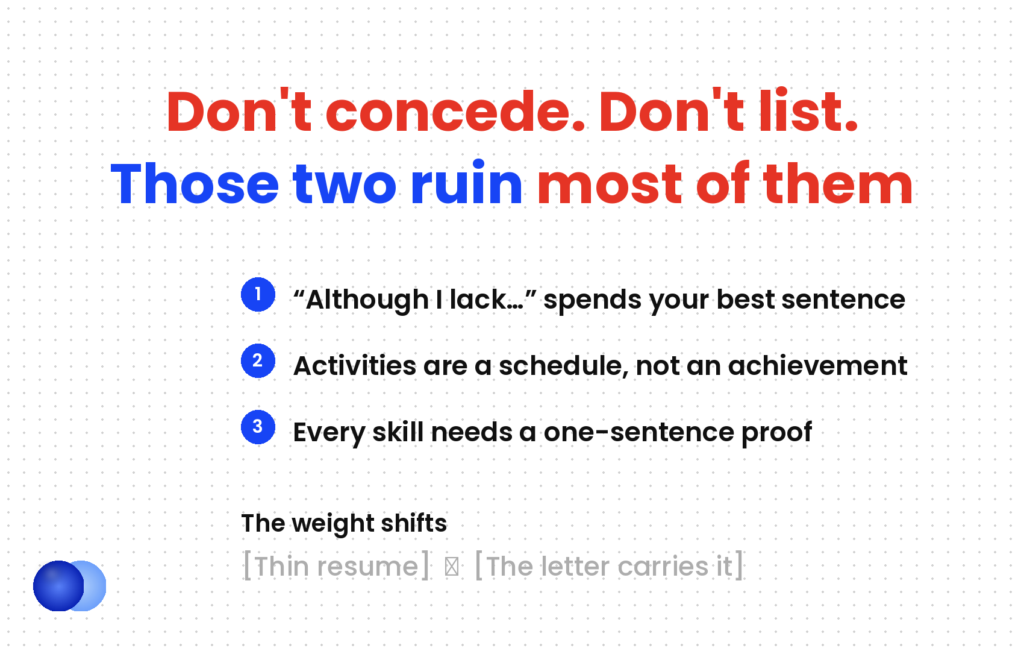
Opening with a concession and listing instead of proving. "Although I don't have direct experience, I'm a fast learner" volunteers a weakness nobody raised. "I was president of the debate society" states a fact without the outcome that makes it evidence.
Both mistakes are so common in a cover letter with no experience that avoiding them is itself a differentiator.
The concession. Any sentence beginning "Although I lack…" or "While I don't have…" spends your opening on the thing you least want emphasised. The reader knew your experience level from your resume; naming it frames the whole letter as a request rather than a proposition.
The list. Activities are not achievements. "Member of the marketing society, volunteer at the food bank, completed a data analytics course" describes a schedule. What did any of it produce?
Helpfully, the fix for both is the same move: replace the claim with the outcome.
Every skill needs a one-sentence proof
Never list a skill without an example attached. "I am proficient in Excel" is weaker than "I tracked campaign performance weekly in Excel and built a pivot table dashboard our class used to identify our best-performing content." The second sentence is longer and it is the only one a reader can evaluate. If you cannot write the proof sentence, the skill is not ready to claim — and that is useful information about what to build next.
Where does the evidence come from?
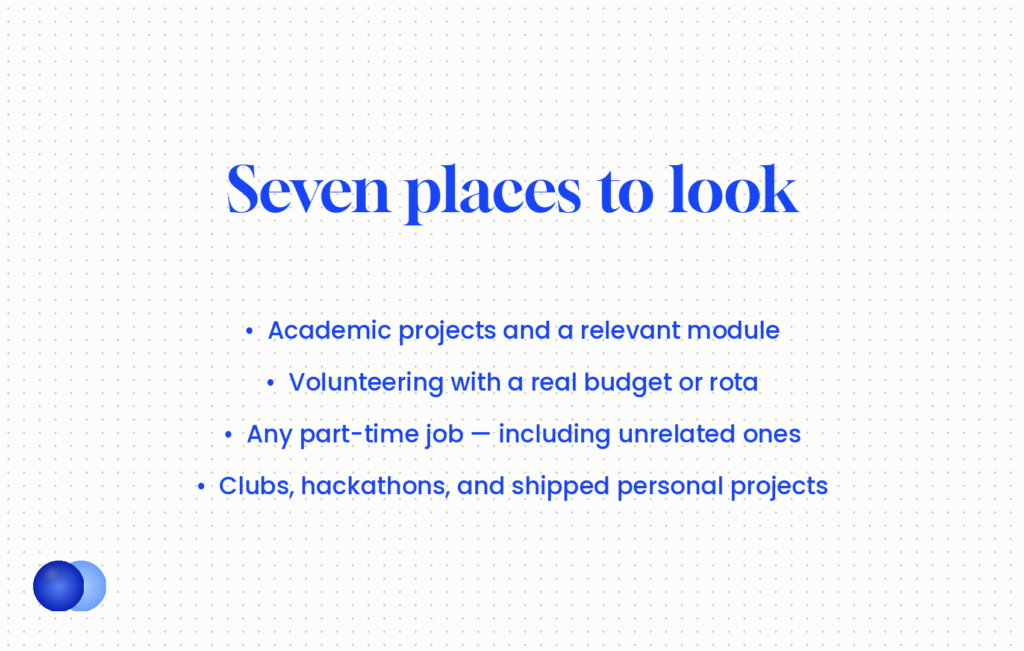
Seven places most candidates undercount — academic projects, coursework, volunteering, part-time work in unrelated fields, club and society roles, hackathons or competitions, and personal projects. The shortage is usually recognition rather than material.
| Source | What counts as evidence |
|---|---|
| Academic projects | A capstone, a group assignment, a dissertation with a finding |
| Coursework | A module directly relevant to the role's core task |
| Volunteering | A responsibility with scope — a budget, a rota, a campaign |
| Part-time work | Any job, including unrelated ones, for reliability and customer contact |
| Clubs and societies | A committee role with something you changed or grew |
| Hackathons and competitions | Placement, or what you built under time pressure |
| Personal projects | A repository with real commits, a blog, a shipped side project |
What people undercount
That last row deserves emphasis for technical roles. A GitHub account with two or three genuinely finished projects frequently reads better than an internship at a company nobody recognises, because the work is inspectable.
The pattern across all seven: scope, decisions and outcomes count regardless of whether anyone paid you.
What does the structure look like?
Three short paragraphs, 200 to 300 words — tighter than a professional letter because you have less to compress. A hook naming the role and one specific reason, one paragraph of proof against the posting's requirements, and a close with a specific next step.
A cover letter with no experience has four parts, each answering a question the reader is actually asking:
1. Hook (2–3 sentences). Names the role and one genuine reason for this company. Is this person interesting to talk to?
2. Proof (1 paragraph). One or two of the seven evidence types, written as outcomes and matched to what the posting asks for. Can they do the core tasks?
3. Company signal (2 sentences). Something specific you noticed about them. Did they research us?
4. Close (2 sentences). A specific next step, stated with confidence. How fast can I schedule this?
Keep the whole thing to 200–300 words across three paragraphs, on one page. That is the ceiling rather than a target, and how long a cover letter should be covers why the number comes from reading time.
Conceded and listed: "Although I don't have professional marketing experience, I am a fast learner and very passionate about the field. I was involved in my university's marketing society and completed several relevant courses."
Proved: "I ran the social accounts for my university's marketing society for a year, growing the Instagram following from 400 to 2,100 by shifting from event announcements to short interviews with alumni. That taught me the thing your posting describes — that distribution matters more than volume."
Same candidate, same year, same society. The second version has an outcome, a decision, and a link to the posting. It also never mentions what she lacks.
Close with confidence. "I'd welcome the chance to discuss how the campaign work I did transfers to your content team" is strong.
Close with an apology. "I know I don't have much experience but I'm a fast learner" is weak even when it is true, and it ends your letter on the weakest thing in it.
How do you tailor it?
Change the company name, the role, and one specific researched detail at minimum. That alone puts you ahead of most of the field, because entry-level roles attract very large applicant pools and most of those applications are identical.
Entry-level postings routinely draw 250 or more applications, which means the baseline you are competing against is a generic letter sent to fifty companies.
Broadly, three levels of tailoring, in ascending order of effort:
Minimum. Company name, role title, and one real detail about the organisation. Ten minutes.
Better. Reorder your proof paragraph so the evidence closest to their top requirement comes first.
Best. Use their vocabulary. If the posting says "customer retention", write that rather than "keeping customers happy" — the same reason it matters on a resume, covered in beating AI resume screening.
Does the platform change anything?
Yes, in small ways. LinkedIn Easy Apply makes the letter optional — attach one anyway. Handshake employers expect school-aware letters citing your degree and coursework. Company career sites often want DOCX. Email submissions should have the letter in the body.
Four channels, four adjustments:
LinkedIn Easy Apply. Optional field. Attach one — a large share of applicants will not.
Handshake. The default early-career platform for US students, and employers there expect the letter to reference your degree, graduation year and relevant coursework more prominently than you would elsewhere.
Company career sites. DOCX primary, PDF secondary, plain text if the field is a paste box.
Email. Put the letter in the body and attach the resume. Smaller employers and nonprofits still work this way.
Most "no experience" letters open with a concession and then list activities instead of proving results.
For finished entry-level letters you can work from, the cover letter examples library covers the situations above.
Finally, the reframe worth keeping: you do not have no experience. You have no experience section — and those are different problems. One is a gap in a document, which this letter exists to fill. How to start a cover letter covers the opening, and the rule there applies double here: your first sentence should be something only you could have written.
Frequently asked questions
How do you write a cover letter with no experience?
Three short paragraphs, 200 to 300 words: a hook naming the role and a genuine reason, a paragraph proving one or two relevant outcomes from any source, and a confident close with a specific next step.
Does a cover letter help if you have no experience?
More than for experienced candidates. NACE's 2025 survey found 65% of employers said a well-written letter influenced their decision to interview an entry-level candidate.
What do you put in a cover letter with no work experience?
Academic projects, coursework, volunteering, part-time work in any field, club or committee roles, hackathons, and personal projects — written as outcomes rather than as a list of activities.
Should I say I have no experience?
No. Opening with "although I lack direct experience" spends your best sentence on the thing you least want emphasised, and the reader already knew from your resume.
How long should an entry-level cover letter be?
200 to 300 words across three paragraphs on one page — tighter than a professional letter, because you have less material to compress.
Do unpaid activities count as experience?
Yes, when they had scope and produced something. A committee role with a budget, a volunteer rota you ran, a project that shipped — scope and outcomes count regardless of pay.
Can a good cover letter make up for a thin resume?
For an experience gap, largely — TopResume reported 78% of employers say a strong letter can compensate. It cannot compensate for a resume that fails to parse or never reaches a human.
Should I attach a cover letter when it's optional?
Yes, particularly at entry level. A meaningful share of applicants skip the optional field, which makes attaching one a low-cost differentiator.



Comments