

Summary
In a survey of 203 HR professionals, the most common rejection reason for first resumes was not a lack of experience — it was poor relevance, meaning candidates listing every job and activity without connecting any of it to the role. Recruiters skim in 20 seconds. The fix is choosing four or five things and writing each as an outcome rather than an activity.
The worry with a resume for a part time job is always the same: I have nothing to put on it.
The data says the opposite is the actual problem. In a survey of 203 HR professionals, the most common rejection reason for first resumes was not a lack of experience — it was poor relevance, meaning candidates listing every job and activity without tying any of it to the role they wanted.
So a resume for a part-time job is a selection problem rather than a filling problem. You almost certainly have enough. What you need is to choose.
What actually gets a first resume rejected?
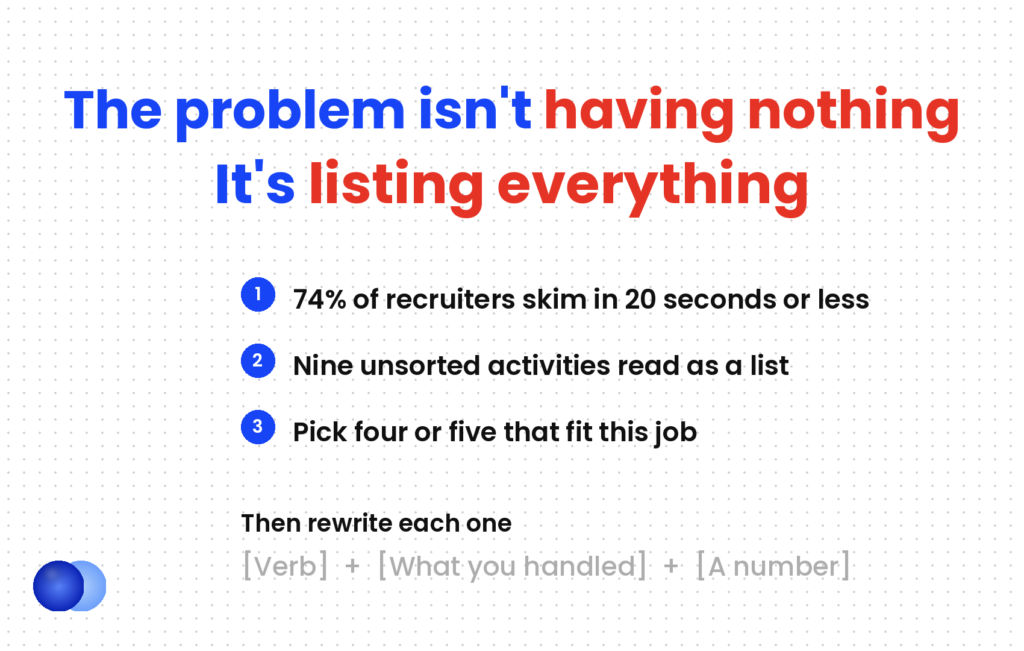
Irrelevance, not emptiness. Recruiters reported that the most common failure was listing everything without connecting it to the role. With 74% skimming a resume in 20 seconds or less, a page of unsorted activities reads as a list rather than an argument.
In practice, two findings from that survey shape everything below.
74% skim in 20 seconds or less. That is not enough time to work out which of your nine activities matters. If you do not sort them, nobody sorts them.
82% use an applicant tracking system. Which means a plain, single-column layout with standard headings, not a decorative template — the same constraint covered in resume format types.
The practical version: pick four or five things that support the specific job, and cut the rest. A tidy page with five relevant items beats a full page with twelve unsorted ones.
What counts as experience?
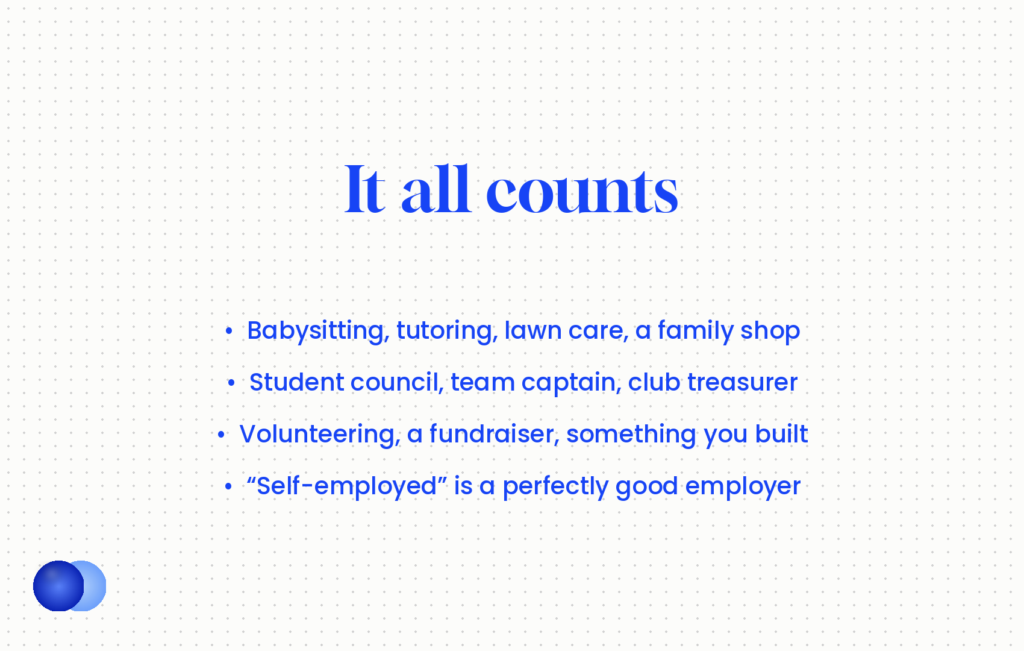
More than you think. Babysitting, tutoring, lawn care, helping at a family business, a school club role, a sports team, volunteering — all of it is work you did and can describe. The test is whether it shows you turning up and handling responsibility.
| Type | Examples |
|---|---|
| Informal paid work | Babysitting, tutoring, lawn care, dog walking, a family business |
| School roles | Student council, club treasurer, yearbook, team captain |
| Volunteering | Food bank, library, community events, coaching juniors |
| Projects | A website you built, a channel you run, a fundraiser you organised |
| Coursework | A module directly relevant to the role |
Informal work belongs in the experience section, not hidden under "activities". List the role, the rough dates, and put "Self-employed" as the employer if there was no company.
One thing managers hiring for a first part-time job care about more than anything else: can they count on you. Every item above that shows you turned up repeatedly, on a schedule, and handled something without supervision is answering that question directly.
Write what happened, not what it was called
"I babysat my cousins" is a label. "Supervised three children aged 2 to 10 on weekday evenings, prepared meals to specific dietary requirements, and organised a birthday party for ten" is the same job described as work. You invented nothing — the second version simply says what you actually did. Run every line on your resume through that test, and the ones that survive are the ones worth keeping.
How do you write a bullet?
Start with an action verb, name what you handled, and add a number where one exists. Numbers are what turn a claim into evidence, and most informal work has them — how many children, how many hours, how much you raised.
Broadly, three parts — and the third is the one people skip:
1. An action verb. Supervised, organised, handled, tracked, coached, sold, served.
2. What you handled. The specific thing, not the general category.
3. A number. How many people, how often, how much, how long.
| Before | After |
|---|---|
| Babysitting for neighbours | Supervised three children aged 2–10 on weekday evenings for two years |
| Member of student council | Organised the winter fundraiser, raising £1,400 across six events |
| Worked in my dad's shop | Served 40+ customers a shift and handled the till on weekend openings |
| Good at maths | Tutored two Year 9 students weekly, both moving up a grade band |
Every "after" line is the same truth with detail added. Numbers are not exaggeration — they are the part a reader can picture.
What order should the sections go in?
Contact details, a two-line summary, education, experience, then activities and skills. Education goes near the top because it is your strongest sellable asset right now, which is the opposite of how an experienced person's resume is ordered.
A resume for a part time job runs in this order:
1. Contact details. Name, phone, email, city. A plain email address — firstname.lastname, not a nickname from a game.
2. A two-line summary. What you are and what you are looking for. "Sixth-form student with two years of babysitting and a student council role, looking for weekend retail work."
3. Education. School, expected finish date, and any grades or subjects relevant to the job.
The lower half
4. Experience. Informal work included, most recent first, two or three bullets each.
5. Activities and skills. Clubs, sports, volunteering. Then hard skills (a language, software, a certification) and the soft ones that matter for this job.
One page, always. When a one page resume still wins covers why, and at this stage it is not a constraint — it is plenty of room.
Everything listed: Nine activities across three sections — chess club, football, babysitting, a coding course, the school play, a charity walk, piano grade 4, a part-time paper round, and a science fair project. No order, no detail, one page and a bit.
Sorted for a café job: A two-line summary naming the role. Education. Then babysitting (reliability, handling people), the paper round (early starts, six days a week for a year), and the charity walk (organised a team of twelve). Three items, each with a number. Half the page, and every line answers the question the manager is actually asking.
The second student did not do less. They chose.
Use your school email or a plain personal one, and check the voicemail on the number you list. A manager who cannot reach you moves to the next application, and that is the most avoidable rejection there is.
Add a photo, your full home address, or your date of birth. US and UK employers expect none of it, it takes up space you need, and your city is all the location information anyone requires.
What should you leave off?
A photo, a full address, a date of birth, a low grade average, hobbies with no connection to the role, and any activity you cannot describe in a sentence. If you would not mention it in the interview, it does not earn a line.
Five things to cut from a resume for a part time job, all freeing space for something better:
Personal details beyond contact information. City and country is enough.
Grades below a strong average. If your average is not something you would volunteer, leave the number off and keep the school and subjects.
Hobbies with no link to the job. "Watching films" tells a manager nothing. "Ran the school film society's Instagram, growing it from 60 to 400 followers" is different, because it has work inside it.
Anything you cannot describe. If you cannot write one specific sentence about it, it is a label rather than evidence.
References. Everyone assumes them, and "references available upon request" stopped being current a decade ago.
Does this work for college students too?
The same structure, with coursework and projects carrying more weight. A college student applying for part-time work has the same selection problem — the difference is that a relevant module or a project you shipped can outrank an unrelated job.
Finally, the principle holds across both, with one shift in emphasis.
High school. Education and reliability carry the page. Managers hiring for a first job are assessing whether you will show up.
College. Coursework, projects and any campus role become genuinely competitive evidence. A student who built something has proof that a job title cannot supply — the same argument the cover letter with no experience makes for the letter that goes with it.
In both cases, a relevant module beats an unrelated job, and a project you can describe beats a club you merely joined.
The most common rejection reason isn't lack of experience. It's poor relevance signalling — applicants listing every part-time job and extracurricular without tying any of it to the role they actually want.
What should you do first?
Write down everything you have done, then cut to the four or five that support the specific job. Doing it in that order is what makes the selection possible — you cannot choose from a list you have not written.
Three steps:
1. List everything. Every job, club, project, volunteer shift and responsibility, without filtering. Twenty minutes.
2. Read the job ad. What does this employer actually need? Reliability, customer contact, weekend availability, handling money, working in a team.
3. Keep what matches. Four or five items. Write each as an outcome with a number, and let the rest go.
Then check it reads cleanly. An AI resume checker against the actual job ad shows whether the words you chose match the words they used, which matters even at this level because the same systems screen part-time applications.
Frequently asked questions
What do you put on a resume for a part-time job with no experience?
Informal work like babysitting, tutoring or a family business, school roles, volunteering, projects and relevant coursework. Choose four or five that support the specific job rather than listing everything.
Why do first resumes get rejected?
Usually for poor relevance rather than a lack of experience. Recruiters reported that the most common failure is listing every job and activity without connecting any of it to the role.
Does babysitting count as work experience?
Yes, and it belongs in the experience section. List the role, rough dates, "Self-employed" as the employer, and two or three bullets describing what you handled.
How long should a teenager's resume be?
One page, and usually less. At this stage the page is not a constraint — a tidy half page with five relevant items beats a full one with twelve unsorted ones.
Should education go at the top?
Yes. It is your strongest sellable asset right now, which is the opposite of how an experienced person orders their resume.
Should I put a photo on my resume?
No. Photos are not expected on US or UK resumes, they take up space you need, and your city is all the location information anyone requires.
How do I describe informal work properly?
Start with an action verb, name what you handled, and add a number. "Supervised three children aged 2 to 10 on weekday evenings" says the same thing as "babysitting" with everything a reader needs added.
What do managers hiring for a first job care about most?
Whether they can count on you. Anything showing you turned up repeatedly, on a schedule, and handled something without supervision answers that directly.



Comments