Availability on Job Application: What to Put (Examples)
What to put for availability on job application forms: how many hours to give, what open availability means, and sample answers for school or childcare.

On this pageWhat does availability on job application forms mean?
- What does availability on job application forms mean?
- Why do employers ask about your availability?
- How much availability should you give?
- Does limited availability hurt your chances?
- How do you fill in the availability section?
- How do you show your availability on a resume or cover letter?
- What if the interviewer questions your availability?
- What should you check before you submit?
- FAQ
- Sources
Your availability is the set of days and hours you can work every week. Fill in every time slot you can truly cover, not just the ones you like. Give as much as you can keep for months, and block out fixed limits like class, childcare or a second job. Honest, wide availability gets more callbacks than a big promise you break later.
For availability on job application forms, list every day and time you can work each week and keep that schedule for months. Give as many hours as you truly can. Block out fixed limits like class or childcare, and never promise open availability you can't keep.
The availability section can look like a grid of days and hours, a yes-or-no list, or a box that asks for hours per week. Each one asks the same thing: when can we count on you?
Quick answers by situation
| Your situation | What to say/do | Example line |
|---|---|---|
| You can work any day, any shift | Check every box and say "open availability" | "Open availability, including nights, weekends and holidays." |
| You're a student | Block class times; offer evenings and weekends | "Mon to Fri after 3 p.m., all day Sat and Sun." |
| You have a second job | List only the hours that never overlap | "Tue, Thu after 5 p.m. and all day Sun." |
| You have kids at home | Give the hours your childcare covers | "Mon to Fri, 8:30 a.m. to 2:30 p.m." |
| You want full-time hours | Say the hours you want and the shifts you'll take | "Full time, 35 to 40 hours, any shift Mon to Sat." |
| You can't work one day for a set reason | Block that day and keep the rest wide | "Any time except Sundays." |
What does availability on job application forms mean?
Availability on job application forms means the days and hours you can work on a regular basis. It is not a wish list. Managers use it to build the schedule, so every box you check is a promise. List the times you can cover every week, plus your weekly hours and full- or part-time preference.
Most forms ask in one of four ways. Some show a grid with each day and a start and end time. Others ask yes-or-no questions like "Are you available to work weekends?"
The four common formats
- Days and hours grid: write a start and end time for each day, or "Not available."
- Shift boxes: check morning, afternoon, evening, overnight or "any."
- Yes-or-no questions: weekends, nights, holidays and overtime.
- Hours per week: a number, or a full-time versus part-time choice.
So the same honest plan works for all four. Decide your real hours once, then copy them into whatever format the form uses. If the form also asks when you can start, our guide to your earliest start date on a job application covers that box.
What "open availability" means
Open availability means you can work any shift on any day the business is open. That includes early mornings, late closes, weekends and often holidays. Only claim it if you mean it, because a manager may schedule you for a 6:00 open and an 11:00 close in the same week.
What to put for earliest start date on job application forms: the first day you could begin if hired. Examples if employed, unemployed or a student.
Why do employers ask about your availability?
Employers ask because shift-based jobs need people for evenings, nights and weekends, not just weekdays. In 2024-25, 40% of leisure and hospitality workers usually worked outside the regular daytime schedule. A wide, honest availability tells the manager you can fill the hard-to-staff shifts they worry about most.
A regular 9-to-5 is still the norm for most jobs. In 2024-25, 85% of wage and salary workers had a regular daytime schedule, the Bureau of Labor Statistics1 reports.
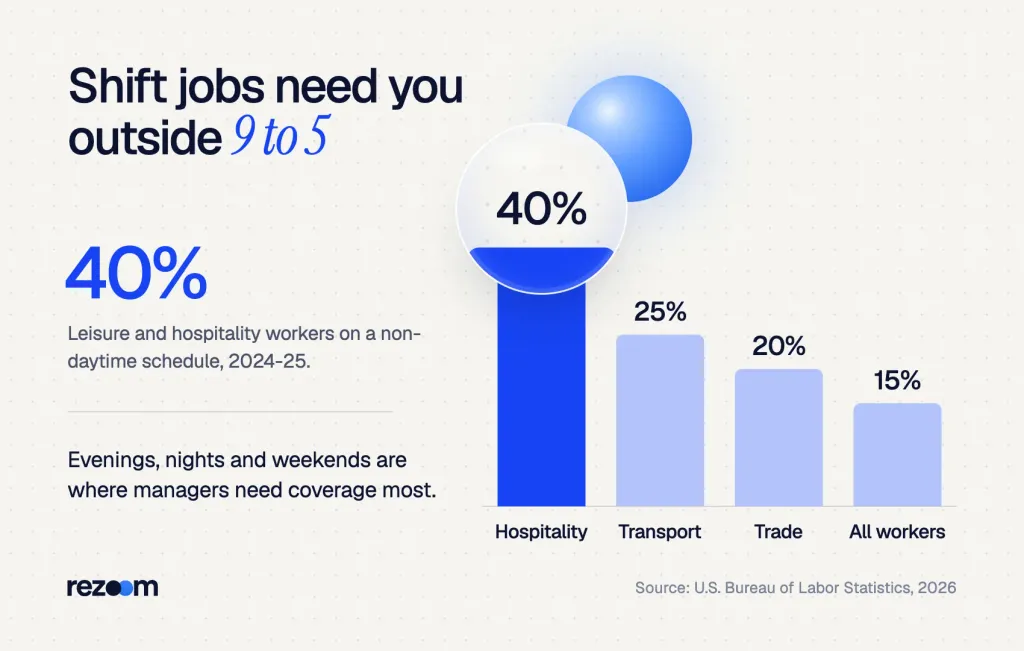
But shift jobs look very different. In that same BLS data, 40% of leisure and hospitality workers worked a non-daytime schedule. The share was 25% in transportation and utilities and 20% in wholesale and retail trade.
What managers read into your answer
- Coverage: can you fill the shifts that are hard to staff, like Friday night or Sunday morning?
- Fit: do your hours match the hours the role needs, or will they have to build around you?
- Reliability: will you keep this schedule after the first month?
That is why the question pairs with others on the same form. A manager who needs you for a 6 a.m. open will also ask if you have reliable transportation at that hour.
How much availability should you give?
Give the most hours you can keep every week for at least a few months. Wider availability, especially evenings and weekends, makes you easier to hire for shift jobs. But never check a box you can't cover. A manager can work around a clear limit, but a missed shift you agreed to costs trust.
A good rule is to start from your real week, not from what you think the manager wants. Then offer every slot that is left.
Full time vs. part time
If the form asks full time or part time, pick the one you want and can do. Full time is often 35 to 40 hours. Part time can be anything below that.
Part time is common, and the reasons are normal.
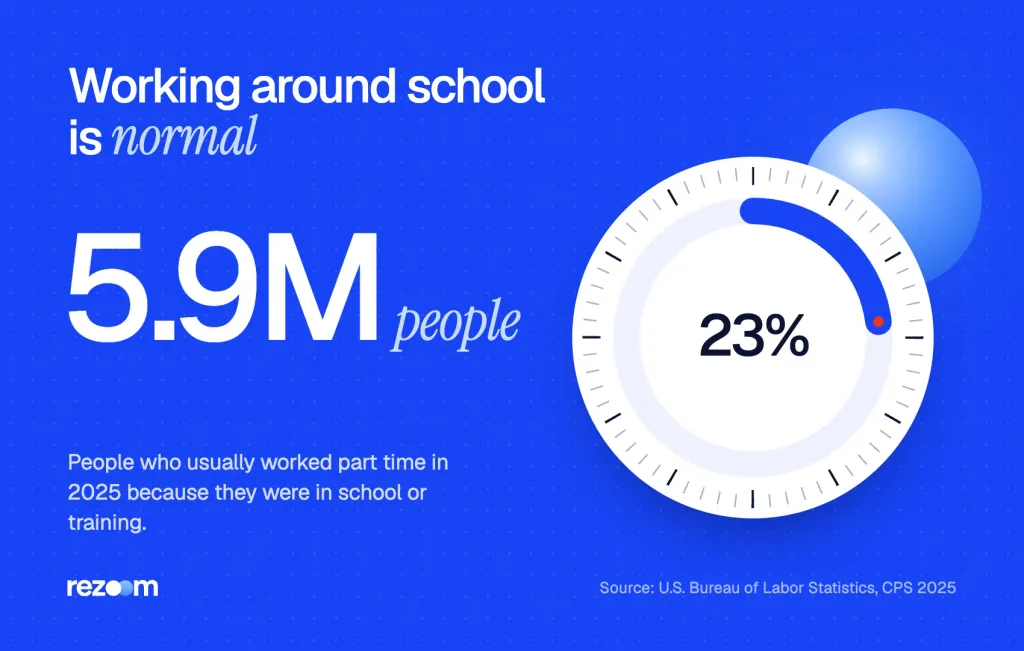
In 2025, about 5.9 million people who usually worked part time did so because they were in school or training, BLS Current Population Survey data2 show. That is about 23% of all usual part-timers who were at work.
Another 1.2 million cited childcare problems, and 4 million cited other family or personal obligations.
How to answer "how many hours per week can you work?"
Give a range, not a single number. "20 to 25 hours" sounds flexible and still sets a limit. If you need a minimum to pay your bills, say it: "I'm looking for at least 30 hours."
If you can work Friday nights, Saturdays or holidays, say so up front. Those are the shifts most managers struggle to fill. A short list with weekend coverage can beat a long list of weekday mornings.
Does limited availability hurt your chances?
Limited availability can cost you some shift jobs, but only when it misses the hours the role needs. A clear, steady limit is easier to schedule than a wide promise that keeps changing. Block only what is fixed, like class or childcare, and offer the weekend and evening hours you can give.
Managers schedule around limits all the time. What they can't plan around is a schedule that changes every week, or a yes that turns into a no.
So be precise. "Not available Mon, Wed, Fri 9:00 to 1:00 (classes)" is easy to plan around. "Limited mornings" is not.
If you're a student
Block class times plus travel time, then offer the rest. Your schedule may change each term, so say when: "This availability runs through May 15."
Campus employers expect this. Towson University's career center6 notes that a supervisor may ask for a copy of your current class schedule, and that interviews may include questions about your availability. Our guide to a resume for a part-time job shows how to list school and work side by side.
If you have a second job
List only the hours that never overlap with your first job, plus travel time. Don't mention the other employer's name unless they ask. If your other schedule changes each week, give the slots that stay the same.
If you have childcare or family limits
Give the hours your care covers and stop there. You don't need to explain why. "Available weekdays 8:30 to 2:30" is a full answer.
"I'm available Monday to Friday from 8:30 a.m. to 2:30 p.m. I can also work one Saturday a month with a week's notice."
Do you have reliable transportation? Learn what counts, how to answer yes with a bus, bike or carpool, and what to say when a job needs your own car.
Free ATS score, the text the software extracts and your missing keywords. No sign-up.
How do you fill in the availability section?
Map your fixed week first, then fill the form with every slot that is left. Use exact times, not words like "flexible." Answer the weekend, night and holiday questions with a plain yes or no plus a limit. Keep a copy, so your answer matches what you say in the interview.
- Map your fixed weekWrite down class, childcare, a second job, travel and anything else that never moves.
- Mark what's leftEvery open block you can cover every week goes on the form.
- Use exact timesWrite "Sat 8 a.m. to 10 p.m.," not "weekends mostly."
- Answer the yes-or-no boxesSay yes to weekends, nights or holidays only if you can work them most weeks.
- Save a copyKeep a photo of what you sent so you can repeat it in the interview.
Sample answers for the availability box
"I'm available [days] from [start time] to [end time], and [days] from [start time] to [end time]. I'm looking for [number] to [number] hours a week, and I can work [weekends / nights / holidays]."
"Open availability. I can work any shift, including doubles, late closes, weekends and holidays."
"Monday to Friday after 3 p.m. and all day Saturday and Sunday. I'm looking for 20 to 25 hours a week through May."
| Form question | Honest yes | Honest limit |
|---|---|---|
| Can you work weekends? | "Yes, both days." | "Saturdays yes, Sundays no." |
| Can you work nights? | "Yes, until close." | "Until 10 p.m. on weeknights." |
| Can you work holidays? | "Yes, all holidays." | "Yes, except Dec. 25." |
| Can you work overtime? | "Yes, with a day's notice." | "Up to 45 hours in a busy week." |
Do
- Give exact days and times you can cover every week.
- Offer weekend and evening slots if you can work them.
- Say when your schedule will change, like a new term.
Don’t
- Check "open availability" to look better and plan to cut back later.
- Write "flexible" with no times attached.
- Overshare about why you can't work a slot.
How do you show your availability on a resume or cover letter?
Your resume can back up your availability with past shift work, weekend coverage and closing duties. Your cover letter can state your hours in one line near the top. For server, retail and hotel jobs, that one line tells the manager you fit the schedule before they reach the form.
You don't need an "Availability" section on a resume. But past shift work proves you can handle the hours. Browse these hospitality resume examples to see how hotel, kitchen and front-of-house staff show nights and weekends.
For restaurant work, these server resume examples show how to list covers per shift, doubles and weekend rushes.
Server resume example
Shows shift work and weekend coverage on a clean one-page resume.
Store jobs work the same way. These retail resume samples show how to mention opening, closing and holiday-season shifts.
Put your hours in the first paragraph
A cover letter is a good place to say your hours in plain words. This server cover letter example shows how to state your shift availability up front.
Server cover letter example
A short letter that states your shift availability up front.
For hotel, bar and catering roles, browse more hospitality cover letter examples to match your tone to the job.
What if the interviewer questions your availability?
If an interviewer pushes on your availability, repeat what you wrote, then offer one thing you can add. Don't cave and promise hours you can't work. Give a clear yes for what you can cover, a clear limit for what you can't, and a date if your schedule will change.
Many interviews ask about it again, often as "What's your availability?" or "Can you work weekends?"
So keep your answer the same as the form. It's smart to practice interview questions out loud so your answer sounds calm, not defensive.
What to say if they push back
- "We need someone with open availability." Offer what you can add: "I can't do weekday mornings, but I can take every Friday, Saturday and Sunday."
- "Can you work more hours later?" Give a date: "My classes end May 15, and then I can work full time."
- "Why can't you work Sundays?" Keep it short: "I have a standing commitment on Sundays. I can cover any other day."
- "Would you take a different shift?" Be honest: "I'd be glad to try evenings. Mornings won't work for me."
Interviewer: "We really need weekday morning coverage."
"I understand. I have class until noon Monday to Friday, so I can't cover mornings this term."
Interviewer: "What can you do?"
"I can work every afternoon from 1 p.m. to close and all day on weekends. In June, I can add mornings too."
Know your scheduling rights
Some cities and states set rules for how employers schedule hourly staff. In Oregon, large retail, hospitality and food service employers must post schedules 14 days ahead, the Oregon Bureau of Labor and Industries3 says. Workers there can also name limits in their availability, including for childcare.
You have the right to provide input into your schedule.
Oregon Bureau of Labor and Industries, Predictive Scheduling
Seattle's Secure Scheduling Ordinance4 also requires 14 days' notice at large retail and food service employers. It gives workers 10 hours of rest between a closing and an opening shift. In New York City, the Fair Workweek law5 gives retail workers at stores with 20 or more employees 72 hours' notice of their schedule.
This is general information, not legal advice. Rules depend on your city, your state and the size of the employer.
Ask when schedules come out and how far ahead. Also ask how many hours a week new hires usually get. The answers tell you if the job fits your life, and they pair well with your desired salary on a job application.
What should you check before you submit?
Before you submit, check that every slot you marked is one you can work every week, your hours per week match your full- or part-time choice, and your weekend and night answers are true. Keep a copy, so your interview answer and your first schedule match your form.
Before you submit your availability
If they also ask when you can begin, our when can you start interview answer guide helps you give a date that fits.
Practice out loud with an AI voice coach.
Frequently asked questions
What should I put for availability on a job application?
Put every day and time you can work each week for the next few months. Use exact times and block out fixed limits like class or childcare.
What does open availability mean?
It means you can work any shift on any day the business is open, including nights, weekends and often holidays. Only claim it if you can keep it.
Does limited availability hurt my chances?
It can for jobs that need the hours you can't cover. But a clear, steady limit is easier to schedule than a wide promise you break later.
How many hours per week should I put?
Give a range you can keep, like 20 to 25 hours. If you need a minimum to pay bills, state it.
Can I change my availability after I'm hired?
Yes, most employers let you update it, often with a few weeks' notice. Big cuts soon after you start can hurt trust, so give your real hours from day one.
Should I put "flexible" for availability?
Not by itself. Write exact days and times, then add "flexible" only if you can truly shift your hours.
What should I put for availability on job application forms?
For availability on job application forms, list the days and hours you can work every week without fail. Give the widest window you can keep, and note fixed limits like classes in one short line.
Sources
We opened and read each page below. The small numbers in the text point here. Pages that carry no publication date show n.d.
- U.S. Bureau of Labor Statistics2026
In 2024-25, 85% of wage and salary workers had a regular daytime schedule, and 40% of leisure and hospitality workers worked a non-daytime schedule.
- U.S. Bureau of Labor Statistics, Current Population Survey2026
In 2025, about 5.9 million people who usually worked part time did so because of school or training, and 1.2 million because of childcare problems.
- Oregon Bureau of Labor and Industriesn.d.
Large Oregon retail, hospitality and food service employers must give a written schedule 14 days in advance, and workers can give input into their schedule.
- Seattle Office of Labor Standards2025
Seattle's Secure Scheduling Ordinance requires 14 days' notice of schedules and 10 hours of rest between a closing and an opening shift.
- NYC Department of Consumer and Worker Protectionn.d.
NYC's Fair Workweek law gives retail workers at stores with 20 or more employees 72 hours' notice of their schedule.
- Towson University Career Centern.d.
Campus supervisors may ask for a copy of a student's class schedule, and interviews may include questions about availability.
Mohammad has spent more than ten years designing consumer products and leads product at Rezoom, deciding what gets built and what gets left out. His guides cover the whole job search, from resume sections and cover letters to interview answers and career moves.
Goodi, M. (2026, November 13). Availability on Job Application: What to Put (Examples). Rezoom. https://rezoom.io/availability-on-job-application/