Emeka Obiora Server, Upscale Casual Charlotte, 28203, United States [email protected] · (704) 555-0796
11 September 2026
Ms. Bernadette Trawick General Manager Latta Hall Charlotte, United States
Application for Server, Latta Hall
Dear Ms. Trawick,
I am applying for the server post at Latta Hall. I come from upscale casual: six years in full service, the last five at Providence Road Chophouse, a 160 seat room running a coursed sequence of service with a two minute table touch, crumbing between courses and a synchronised drop on every plate. Before that I worked quick casual, which is where I learned to hold a ticket time.
The number I would bring with me is wine attach. I sell from a 40 label by-the-glass list against a 220 bin cellar, and my station has held wine attach at 54 percent of covers against a floor average of 41 over two years. That came from tasting every list change with the beverage manager and from putting the pairing question before the order rather than after it. I also own the allergen protocol on my station: repeat back at the table, flag the ticket, take a verbal confirmation from the kitchen, hand deliver the plate myself.
I have read your tasting menu and I understand Latta Hall runs a captain with a front and back server, which is the structure I want to work in next. I would come in as a back server if that is where the room needs me, because the way to learn a coursed tasting menu is from behind it rather than in front of it.
I hold the Introductory Sommelier certification from the Court of Master Sommeliers Americas and a Certified Food Protection Manager qualification, and I can start in two weeks. Thank you for your time.
Sincerely, Emeka Obiora
Summary
A server cover letter names the service model you were trained in, the standard that model runs to, and one number that only makes sense inside it. This guide gives you a full adaptable letter, the openings that work, how the same letter changes across quick casual, upscale casual, fine dining, banquet and in-room dining, and five questions servers ask before sending it.
Server cover letter examples by experience level
In short, a server cover letter is a one page letter that tells the reader which service model trained you, what standard that model ran to, and one number that only makes sense inside it.
In practice, the title "server" hides six different jobs, and a hiring manager reads every letter through the format they run themselves. If you do not name yours, they will assume the one they know, which is a poor starting point for a file with a trial shift attached.
Guide to a server cover letter
Specifically, this guide and the corresponding server cover letter example will cover:
- First, how to structure the letter, paragraph by paragraph
- Then, why the service model belongs in the first sentence
- Finally, how the same letter changes across five formats
- What evidence each format is actually looking for
How to write a server cover letter
| Paragraph | Its job | Length |
|---|---|---|
| Opening | The role, the service model you come from, and the standard | 2 to 3 sentences |
| Evidence | One number that belongs to that format, with a period of time | 4 to 5 sentences |
| Fit | Something specific about their room, and the format you are moving toward | 3 to 4 sentences |
| Close | Certifications, availability, thank you | 2 sentences |
Name the format in the first sentence
"Six years of serving experience" is unreadable. Six years of what, in what kind of room, to what standard?
"Six years in full service, the last four in a 160 seat upscale casual room running a coursed sequence with a synchronised drop" is readable, and tells a reader which parts of their onboarding you will not need.
If you are changing format, say so in the same sentence. A banquet server applying to a restaurant should write it as a move rather than let the reader find it in the dates.
A server cover letter example you can adapt
Dear Ms. Trawick,
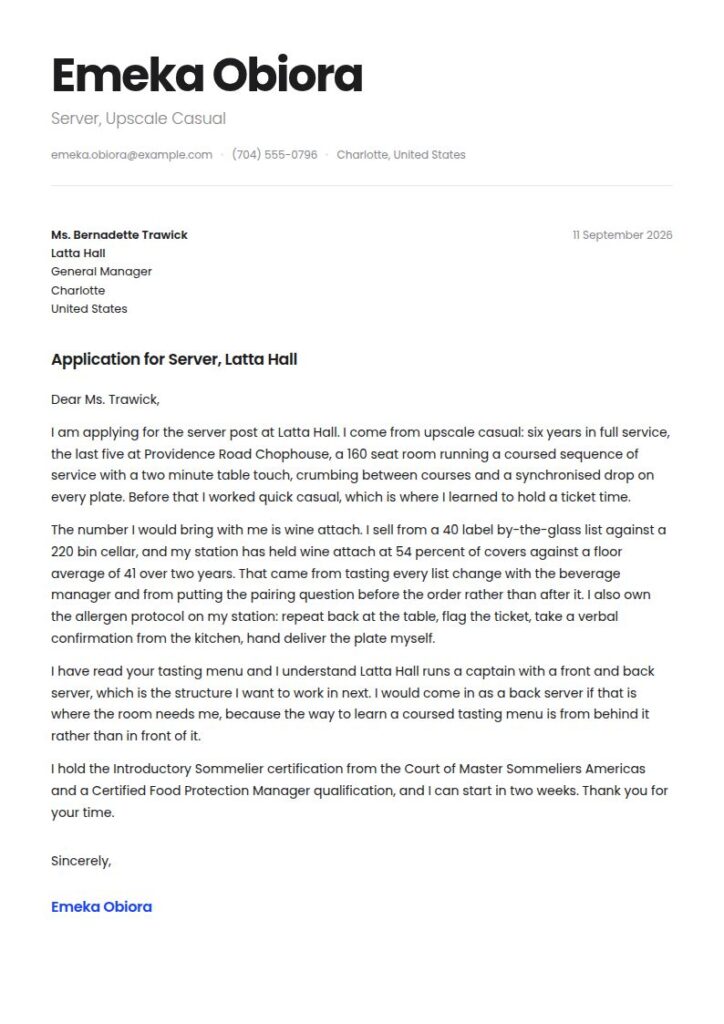
I am applying for the server post at Latta Hall. I come from upscale casual: six years in full service, the last five at Providence Road Chophouse, a 160 seat room running a coursed sequence of service with a two minute table touch, crumbing between courses and a synchronised drop on every plate. Before that I worked quick casual, which is where I learned to hold a ticket time.
The number I would bring with me is wine attach. I sell from a 40 label by-the-glass list against a 220 bin cellar, and my station has held wine attach at 54 percent of covers against a floor average of 41 over two years. That came from tasting every list change with the beverage manager and from putting the pairing question before the order rather than after it. I also own the allergen protocol on my station: repeat back at the table, flag the ticket, take a verbal confirmation from the kitchen, hand deliver the plate myself.
I have read your tasting menu and I understand Latta Hall runs a captain with a front and back server, which is the structure I want to work in next. I would come in as a back server if that is where the room needs me, because the way to learn a coursed tasting menu is from behind it rather than in front of it.
I hold the Introductory Sommelier certification from the Court of Master Sommeliers Americas and a Certified Food Protection Manager qualification, and I can start in two weeks. Thank you for your time.
Sincerely, Emeka Obiora
Openings that work
| Instead of | Use |
|---|---|
| I have several years of experience in the restaurant industry | I come from upscale casual: six years in full service, the last five in a 160 seat coursed room |
| I am passionate about hospitality and fine dining | I would come in as a back server, because a coursed tasting menu is learned from behind it |
| I provide excellent service to every guest | My station has held wine attach at 54 percent of covers against a floor average of 41 |
| I am a quick learner and a hard worker | Before upscale casual I worked quick casual, which is where I learned to hold a ticket time |
The same letter, written for five service models
The structure does not change. The evidence, however, does, and using the wrong evidence is what makes a good server look like a poor fit.
| Applying to | Lead the letter with |
|---|---|
| Quick casual | Ticket times, expo accuracy, the mobile order queue, allergen handling at speed |
| Casual full service | Station size, timing across many tables, sidework discipline, turns in a shift |
| Upscale casual | The sequence of service, wine attach, check average, the allergen protocol |
| Fine dining | Which brigade role you held, coursing, wine and pairing service, guest recall |
| Banquet and in-room dining | Guests per server on plated service, the event order, timings, folio and cash handling |
If you are moving up a format, use your current one as the bridge. Banquet counts and timings are the closest thing in the industry to fine dining coursing, and saying so shows a reader you understand what you are asking for.
Name your format in the first sentence and theirs in the third paragraph. Use one number that only makes sense inside your format. Write the allergen protocol as steps. Name the wine credential and its level. Offer to start a level below if you are changing format, because it reads as seriousness rather than as a lack of confidence.
Do not call an upscale casual room fine dining. Do not lead with years alone. Do not send a fine dining room a letter about ticket times, or a quick casual room a letter about decanting. Do not claim a tasting menu you have only eaten. Do not write more than one page.
Hotels pay the highest published median, and they hold two of the formats
Traveler accommodation employs 6 percent of waiters and waitresses at a median of $17.09 an hour, the highest of the three settings published in the Handbook, against $16.93 in food services and drinking places, which employs 85 percent, and $16.85 in arts, entertainment, and recreation (BLS Occupational Outlook Handbook, Waiters and Waitresses, May 2025 wage data, last modified 27 August 2026).
The occupation had 2,284,400 workers in 2025, is projected to grow 2 percent to 2035, and turns over at about 423,100 openings a year (BLS Occupational Outlook Handbook, 2025-35 projections).
Banquet and in-room dining are hotel formats, and both are hired on a document rather than a floor plan: the event order in one, the delivery window and folio in the other. A letter aimed at a hotel should be built from those nouns, and it is the cheapest way for a restaurant server to widen the shifts they can be offered.
Length, format and sending it
One page, four paragraphs, 250 to 400 words. PDF unless the form says otherwise, named for yourself and the role: emeka-obiora-server-cover-letter.pdf.
Address a person. Also, restaurant and hotel management teams list themselves on their own sites, and in fine dining the general manager's name is usually there.
Read their menu first. One accurate sentence about their format, their tasting menu or their by-the-glass list does more than a paragraph of admiration, and you cannot reuse it in the next letter.
Keep the letter and the resume on the same numbers. Our server resume example uses the figures here, and the free ATS checker will read the file back before you send it.
Key takeaways
- First, name your service model in the first sentence, and theirs in the third paragraph.
- Use one number that only makes sense inside your format.
- Write the allergen protocol as steps rather than as a claim.
- Then give the wine credential its exact level and awarding body.
- If you are changing format, say so, and offer to come in a level below.
- Next, use banquet counts and timings as the bridge into a coursed room.
- In short, one page, four paragraphs, to a named person.
Write your server cover letter in 10 minutes with our AI cover letter builder.
Server cover letter questions, answered
How long should a server cover letter be?
One page, four paragraphs, 250 to 400 words. Managers read these between services, and length is not read as effort in this industry.
Do I need a cover letter for a server job?
Attach one wherever there is a field for it. Server applications are otherwise identical, and the letter is the only place you name the service model you come from and the standard you were trained to. It matters most in fine dining, where rooms hire slowly and read carefully.
How do I write a server cover letter with no experience?
Apply to quick casual or casual full service, and be specific about the capacity you do have from any job with a queue, a till or a timing target. Then remove obstacles for the reader: your availability, whether you can work the shifts they are short of, and whatever alcohol training applies where you are. In North Carolina, for example, the requirement sits on the business rather than the individual, and the ABC Commission offers free Responsible Alcohol Seller/Server classes (North Carolina ABC Commission).
Should I mention certifications in the letter?
Name two at most, in the closing paragraph, with the awarding body. A wine credential and a food protection certification carry the most weight. The Court of Master Sommeliers Americas runs four levels, beginning with the Introductory Sommelier Course and Examination (Court of Master Sommeliers Americas, certification levels), and food protection manager programs are accredited against Conference for Food Protection standards by the ANSI National Accreditation Board.
How do I ask for a trial shift or a stage?
Ask plainly in the closing sentence and give your availability. In upscale casual and fine dining a trial is expected anyway, so offering first saves a round of email and shows you know how the format hires.