Terrence Baptiste Line Cook, Saute and Grill New Orleans, 70117, United States [email protected] · (504) 555-0760
11 September 2026
Chef Elise Moreau Kitchen Verdine New Orleans, United States
Application for Line Cook, Verdine
Dear Chef Moreau,
I am applying for the line cook post at Verdine. I currently work saute and grill at Crescent House, a 180-seat Creole restaurant doing 320 covers on a Saturday and around 1,400 a week, with six of us on the line and no separate prep team.
My section is 14 tables. I hold a six minute average ticket time on saute with a 2% refire rate over the last two quarters, measured on our kitchen display system. I own the protein prep list, which is roughly 140 pounds of seafood and 90 pounds of beef a week portioned to written spec with a yield log per case, and I cover grill and the pass when the sous chef is off. Before this I spent two years on pantry and fry and two cooking a hospital hot line at about 900 meals a day, which is where I learned to hold a service window.
I have eaten at Verdine twice and the thing I would most want to work is the wood grill, which is the one station I have not run as a primary. I can work nights, weekends and holidays, and I am available on four weeks' notice or sooner if that suits your schedule.
I hold ServSafe Food Handler certification through 2027 and an ACF Certified Cook designation. I would be glad to stage a service whenever it is useful. Thank you for your time.
Sincerely, Terrence Baptiste
Summary
A cook cover letter names the station you work, the covers you handle in a service and the ticket times you hold, then offers a stage. This guide gives you a full adaptable letter, the openings that work, a table for translating a cafeteria, catering or fast food job into line language, and what to say about your availability and your notice period.
Cook cover letter examples by experience level
A cook cover letter is a short letter telling a chef which station you work, how many covers you push through it, and when you can start.
It gets read fast, often on a phone between services, so it is a different document to a corporate cover letter: shorter, flatter, built around things that can be checked on a trial shift. Four tight paragraphs beat a page of prose, and offering to stage beats any closing sentence you could write.
Guide to a cook cover letter
This guide and the corresponding cook cover letter example will cover:
- How to structure the letter, paragraph by paragraph
- Why the station and the covers belong in the first sentence
- How to translate a cafeteria, catering or fast food job into line language
- What to say about your availability, and why it matters more than you think
- How to offer a stage without offering to work for free
How to write a cook cover letter
| Paragraph | Its job | Length |
|---|---|---|
| Opening | The post, your station, the covers you run | 2 sentences |
| Evidence | Ticket time, prep you own, stations you cover | 3 to 4 sentences |
| Fit | One real thing about their kitchen, and your availability | 2 to 3 sentences |
| Close | Food safety certification and an offer to stage | 2 sentences |
The first sentence is a station and a number
A chef opening a cook application wants two facts immediately: what can you work, and how busy have you been.
"I work saute across a 14 table section at 320 covers on a Saturday" delivers both in one line, and it tells the chef whether their kitchen is a step up, sideways or down for you, which decides whether you are still there in six months.
Everything that usually opens a cook letter, the passion for food, the fast-paced environment, the strong work ethic, delays those two facts and adds nothing.
A cook cover letter example you can adapt
Dear Chef Moreau,
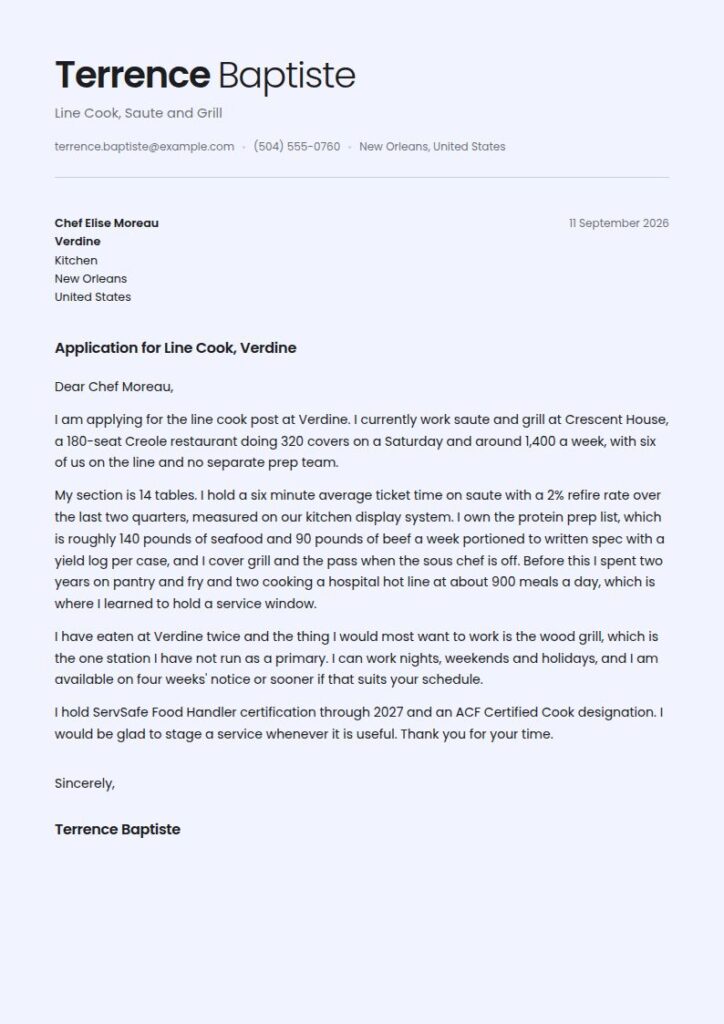
I am applying for the line cook post at Verdine. I currently work saute and grill at Crescent House, a 180-seat Creole restaurant doing 320 covers on a Saturday and around 1,400 a week, with six of us on the line and no separate prep team.
My section is 14 tables. I hold a six minute average ticket time on saute with a 2% refire rate over the last two quarters, measured on our kitchen display system. I own the protein prep list, which is roughly 140 pounds of seafood and 90 pounds of beef a week portioned to written spec with a yield log per case, and I cover grill and the pass when the sous chef is off. Before this I spent two years on pantry and fry and two cooking a hospital hot line at about 900 meals a day, which is where I learned to hold a service window.
I have eaten at Verdine twice and the thing I would most want to work is the wood grill, which is the one station I have not run as a primary. I can work nights, weekends and holidays, and I am available on four weeks' notice or sooner if that suits your schedule.
I hold ServSafe Food Handler certification through 2027 and an ACF Certified Cook designation. I would be glad to stage a service whenever it is useful. Thank you for your time.
Sincerely, Terrence Baptiste
Openings that work
| Instead of | Use |
|---|---|
| I am passionate about food and thrive in a fast-paced kitchen | I work saute across a 14 table section at 320 covers on a Saturday |
| I am writing to apply for the line cook position advertised online | I am applying for the line cook post at Verdine |
| I have strong attention to detail and a great work ethic | Six minute average ticket time on saute with a 2% refire rate over two quarters |
| I am a quick learner and a team player | I own the protein prep list and cover the pass when the sous chef is off |
Translating a cafeteria, catering or fast food job
Most cooks reach a restaurant line from somewhere that never says covers, tickets or stations. The work transfers; the vocabulary does not, and a chef will not translate it for you.
| Where you worked | What to write in the letter |
|---|---|
| Hospital or aged care | Meals per day, tray line window in minutes, modified and allergen diets plated |
| School or university dining | Meals per service, meal periods covered, batch sizes, participation numbers |
| Fast food | Meals or transactions per hour at peak, positions worked, opening or closing duty |
| Catering and events | Guest counts per event, events per week, plated versus buffet, off-site service |
| Grocery or production kitchen | Units per shift, yield per case, hold and cool times, spec adherence |
Every row has the same shape: a volume number, a time constraint, something you owned. That is what a station and a ticket time are, in your own kitchen's language.
Availability is part of the pitch
Say which shifts you can work, plainly, in the third paragraph. Nights, weekends and holidays are the shifts chefs struggle to fill, and a cook who offers them is worth reading twice. Name a start date or a notice period. Offer to stage a service. Name one real thing about their kitchen, from their menu or from eating there. Give a three-word reason for any short stint before the chef has to wonder about it.
Do not write a letter longer than the resume it is attached to. Do not list dishes you can cook. Do not claim every station; name what you have actually worked. Do not leave your availability out and hope it comes up later, because a chef filling a Friday will move to the next file. Do not say you will work for free, and do check what your state requires around paying for trial shifts.
Which kind of cook you are decides the pay
The Bureau of Labor Statistics publishes six cook types with six different medians. As of May 2025: private household $23.05 an hour, all other cooks $18.12, institution and cafeteria $18.01, restaurant $17.98, short order $17.25 and fast food $14.85 (BLS Occupational Outlook Handbook, Cooks, last modified 27 August 2026).
Sector layers on top of that. Cooks in traveler accommodation earn a median of $21.35 an hour against $17.48 in food services and drinking places (BLS, May 2025).
The occupation is wide open: 2,705,800 jobs in 2025, 7 percent projected growth to 2035 and about 393,200 openings a year, almost all replacements (BLS Occupational Outlook Handbook, 2025-35 projections). There is no shortage of doors. The letter's job is to make you credible for the better-paid ones, and volume, stations and speed are the evidence that does it.
Length, format and sending it
Four short paragraphs, 180 to 300 words. Shorter than a normal cover letter, because the reader is a chef and not a recruiter.
Send it however the kitchen asks. If the posting gives an email, send a PDF named for you and the post: terrence-baptiste-line-cook-cover-letter.pdf. If it says drop in, print it and bring it in the afternoon between services, never during one.
Address the chef by name where you can find it. "Dear Chef" is acceptable in this industry in a way that "Dear Hiring Manager" is not, but a name is still better.
Use the same figures as your resume so the two agree. Our cook resume example is written with the numbers used here.
Key takeaways
- Open with the station and the covers, in one sentence.
- Give a ticket time or a refire rate, and say how it was measured.
- Name the prep you own, by weight or by item.
- Translate cafeteria, catering or fast food work into volume, time and ownership.
- State your availability, because the hard shifts are the ones being filled.
- Offer to stage a service and give a start date.
- Keep it to four short paragraphs and address the chef by name.
Write your cook cover letter in 10 minutes with our AI cover letter builder.
Cook cover letter questions, answered
How long should a cook cover letter be?
Four short paragraphs, 180 to 300 words. Chefs read these between services, and a long letter reads as someone who has not worked a line.
Do I even need a cover letter to apply for a cook job?
Not always; plenty of cooks get hired on a resume and a stage. Send one anyway where there is a field for it, because it is the only place you can put availability, notice period and an offer to stage, and those three often decide between two similar files.
How do I write one with no professional kitchen experience?
Lead with whatever volume you have produced under a deadline: a school cafeteria, a catering shift, a quick service kitchen, a military mess. Give meals per service, the window you held and what you opened or closed. Then your food handler certification, your availability and an offer to stage. It is an occupation with about 393,200 openings a year (BLS Occupational Outlook Handbook, 2025-35 projections), and chefs hire people who show up and can be trained.
Should I offer to stage in the letter?
Yes, in the last line. It is the industry's normal next step and offering first reads as confidence, not desperation. Phrase it as an offer of your time rather than an offer to work unpaid, and check your state's rules on trial shifts first.
What do I say about leaving a job after two months?
Give the reason in three words and move on. "Restaurant closed", "seasonal contract", "relocated" and "kitchen changed hands" are all normal in this trade. Silence reads worse, because the chef fills the gap with a worse explanation than the real one.