Line Cook, Pantry and Fry Terrence Baptiste
Line Cook, Pantry and Fry
[email protected] | (504) 555-0760 | New Orleans, United States
Profile
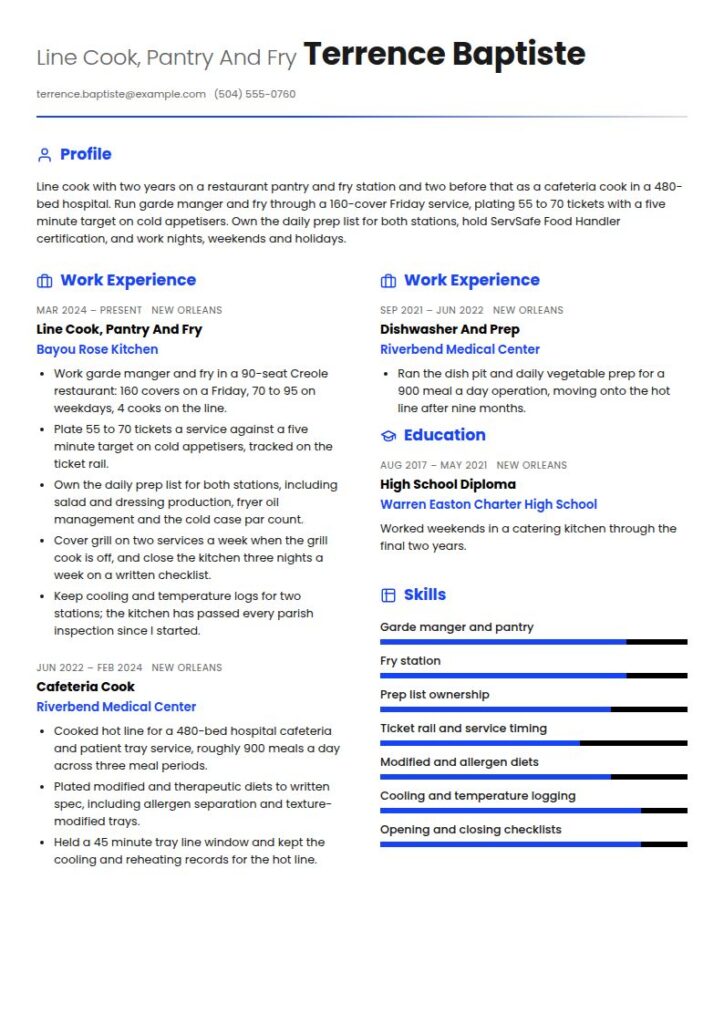
Line cook with two years on a restaurant pantry and fry station and two before that as a cafeteria cook in a 480-bed hospital. Run garde manger and fry through a 160-cover Friday service, plating 55 to 70 tickets with a five minute target on cold appetisers. Own the daily prep list for both stations, hold ServSafe Food Handler certification, and work nights, weekends and holidays.
Work Experience
03/2024 - Present, Line Cook, Pantry and Fry, Bayou Rose Kitchen, New Orleans, United States
- Work garde manger and fry in a 90-seat Creole restaurant: 160 covers on a Friday, 70 to 95 on weekdays, 4 cooks on the line.
- Plate 55 to 70 tickets a service against a five minute target on cold appetisers, tracked on the ticket rail.
- Own the daily prep list for both stations, including salad and dressing production, fryer oil management and the cold case par count.
- Cover grill on two services a week when the grill cook is off, and close the kitchen three nights a week on a written checklist.
- Keep cooling and temperature logs for two stations; the kitchen has passed every parish inspection since I started.
06/2022 - 02/2024, Cafeteria Cook, Riverbend Medical Center, New Orleans, United States
- Cooked hot line for a 480-bed hospital cafeteria and patient tray service, roughly 900 meals a day across three meal periods.
- Plated modified and therapeutic diets to written spec, including allergen separation and texture-modified trays.
- Held a 45 minute tray line window and kept the cooling and reheating records for the hot line.
09/2021 - 06/2022, Dishwasher and Prep, Riverbend Medical Center, New Orleans, United States
- Ran the dish pit and daily vegetable prep for a 900 meal a day operation, moving onto the hot line after nine months.
Education
08/2017 - 05/2021, High School Diploma, General studies, Warren Easton Charter High School, New Orleans, United States
Worked weekends in a catering kitchen through the final two years.
Skills
Garde manger and pantry, 80
Fry station, 80
Prep list ownership, 75
Ticket rail and service timing, 65
Modified and allergen diets, 75
Cooling and temperature logging, 85
Opening and closing checklists, 85
Languages
English, native
French, intermediate
Certificates
01/2025, ServSafe Food Handler, National Restaurant Association
Valid to 2027.
04/2025, Allergen Awareness Training, Employer provided
Summary
A cook resume is a one page document naming the stations you can work, the covers you handle in a service and the ticket times you hold. This guide gives you three adaptable versions, the station and volume detail most applicants leave out, a way to translate cafeteria or fast food work into line language, and current Bureau of Labor Statistics pay and outlook for each of the six published cook types.
Cook resume examples by experience level
A cook resume is a one page document that answers three questions: which stations can you work, how many covers can you push through them, and how fast do your tickets go out.
Everything else is secondary. A chef reading applications is filling a specific hole on a specific board: saute is leaving, fry cannot keep up on Fridays, or nobody can run garde manger on a Sunday brunch. Cooking is one of the largest occupations in the country, with 2,705,800 jobs in 2025 (BLS Occupational Outlook Handbook, Cooks, last modified 27 August 2026), so the file that names a station and a covers number gets read and the one that says "responsible for food preparation" does not.
Resume guide for a cook resume
This guide and the corresponding cook resume example will cover:
- How to write a cook resume, section by section
- Why the station, the covers and the ticket time are the whole screen
- Three adaptable summaries: new cook, line cook and lead cook
- Which of the six cook types you have worked, and why it decides your pay
- What the job market looks like and what you can expect to earn
How to write a cook resume
Five sections: contact header, summary, stations and volume, kitchen experience, certifications. One page. A two-page cook resume is a cook resume with padding in it.
The stations block goes above experience because it is the screen. A chef decides in three seconds whether a file is worth reading properly, and that block is what makes the three seconds work.
| Section | What it is answering | Where it goes |
|---|---|---|
| Summary | What can this person work, and at what volume? | Top, three or four lines |
| Stations and volume | Which hole on my board does this close? | Directly under the summary |
| Kitchen experience | What kind of house, how busy, how long? | Reverse chronological, with numbers |
| Certifications | Is the food safety paperwork current? | Bottom, with dates |
Write the house, not just the job title
"Line cook" describes a hundred different jobs. A line cook at a 40-seat place doing 60 covers and a line cook at a 180-seat restaurant doing 320 on a Saturday are not doing the same work, and the title does not say which you are.
Put the house next to the role: seats, style, covers on a weekday and on a Saturday, how many cooks on the line, and whether you prep your own station.
"Line Cook, saute and grill, Crescent House, 180 seats, Creole, 320 covers Saturday, 6 on the line, no separate prep team" is one line and it tells a chef everything they need to decide whether to call you.
Run your file through the ATS resume checker before you send it. Restaurant groups, hospital systems and school districts all screen cook applications through software before a chef opens one.
Choosing the best resume format for a cook resume
Reverse chronological, one page, no exceptions worth taking.
Cook careers have short stints in them: seasonal closures, a restaurant that folded, a move, a kitchen that changed hands. A functional format hides that and makes a chef assume the worst. Keep the dates and the order, and put a three-word reason next to anything under six months: "seasonal", "restaurant closed", "relocated".
Include your contact information
| ✅ Right | ❌ Wrong |
|---|---|
| Terrence Baptiste | Terrence Baptiste |
| Line Cook, saute and grill, 320 covers | Hardworking team player |
| ServSafe Food Handler, valid to 2027 | Food safety trained |
| (504) 555-0760, [email protected], New Orleans, LA | (504) 555-0760, [email protected] |
Put your availability in the header if it is good news. "Available nights, weekends and holidays" is worth more to a chef than a line of adjectives, because those are the shifts that are hard to fill.
Make use of a summary
Three or four lines: the stations you work, the covers you handle, one speed or quality number, and what you own beyond your own station.
Line cook with two years on a restaurant pantry and fry station and two before that as a cafeteria cook in a 480-bed hospital. Run garde manger and fry through a 160-cover Friday service, plating 55 to 70 tickets with a five minute target on cold appetisers. Own the daily prep list for both stations, hold ServSafe Food Handler certification, and work nights, weekends and holidays.
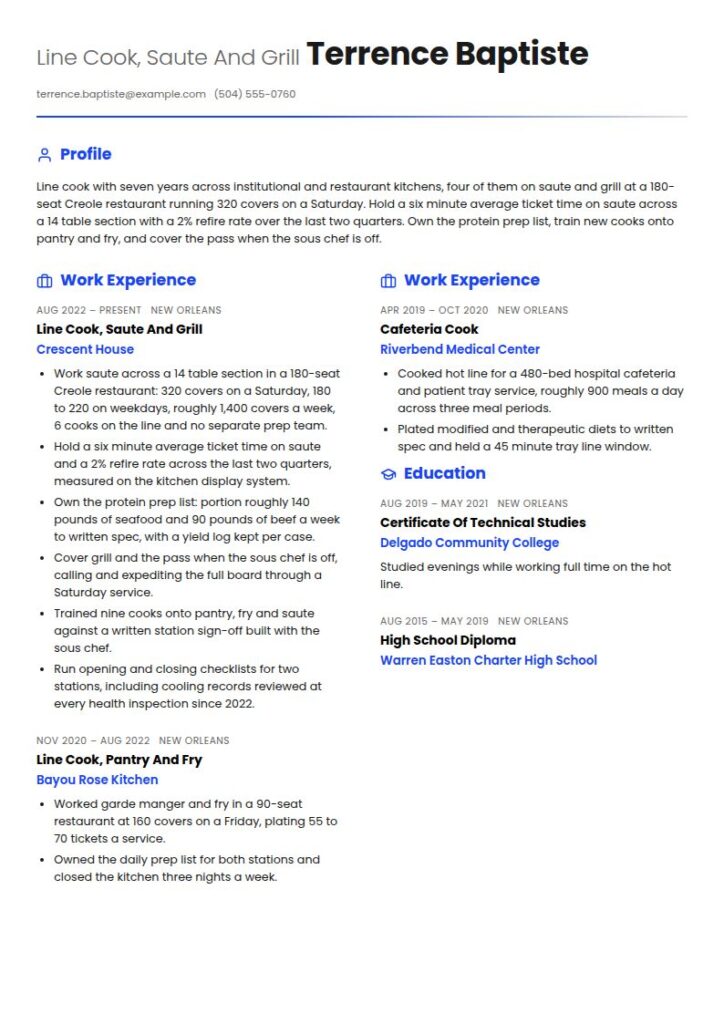
Line cook with seven years across institutional and restaurant kitchens, four of them on saute and grill at a 180-seat Creole restaurant running 320 covers on a Saturday. Hold a six minute average ticket time on saute across a 14 table section with a 2% refire rate over the last two quarters. Own the protein prep list, train new cooks onto pantry and fry, and cover the pass when the sous chef is off.
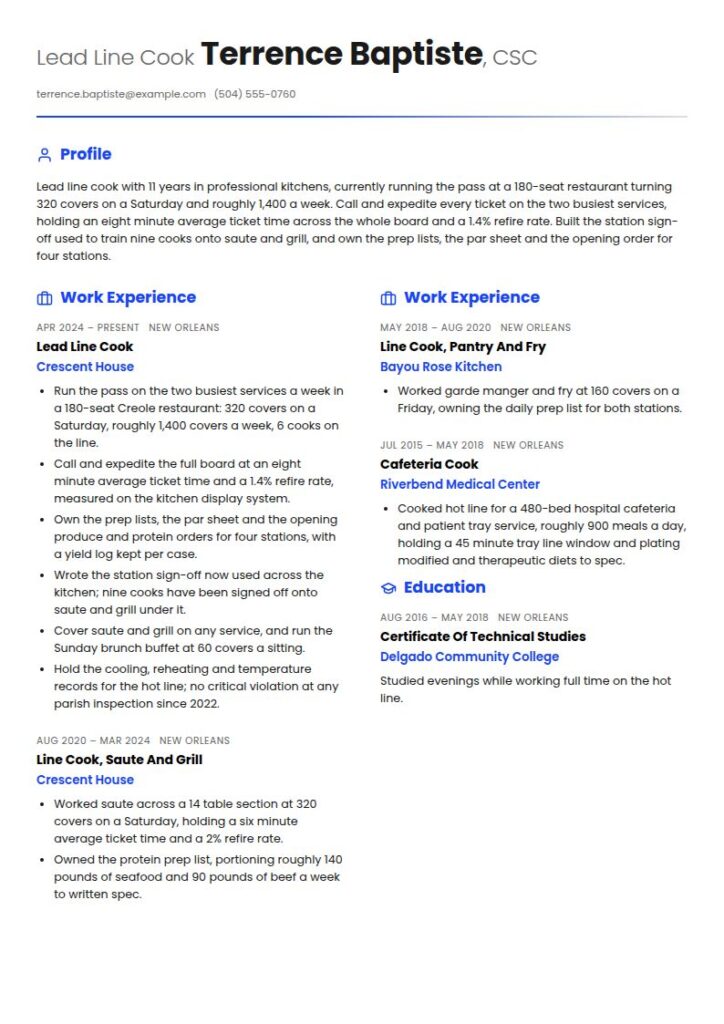
Lead line cook with 11 years in professional kitchens, currently running the pass at a 180-seat restaurant turning 320 covers on a Saturday and roughly 1,400 a week. Call and expedite every ticket on the two busiest services, holding an eight minute average ticket time across the whole board and a 1.4% refire rate. Built the station sign-off used to train nine cooks onto saute and grill, and own the prep lists, the par sheet and the opening order for four stations.
Right vs wrong: the same cook summary, twice
| ✅ Right | ❌ Wrong |
|---|---|
| Four years on saute and grill at a 180-seat Creole restaurant running 320 covers on a Saturday. | Experienced cook with a strong work ethic and attention to detail. |
| Six minute average ticket time on saute across a 14 table section, 2% refire rate. | Skilled in preparing a wide variety of dishes to a high standard. |
| Own the protein prep list and cover the pass when the sous chef is off. | Works well under pressure in a fast-paced kitchen environment. |
Every phrase in the wrong column appears on most cook resumes a chef reads this month, which makes it worth nothing. The right column is checkable, and a chef who wants to check it calls.
Outline your kitchen experience
House, city, style, seats, covers, stations worked, dates. Then three or four bullets, each with a number in it.
| Instead of | Use |
|---|---|
| Prepared food according to recipes | Worked saute across a 14 table section, 55 to 70 tickets a service on a six minute average |
| Worked in a fast-paced kitchen | Held station through 320 covers on a Saturday with 6 cooks on the line and no separate prep team |
| Maintained a clean and safe work area | Ran opening and closing checklists for two stations including temperature logs and cooling records |
| Assisted with food preparation | Owned the protein prep list: portioned 140 pounds of seafood and 90 pounds of beef a week to spec |
| Trained new staff | Trained 9 cooks onto pantry, fry and saute using a written station sign-off |
| Helped with inventory | Counted the walk-in twice a week against a par sheet and placed the Tuesday produce order |
Line Cook, Saute and Grill, Crescent House, New Orleans, LA, August 2022 to Present. Creole, 180 seats, 320 covers Saturday, roughly 1,400 covers a week, 6 cooks on the line.
Work saute across a 14 table section, 55 to 70 tickets a service, six minute average ticket time and a 2% refire rate over the last two quarters.
Own the protein prep list: portion roughly 140 pounds of seafood and 90 pounds of beef a week to written spec, with a yield log kept per case.
Cover grill and the pass when the sous chef is off, calling and expediting the full board through a Saturday service.
Trained nine cooks onto pantry, fry and saute against a written station sign-off that I wrote with the sous chef.
Run opening and closing checklists for two stations, including cooling records and temperature logs reviewed at every health inspection since 2022.
Name your station, your covers per service and your ticket times
This is the section a chef actually reads, and almost nobody writes it as its own block.
A kitchen is a set of stations and a chef hires to fill one. "Works all stations" is weaker than naming four, because the first is a claim and the second is a history. Give the stations, the volume you hold them at, and one speed number.
Stations worked: Saute (primary, 4 years), Grill (2 years), Fry (2 years), Garde manger and pantry (3 years), Expo and pass (relief, 2 years)
Volume: 320 covers Saturday, 180 to 220 weekdays, roughly 1,400 covers a week. 55 to 70 tickets a service on saute across a 14 table section. 6 cooks on the line, no separate prep team.
Speed and quality: Six minute average ticket time on saute. 2% refire rate across the last two quarters. Eight minute average across the whole board on services where I run the pass.
Prep owned: Protein prep list, roughly 140 pounds of seafood and 90 pounds of beef a week to written spec, with a yield log per case. Tuesday and Friday produce orders against a par sheet.
Menu and service: 34 item menu plus 2 daily specials, four service styles including a 60 cover Sunday brunch buffet.
Five lines, and three of them do the real work.
The station list with years attached is a history, not a claim. A chef reading "Saute, primary, 4 years" knows what they are getting; "proficient in all stations" tells them nothing.
The covers number is the size of house you are used to. Going from 80 covers to 320 is a real jump and no chef risks it on a Friday without evidence. Give the weekday figure too, because the weekday to weekend gap is what a chef staffs against.
The speed number separates files. Ticket time is watched in almost every kitchen, through the rail, the kitchen display system or a written log, and almost no cook puts it on a resume. If yours does not track it, count for a week and label it as your own count.
If you have worked outside restaurants, translate. A hospital or school kitchen has meals served, tray line positions, modified diets and a service window rather than covers and tickets. Write meals per service, the number of modified diets you plated and the window you held.
Which kind of cook you are is worth more than what you cook
The Bureau of Labor Statistics publishes six separate cook types with six separate medians. As of May 2025 they were: private household cooks $23.05 an hour, all other cooks $18.12, institution and cafeteria cooks $18.01, restaurant cooks $17.98, short order cooks $17.25 and fast food cooks $14.85 (BLS Occupational Outlook Handbook, Cooks, last modified 27 August 2026).
The distance between the top and the bottom is $8.20 an hour, which is roughly a 55 percent difference for a job that carries the same one word title on a resume. No amount of technique closes that gap, and nothing else on your resume moves your pay as much as which of those six categories you are working in.
It changes how you write, too. Fast food cooks are 640,500 of the 2,705,800 cooks in the country, and restaurant cooks are 1,417,500 (BLS, 2025). Moving between categories means carrying the evidence across: a fast food cook applying to a restaurant line needs volume, speed and station language on the page, or the chef will assume none of it transfers.
Build a snapshot of your key skills
Ten to fourteen entries in three groups: stations and technique, service, food safety. Keep it factual; a chef can tell a skill from a wish.
Stations and technique: Saute, Grill and broiler, Fry, Garde manger and pantry, Expo and pass, Butchery and portioning, Sauce and stock production, Seafood handling
Service and volume: Ticket time management, Kitchen display and ticket rail systems, Prep list and par sheet ownership, Yield logging, Mise en place for high volume service, Multi-station coverage
Food safety: ServSafe Food Handler, Cooling and reheating records, Temperature logging, Allergen handling and cross contact control, Opening and closing checklists, FIFO stock rotation
List your education and certifications
For a cook, certifications matter and degrees mostly do not. Cooks typically learn their skills through on-the-job training and work-related experience, with no formal education typically required, although some attend culinary schools (BLS Occupational Outlook Handbook, Cooks, last modified 27 August 2026).
So put food safety first. Most states require a food handler certification, and the person-in-charge rules behind them trace back to the FDA Food Code, whose current full edition is 2022. ServSafe, administered by the National Restaurant Association, is the one most operators recognize by name.
If you want a credential ladder, the American Culinary Federation savory track runs Certified Foundational Cook (CFC), Certified Cook (CC), Certified Sous Chef (CSC), Certified Chef de Cuisine (CCC), Certified Executive Chef (CEC) and Certified Master Chef (CMC), with a parallel pastry track (American Culinary Federation, accessed September 2026). A Certified Cook designation is an unusual and useful line on a cook resume.
ServSafe Food Handler, National Restaurant Association, 2025, valid to 2027
ACF Certified Cook (CC), American Culinary Federation, 2024
Allergen awareness training, employer provided, 2025
Certificate of Technical Studies, Culinary Arts, Delgado Community College, New Orleans, LA, 2021
High School Diploma, 2018
Choose the right layout and design
Single column, 11 or 12 point type, plain headings, no photograph, no graphics. A cook resume should be readable on a phone in a walk-in, because that is often where it is read.
Name your stations with the years you worked each one. Give covers for a weekday and a weekend, because the gap is what a chef staffs against. Put a ticket time or a refire rate on the page. Say what prep you own, by weight or by item. Put your availability in the header if you can work nights, weekends and holidays. Give a three-word reason next to any stint under six months. Keep it to one page.
Do not write "responsible for" or "assisted with" anywhere. Do not claim you can work every station; name the four you have actually held. Do not list dishes as if they were skills. Do not leave out the hospital, school or fast food job, because volume is volume and a chef knows it. Do not use a template with icons or a skills bar chart. Do not send two pages.
Cook job market and outlook
One of the largest occupations in the country, growing fast, with turnover so high that openings run to many times the growth itself.
| Measure | Value |
|---|---|
| Cook jobs, 2025 | 2,705,800 |
| Projected change, 2025-35 | 7% (much faster than average), +183,200 |
| Projected annual openings | About 393,200 |
| Typical entry-level education | No formal educational credential typically required |
| Median hourly wage, May 2025 | $17.62 |
| Median annual wage, May 2025 | $36,640 |
Source: U.S. Bureau of Labor Statistics, Occupational Outlook Handbook, Cooks, 2025-35 projections and May 2025 wage data, last modified 27 August 2026.
Roughly 393,200 openings a year against growth of 183,200 across the whole decade means almost all of those openings are replacements. That is the market you are applying into: chefs hire constantly and under pressure, and a file that is easy to act on wins on speed as much as on quality.
The wider industry is expanding too. The National Restaurant Association's 2026 State of the Restaurant Industry report, released 12 February 2026, projects restaurant and foodservice sales of $1.55 trillion and employment of 15.8 million jobs in 2026, with operators adding more than 100,000 jobs against real sales growth of 1.3 percent.
Where cooks actually work, by median hourly wage:
| Industry | Median hourly wage (May 2025) |
|---|---|
| Traveler accommodation | $21.35 |
| Amusement, gambling and recreation | $18.56 |
| Healthcare and social assistance | $18.35 |
| Food services and drinking places | $17.48 |
| Educational services | $17.22 |
Source: U.S. Bureau of Labor Statistics, Occupational Outlook Handbook, Cooks, May 2025.
What salary you can expect as a cook
The median hourly wage for cooks was $17.62 as of May 2025, which works out at $36,640 a year (BLS Occupational Outlook Handbook, Cooks, last modified 27 August 2026).
That median hides more than it shows, because it averages six different jobs. The published May 2025 medians by type were:
| Cook type | Median hourly wage (May 2025) | Employment, 2025 |
|---|---|---|
| Private household | $23.05 | 35,400 |
| All other cooks | $18.12 | 19,700 |
| Institution and cafeteria | $18.01 | 454,000 |
| Restaurant | $17.98 | 1,417,500 |
| Short order | $17.25 | 138,700 |
| Fast food | $14.85 | 640,500 |
Source: U.S. Bureau of Labor Statistics, Occupational Outlook Handbook, Cooks, May 2025.
Read the two columns together. The best paid category employs 35,400 people, the worst paid employs 640,500, and $8.20 an hour separates them. Restaurant cooks, the largest group at 1,417,500, sit almost exactly level with institution and cafeteria cooks, which surprises most people who assume restaurant work pays better than a hospital or a school.
Sector moves pay on top of type. Traveler accommodation pays cooks a median of $21.35 an hour against $17.48 in food services and drinking places (BLS, May 2025), nearly $4 an hour, and hotel kitchens tend to offer steadier schedules than independent restaurants.
The two moves available to a cook are category and sector, and both are settled before you negotiate anything. The resume's job is to make you credible for the move: volume, stations and speed are the evidence that your experience transfers from a cafeteria line to a restaurant line, or from a restaurant line to a hotel kitchen.
Key takeaways for a cook resume
- Name your stations with the years attached; a list with years is a history, not a claim.
- Give covers for a weekday and a weekend, plus the number of cooks on the line.
- Put a ticket time or a refire rate on the page, because almost no other applicant will.
- Say what prep you own, by weight or by item, and what you order.
- Translate institutional work into meals served, modified diets and service windows.
- Know which of the six BLS cook types you have worked, because it decides your pay more than technique does.
- Keep it to one page, single column, with your availability in the header.
Build your cook resume in 15 minutes with our AI resume builder.
Related hospitality and catering resume examples
- Line cook resume
- Chef resume
- Sous chef resume
- Dishwasher resume
- Fast food worker resume
- Food service worker resume
- Busser resume
- Server resume
- Waiter resume
- Barista resume
- McDonalds resume
- Chick-fil-A resume
Pair it with a matching cook cover letter.
Cook resume questions, answered
How long should a cook resume be?
One page. A chef reads cook applications in a stack between services, and the files that get called are the ones where the station and the covers are visible without scrolling. With eleven years behind you, cut the oldest jobs to one line each rather than run to a second page.
What do I put on a cook resume with no restaurant experience?
Volume and reliability, from wherever you have them. A school cafeteria, a hospital tray line, a catering shift, a fast food kitchen or a military mess all involve producing food to a deadline at a volume you can count. Write meals served, the service window you held, the positions you covered and your food handler certification, then say what shifts you can work.
Should I put the fast food job on my resume?
Yes. Fast food cooks are 640,500 of the 2,705,800 cooks in the country (BLS, 2025), and a chef knows a busy quick service kitchen teaches speed, consistency and holding a station under pressure. Write it as volume: meals per hour, the positions you worked, any opening or closing responsibility. Just do not write it in fast food language on a restaurant application; translate it into stations and covers.
How do I show ticket times if my kitchen does not track them?
Count them yourself for a week and label it honestly: "six minute average ticket time on saute, own count across one week". A cook who has measured their own speed is already unusual, and the measuring is half of what the line says. Never invent the number; a chef watches you work it in the first shift.
What is a stage and should I offer one?
A stage is a trial shift where you work a service so the kitchen can see you. It is the normal next step after a cook resume, and offering one in your last line is a strong close. Check what your state requires around paying for trial shifts before agreeing to work unpaid.
Do I need culinary school to get hired as a cook?
No. BLS gives no formal educational credential as typically required for cooks and lists on-the-job training and work-related experience as the usual route (BLS Occupational Outlook Handbook, Cooks, last modified 27 August 2026). Culinary school can shorten the first couple of years and is worth listing, but a station list with years attached outweighs it on a line cook application.