Dishwasher Abel Mengistu
Dishwasher
[email protected] | (612) 555-0850 | Minneapolis, United States
Profile
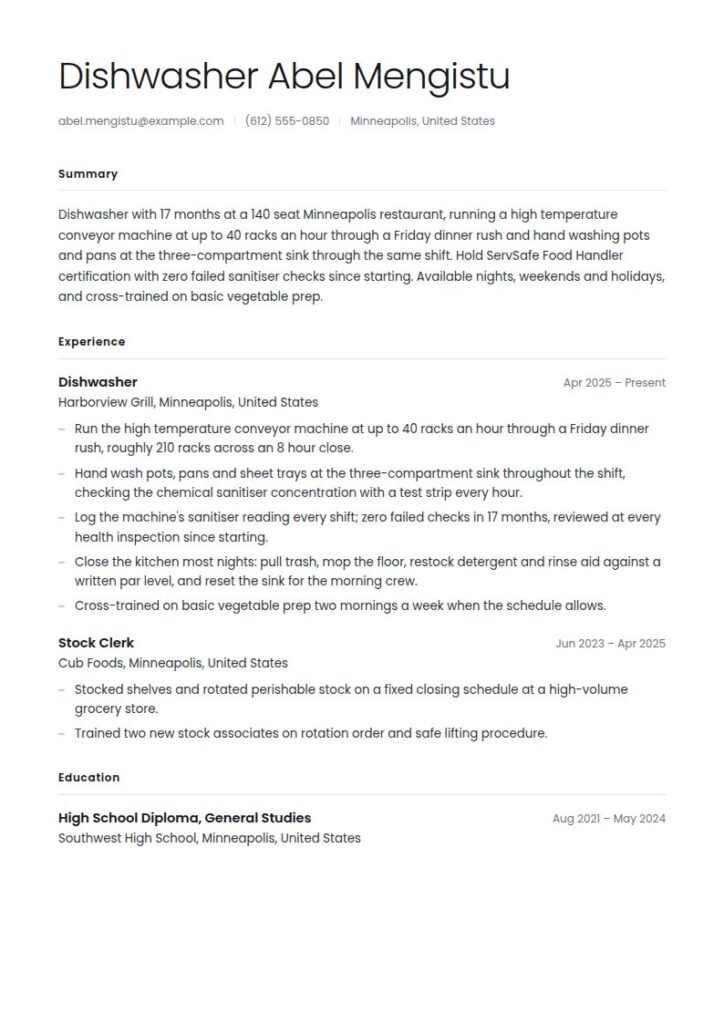
Dishwasher with 17 months at a 140 seat Minneapolis restaurant, running a high temperature conveyor machine at up to 40 racks an hour through a Friday dinner rush and hand washing pots and pans at the three-compartment sink through the same shift. Hold ServSafe Food Handler certification with zero failed sanitiser checks since starting. Available nights, weekends and holidays, and cross-trained on basic vegetable prep.
Work Experience
04/2025 - Present, Dishwasher, Harborview Grill, Minneapolis, United States
- Run the high temperature conveyor machine at up to 40 racks an hour through a Friday dinner rush, roughly 210 racks across an 8 hour close.
- Hand wash pots, pans and sheet trays at the three-compartment sink throughout the shift, checking the chemical sanitiser concentration with a test strip every hour.
- Log the machine's sanitiser reading every shift; zero failed checks in 17 months, reviewed at every health inspection since starting.
- Close the kitchen most nights: pull trash, mop the floor, restock detergent and rinse aid against a written par level, and reset the sink for the morning crew.
- Cross-trained on basic vegetable prep two mornings a week when the schedule allows.
06/2023 - 04/2025, Stock Clerk, Cub Foods, Minneapolis, United States
- Stocked shelves and rotated perishable stock on a fixed closing schedule at a high-volume grocery store.
- Trained two new stock associates on rotation order and safe lifting procedure.
Education
08/2021 - 05/2024, High School Diploma, General Studies, Southwest High School, Minneapolis, United States
Skills
High temperature conveyor dish machines, 80
Three-compartment sink procedure, 75
Sanitiser test strip reading, 70
Closing checklists and floor care, 75
Basic vegetable prep, 55
Allergen awareness, 65
Languages
English, native
Amharic, fluent
Certificates
06/2025, ServSafe Food Handler, National Restaurant Association
Valid through 2027.
07/2025, Allergen awareness training, Harborview Grill, employer provided
Summary
A dishwasher resume is a one page document that names the machine you run, how you sanitise, how many racks you move an hour, and what it costs to keep the pit running. This guide gives you three adaptable versions, the block that turns a chore into a checkable job, and an honest account of what federal wage data does and does not publish for the role.
Dishwasher resume examples by experience level
A dishwasher resume is a one page document that names the machine you run, how you sanitise when the machine cannot keep up, how many racks you move an hour, and what it costs the kitchen to keep your pit running.
In short, that is a real, skilled, physically demanding job, not a placeholder line on someone else's resume. A kitchen manager reading dishwasher applications is not screening for effort; every applicant claims effort. They are screening for whether this specific person can be handed a machine, a chemical account and a closing checklist without supervision on a Friday night, because when the pit backs up the whole kitchen backs up behind it.
Resume guide for a dishwasher resume
To start, this guide and the corresponding dishwasher resume example will cover:
- How to write a dishwasher resume, section by section
- Also, why the machine, the chemicals and the volume belong on the page as their own block
- Three adaptable summaries: new dishwasher, lead dishwasher and kitchen steward
- What a high temperature machine and a chemical sanitising system each require, and what the food safety stakes actually are
- What the job market looks like, including the honest gap in federal wage data
How to write a dishwasher resume
Overall, use five sections: contact header, summary, dish pit systems, kitchen experience, education and certifications. One page. There is no version of this job where a second page helps; a kitchen manager wants the volume and the machine, not a story.
The dish pit systems block sits directly under the summary because it is the fastest possible answer to the question a manager is actually asking, which is whether you have run this specific kind of setup before.
| Section | What it is answering | Where it goes |
|---|---|---|
| Summary | What machine have you run, and at what volume? | Top, three or four lines |
| Dish pit systems | Can this person run my machine and my sink without training from zero? | Directly under the summary |
| Kitchen experience | How busy was the house, and how long did you stay? | Reverse chronological, with numbers |
| Education and certifications | Is the food safety paperwork current? | Bottom, with dates |
Name the machine before you name the restaurant
Two dishwashers who both write "Dishwasher, casual dining restaurant" could have run completely different jobs. One ran a single under-counter machine doing 15 racks an hour at a 40-seat diner. The other ran a conveyor machine at 60 racks an hour with a second person feeding it, backed by a three-compartment sink for stockpots too big for either machine.
Name the machine type, whether it is high temperature or chemical sanitising, and the volume you ran it at. "High temperature conveyor dish machine, up to 40 racks an hour through a Friday close" tells a hiring manager in one line whether you have handled their exact setup, which is the only question a fast hire is actually asking.
Run the finished file through the ATS resume checker before you send it. Restaurant groups, hotels and hospital systems increasingly screen entry-level food service applications through the same software they use for every other role.
Choosing the best resume format for a dishwasher resume
Reverse chronological, one page, single column.
Dishwashing careers often have short stints in them: a seasonal restaurant, a closure, a move, a job that just did not work out. However, a functional format hides the timeline and makes a manager assume the worst about it. Keep the dates in order and add a three-word reason next to anything under six months, such as "restaurant closed" or "seasonal only."
Include your contact information
| ✅ Right | ❌ Wrong |
|---|---|
| Abel Mengistu | Abel Mengistu |
| Dishwasher, high temperature machine and three-compartment sink, 40 racks an hour | Hardworking and reliable team player |
| ServSafe Food Handler, valid to 2027 | Food safety trained |
| (612) 555-0850, [email protected], Minneapolis, MN | (612) 555-0850, [email protected] |
Next, put your availability in the header if it helps. "Available nights, weekends and holidays" tells a kitchen manager you can cover the shifts that are hardest to staff, which is often the deciding line on an entry-level application.
Make use of a summary
Three or four lines: the machine and sanitising method you run, the volume, one cost or quality number, and what you own beyond the pit itself.
Dishwasher with 17 months at a 140 seat Minneapolis restaurant, running a high temperature conveyor machine at up to 40 racks an hour through a Friday dinner rush and hand washing pots and pans at the three-compartment sink through the same shift. Hold ServSafe Food Handler certification with zero failed sanitiser checks since starting. Available nights, weekends and holidays, and cross-trained on basic vegetable prep.
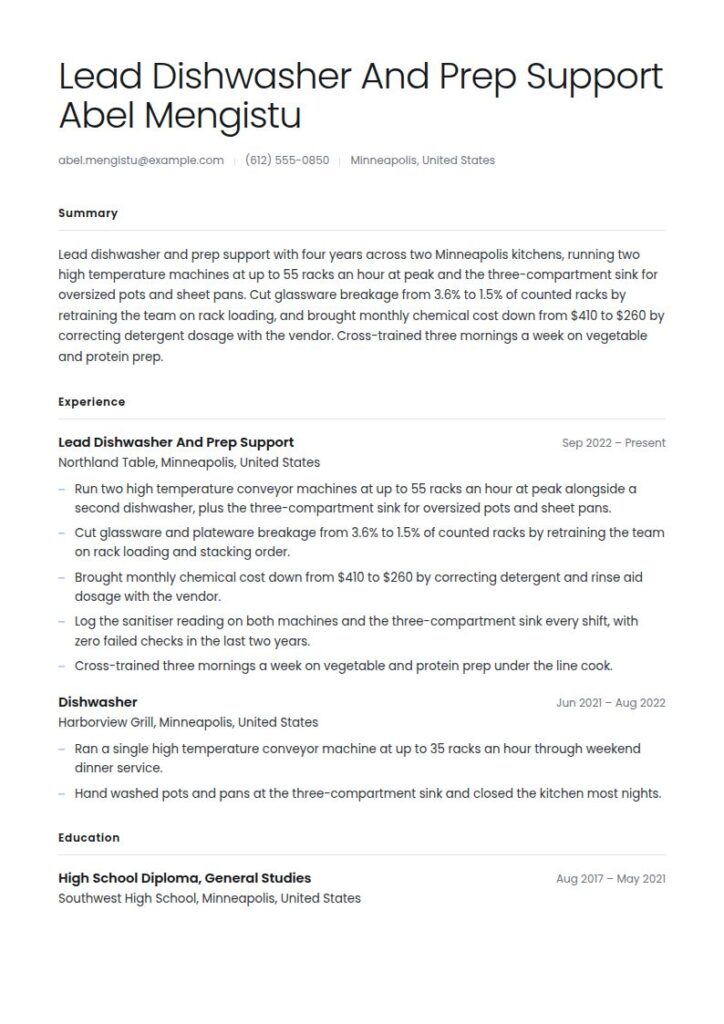
Lead dishwasher and prep support with four years across two Minneapolis kitchens, running two high temperature machines at up to 55 racks an hour at peak and the three-compartment sink for oversized pots and sheet pans. Cut glassware breakage from 3.6% to 1.5% of counted racks by retraining the team on rack loading, and brought monthly chemical cost down from $410 to $260 by correcting detergent dosage with the vendor. Cross-trained three mornings a week on vegetable and protein prep.
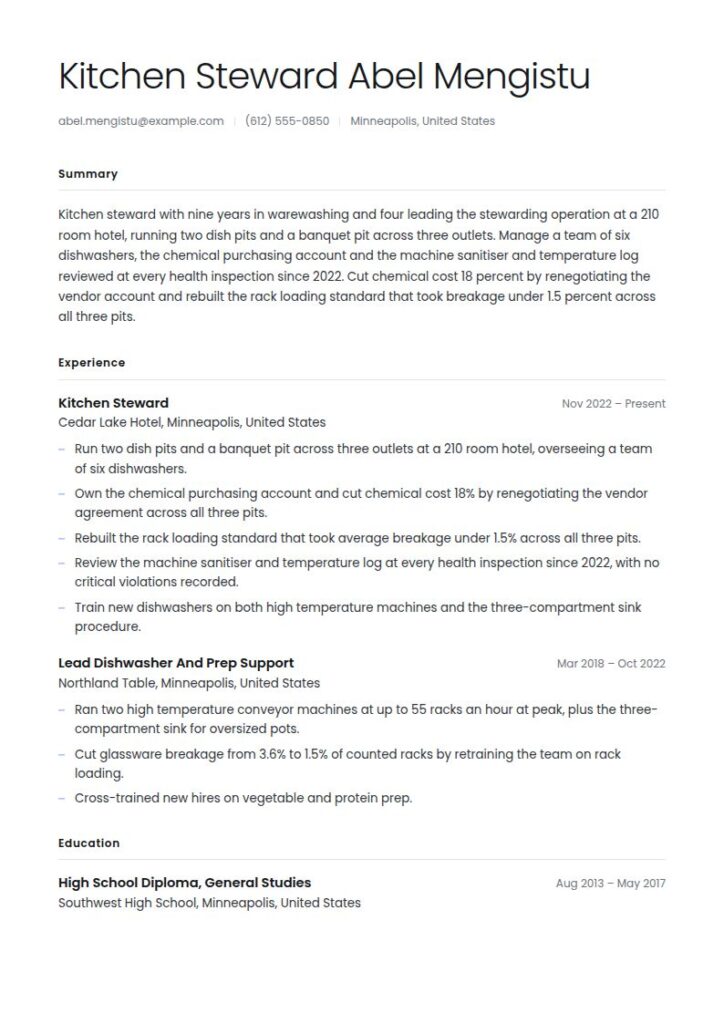
Kitchen steward with nine years in warewashing and four leading the stewarding operation at a 210 room hotel, running two dish pits and a banquet pit across three outlets. Manage a team of six dishwashers, the chemical purchasing account and the machine sanitiser and temperature log reviewed at every health inspection since 2022. Cut chemical cost 18 percent by renegotiating the vendor account and rebuilt the rack loading standard that took breakage under 1.5 percent across all three pits.
Right vs wrong: the same summary, twice
| ✅ Right | ❌ Wrong |
|---|---|
| Ran a high temperature conveyor machine at up to 40 racks an hour through a Friday dinner rush. | Cleaned dishes and kept the kitchen tidy. |
| Cut monthly chemical cost from $410 to $260 by correcting detergent dosage. | Responsible for washing dishes and equipment. |
| Zero failed sanitiser checks in 17 months of logged shifts. | Hardworking team player with a strong work ethic. |
In practice, the right column can be checked against a sanitiser log and a chemical invoice. The left column is what almost every entry-level application in the stack says, which is why it gets almost no weight.
Outline your experience
Restaurant, city, seats, machine type, dates. Then three to five bullets, each carrying a number.
| Instead of | Use |
|---|---|
| Washed dishes and kept the kitchen clean | Ran a high temperature conveyor machine at up to 40 racks an hour through a Friday close |
| Helped keep the kitchen sanitary | Logged the machine's sanitiser reading every shift, with zero failed checks in 17 months |
| Took out trash and mopped floors | Closed the kitchen: pulled trash, mopped, and reset the three-compartment sink for the morning crew |
| Assisted with food prep sometimes | Cross-trained three mornings a week on vegetable and protein prep under the line cook |
| Managed dish room supplies | Tracked detergent and rinse aid against a par level, flagging reorders before the machine ran dry |
Dishwasher, Harborview Grill, Minneapolis, MN, April 2025 to Present. 140 seat neighbourhood restaurant, one high temperature conveyor machine, one dishwasher a shift.
Run the high temperature conveyor machine at up to 40 racks an hour through a Friday dinner rush, roughly 210 racks across an 8 hour close.
Hand wash pots, pans and sheet trays at the three-compartment sink throughout the shift, checking the chemical sanitiser concentration with a test strip every hour.
Log the machine's sanitiser reading every shift; zero failed checks in 17 months, reviewed at every health inspection since I started.
Close the kitchen most nights: pull trash, mop the floor, restock detergent and rinse aid against a written par level, and reset the sink for the morning crew.
Cross-trained on basic vegetable prep two mornings a week when the schedule allows.
The dish pit is a machine: name the machine, the chemicals and the temperatures
A kitchen manager reading a dishwasher application already assumes you can wash a plate. What they do not know is whether you can run their specific machine without flooding the floor or burning through a case of detergent in a week, and whether you can run the three-compartment sink correctly the moment the machine goes down. That is why naming both turns a generic application into a checkable one.
Two systems do the sanitising, and saying which one you have run reads as real experience rather than a guess. A high temperature machine sanitises with hot water alone in its final rinse cycle, with no chemical added, which is why it needs a booster heater and produces the wall of steam over most dish pits. A chemical sanitising machine, or a three-compartment sink when there is no machine at all, does the same job with a chemical sanitiser solution instead of heat, checked against a test strip rather than a thermometer. Both routes end at the same requirement: a surface clean and sanitised enough to serve food off, verified by whoever is in charge that shift, and checked again by a health inspector.
Say which system you ran, then attach the volume, the cost and the failure record.
Machines: High temperature conveyor dish machine, booster heated final rinse, no chemical sanitiser added. Backup: three-compartment sink with a chemical sanitiser, tested with a strip every hour.
Volume: Up to 40 racks an hour through a Friday dinner rush, roughly 210 racks across an 8 hour close. Hand washed pots, pans and sheet trays at the three-compartment sink throughout the same shift.
Chemical and supply cost: Tracked detergent and rinse aid usage against a written par level and flagged reorders before the machine ran dry; brought monthly chemical cost down from $410 to $260 by correcting the detergent dosage with the vendor.
Breakage: Cut glassware and plateware breakage from 3.6% to 1.5% of counted racks by retraining the team on rack loading and stacking order.
Compliance: Logged the machine's sanitiser reading and the three-compartment sink's chemical concentration every shift, zero failed checks in 17 months, reviewed at every health inspection.
Route out: Cross-trained three mornings a week on vegetable and protein prep under the line cook, the usual next step off the pit.
Dishwasher systems a manager can check
Every line in that block is checkable against something a manager can actually ask for: a sanitiser log, a chemical invoice, a rack count. That is worth more than any adjective, because a kitchen manager who has been burned by a bad hire before is reading for exactly this kind of proof.
The sanitising job also carries a food safety weight that most applicants never write down. Since 1 January 2023 there have been nine major food allergens recognized in the Federal Food, Drug, and Cosmetic Act and the 2022 FDA Food Code, and the FDA states that employee food safety training must include allergy awareness of all nine (U.S. Food and Drug Administration). A pan that goes back onto the line with a trace of shellfish or tree nut residue because a wash cycle was rushed is how a reaction happens two tables later, and the dishwasher is the last person who touches that pan before it does. Say plainly that you treat the sanitising step as a food safety control rather than a chore. That sentence tells a kitchen manager you understand what the job is actually protecting against.
Build a snapshot of your key skills
Generally, list twelve to sixteen entries in three groups: machines and sanitising, kitchen operations, food safety.
Machines and sanitising: High temperature conveyor dish machines, Chemical sanitising machines, Three-compartment sink procedure, Sanitiser test strip reading, Detergent and rinse aid dosing, Rack loading and breakage prevention
Kitchen operations: Pots and pans washing at volume, Closing checklists and floor care, Trash and recycling pull, Stockroom and chemical inventory, Basic vegetable and protein prep, Par level tracking
Food safety: ServSafe Food Handler, Allergen awareness, Temperature and sanitiser logging, FIFO stock rotation, Cross contact prevention, Health inspection readiness
List your education and certifications
Most dishwasher postings ask for no formal educational credential, so this block is short and the training lines carry the weight.
ServSafe Food Handler, National Restaurant Association, 2025, valid to 2027
High School Diploma, Southwest High School, Minneapolis, MN, 2024
Allergen awareness training, employer provided, 2025
If you want the next credential on the ladder, look at a food protection manager certification. The Conference for Food Protection states that its Standards for Accreditation of Food Protection Manager Certification Programs provide the framework for universal acceptance of the resulting credentials, and that certificates from an accredited program meet the FDA Food Code knowledge requirement, with the directory maintained by the ANSI National Accreditation Board (Conference for Food Protection, accessed September 2026). It is usually the credential a kitchen asks for before handing someone the title of shift lead or kitchen steward, and it is worth working toward while you are still on the pit rather than after you leave it.
Choose the right layout and design
Single column, 11 or 12 point type, plain headings, no photograph, no graphics. This resume is often read on a phone between shifts; as a result, anything that does not render cleanly on a small screen gets skipped.
Name the machine type and whether it is high temperature or chemical sanitising. Give a racks-per-hour number for your busiest shift. Put a chemical cost or breakage number on the page if you have one. Say how you logged sanitiser readings and whether any check ever failed. State your availability for nights, weekends and holidays in the header. Name the extra task you cross-train on, since that is the route off the pit.
Do not write "responsible for" or "assisted with" anywhere. Do not describe the job only as washing dishes; name the systems you ran. Do not leave out a short stint, because a three-word reason reads better than an unexplained gap. Do not use a template with icons, borders or a skills bar chart. Do not send two pages for a one page job. Do not claim a certification you do not currently hold.
Dishwasher job market and outlook
The Bureau of Labor Statistics publishes no current Occupational Outlook Handbook profile for dishwashers, and the Handbook's page for occupations not covered in detail does not reach the food preparation and serving group in a single fetch, so this section does not fall back to a retired figure. It uses the current national wage table instead, and names the published occupations that bracket the job.
The current May 2025 Occupational Employment and Wage Statistics national release does list dishwashers directly, and this figure is current, not retired:
| Measure, Dishwashers | Value |
|---|---|
| Employment, May 2025 | 477,450 |
| Median hourly wage, May 2025 | $16.49 |
| Median annual wage, May 2025 | $34,310 |
Source: U.S. Bureau of Labor Statistics, Occupational Employment and Wage Statistics, national occupational employment and wage estimates, May 2025.
Dishwasher job outlook from related profiles
That table does not publish growth projections, so for outlook, use the two closest published Occupational Outlook Handbook profiles. Food Preparation Workers, whose duties overlap with the prep side of a dish pit, had a median pay of $35,320 a year, or $16.98 an hour, in May 2025, with employment of 908,500 and a projected decline of 3 percent through 2035, about 135,700 openings a year even so (BLS Occupational Outlook Handbook, Food Preparation Workers, last modified 27 August 2026).
Food and Beverage Serving and Related Workers, the entry-level front of house occupation with the same no-credential hiring pattern, had a median pay of $31,710 a year, or $15.24 an hour, with employment of 5,143,000 and projected growth of 5 percent through 2035, about 1,078,500 openings a year; that profile explicitly does not cover dishwashers, which is part of why the role has no page of its own (BLS Occupational Outlook Handbook, Food and Beverage Serving and Related Workers, last modified 27 August 2026).
No profile, but a real number, and a shrinking neighbor
The current May 2025 national wage table puts 477,450 people in the dishwasher occupation directly, at a median of $16.49 an hour (BLS Occupational Employment and Wage Statistics, May 2025). That is a real, current, citable figure, even though it does not come with a Handbook narrative or a growth projection attached.
The closest occupation by daily task, food preparation workers, is one of the few in food service projected to shrink, down 3 percent through 2035 even as most food service occupations grow (BLS Occupational Outlook Handbook, Food Preparation Workers, 2025-35 projections). Read together, the picture is a large, steady, largely automation-resistant occupation sitting next to one that is slowly contracting, which is exactly why naming your own volume and cost numbers matters more here than leaning on an industry growth story.
Where dishwasher work sits in the kitchen
For context on where this kind of work sits, food preparation workers are concentrated in food services and drinking places (55%), grocery and specialty food retailers (21%), healthcare and social assistance (6%), educational services (4%) and general merchandise retailers (3%), with industry median hourly wages ranging from $18.66 in general merchandise retailers down to $16.62 in healthcare and social assistance (BLS Occupational Outlook Handbook, Food Preparation Workers, May 2025). Dishwashing work sits across the same range of settings, from independent restaurants through hospital and school kitchens to hotel banquet operations, and the setting moves pay as much as the title does.
What salary you can expect as a dishwasher
Specifically, the current national estimate puts the median dishwasher wage at $16.49 an hour, or $34,310 a year, as of May 2025, across 477,450 jobs counted directly under the occupation (BLS Occupational Employment and Wage Statistics, May 2025). That figure did not come from a Handbook profile, since none exists for this occupation, but it is the current cycle and it is real.
Set against the two closest published Handbook occupations, dishwashing sits between them: Food and Beverage Serving and Related Workers at $31,710 a year and Food Preparation Workers at $35,320 a year, both May 2025 (BLS Occupational Outlook Handbook, last modified 27 August 2026). That is a narrow band, which tells you most of the pay difference between dishwasher jobs is set by setting and shift rather than by title. A hotel banquet pit, a hospital kitchen and an independent restaurant all pay differently for the identical machine work, and the hourly rate follows the kind of operation more than it follows years on the job.
Where a resume moves money inside that band is the same evidence used throughout this guide: a machine you can run without training, a volume you can hold on the busiest shift, a chemical or breakage number you have actually improved, and a clean sanitiser log. Those are the facts that justify a higher starting wage or a move from dishwasher to lead dishwasher or kitchen steward, where the pay steps up because the job now includes the chemical account, the schedule and other people's work.
Key takeaways for a dishwasher resume
- Name the machine type, high temperature or chemical sanitising, and whether you also run a three-compartment sink.
- Above all, give a racks-per-hour number for your busiest shift, not just a job title.
- Put a chemical cost or breakage number on the page if you have moved one.
- Say how sanitiser readings were logged and whether any check ever failed.
- State your availability for nights, weekends and holidays in the header.
- Name the cross-training you have done, since that is the visible route off the pit.
- Keep it to one page, single column, and treat a short stint as a labeled fact rather than a gap to hide.
Build your dishwasher resume in 15 minutes with our AI resume builder.
Related hospitality and catering resume examples
- Cook resume
- Line cook resume
- Chef resume
- Food service worker resume
- Fast food worker resume
- Busser resume
- Server resume
- Waiter resume
- Waitress resume
- Restaurant resume
- Hospitality and catering resume
- Food services manager resume
Pair it with a matching dishwasher cover letter.
Dishwasher resume questions, answered
How long should a dishwasher resume be?
One page. This is a job measured in a handful of concrete facts: the machine, the volume, the chemical and breakage numbers, the certification. A second page almost always means padding rather than evidence.
What do I put on a dishwasher resume with no kitchen experience?
Any job that involved a repeated physical task at a deadline: stocking shelves, a warehouse shift, a grocery job, a moving crew. Write what you handled, how fast, and whether you closed or opened. Add that you are available nights, weekends and holidays, and that you can start immediately if that is true. A kitchen manager hiring for a Friday-night hole cares about reliability first.
Why does this page not give a dishwasher salary from the BLS Occupational Outlook Handbook?
Because the Handbook does not currently publish one. Dishwashers are one of a handful of occupations with no detailed BLS profile, and the retired per-occupation wage pages are from an older cycle not worth citing. This page uses the current May 2025 national wage table instead, which does list the occupation directly, and names the closest published Handbook occupations for context.
Do I need a food handler certification to work as a dishwasher?
Most states and most employers require or strongly prefer one, and it costs little to get. ServSafe Food Handler, administered by the National Restaurant Association, is the credential most operators recognize by name, and putting it on the page with its expiry date is worth more than a line describing yourself as food safety conscious.
What is the next job after dishwashing?
Prep cook is the most common route, since the sanitising and inventory habits transfer directly and many kitchens cross-train dishwashers onto morning prep before they cross-train anyone from outside. Lead dishwasher or kitchen steward is the other route, moving from running the machine to owning the chemical account, the schedule and the sanitiser log for the whole pit. Both routes reward the same evidence this guide asks for: volume, cost control and a clean compliance record.
Should I really put the chemical cost and breakage numbers on the page?
Yes, if you have moved either one. Almost no dishwasher resume includes a cost or breakage figure, which means the two or three lines in this guide's example block are close to the only checkable evidence a hiring manager will see all day. A number a manager can verify against an invoice or a rack count is worth far more than any description of your work ethic.