Food Service Worker, School Nutrition Kwame Asante
Food Service Worker
[email protected] | (410) 555-0874 | Baltimore, United States
Profile
Food service worker with one year in K-12 school nutrition, serving 400 to 550 reimbursable meals a day across two lunch periods on the tray line and in the serving lane. Trained on portioning to federal meal pattern requirements and allergy identification for the nine major food allergens. Logged temperatures on the steam table and walk-in cooler every shift with zero corrective actions required.
Work Experience
08/2020 - Present, Food Service Worker, Baltimore City Public Schools, Nutrition Services, Baltimore, United States
- Serve 400 to 550 reimbursable meals a day across two lunch periods on the tray line and in the serving lane.
- Portion meals to federal reimbursable meal pattern requirements and flag allergy-flagged trays for the nine major food allergens.
- Log temperatures on the steam table and walk-in cooler every shift, zero corrective actions required to date.
Education
08/2016 - 05/2020, High School Diploma, General studies, Baltimore City College High School, Baltimore, United States
Skills
Federal meal pattern portioning, 70
Allergen identification, 70
Temperature logging, 75
Tray line and serving lane service, 70
High-volume portioning, 65
Languages
English, native
Certificates
08/2020, ServSafe Food Handler, National Restaurant Association
Valid through 2023.
Summary
A food service worker resume changes depending on the setting: a school cafeteria, a hospital tray line and a contract dining account all hire for the same job title in different ways. This guide gives you three adaptable versions built around schools, healthcare and contract dining, the HACCP and temperature log language that setting actually checks for, and current Bureau of Labor Statistics pay and outlook for the occupation.
Food Service Worker resume examples by experience level
A food service worker resume has to say more than the job title, because the same title means a different job depending on where it is worked. For example, a school cafeteria, a hospital tray line, a senior living dining room and a contract dining account for an office building all hire food service workers, and they check for different things on the page.
However, most food service worker resumes read as one generic list: prepared food, served customers, maintained cleanliness. A hiring manager in a hospital kitchen is reading for whether you can follow a diet order without a slip. A school district, for instance, is reading for allergy awareness and portioning to a reimbursable meal pattern. A contract dining supervisor covering several accounts is reading for whether you can pass an audit. Naming the setting you have actually worked is what makes the rest of the page believable.
Resume guide for a food service worker resume
In short, this guide and the corresponding food service worker resume example will cover:
- How to write a food service worker resume, section by section
- Why the setting you worked in changes what the page needs to prove
- Three adaptable summaries: school nutrition, hospital tray line and contract dining lead
- What HACCP records, temperature logs and diet orders mean on the page
- What the job market looks like and what you can expect to earn
How to write a food service worker resume
Overall, five sections: contact header, summary, setting and compliance, experience, and skills and certifications. In general, one page for most applicants, two once you are supervising across several accounts.
Naming the setting early matters because the required knowledge does not transfer as cleanly as the job title suggests. A tray line in a hospital runs against dietitian-directed orders and modified diet codes. Meanwhile, a school cafeteria runs against a federal reimbursable meal pattern and a much younger, allergy-sensitive population. Finally, a contract dining account runs against whatever standard the client and the contracting company have agreed to, often audited by a third party. Naming which of these you have actually done tells a manager how much retraining you need, if any.
| Section | What it is answering | Where it goes |
|---|---|---|
| Setting and compliance | Which kind of kitchen have they actually worked, and to what standard | Directly under the summary |
| Summary | Years, setting, and one measured result | Top of the page |
| Experience | Volume, records kept, and what changed | Reverse chronological |
| Skills and certifications | Food safety credentials and setting-specific tools | Near the bottom |
Write the record, not just the task
"Maintained food safety standards" is a sentence every food service worker resume already has. What separates a file is naming the actual record kept: a temperature log taken and signed four times a shift, a HACCP corrective action written up and closed, a modified diet ticket followed without error across a set number of trays.
The Conference for Food Protection states that its Standards for Accreditation of Food Protection Manager Certification Programs provide the framework for universal acceptance of the resulting credentials, and that certificates from an accredited program meet the FDA Food Code knowledge requirement, with the directory maintained by the ANSI National Accreditation Board (Conference for Food Protection, accessed September 2026). If you hold a food protection manager certificate from an accredited program, name the program and the date; it tells a manager you can be the certified person of record on a shift if needed.
Run the finished file through the ATS resume checker before you apply. Hospital systems, school districts and contract dining companies increasingly route applications through applicant tracking software.
Choosing the best resume format for a food service worker resume
Reverse chronological, one page, single column. List every setting with its dates, since a hiring manager is reading for which kitchens you have actually worked, not just how long you have worked in food service overall.
A skills-first format hides the one thing that matters most here: which setting each skill was built in. "Food safety, portioning, tray assembly", for example, tells a hospital nothing about whether you have ever followed a modified diet order. That is why chronological, setting-first, is the format that answers the actual question.
Include your contact information
| ✅ Right | ❌ Wrong |
|---|---|
| Kwame Asante | Kwame Asante |
| Food Service Worker, Healthcare Dining | Food service professional |
| ServSafe Food Handler, current | Food safety trained |
| (410) 555-0874, [email protected], Baltimore, MD | (410) 555-0874, [email protected] |
Naming the setting in your header, such as "Healthcare Dining" or "School Nutrition", tells a manager in that setting they do not have to guess whether your experience transfers.
Make use of a summary
In practice, three or four lines: years of experience, the setting, the volume or record you kept, and one measured result.
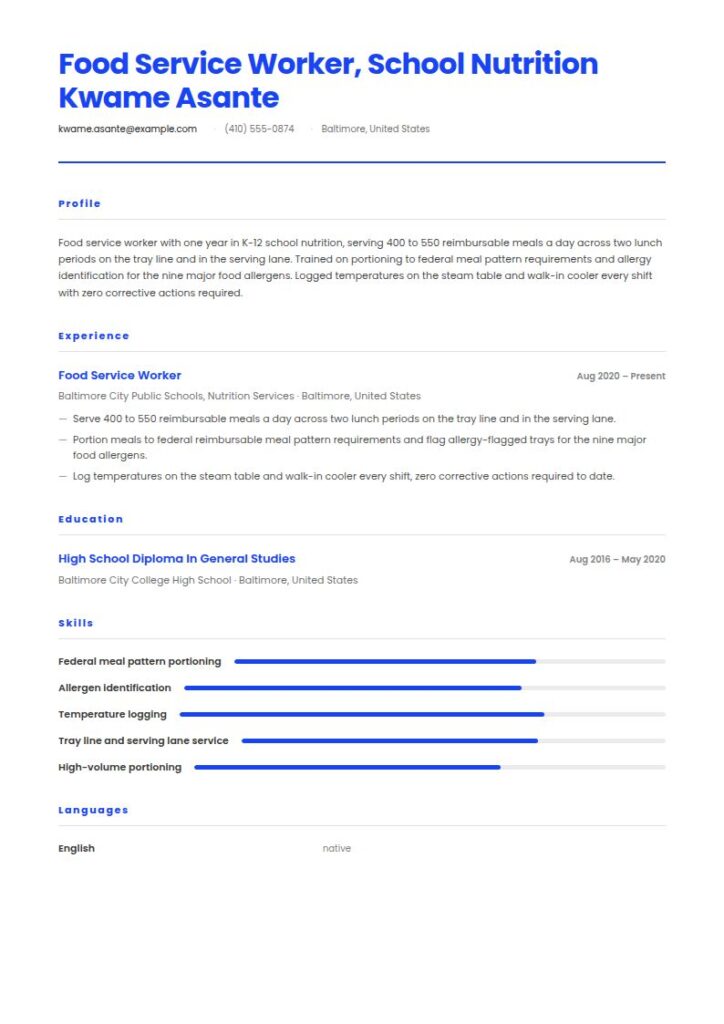
Food service worker with one year in K-12 school nutrition, serving 400 to 550 reimbursable meals a day across two lunch periods on the tray line and in the serving lane. Trained on portioning to federal meal pattern requirements and allergy identification for the nine major food allergens. Logged temperatures on the steam table and walk-in cooler every shift with zero corrective actions required.
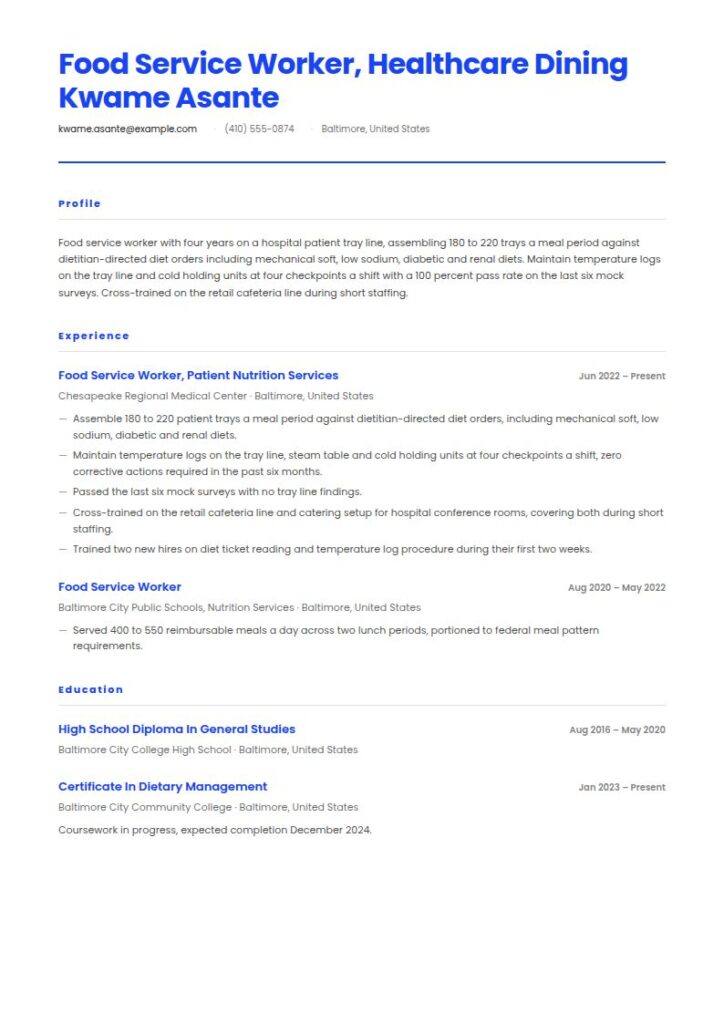
Food service worker with four years on a hospital patient tray line, assembling 180 to 220 trays a meal period against dietitian-directed diet orders including mechanical soft, low sodium, diabetic and renal diets. Maintain temperature logs on the tray line and cold holding units at four checkpoints a shift with a 100 percent pass rate on the last six mock surveys. Cross-trained on the retail cafeteria line during short staffing.
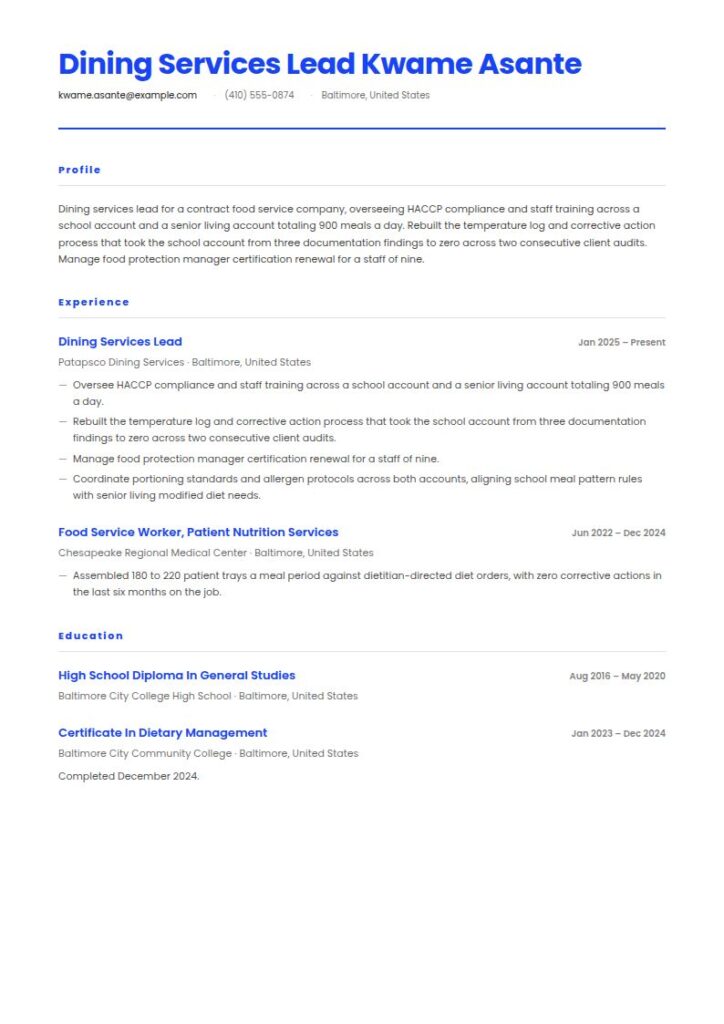
Dining services lead for a contract food service company, overseeing HACCP compliance and staff training across a school account and a senior living account totaling 900 meals a day. Rebuilt the temperature log and corrective action process that took the school account from three documentation findings to zero across two consecutive client audits. Manage food protection manager certification renewal for a staff of nine.
Right vs wrong: the same summary, twice
| ✅ Right | ❌ Wrong |
|---|---|
| Four years on a hospital patient tray line, assembling 180 to 220 trays a meal period against dietitian-directed diet orders. | Experienced food service worker with a strong work ethic. |
| Maintain temperature logs on the tray line and cold holding units at four checkpoints a shift with a 100 percent pass rate on the last six mock surveys. | Committed to food safety and cleanliness. |
| Rebuilt the temperature log process that took the school account from three documentation findings to zero across two audits. | Team player who works well under pressure. |
The right column, on the other hand, can be checked against a real log or a real audit report. In contrast, the left column could describe anyone who has ever worked in a kitchen.
Outline your experience
Setting, employer, city, dates and title, then three to five bullets. Name the setting explicitly in the job title line, and put a volume, a record, or an audit result in every bullet.
| Instead of | Use |
|---|---|
| Prepared and served food | Assembled 180 to 220 patient trays a meal period against dietitian-directed diet orders |
| Followed food safety procedures | Logged tray line and cold holding temperatures at four checkpoints a shift, zero corrective actions in six months |
| Worked in a school cafeteria | Served 400 to 550 reimbursable meals a day across two lunch periods, portioned to federal meal pattern requirements |
| Helped with special diets | Followed modified diet tickets, including mechanical soft, low sodium and diabetic diets, without a tray error in the last quarter |
| Trained staff | Trained three new hires on HACCP recordkeeping and the corrective action log |
Food Service Worker, Patient Nutrition Services, Chesapeake Regional Medical Center, Baltimore, MD, June 2022 to Present
Assemble 180 to 220 patient trays a meal period against dietitian-directed diet orders, including mechanical soft, low sodium, diabetic and renal diets.
Maintain temperature logs on the tray line, steam table and cold holding units at four checkpoints a shift, with zero corrective actions required in the past six months.
Passed the last six mock surveys with no tray line findings.
Cross-trained on the retail cafeteria line and catering setup for hospital conference rooms, covering both during short staffing.
Trained two new hires on diet ticket reading and temperature log procedure during their first two weeks.
Name the setting: schools, hospitals and contract dining hire differently
The job title "food service worker" covers a school cafeteria line, a hospital patient tray line, a senior living dining room and a corporate contract dining account, and a hiring manager in any one of those settings is checking for something the others do not require.
First, a school nutrition department is checking for portioning against a federal reimbursable meal pattern and allergy identification for a population of children who cannot always self-report a reaction. A hospital or senior living kitchen is checking for the ability to follow a diet order written by a dietitian without substitution, because a mechanical soft or renal diet ticket followed incorrectly is a patient safety event, not a customer complaint. A contract dining company managing several accounts is checking for whether you can pass an audit written by someone outside the kitchen, since that audit is what keeps the client contract.
Why food service worker pay varies by setting
This is also why the same job title pays differently by setting. Both Bureau of Labor Statistics occupations that food service workers fall under, food and beverage serving and related workers and food preparation workers, pay more in healthcare and education than in a standalone restaurant, because those settings are hiring for compliance on top of the kitchen work itself.
Setting: Hospital patient nutrition services, acute care
Diet orders followed: Mechanical soft, pureed, low sodium, diabetic, renal, and clear or full liquid, per dietitian-directed tickets
Records kept: Temperature logs at four checkpoints a shift on tray line, steam table and cold holding; HACCP corrective action log; tray accuracy spot checks
Volume: 180 to 220 trays a meal period, three meal periods a day
Audit history: Passed the last six internal mock surveys with no tray line findings
Certifications: ServSafe Food Handler, current; allergen awareness training covering the nine major food allergens
As a result, three lines there are doing work a generic bullet cannot.
The diet orders line names exactly what you can be trusted with on day one. A hospital does not want to discover during onboarding that "special diets" meant garnishing a salad differently; therefore, naming the specific diet types you have followed answers the question before it is asked.
Similarly, the records line proves you understand that in these settings, the paperwork is not separate from the job, it is evidence the job was done correctly. A temperature log or a HACCP corrective action write-up is what an inspector or an auditor actually reads.
Also, the setting line at the top lets a reader in a different setting immediately calibrate what transfers. For instance, a school nutrition manager reading "hospital patient nutrition services" knows the diet-order discipline will transfer even though the meal pattern rules will not, and can ask about that specifically at interview instead of guessing.
Name the exact setting in your job title line: school nutrition, hospital patient dining, senior living, or contract dining. List the specific diet types or meal pattern requirements you have followed. Name the actual record you kept: a temperature log, a HACCP corrective action, a tray accuracy check. Give an audit or inspection result if you have one. Say plainly if you are cross-trained across settings, since it is a real advantage for a contract dining employer covering several account types.
Do not write "followed food safety procedures" without naming the record. Do not describe a diet order in clinical detail beyond what you actually did, since it is not your role to describe the medical reasoning behind a diet. Do not claim HACCP or food protection manager certification you do not hold; the certifying body's directory can be checked. Do not assume one setting's experience automatically satisfies another; name what is the same and let the interview cover what is different.
Build a snapshot of your key skills
Ten to fourteen entries in three groups: setting-specific knowledge, food safety and records, and operations.
Setting-specific: Dietitian-directed diet order execution, Federal reimbursable meal pattern portioning, Modified diet tray assembly, Allergen identification, Contract account audit preparation
Food safety and records: Temperature logging and cold holding, HACCP corrective action documentation, ServSafe food handler practices, Cross-contact and allergen control
Operations: Tray line and steam table service, High-volume portioning, Inventory and par level tracking, Point of sale and meal card systems, Staff training and onboarding
List your education and certifications
Formal education is not a gate here. The Bureau of Labor Statistics lists no formal educational credential as the typical entry-level requirement for food and beverage serving and related workers or for food preparation workers, the two occupational groups food service workers most often sit inside (BLS Occupational Outlook Handbook, last modified 27 August 2026). Then lead with your food safety credential and the settings you are trained for.
ServSafe Food Handler, National Restaurant Association, issued 2024, valid through 2027
Allergen awareness training covering the nine major food allergens recognized under the FDA Food Code, completed 2024
Certificate in Dietary Management coursework, Baltimore City Community College, 2023, in progress
High school diploma, Baltimore, MD, 2020
Since 1 January 2023, nine major food allergens have been recognized in the Federal Food, Drug, and Cosmetic Act and the 2022 FDA Food Code, and the FDA states that employee food safety training must include allergy awareness of all nine (U.S. Food and Drug Administration). Naming that training specifically, rather than "food safety trained", therefore tells a school or healthcare employer you know the current standard.
Choose the right layout and design
Single column, plain type, no photograph, one page for most applicants, two once you are supervising staff or multiple accounts. Hospital systems and school districts increasingly route applications through applicant tracking software, and a plain, clearly headed file parses more reliably than a graphic template.
Lead with the setting in your job title line. Name the diet types, meal pattern rules or audit standard you have worked to. State your food safety certification with its issuing body and expiry. Give a volume figure: trays, meals or covers a shift. Note if you are cross-trained across more than one setting.
Do not use a two column template or a graphic header; applicant tracking software parses these badly. Do not write "food safety trained" without naming the credential. Do not omit the setting; "food service worker" alone tells a hiring manager almost nothing about what you can do on day one. Do not pad a one page resume to two before you are supervising others.
Food service worker job market and outlook
Food service workers sit across two Bureau of Labor Statistics occupations depending on the role: food and beverage serving and related workers, and food preparation workers, and both show the same pattern of paying more outside a standalone restaurant.
| Measure | Food and beverage serving | Food preparation workers |
|---|---|---|
| Employment, 2025 | 5,143,000 | 908,500 |
| Projected change, 2025-35 | 5 percent, +280,800 jobs | minus 3 percent (decline) |
| Projected annual average openings | ~1,078,500 | ~135,700 |
| Median annual wage, May 2025 | $31,710 | $35,320 |
| Median hourly wage, May 2025 | $15.24 | $16.98 |
| Typical entry-level education | No formal educational credential | No formal educational credential |
Source: U.S. Bureau of Labor Statistics, Occupational Outlook Handbook, Food and Beverage Serving and Related Workers and Food Preparation Workers, May 2025 wage data and 2025-35 projections, last modified 27 August 2026.
Healthcare and education pay more in both occupations that feed into this job
In food and beverage serving and related workers, healthcare and social assistance employs 4 percent of the occupation at a median of $17.12 an hour and educational services employs 3 percent at $17.02, both above the food services and drinking places median of $15.00 (BLS Occupational Outlook Handbook, May 2025 wage data, last modified 27 August 2026).
In food preparation workers, the pattern holds again: educational services pays a median of $17.89 an hour and healthcare and social assistance $16.62, against $16.67 in food services and drinking places, while general merchandise retailers pay the highest median in that occupation at $18.66 (BLS Occupational Outlook Handbook, Food Preparation Workers, May 2025 wage data, last modified 27 August 2026).
Two different occupations, and the same setting effect appears in both. Institutional kitchens pay a premium over restaurant kitchens for the same underlying food service work, and the resume that names the setting is the one that can ask for that premium credibly.
What salary you can expect
The median wage for food and beverage serving and related workers was $15.24 an hour, or $31,710 a year, and for food preparation workers $16.98 an hour, or $35,320 a year, both as of May 2025 (BLS Occupational Outlook Handbook, last modified 27 August 2026). Which of the two applies to a given food service worker role depends on whether the job is closer to service, such as a tray line or serving lane, or closer to preparation, such as portioning and tray assembly before service.
Setting moves pay more than job title does. Educational services and healthcare and social assistance pay above the food services and drinking places median in both occupations, which is consistent with the compliance and audit burden those settings carry. After all, a contract dining company managing a hospital or school account is being paid by its client partly for that compliance, and it can afford to pay staff who bring proven experience in it.
What a resume can move within that structure is the step from line worker to lead or supervisor, which is awarded on exactly the evidence this guide describes: named diet orders followed without error, a temperature log with a clean corrective action history, and an audit or survey result you can point to.
Key takeaways for a food service worker resume
- Name the exact setting in your job title line: school, hospital, senior living or contract dining.
- Instead, list the specific diet types or meal pattern rules you have followed, not "special diets".
- Also name the actual record you kept: temperature log, HACCP corrective action, tray accuracy check.
- Give a volume figure, trays or meals a shift, and an audit result if you have one.
- Name your food safety certification with its issuing body and expiry date.
- Say plainly if you are cross-trained across settings; it is a real advantage for contract dining employers.
- Keep the resume to one page until you are supervising staff across more than one account.
Build your resume in 15 minutes.
Related hospitality and catering resume examples
- Dishwasher resume
- Cook resume
- Food services manager resume
- Caterer resume
- Line cook resume
- Baker resume
- Fast food worker resume
- Busser resume
- Chef resume
- Restaurant resume
- Hospitality catering resume
- Sous chef resume
Pair it with a matching food service worker cover letter.
Food service worker resume questions, answered
How long should a food service worker resume be?
One page for most applicants, even across two or three settings. Two pages once you are supervising staff or managing compliance across more than one account.
What is the difference between a food service worker and a cook?
A food service worker's core work is portioning, tray assembly, serving and the records around it, while a cook's core work is preparing food from a recipe. Many people do both across a shift, especially in schools and smaller healthcare kitchens, but name the split honestly: what you cooked versus what you portioned and served.
Do I need a special certification to work in a hospital kitchen?
Requirements vary by employer, but a current food handler credential such as ServSafe Food Handler is commonly expected, and hospitals typically add their own onboarding on diet order reading and HACCP recordkeeping. If you hold a food protection manager certificate from a program accredited under the Conference for Food Protection's standards, it meets the FDA Food Code knowledge requirement and is worth naming by program and date (Conference for Food Protection, accessed September 2026).
How do I describe following a special diet without overstating my role?
Name the diet type and what you did with it: assembled the tray, checked it against the ticket, flagged a substitution question to the dietitian. Do not describe why a patient is on a particular diet or any clinical detail about them; that is outside your role and outside what belongs on a resume.
Why does the same job pay differently at a school, a hospital and a restaurant?
Bureau of Labor Statistics data shows both occupations that food service workers fall under pay more in educational services and healthcare and social assistance than in food services and drinking places (BLS Occupational Outlook Handbook, May 2025 wage data, last modified 27 August 2026). Institutional settings carry a compliance and audit burden that a standalone restaurant does not, and they pay for staff who already understand it.