Barista Marisol Quintero
Barista
[email protected] | (503) 555-0772 | Portland, United States
Profile
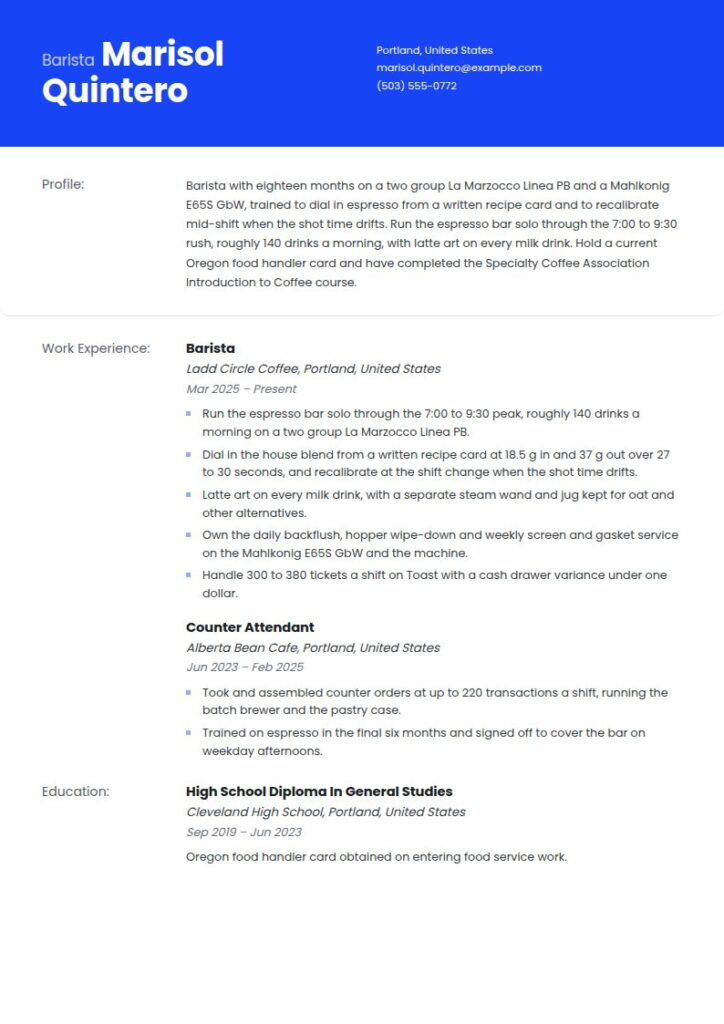
Barista with eighteen months on a two group La Marzocco Linea PB and a Mahlkonig E65S GbW, trained to dial in espresso from a written recipe card and to recalibrate mid-shift when the shot time drifts. Run the espresso bar solo through the 7:00 to 9:30 rush, roughly 140 drinks a morning, with latte art on every milk drink. Hold a current Oregon food handler card and have completed the Specialty Coffee Association Introduction to Coffee course.
Work Experience
03/2025 - Present, Barista, Ladd Circle Coffee, Portland, United States
- Run the espresso bar solo through the 7:00 to 9:30 peak, roughly 140 drinks a morning on a two group La Marzocco Linea PB.
- Dial in the house blend from a written recipe card at 18.5 g in and 37 g out over 27 to 30 seconds, and recalibrate at the shift change when the shot time drifts.
- Latte art on every milk drink, with a separate steam wand and jug kept for oat and other alternatives.
- Own the daily backflush, hopper wipe-down and weekly screen and gasket service on the Mahlkonig E65S GbW and the machine.
- Handle 300 to 380 tickets a shift on Toast with a cash drawer variance under one dollar.
06/2023 - 02/2025, Counter Attendant, Alberta Bean Cafe, Portland, United States
- Took and assembled counter orders at up to 220 transactions a shift, running the batch brewer and the pastry case.
- Trained on espresso in the final six months and signed off to cover the bar on weekday afternoons.
Education
09/2019 - 06/2023, High School Diploma, General Studies, Cleveland High School, Portland, United States
Oregon food handler card obtained on entering food service work.
Skills
Espresso dial-in from a recipe card, 70
Milk texturing and latte art, 75
Solo bar at peak, 70
Daily and weekly machine cleaning, 80
Toast point of sale, 80
Cash handling and drawer reconciliation, 75
Alternative milks and cross-contact control, 70
Languages
English, native
Spanish, native
Certificates
03/2025, Oregon Food Handler Card, Oregon Health Authority, OR-FH-4482119
Valid through 2028. Required within 30 days of beginning food service work in Oregon.
09/2025, Introduction to Coffee, Specialty Coffee Association
Foundational course of the SCA Coffee Skills Program.
Summary
A barista resume is a one page document naming the espresso machine and grinder you can run, the dial-in routine you follow when the coffee changes, the drinks you put out at peak, and the food handler card that lets you work the bar. This guide gives you three adaptable versions and current Bureau of Labor Statistics pay and outlook for food and beverage serving workers.
Barista resume examples by experience level
A barista resume is a one page document proving you can open a bar alone, pull the grinder back into range when the coffee changes, and hold both drink quality and ticket times through a four-hour morning peak.
Almost every barista resume says "made espresso drinks in a fast-paced environment", which tells a cafe owner nothing they had not assumed. What they want to know before booking a trial shift is mechanical: which machine have you stood in front of, which grinder have you calibrated, what do you do when the recipe suddenly runs eight seconds fast, and can you be left on bar alone at 7:40 in the morning.
Resume guide for a barista resume
This guide and the corresponding barista resume example will cover:
- How to write a barista resume, section by section
- Why the machine, the grinder and your dial-in routine belong on the page
- Three adaptable summaries: new barista, working barista and head barista
- What a food handler card is, when you need one, and the coffee credentials that carry weight
- What the job market looks like and what you can expect to earn
How to write a barista resume
Six blocks: contact header, summary, equipment and dial-in, bar experience, skills, and certifications. One page, because a two page barista resume is padded and padding shows.
The order matters. Put the equipment block high; it is the only part of the page a bar manager reads slowly.
| Block | What it is answering | Where it goes |
|---|---|---|
| Equipment and dial-in | Can this person be handed my bar without retraining from zero? | Directly under the summary |
| Bar experience | What volume have they held, and for how long? | Reverse chronological, with drink counts |
| Skills | Milk, brew, retail, cleaning and the point of sale | A grouped block, not a keyword dump |
| Certifications | Is the food handler card current, and does anything else apply? | Last, with issue dates |
The food handler card is a date, not a badge
Food handler rules are set state by state and sometimes county by county, so what you write depends on where you work. In Oregon the Oregon Health Authority requires food service workers to obtain a food handler card within 30 days of beginning work, keeps it valid for three years, and does not accept a card issued in another state (Oregon Health Authority, Food Handler Cards, under OAR 333-175).
If you hold one, write the issuing authority and the expiry, not the word "certified". A manager who can see the card runs to 2028 can schedule you this week; one who cannot has to ask.
If your cafe pours beer or wine, check your state's alcohol agency too. Oregon requires an alcohol service permit for everyone involved in mixing, serving or selling alcohol on a licensed premises, minimum age 18, valid five years (Oregon Liquor and Cannabis Commission, Alcohol Service Permits).
Run the finished file through the ATS resume checker before you send it. Coffee groups with more than a handful of sites collect applications through software now.
Choosing the best resume format for a barista resume
Reverse chronological, one page, single column. List every cafe with its dates, even the six-month ones, because a bar manager reads your history for volume and stability, not prestige.
Functional and skills-first formats do not work here. "Customer service, teamwork, attention to detail" at the top of a barista resume reads as a page with no cafes behind it. If your history is short, keep the chronological shape and let the equipment block carry the weight.
Include your contact information
| ✅ Right | ❌ Wrong |
|---|---|
| Marisol Quintero | Marisol Quintero |
| Barista, Linea PB and E65S | Coffee enthusiast and people person |
| Oregon Food Handler Card #OR-FH-4482119, valid to 2028 | Food safety certified |
| (503) 555-0772, [email protected], Portland, OR | (503) 555-0772, [email protected] |
Two things earn space in a barista header: the kit you are fluent on and the card that lets you work.
Make use of a summary
Three or four lines: years on bar, the machine and grinder you know, your peak volume, and one thing you improved.
Barista with eighteen months on a two group La Marzocco Linea PB and a Mahlkonig E65S GbW, trained to dial in espresso from a written recipe card and to recalibrate mid-shift when the shot time drifts. Run the espresso bar solo through the 7:00 to 9:30 rush, roughly 140 drinks a morning, with latte art on every milk drink. Hold a current Oregon food handler card and have completed the Specialty Coffee Association Introduction to Coffee course.
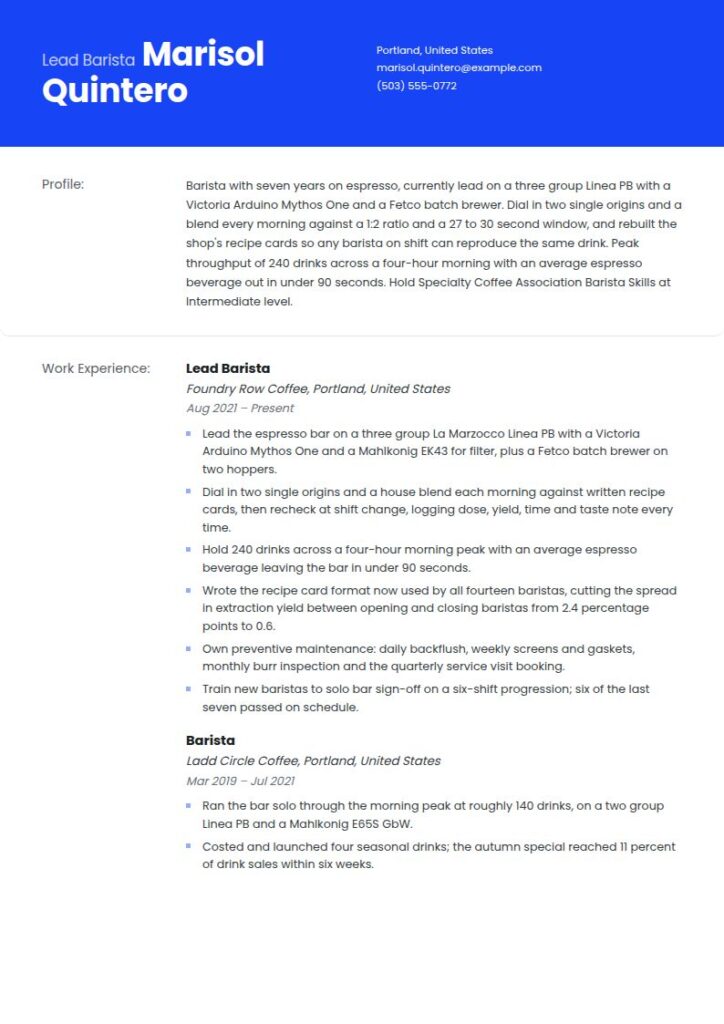
Barista with seven years on espresso, currently lead on a three group Linea PB with a Victoria Arduino Mythos One and a Fetco batch brewer. Dial in two single origins and a blend every morning against a 1:2 ratio and a 27 to 30 second window, and rebuilt the shop's recipe cards so any barista on shift can reproduce the same drink. Peak throughput of 240 drinks across a four-hour morning with an average espresso beverage out in under 90 seconds. Hold Specialty Coffee Association Barista Skills at Intermediate level.
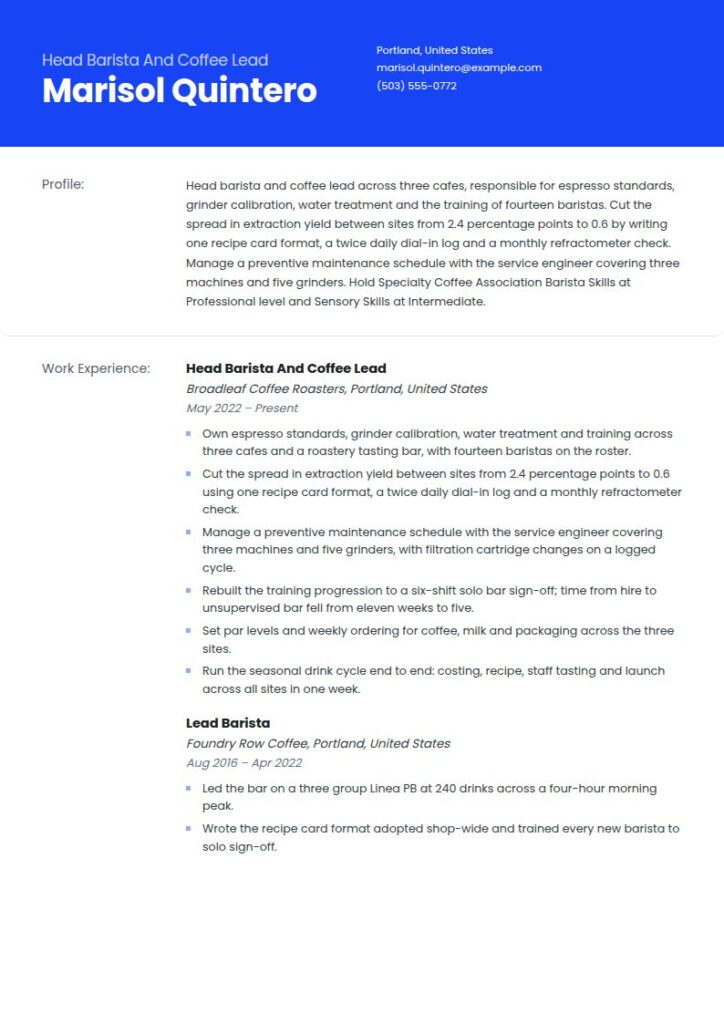
Head barista and coffee lead across three cafes, responsible for espresso standards, grinder calibration, water treatment and the training of fourteen baristas. Cut the spread in extraction yield between sites from 2.4 percentage points to 0.6 by writing one recipe card format, a twice daily dial-in log and a monthly refractometer check. Manage a preventive maintenance schedule with the service engineer covering three machines and five grinders. Hold Specialty Coffee Association Barista Skills at Professional level and Sensory Skills at Intermediate.
Right vs wrong: the same barista summary, twice
| ✅ Right | ❌ Wrong |
|---|---|
| Seven years on espresso, currently lead on a three group Linea PB with a Mythos One. | Experienced barista with a love of coffee and people. |
| Dial in two single origins and a blend every morning against a 1:2 ratio and a 27 to 30 second window. | Skilled at making a wide variety of espresso-based beverages. |
| 240 drinks across a four-hour morning with an average espresso beverage out in under 90 seconds. | Thrives in a fast-paced environment. |
The right column can be rostered on Saturday. The left column has to be trialled first, and the trial is a week of waiting neither of you wanted.
Outline your experience behind the bar
Cafe, city, title, dates, then three or four bullets. Each bullet carries a number: drinks, tickets, minutes, dollars or people.
| Instead of | Use |
|---|---|
| Made coffee for customers | Ran the espresso bar solo through a 7:00 to 9:30 peak, roughly 140 drinks a morning |
| Trained new staff | Trained six new baristas to solo bar sign-off using a written six-shift progression |
| Maintained cleanliness | Owned the daily backflush, weekly gasket and screen service and the monthly grinder burr inspection |
| Worked the register | Handled 300 to 380 tickets a shift on Toast with a cash drawer variance under one dollar |
| Helped with new drinks | Costed and launched four seasonal drinks; the autumn special reached 11 percent of drink sales in six weeks |
Lead Barista, Foundry Row Coffee, Portland, OR, August 2021 to Present
Lead the espresso bar on a three group La Marzocco Linea PB with a Victoria Arduino Mythos One and a Mahlkonig EK43 for filter, plus a Fetco batch brewer on two hoppers.
Dial in two single origins and a house blend each morning against written recipe cards, then recheck at the shift change; log dose, yield, time and taste note every time.
Hold 240 drinks across a four-hour morning peak with an average espresso beverage leaving the bar in under 90 seconds.
Wrote the recipe card format now used by all fourteen baristas, which cut the spread in extraction yield between opening and closing baristas from 2.4 percentage points to 0.6.
Own preventive maintenance: daily backflush, weekly screens and gaskets, monthly burr inspection, and the quarterly service visit booking.
Train new baristas to solo bar sign-off on a six-shift progression; six of the last seven passed on schedule.
Name the machine, the grinder and your dial-in routine
This is the block that separates a barista resume from a counter service resume, and almost nobody writes it.
A cafe owner hiring a barista is buying two things. The first is throughput: can you stand in front of a queue of eleven people and keep drinks moving. The second, and the one that costs them money when it is missing, is calibration: can you tell the coffee is running fast, work out why, and fix it before forty drinks go out sour.
Coffee changes. A bag dialled in on Monday is different on Thursday because it has degassed. Humidity moves, a new lot lands, burrs wear. A barista who can only reproduce a setting someone else made needs a supervisor on every shift. A barista who can find the setting can be handed the keys.
Write the block as a short stack of labeled lines.
Espresso: La Marzocco Linea PB, 3 group, with Victoria Arduino Mythos One and Mazzer Robur grinders. Also worked on Nuova Simonelli Appia Life and Synesso MVP.
Dial-in routine: Recipe card per coffee giving dose, yield, time and target taste. Baseline 18.5 g in, 37 g out, 27 to 30 seconds. Pull, taste, adjust grind in one direction only, re-pull, log. Re-check at every shift change and after any bag change. Extraction yield verified weekly with a refractometer against the recipe card.
Brew and batch: Mahlkonig EK43 for pourover and single cup, Fetco CBS-2132XTS on two hoppers at 55 g per liter, V60 and Chemex to a written brew sheet. Batch discard timer set at 60 minutes.
Milk and standards: Three jug rotation at peak, texture to a written standard, latte art on every milk drink, separate steam wand and jug for oat and other alternatives.
Maintenance: Daily backflush and hopper wipe-down, weekly screens, gaskets and grouphead brush, monthly burr inspection and grind retention purge, quarterly engineer visit booked and logged.
Water: Filtration cartridge changed on a logged schedule, with hardness and alkalinity checked against the machine manufacturer's specification.
Every line there is a question a bar manager would otherwise ask at the trial. Three rules keep it honest.
Name the exact model, not the brand family. "La Marzocco" could mean a Linea Classic with no scales or a Linea PB with paddle groups and a very different workflow.
Give the routine, not the setting. Your grind setting at the old shop is meaningless elsewhere because it belongs to that grinder, that coffee and that day. The sequence you follow when something drifts is what transfers.
Separate what you have run from what you have been trained on. If you sat the Barista Skills module on a machine you have never used at work, say so on the certifications line rather than implying bar hours you do not have.
Write the volume, because everyone else writes the adjective
"High volume" means one thing in a drive-through and another in a twelve-seat espresso bar. Replace it with a count and a window: 240 drinks in a four-hour morning, 65 tickets an hour at peak, 380 transactions on a Saturday.
If you have never counted, count on your next four shifts; most point of sale systems produce an hourly ticket report and your manager will usually print it.
Then set the quality number beside the volume number. Throughput alone reads as a claim about speed; throughput next to a dial-in log reads as a claim about control, and control is the rarer thing.
Build a snapshot of your key skills
Twelve to sixteen entries in four groups: espresso and brew, milk and drinks, bar operations, and systems.
Espresso and brew: Grinder calibration and dial-in, Recipe card design, Refractometry and extraction yield, Batch brew ratios, Manual brew methods, Water filtration and hardness
Milk and drinks: Milk texturing to standard, Latte art, Alternative milks and cross-contact control, Seasonal drink development, Drink costing
Bar operations: Solo bar at peak, Ticket sequencing and call order, Opening and closing procedure, Preventive maintenance, Par levels and ordering, Waste and discard logging
Systems and service: Toast and Square point of sale, Cash handling and drawer reconciliation, Mobile order queue management, Allergen questions at the counter, Barista training and sign-off
Keep the list to things you would be happy to be tested on at a trial shift.
List your education and certifications
Formal education is not a gate here. The Bureau of Labor Statistics lists no formal educational credential as the typical entry-level requirement for food and beverage serving and related workers (BLS Occupational Outlook Handbook, last modified 27 August 2026). Lead with the card that is a legal requirement and the coffee credentials that are not.
Oregon Food Handler Card, Oregon Health Authority, #OR-FH-4482119, issued 2025, valid through 2028
Specialty Coffee Association Coffee Skills Program: Barista Skills Professional (2024), Barista Skills Intermediate (2021), Brewing Foundation (2022), Sensory Skills Intermediate (2025), building toward an SCA Skills Diploma
OLCC Alcohol Service Permit, Oregon Liquor and Cannabis Commission, #OLCC-SP-2288471, valid through 2029
Associate of Applied Science, Business Management, Portland Community College, Portland, OR, 2019
The Specialty Coffee Association runs its Coffee Skills Program as six modules, including Barista Skills, Brewing and Sensory Skills, each at Foundation, Intermediate and Professional level, with completed courses accumulating toward an SCA Skills Diploma (Specialty Coffee Association, Coffee Skills Program). Name the module and the level. "SCA certified" does not tell a reader which course you sat.
Choose the right layout and design
Single column, 11 point type, clear headings, no photograph, no coffee cup graphics. Send a PDF unless the form asks otherwise, named for yourself and the job. If you have more than a page of material, the equipment block and the last three cafes stay and the rest goes.
Name the exact espresso machine and grinder models you have worked on. Describe your dial-in routine as a sequence, not as a setting. Put a drink count and a time window on every volume claim. Write the food handler card with its issuing authority and expiry date. Say which Specialty Coffee Association module and level you hold. List the cleaning and maintenance you own, because it is the part managers most often inherit as a problem.
Do not write "fast-paced environment" or "passionate about coffee"; both appear on almost every file in the stack. Do not claim latte art without saying which pours you can produce consistently. Do not list a food handler card that has expired without marking it as expired. Do not pad to two pages. Do not include a photograph or a two-column template, since the larger groups parse applications with software before a person opens them.
Barista job market and outlook
Baristas are counted by the Bureau of Labor Statistics inside food and beverage serving and related workers, an enormous occupation with steady growth and extremely heavy turnover.
| Measure | Value |
|---|---|
| Food and beverage serving and related workers, 2025 | 5,143,000 |
| Projected change, 2025-35 | 5 percent |
| Projected annual average openings | ~1,078,500 |
| Typical entry-level education | No formal educational credential |
| Median annual wage, May 2025 | $31,710 |
| Median hourly wage, May 2025 | $15.24 |
Source: U.S. Bureau of Labor Statistics, Occupational Outlook Handbook, Food and Beverage Serving and Related Workers, May 2025 wage data and 2025-35 projections.
Roughly a million openings a year sounds like an easy market, and for a first job it is. The competition is for the good bar: the independent with a serious coffee program, the roaster's flagship, the hotel outlet paying above the street. Those places filter on the details this guide is about.
The cafe is the lowest paying place to be a barista
Food services and drinking places employ 81 percent of all food and beverage serving and related workers and pay a median of $15.00 an hour. Healthcare and social assistance employs 4 percent at a median of $17.12, educational services 3 percent at $17.02, traveler accommodation 2 percent at $16.82 and retail trade 4 percent at $16.72 (BLS Occupational Outlook Handbook, Food and Beverage Serving and Related Workers, May 2025 wage data, last modified 27 August 2026).
The gap between the sector where nearly everyone works and the best paying sector is $2.12 an hour at the median, which is roughly $4,400 a year on full-time hours before tips.
Hospital cafes, university coffee shops, corporate campus outlets and hotel lobby bars all hire baristas and all sit outside food services and drinking places. They want the same skills plus evidence you can work inside somebody else's compliance regime: the food handler card, the cleaning and maintenance log, allergen handling, and a bar run to a written standard.
What salary you can expect as a barista
The median wage for food and beverage serving and related workers was $15.24 an hour, or $31,710 a year, as of May 2025 (BLS Occupational Outlook Handbook, May 2025 wage data). That is the base only. Tips sit on top of it in most cafes and vary far too much by city and format for a national figure to describe your bar.
Three things visibly move a barista's pay, and each is something your resume can carry.
The sector is the largest single lever: the $2.12 an hour median gap between food services and healthcare settings described above.
The second is the step to lead or head barista. Those roles sit on training, ordering, calibration standards and maintenance scheduling, which is why the equipment and dial-in block is worth writing in full even for an ordinary barista role. It is the evidence base for the next promotion.
The third is scarcity of skill locally. Refractometry, water chemistry, grinder servicing, competition experience and the ability to hold one standard across several sites are uncommon, and independents with a coffee program pay for them because they cannot train them in quickly.
Key takeaways for a barista resume
- Name the exact machine and grinder models; the model is the fact, the brand is not.
- Write your dial-in routine as a sequence you follow, not as a grind setting from a shop you left.
- Put a drink count and a time window behind every claim about volume.
- Give the food handler card its issuing authority and expiry date, because rules are state by state.
- Say which Specialty Coffee Association module and level you hold, not just that you are certified.
- Claim the maintenance you own; it is the work managers most often find missing after a hire.
- Keep it to one page, single column, and let the equipment block do the persuading.
Build your barista resume in 15 minutes with our AI resume builder.
Related hospitality and catering resume examples
- Cook resume
- Food service worker resume
- Fast food worker resume
- McDonalds resume
- Chick-fil-A resume
- Busser resume
- Hostess resume
- Dishwasher resume
- Waiter resume
- Bartender resume
- Baker resume
- Restaurant resume
Pair it with a matching barista cover letter.
Barista resume questions, answered
How long should a barista resume be?
One page, always. Even a head barista with twelve years and three sites can hold the machine list, the standards work, the training numbers and the last three employers inside a page.
Do I need a food handler card to be a barista?
It depends on your state and sometimes your county. Oregon requires food service workers to get a food handler card within 30 days of beginning work, keeps it valid for three years, and does not accept cards from other states (Oregon Health Authority, Food Handler Cards). Check your own state health authority, and write the authority and the expiry rather than the word "certified".
Is a Specialty Coffee Association certification worth it for a barista?
It is worth it when you name it precisely. The Coffee Skills Program runs six modules, each at Foundation, Intermediate and Professional level, and completed courses build toward an SCA Skills Diploma (Specialty Coffee Association, Coffee Skills Program). "Barista Skills Intermediate, 2024" tells a manager what you sat; "SCA certified" does not. It rarely beats bar hours on its own, but it separates two similar candidates.
What do I put on a barista resume with no experience?
Put the equipment you trained on and the routine you were taught, even if the hours were short. Then any counter, till or volume service work, written with numbers: transactions a shift, drawer accuracy, queue length. Then your food handler card, because a candidate who holds one can be scheduled immediately. Finally, ask for a trial shift, since that is how the job is decided.
Should I put latte art on my barista resume?
Yes, but specifically. "Latte art on every milk drink, consistent rosetta, tulip and heart at 6 and 8 ounce" is a claim a manager can check in four minutes; "latte art skills" is not. A placing in a local throwdown belongs on the page too, with the year.
How do I move from a chain cafe into an independent coffee bar?
Build the three things a chain rarely gives you room to show: calibration, taste vocabulary and maintenance. Ask to be trained on the dial-in even where a central recipe is issued, keep your own log of dose, yield, time and taste, and sit the Barista Skills module at Foundation or Intermediate level. Then write the resume around that log rather than around the brand.