Food and Beverage Attendant Yusuf Kaplan
Food and Beverage Attendant, Banquets and Outlet
[email protected] | (206) 555-0880 | Seattle, United States
Profile
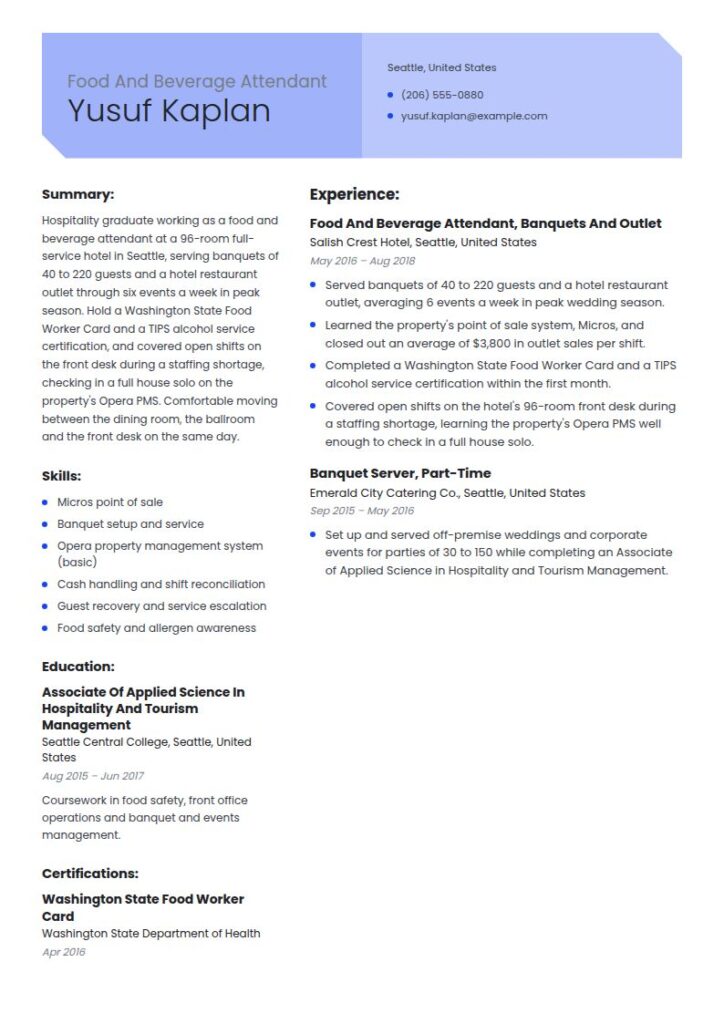
Hospitality graduate working as a food and beverage attendant at a 96-room full-service hotel in Seattle, serving banquets of 40 to 220 guests and a hotel restaurant outlet through six events a week in peak season. Hold a Washington State Food Worker Card and a TIPS alcohol service certification, and covered open shifts on the front desk during a staffing shortage, checking in a full house solo on the property's Opera PMS. Comfortable moving between the dining room, the ballroom and the front desk on the same day.
Work Experience
05/2016 - 08/2018, Food and Beverage Attendant, Banquets and Outlet, Salish Crest Hotel, Seattle, United States
- Served banquets of 40 to 220 guests and a hotel restaurant outlet, averaging 6 events a week in peak wedding season.
- Learned the property's point of sale system, Micros, and closed out an average of $3,800 in outlet sales per shift.
- Completed a Washington State Food Worker Card and a TIPS alcohol service certification within the first month.
- Covered open shifts on the hotel's 96-room front desk during a staffing shortage, learning the property's Opera PMS well enough to check in a full house solo.
09/2015 - 05/2016, Banquet Server, Part-Time, Emerald City Catering Co., Seattle, United States
- Set up and served off-premise weddings and corporate events for parties of 30 to 150 while completing an Associate of Applied Science in Hospitality and Tourism Management.
Education
08/2015 - 06/2017, Associate of Applied Science, Hospitality and Tourism Management, Seattle Central College, Seattle, United States
Coursework in food safety, front office operations and banquet and events management.
Skills
Micros point of sale, 65
Banquet setup and service, 80
Opera property management system (basic), 50
Cash handling and shift reconciliation, 70
Guest recovery and service escalation, 60
Food safety and allergen awareness, 75
Languages
English, native
Turkish, native
Spanish, beginner
Certificates
04/2016, Washington State Food Worker Card, Washington State Department of Health
05/2016, TIPS Alcohol Service Certification, Health Communications Inc. (TIPS)
Summary
A hospitality and catering resume has to name the lane before it names the job: rooms, food and beverage, events or the kitchen each hire on different evidence. This guide gives you three adaptable versions built on a career that moved through three of the four lanes, the systems and numbers each lane actually reads, and current Bureau of Labor Statistics pay and outlook for the named occupations this sector is built from.
Hospitality and Catering resume examples by experience level
A hospitality and catering resume is a one to two page document, and the decision that matters most is not the format but the lane: rooms, food and beverage, events or the kitchen. Each is read by a different hiring manager against different evidence, and a resume written to please all four at once reads as though it was written for none of them.
In fact, hospitality and catering is not a single occupation. It sits over a large family of jobs, front desk agents, housekeepers, servers, bartenders, banquet and event staff, cooks and dishroom staff, reporting up through food service managers and lodging managers, and the job title on the posting tells you which lane you are being read against.
Resume guide for a hospitality and catering resume
In short, this guide and the corresponding hospitality and catering resume example will cover:
- First, how to write a hospitality and catering resume, section by section
- Then, why the lane, rooms, food and beverage, events or the kitchen, decides what counts as evidence
- Next, three adaptable summaries built on one career that moved through three of the four lanes
- What actually carries across when you change lanes, and what has to be rewritten
- Finally, what the job market and pay look like across the named occupations this sector is built from
How to write a hospitality and catering resume
Overall, five sections: contact header, a summary naming the lane and the scale, experience, a skills block naming the systems for that lane, and education and certifications. In general, one page for the first few years, then two once you are supervising a department.
| Section | What it is answering | Where it goes |
|---|---|---|
| Header and title line | Which lane, and at what scale | Top, with the venue size named |
| Summary | The property, the systems you run and one number | Directly under the header |
| Experience | What you did in each lane, with covers, rooms or guests attached | Reverse chronological |
| Skills | The named systems and certifications for the lane you are targeting | Its own block |
| Education and certifications | Food safety and any lane-specific credential | Near the end, unless newly graduated |
Name the system for the lane you are applying to
A posting for a front desk role will usually name a property management system by product: Oracle Opera, OnQ or Cloudbeds. A posting for a server or bartender role will name a point of sale system: Toast, Micros, Aloha or Square. A posting for an events or catering coordinator will name a sales and catering platform, most often Delphi, Tripleseat or Caterease.
Write the product name you actually used, not the category. "Property management system experience" does not match "Opera" in a search or a scan, and a hiring manager reading forty resumes for a front desk supervisor post is looking for the one word that tells them training time will be short.
Run the finished file through the ATS resume checker before you submit; hotel and restaurant groups increasingly parse applications the same way, and a system name in plain text is what a parser is built to find.
Choosing the best resume format for a hospitality and catering resume
In practice, reverse chronological, single column, one page for the first few years, two once you are supervising a department or running multiple outlets.
Functional formats fail here for the same reason they fail everywhere hiring managers read for continuity: hospitality careers move often, between properties and between lanes, and a reader wants to see the sequence. Short stints during seasonal or shift-based work read as normal in this industry; a format that hides the timeline reads as a timeline worth hiding.
Include your contact information
| ✅ Right | ❌ Wrong |
|---|---|
| Yusuf Kaplan | Yusuf Kaplan |
| Front Desk Supervisor, Rooms Division | Hospitality Professional |
| 214-room full-service hotel, 6 agents supervised | Passionate about guest service |
| (206) 555-0880, [email protected], Seattle, WA | (206) 555-0880, [email protected] |
Also, the second line names the lane and the title, not a category like "hospitality professional", which carries no information at all. Then the third line is scope: the property size, the team you run or the covers you serve. A reader deciding whether to open the rest of the page is deciding on that line.
Make use of a summary
In short, four lines: the lane and the property, the scale, the systems you run, and one number with a period attached.
Hospitality graduate working as a food and beverage attendant at a 96-room full-service hotel in Seattle, serving banquets of 40 to 220 guests and a hotel restaurant outlet through six events a week in peak season. Hold a Washington State Food Worker Card and a TIPS alcohol service certification, and covered open shifts on the front desk during a staffing shortage, checking in a full house solo on the property's Opera PMS. Comfortable moving between the dining room, the ballroom and the front desk on the same day.
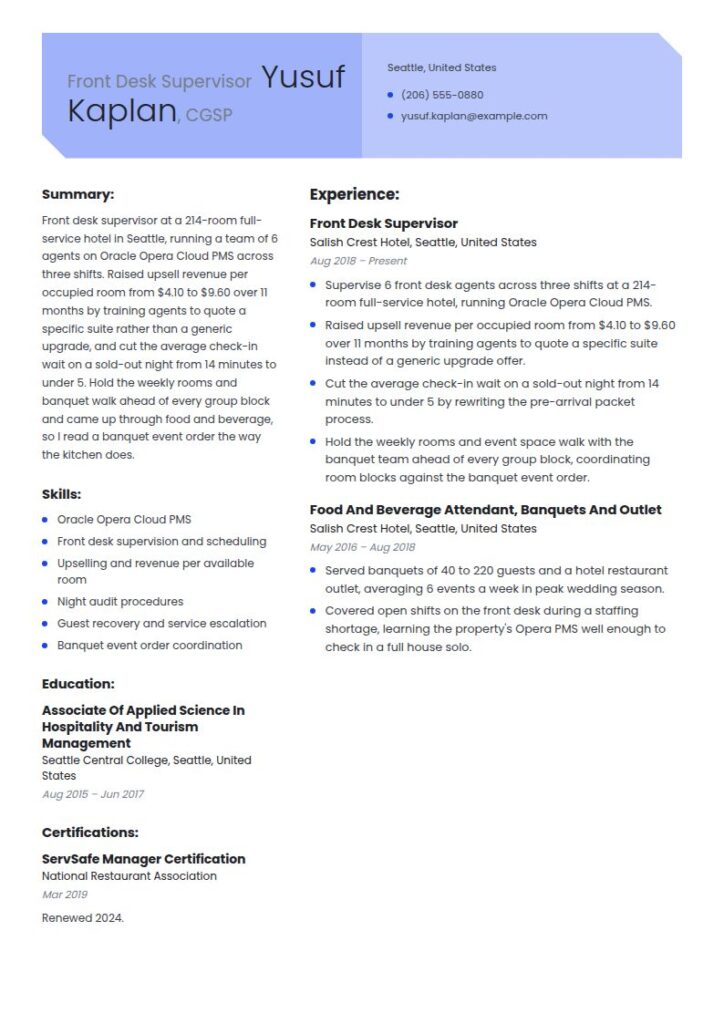
Front desk supervisor at a 214-room full-service hotel in Seattle, running a team of 6 agents on Oracle Opera Cloud PMS across three shifts. Raised upsell revenue per occupied room from $4.10 to $9.60 over 11 months by training agents to quote a specific suite rather than a generic upgrade, and cut the average check-in wait on a sold-out night from 14 minutes to under 5. Hold the weekly rooms and banquet walk ahead of every group block and came up through food and beverage, so I read a banquet event order the way the kitchen does.
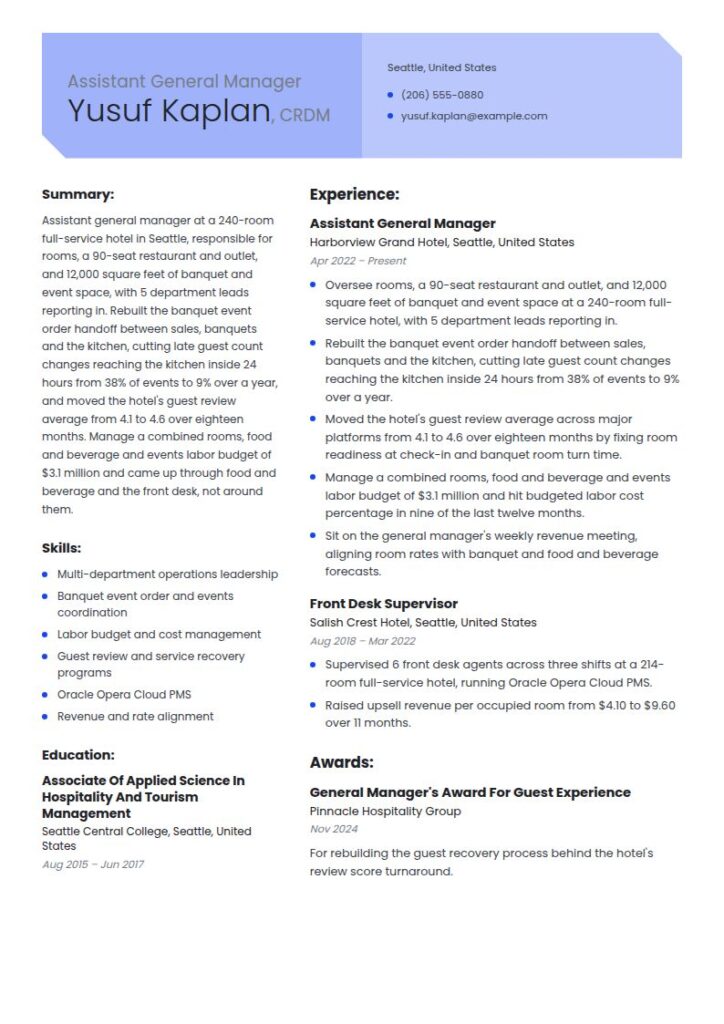
Assistant general manager at a 240-room full-service hotel in Seattle, responsible for rooms, a 90-seat restaurant and outlet, and 12,000 square feet of banquet and event space, with 5 department leads reporting in. Rebuilt the banquet event order handoff between sales, banquets and the kitchen, cutting late guest count changes reaching the kitchen inside 24 hours from 38% of events to 9% over a year, and moved the hotel's guest review average from 4.1 to 4.6 over eighteen months. Manage a combined rooms, food and beverage and events labor budget of $3.1 million and came up through food and beverage and the front desk, not around them.
Right vs wrong: the same summary, twice
| ✅ Right | ❌ Wrong |
|---|---|
| Front desk supervisor at a 214-room full-service hotel, running a team of 6 agents on Oracle Opera Cloud PMS. | Experienced hospitality professional with excellent customer service skills. |
| Raised upsell revenue per occupied room from $4.10 to $9.60 over 11 months. | Proven ability to exceed guest expectations. |
| Came up through food and beverage, so I read a banquet event order the way the kitchen does. | Team player with a passion for the hospitality industry. |
For example, the right column states a property, a system, a scale and a movement. In contrast, the wrong column states a category and three abilities every applicant claims, none of them checkable by calling a reference.
Outline your hospitality and catering experience
For instance: property or venue, what it is, its size, dates. Then three to five bullets. Each bullet names a number, covers, rooms, guests, revenue or a rate, tied to a period, so it reads as a movement rather than a boast.
| Instead of | Use |
|---|---|
| Provided excellent customer service | Served banquets of 40 to 220 guests, averaging 6 events a week in peak season |
| Managed front desk operations | Supervise 6 front desk agents across three shifts at a 214-room hotel on Oracle Opera Cloud PMS |
| Increased hotel revenue | Raised upsell revenue per occupied room from $4.10 to $9.60 over 11 months |
| Handled guest complaints | Cut the average check-in wait on a sold-out night from 14 minutes to under 5 |
| Coordinated events with the kitchen | Rebuilt the banquet event order handoff, cutting late guest count changes reaching the kitchen inside 24 hours from 38% of events to 9% |
Assistant General Manager, Harborview Grand Hotel, Seattle, WA, April 2022 to Present
Oversee rooms, a 90-seat restaurant and outlet, and 12,000 square feet of banquet and event space at a 240-room full-service hotel, with 5 department leads reporting in.
Rebuilt the banquet event order handoff between sales, banquets and the kitchen, cutting late guest count changes reaching the kitchen inside 24 hours from 38% of events to 9% over a year.
Moved the hotel's guest review average across major platforms from 4.1 to 4.6 over eighteen months by fixing the two service breakdowns guests named most: room readiness at check-in and banquet room turn time.
Manage a combined rooms, food and beverage and events labor budget of $3.1 million and hit budgeted labor cost percentage in nine of the last twelve months.
Front Desk Supervisor, Salish Crest Hotel, Seattle, WA, August 2018 to March 2022
Supervised 6 front desk agents across three shifts at a 214-room full-service hotel, running Oracle Opera Cloud PMS.
Raised upsell revenue per occupied room from $4.10 to $9.60 over 11 months by training agents to quote a specific suite instead of a generic upgrade offer.
Cut the average check-in wait on a sold-out night from 14 minutes to under 5 by rewriting the pre-arrival packet process.
Pick the lane before you write the resume: rooms, food and beverage, events or kitchen
In other words, hospitality and catering is four different hiring conversations wearing one industry name. For this reason, a rooms hiring manager, a food and beverage manager, an events or catering director and an executive chef are reading for different evidence, and a resume that tries to speak to all four at once ends up specific to none of them.
| Lane | What it hires on | The evidence to lead with | The system usually named |
|---|---|---|---|
| Rooms | Accuracy under a full house, and revenue per available room | Occupancy, upsell revenue, check-in and check-out times, guest satisfaction score | Property management system: Opera, OnQ, Cloudbeds |
| Food and beverage | Covers, ticket times and cost control | Covers per shift, table turns, beverage or food cost percentage, section size | Point of sale: Toast, Micros, Aloha, Square |
| Events and catering | Guest counts, service style and the handoff to the kitchen | Guest count and service style, plated, buffet or stations, staffing ratio, banquet event order accuracy | Sales and catering platform: Delphi, Tripleseat, Caterease |
| Kitchen | Speed, consistency and food cost | Covers per station, ticket times, food cost percentage, prep and par accuracy | Kitchen display or inventory system, named where used |
Evidence that carries across every hospitality lane
The four lanes hire differently, but three kinds of evidence carry across all of them, because every hiring manager in the sector reads for the same three things regardless of lane. The first is a food safety credential: a food worker card, ServSafe or an equivalent certificate accredited under the Conference for Food Protection's Standards for Accreditation of Food Protection Manager Certification Programs is read the same way in a kitchen, a banquet department or a hotel outlet, because that accreditation gives every employer a single, portable measure of the training (Conference for Food Protection, accessed September 2026). The second, for instance, is a volume number attached to a period: covers a shift, rooms a night, guests an event. Finally, the third is evidence that you have held a service recovery conversation and closed it, whatever the setting.
However, what does not carry is the system name and the process vocabulary. For example, a front desk resume that leads with beverage cost percentage reads as misfiled, and a banquet captain resume that opens with revenue per available room reads the same way. If you are applying across two lanes, keep one master document, then cut the systems block and the opening bullets down to the lane the posting is for before you send it.
How one hospitality career crossed three lanes
The persona in this guide moved through three of the four lanes over roughly six years: food and beverage first, into rooms, and now overseeing rooms, food and beverage and events together as an assistant general manager. What made the moves possible was never the job title; it was that each summary kept naming a volume, a system and a result, so a reader in a different lane could still tell what the candidate had actually been responsible for.
Build a snapshot of your key skills
Next, twelve to sixteen entries in groups that match the lanes above. Then lead with the group that matches the posting.
Rooms and guest service: Oracle Opera Cloud PMS, Front desk supervision and scheduling, Upselling and revenue per available room, Night audit procedures, Guest recovery and service escalation
Food and beverage: Toast and Micros point of sale, Covers and table turn management, Beverage cost tracking, TIPS alcohol service certification, Section and shift scheduling
Events and banquets: Banquet event order review and execution, Guest count and staffing ratio planning, Delphi sales and catering platform, Room set and turn coordination
Compliance and operations: Washington State Food Worker Card, ServSafe Manager Certification, Cash handling and shift reconciliation, Labor cost and scheduling budget management
List your education and certifications
In fact, most entry-level hospitality and catering roles carry no formal education requirement. Indeed, the Bureau of Labor Statistics records no formal educational credential as typical entry-level education for food and beverage serving occupations, and a high school diploma or equivalent for food service managers, in the current cycle (BLS Occupational Outlook Handbook, published 27 August 2026). What separates candidates instead is certification and demonstrated scope, so put them first.
Associate of Applied Science, Hospitality and Tourism Management, Seattle Central College, Seattle, WA, 2015 to 2017
Certifications: ServSafe Manager Certification, National Restaurant Association, 2019, renewed 2024. AHLEI Certified Guest Service Professional (CGSP), American Hotel & Lodging Educational Institute, 2020. Washington State Food Worker Card, Washington State Department of Health, renewed 2026.
Later, a rooms-specific credential such as AHLEI's Certified Rooms Division Manager is worth adding once you supervise a department; it reads as a deliberate move up the rooms lane rather than a general hospitality credential.
Choose the right layout and design
Above all: single column, 11 or 12 point body type, clear headings, no photograph. Hotel groups and restaurant chains run applications through a corporate applicant tracking system before a property sees them, and two columns, text boxes and icons are where that parsing breaks.
Name the lane in your title line, not a general category like "hospitality professional". Put scope in the header: property size, covers, or guests served. Name the actual system: Opera, Toast, Micros or Delphi, not "hotel software". Give every bullet a number tied to a period. List the food safety or lane-specific certification with its issuing body and date. Cut the resume down to the lane a specific posting is for before you send it.
Do not describe yourself as passionate about hospitality or a people person; every applicant in the folder writes that. Do not lead a front desk resume with a food and beverage cost metric or the reverse. Do not list "various hotel systems" when the product name is what a scan is built to find. Do not leave an expired certification on the page without saying it has lapsed. Do not use a two-column template for a corporate applicant tracking system.
Hospitality and catering job market and outlook
To be clear, there is no single Bureau of Labor Statistics occupation called hospitality and catering; instead, it is the umbrella over several published occupations, and the honest way to read the market is across all of them.
| Occupation | Jobs, 2025 | Projected change, 2025-35 | Annual openings | Median annual wage, May 2025 |
|---|---|---|---|---|
| Food and beverage serving and related workers | 5,143,000 | 5% growth, +280,800 | ~1,078,500 | $31,710 |
| Cooks | 2,705,800 | 7% growth | ~393,200 | $36,640 |
| Waiters and waitresses | 2,284,400 | 2% growth | ~423,100 | $35,230 |
| Bartenders | 762,600 | 5% growth | ~121,200 | $34,340 |
| Food service managers | 344,300 | 6% growth | ~38,800 | $69,390 |
| Lodging managers | 54,800 | 4% growth | ~5,500 | $69,250 |
Source: U.S. For reference: Bureau of Labor Statistics, Occupational Outlook Handbook, May 2025 wage data and 2025 to 2035 projections, published 27 August 2026.
The gap between the frontline and the management lane is the whole story
Set the frontline occupations against the two management occupations and the sector's pay ladder becomes visible in one table. Food and beverage serving and related workers had a median annual wage of $31,710 in May 2025, waiters and waitresses $35,230, cooks $36,640 and bartenders $34,340, while food service managers had a median of $69,390 and lodging managers $69,250, more than double the frontline figures (BLS Occupational Outlook Handbook, published 27 August 2026).
Every one of the frontline occupations is also growing: food and beverage serving and related workers are projected to add 280,800 jobs between 2025 and 2035, and cooks about 393,200 annual openings (BLS, published 27 August 2026). That combination, a wide pay gap and steady demand, is why so many careers in this sector move into a supervisory or management lane inside the same building rather than out of the industry.
What salary you can expect in hospitality and catering
As a result, there is no single hospitality and catering salary. What a resume in this sector is paid against depends on the lane and on whether the role is frontline or management.
Frontline pay sits in a narrow band regardless of lane: $31,710 for food and beverage serving and related workers, $34,340 for bartenders, $35,230 for waiters and waitresses and $36,640 for cooks, all May 2025 medians from the current BLS Occupational Outlook Handbook cycle.
Management pay is a different band. Food service managers had a median annual wage of $69,390 in May 2025, and lodging managers $69,250, both roughly double the frontline figures above (BLS Occupational Outlook Handbook, published 27 August 2026). The Handbook records a high school diploma or equivalent and under five years of related experience as typical for food service managers, which means the credential bar into that band is low; the bar that actually matters is the scope you can put on the page, headcount, covers, rooms or budget.
Certification adds a smaller but real premium inside a lane rather than a jump between lanes. A ServSafe Manager Certification, an AHLEI credential or a state alcohol service card lets a hiring manager schedule you into a role immediately rather than sending you to training first, and it is worth stating with its issuing body and date.
Key takeaways for a hospitality and catering resume
- Decide the lane, rooms, food and beverage, events or the kitchen, before you write a line.
- Also name the actual system: Opera, Toast, Micros or Delphi, never a category, and put scope in the header: property size, covers, rooms or guests served.
- In addition, give every bullet a number tied to a period, not an adjective.
- Similarly, lead with a food safety or lane-specific certification and its issuing body.
- Cut the master document to the lane a specific posting is for before you send it.
- Finally, expect the real pay jump to sit between frontline and management, not between properties, and keep the file single column and ATS-parseable.
Build your hospitality and catering resume in 15 minutes with our AI resume builder.
Related hospitality and catering resume examples
- Chef resume
- Cook resume
- Pastry chef resume
- Executive chef resume
- Barista resume
- Bartender resume
- Server resume
- Waitress resume
- Hotel front desk employee resume
- Hotel management resume
- Concierge resume
- Caterer resume
Pair it with a matching hospitality and catering cover letter.
Hospitality and catering resume questions, answered
What is the difference between this guide and a resume for one job in the category, like a server or a hotel front desk employee?
This guide is for the umbrella and for careers that move across lanes; once you are applying to one named role, use that role's own guide, for example our [server resume example](/resume/server/) or [hotel front desk employee resume example](/resume/hotel-front-desk-employee/), since a specific lane's guide reads more precisely than this one.
What do I put on a hospitality and catering resume with no experience?
Any shift-based, seasonal or part-time work written at full scale: the covers you served, the guests you checked in, the shift you covered. Add a food safety credential such as a state food worker card if you have one; it is inexpensive and read the same way by every lane.
How do I write a resume that covers more than one lane?
Keep one master document with your full history, then cut the systems block and the opening bullets to the lane a specific posting names before you send it. A resume that opens with beverage cost for a front desk posting reads as misfiled.
Is a hospitality degree worth listing?
Yes, briefly: it signals baseline vocabulary in a sector where the BLS records no formal educational credential as typical for most frontline roles (BLS Occupational Outlook Handbook, published 27 August 2026). It should not crowd out certification and scope once you have both.
What certification actually moves a hospitality and catering resume forward?
A food safety credential accredited under the Conference for Food Protection's Standards for Accreditation of Food Protection Manager Certification Programs, such as ServSafe Manager Certification, is read consistently across every lane (Conference for Food Protection, accessed September 2026). Beyond that, a lane-specific credential, an alcohol service card or an AHLEI credential, adds a smaller premium inside that lane.
Does moving between lanes hurt a resume?
No, if the numbers and systems are named clearly in each role. A reader in a different lane cannot judge unfamiliar jargon, but can judge a covers figure, a rooms figure or a dollar figure attached to a period, which is why volume and outcome numbers should carry the page rather than lane-specific terms alone.