Chef de Cuisine Rachid Zerhouni
Chef de Cuisine
[email protected] | (312) 555-0940 | Chicago, United States
Profile
Chef de cuisine with nine years in Chicago kitchens, four of them running a 140-seat tavern kitchen with 11 cooks and a 62-item menu. Wrote and costed the first full menu rewrite the restaurant had done in six years, 22 dishes across four sections, and standardized all 22 into a written spec book with yields, portion weights and allergen lines. Run a weekly specials program of 3 dishes and hold a ServSafe Food Protection Manager Certification.
Work Experience
09/2022 - Present, Chef de Cuisine, Fulton Yard Tavern, 140-seat tavern, Chicago, United States
- Run a 140-seat tavern kitchen with 11 cooks and a 62-item menu, 1,400 covers a week.
- Wrote and costed the first full menu rewrite in six years: 22 dishes across four sections, approved by the owner in two tasting rounds.
- Standardized all 22 dishes into a written spec book with yields, portion weights, method, plating photograph and allergen line.
- Author a weekly specials program of 3 dishes, costed at yield-tested portion weight before it goes on the board.
- Run ordering and receiving against written vendor specifications for 18 suppliers.
06/2019 - 08/2022, Sous Chef, Marquette Street Kitchen, 80-seat neighbourhood restaurant, Chicago, United States
- Ran service on the chef's days off and wrote the section prep lists for a 7-cook brigade.
- Rewrote the vegetable and garnish sections of two seasonal menus with the chef.
03/2017 - 06/2019, Chef de Partie, Marquette Street Kitchen, 80-seat neighbourhood restaurant, Chicago, United States
- Held saute and grill across a 5-day service week and trained two commis cooks on both sections.
Education
09/2015 - 05/2017, Associate in Applied Science, Culinary Arts, Bridgeport Culinary Institute, Chicago, United States
Culinary arts with coursework in nutrition, food safety and sanitation, and cost control.
Skills
Menu writing and dish development, 80
Recipe standardization and spec books, 80
Yield testing and portion control, 75
Dish costing before sign-off, 75
Ordering and vendor specification, 70
HACCP and cooling records, 80
Brigade training and line checks, 75
Languages
English, native
French, advanced
Arabic, native
Certificates
05/2023, ServSafe Food Protection Manager Certification, National Restaurant Association
Renewal due 2028.
02/2024, HACCP for Food Service, International HACCP Alliance accredited provider
Summary
An executive chef resume is judged on menu development as an output: how many menus you wrote, how often they changed, how they were standardized, costed, approved and rolled out to a brigade. This guide gives you three adaptable versions, a menu portfolio block, the published American Culinary Federation requirements for Certified Executive Chef, and current Bureau of Labor Statistics pay and outlook for chefs and head cooks.
Executive Chef resume examples by experience level
An executive chef resume is a two page document, and what it is actually judged on is your menus.
Not the restaurants. After all, a list of good kitchens proves you were hired, which the reader already assumes. What an owner, a general manager or a hotel food and beverage lead needs to know is what you produced there: how many menus you wrote, how often they changed, whether they were written down properly, whether they costed out before reaching a printer, and whether a brigade could execute them on the second night.
However, most executive chef resumes describe kitchens. The strong ones describe output.
Resume guide for an executive chef resume
In addition, this guide and the corresponding executive chef resume example will cover:
- First, how to write an executive chef resume, section by section
- Next, why menu development is the evidence, and how to count it
- In addition, three adaptable summaries: first menu you owned, single restaurant, multi-outlet
- Similarly, what the American Culinary Federation requires for Certified Executive Chef
- Finally, what the job market looks like and what you can expect to earn
How to write an executive chef resume
Overall, six sections: contact header with a scope line, summary, experience, a menu portfolio block, skills and systems, and certifications and education. In practice, two pages is normal here; one page cannot carry a menu record.
Above all, the menu block is the section almost nobody includes, and it separates two candidates with identical job titles.
| Section | What it is answering | Where it goes |
|---|---|---|
| Header and scope line | Covers, outlets, brigade size, food sales | Top, under your name |
| Summary | Level, years, scope, one menu outcome | Directly under the header |
| Experience | What you ran and what changed, per kitchen | Reverse chronological |
| Menu portfolio | What you actually developed, with cadence and counts | Its own block, page one if it fits |
| Skills and systems | Standards, costing and inventory tools by name | After experience |
| Certifications and education | ACF level, food safety, culinary qualification | End of page two |
Count your menus before you write anything else
Sit down with a calendar. How many menus have you written from a blank page, how many were revisions, how many dishes in each, and who set the cadence?
Most executive chefs find a bigger number than they expected. Four seasonal changes a year over six years at eighteen dishes a menu is twenty-four menus and several hundred dishes, none of it on the page because it lives in the job description rather than the achievements.
Write the count first. Then run the file through the free Rezoom ATS resume checker, because hotel groups and restaurant companies parse chef applications before a human opens them.
Choosing the best resume format for an executive chef resume
In general, reverse chronological, single column, two pages. The menu portfolio sits inside that structure, not instead of it.
By contrast, a functional or skills-first format fails here. At executive level the reader is checking a progression: line, chef de partie, sous, chef de cuisine or executive sous, then executive. In fact, the American Culinary Federation's Certified Executive Chef requirements are written in those same terms, which tells you how the industry reads a career.
Kitchens are also public. Meanwhile, the reader will recognize half the restaurants on your page and look the rest up in ninety seconds. Write the concept, covers and price point next to each one so they do not have to.
Include your contact information
| ✅ Right | ❌ Wrong |
|---|---|
| Rachid Zerhouni, CEC | Chef Rachid Zerhouni |
| Executive Chef | Award-winning culinary professional |
| 210-room hotel, restaurant, bar and banquet, 24 cooks, 9 menus a year | Passionate about food and creating memorable experiences |
| (312) 555-0940, [email protected], Chicago, IL | (312) 555-0940, [email protected] |
Put the certification suffix on the name line if you hold one; it is verifiable and most applicants do not have it. The third line is scope, and its last item matters most here: menus per year.
Make use of a summary
In short, four lines: level and years, scope, menu cadence, and one outcome with a number attached.
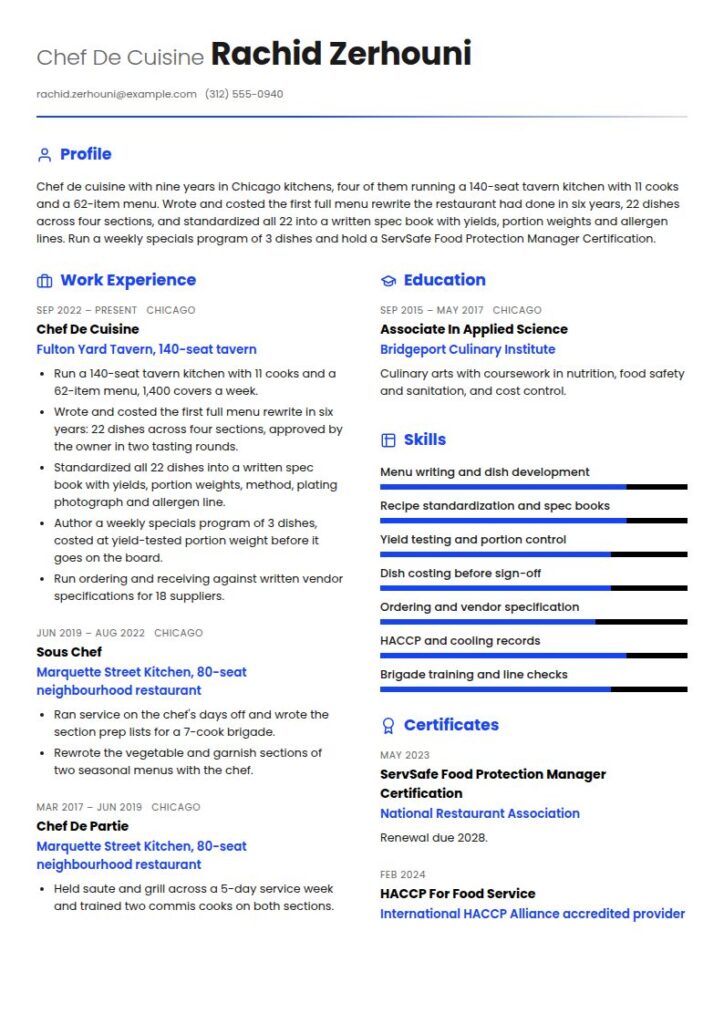
Chef de cuisine with nine years in Chicago kitchens, four of them running a 140-seat tavern kitchen with 11 cooks and a 62-item menu. Wrote and costed the first full menu rewrite the restaurant had done in six years, 22 dishes across four sections, and standardized all 22 into a written spec book with yields, portion weights and allergen lines. Run a weekly specials program of 3 dishes and hold a ServSafe Food Protection Manager Certification.
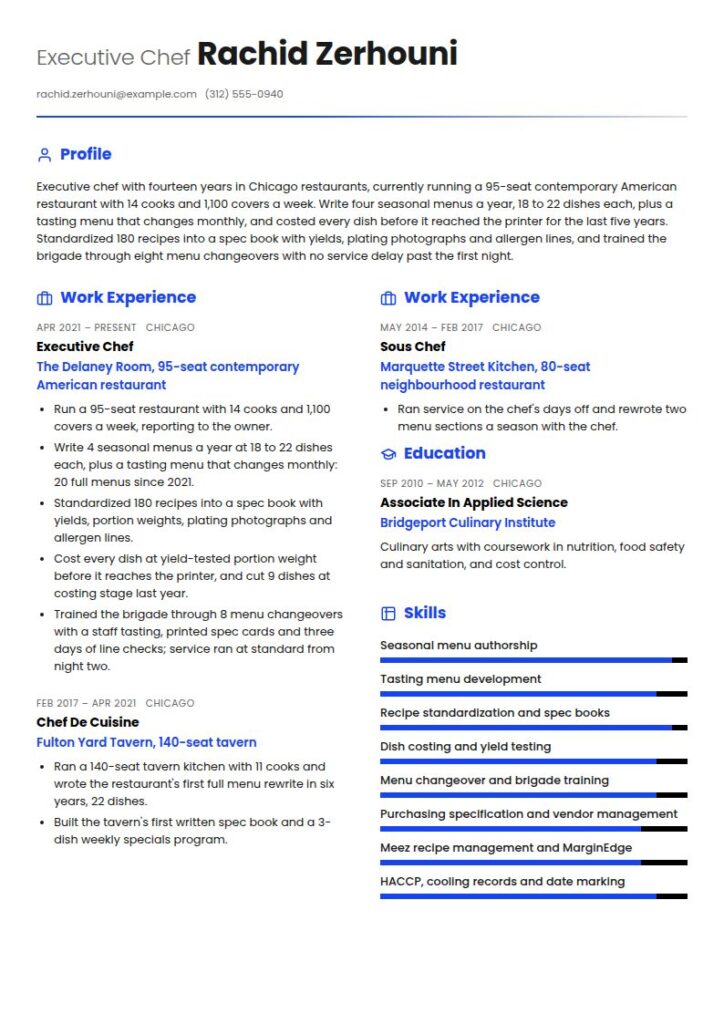
Executive chef with fourteen years in Chicago restaurants, currently running a 95-seat contemporary American restaurant with 14 cooks and 1,100 covers a week. Write four seasonal menus a year, 18 to 22 dishes each, plus a tasting menu that changes monthly, and costed every dish before it reached the printer for the last five years. Standardized 180 recipes into a spec book with yields, plating photographs and allergen lines, and trained the brigade through eight menu changeovers with no service delay past the first night.
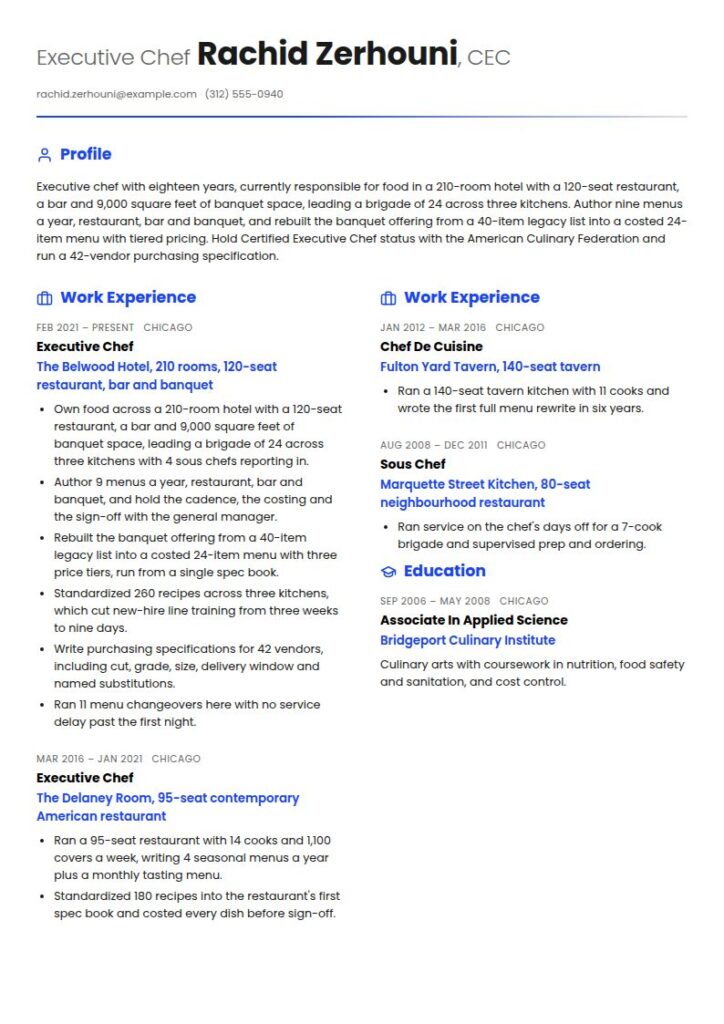
Executive chef with eighteen years, currently responsible for food in a 210-room hotel with a 120-seat restaurant, a bar and 9,000 square feet of banquet space, leading a brigade of 24 across three kitchens. Author nine menus a year, restaurant, bar and banquet, and rebuilt the banquet offering from a 40-item legacy list into a costed 24-item menu with tiered pricing. Hold Certified Executive Chef status with the American Culinary Federation and run a 42-vendor purchasing specification.
Right vs wrong: the same executive chef summary, twice
| ✅ Right | ❌ Wrong |
|---|---|
| Write four seasonal menus a year, 18 to 22 dishes each, plus a monthly tasting menu. | Create innovative seasonal menus using fresh local ingredients. |
| Standardized 180 recipes into a spec book with yields, plating photographs and allergen lines. | Ensure consistency and quality across all dishes. |
| Trained the brigade through eight changeovers with no service delay past the first night. | Lead and inspire a team to deliver excellence. |
| Costed every dish before it reached the printer for five years. | Strong understanding of food cost management. |
In other words, the right column is a portfolio. On the other hand, the left is a job description, and every executive chef in the stack has the same one.
Outline your executive chef experience
To begin with, restaurant or property, city, concept, covers, brigade size and price point on the first line. Then four to six bullets, each attached to a number: the reader wants scope and output in the same glance.
| Instead of | Use |
|---|---|
| Developed seasonal menus | Wrote 4 seasonal menus a year for 5 years, 18 to 22 dishes each, 20 menus in total |
| Standardized recipes across the kitchen | Standardized 180 recipes into a spec book with yields, portion weights, plating photographs and allergen lines |
| Managed food costs | Costed every dish at yield-tested portion weights before it reached the menu, cutting 9 dishes at that stage in one year |
Executive Chef, The Belwood Hotel, Chicago, IL, 210 rooms, 120-seat restaurant, bar and 9,000 square feet of banquet space, brigade of 24, February 2021 to Present
Author nine menus a year across restaurant, bar and banquet, owning the cadence, the costing and the sign-off with the general manager.
Rebuilt the banquet offering from a 40-item legacy list into a costed 24-item menu with three price tiers, run from a single spec book.
Standardized 260 recipes across three kitchens with yields, portion weights, plating photographs and allergen lines, cutting new-hire line training from three weeks to nine days.
Write purchasing specifications for 42 vendors, including cut, grade, size, delivery window and the substitution rules that keep a menu running when a product is short.
Lead 4 sous chefs and a brigade of 24, and have run 11 changeovers here with no service delay past the first night.
Your menu is the portfolio: write the menus you developed, not the kitchens you stood in
A designer sends a portfolio. An architect sends a portfolio. In contrast, an executive chef sends a list of employers, which is the only creative discipline that expects the reader to infer the work from the address.
Instead, fix that with a block that treats menu development as output. Specifically, six things belong in it, and each is countable.
One: cadence and count. First, say how many menus, how often, how many dishes. Four seasonal menus a year is a different job from one menu a year with monthly specials, and both differ from a tasting menu that changes every four weeks. Therefore, state the rhythm: it tells a reader how fast you work.
The executive chef spec book and costing
Two: the spec book. After all, a menu that exists only in your head is one the restaurant loses when you leave, and every owner has been through that. For this reason, say how many recipes you standardized and what a spec contains: yield, portion weight, method, plating photograph, allergen line. Then say what it bought, such as training time.
Three: costing before the menu, not after it. In practice, you cost a dish at the development stage, while it can still be changed or cut. The evidence is the discipline, not the percentage: yield tests on the actual product, portion weights tested on the line, a target price the dish has to clear before it is written up, and the dishes you cut because they did not.
Four: tasting and approval. For example, name who signs off and how many rounds it takes: an owner, a general manager, a food and beverage director or a tasting panel. This part of the job is political rather than technical, and evidence that you can carry a menu through approval without three weeks of argument is worth a great deal.
Sourcing and menu rollout
Five: sourcing and specification. In effect, a menu is a purchasing document. Write the vendor count, what your specifications contain, the seasonal windows you write around and the substitution rules that keep a menu running when a product is short.
Six: the rollout. However, most chefs leave this out, and it decides whether a menu works. For example, how you get a new menu into a brigade: staff tasting, printed spec cards, a walkthrough by section, line checks for the first three days. Then the number: how long before it ran at standard.
Menu development
Nine menus a year: 4 restaurant seasonal, 2 bar, 3 banquet and event. 24 to 32 dishes on the restaurant menu, 24 on banquet.
20 full menus written from a blank page since 2019; 11 changeovers led in the current property.
260 recipes standardized into a spec book: yield, portion weight, method, plating photograph, allergen line. New-hire line training cut from three weeks to nine days.
Every dish costed at yield-tested portion weight before sign-off; 9 cut at that stage last year.
Purchasing specifications for 42 vendors: cut, grade, size, delivery window, named substitutions.
Rollout: staff tasting, printed spec cards by section, three days of line checks. At standard from night two on the last 8 changeovers.
In short, that block is half a page and it is the reason to interview you. It also shapes the interview, because every line is something the reader can ask you to talk through.
Write the changeover, not the concept
Concept language is the easiest thing to write and the hardest to evaluate. Nobody was ever hired on the strength of "modern American with global influences".
The changeover is the opposite: specific, repeatable, and the thing a general manager is actually worried about, because a menu change is when service breaks and tickets run long.
"Eight changeovers, staff tasting, spec cards by section, three days of line checks, at standard from night two" describes a professional process that most kitchens do badly. It is worth more than a paragraph about your cooking.
Build a snapshot of your key skills
Overall, twelve to sixteen entries in four groups: menu development, kitchen operations, systems by product name, and compliance. Above all, development goes first, because it is the page's argument.
Menu development: Seasonal menu authorship, Recipe standardization and spec books, Yield testing and portion control, Dish costing before sign-off, Tasting menus, Banquet menu design, Allergen and dietary menu architecture
Kitchen operations: Brigade structure and section design, Prep and production planning, Ordering and receiving specification, Inventory and stock rotation, Equipment specification
Systems: MarginEdge, Toast, Compeat, Meez recipe management, Excel costing models
Compliance and people: HACCP plans, Cooling and holding records, Date marking and traceability, Hiring and brigade training, Succession planning
List your education and certifications
As a rule, certifications first, with the issuing body and the date. In particular, the American Culinary Federation level is the one the industry recognizes, and it is worth knowing what it asks for.
Certified Executive Chef (CEC), American Culinary Federation, 2022, renewal due 2027
ServSafe Food Protection Manager Certification, National Restaurant Association, 2024
HACCP for Food Service, 2021
Associate in Applied Science, Culinary Arts, Bridgeport Culinary Institute, Chicago, IL, 2008
The American Culinary Federation states that a Certified Executive Chef candidate needs "five years as a chef de cuisine, executive sous chef or chef in charge of food production in a foodservice operation", must have "supervised at least five fulltime people in the preparation of food", and that the experience "must be within the past ten years" (American Culinary Federation, CEC level page, retrieved 16 September 2026).
For example, the education requirement is one of four routes: a high school diploma or GED plus 150 continuing education hours, 250 continuing education hours, an associate's degree in culinary arts, or the ACFEF apprenticeship program. Mandatory coursework covers nutrition, food safety and sanitation, supervisory management, beverage management and cost control management, with eight-hour refreshers for courses older than five years except the last two. In addition, there are written and practical exams, and the certification renews every five years (American Culinary Federation, retrieved 16 September 2026).
Two things follow. The supervision requirement makes headcount a qualifying fact rather than a vanity number, so write how many full-time cooks you have supervised. And the cost control and beverage courses say what the profession thinks an executive chef is: a manager of money and inventory who can also cook.
Choose the right layout and design
In general, single column, two pages, 11 point, clear headings. No plate photographs, no logos, no color blocks, no QR code to a gallery; send a portfolio link as a plain URL line if you have one. Write the concept, covers, brigade size and price point beside every property, and keep the menu block in plain text, because it will be parsed before it is read.
Count your menus and put the number on the page. Say how many recipes you standardized and what a spec contains. Name who signs a menu off and how many rounds it takes. Write the rollout method and how long a new menu takes to run at standard. Give covers, outlets, brigade size and vendor count. Put your ACF level with its renewal year.
Do not describe your cooking style in adjectives; a reader cannot evaluate them. Do not list restaurants without concept, covers and brigade size. Do not send a photograph-led file to a hotel group's application system. Do not claim an ACF level you have not been awarded, because it is verifiable. Do not write the sous chef's duties as your own; at this level the reader expects delegation, not tasks.
Executive chef job market and outlook
For reference, executive chefs sit inside the Bureau of Labor Statistics occupation chefs and head cooks, a small occupation with strong projected growth.
| Measure | Value |
|---|---|
| Chefs and head cooks, jobs 2025 | 220,300 |
| Projected change, 2025-35 | 7 percent (much faster than average), +14,400 |
| Projected annual openings | ~25,200 |
| Typical entry-level education | High school diploma or equivalent |
| Work experience in a related occupation | 5 years or more |
| Median annual wage, May 2025 | $62,470 ($30.03 per hour) |
Source: U.S. Bureau of Labor Statistics, Occupational Outlook Handbook, chefs and head cooks, May 2025 wage data and 2025 to 2035 projections, published 27 August 2026.
The setting you cook in is worth more than a title change
Chefs and head cooks are concentrated in restaurants; the pay is not. Food services and drinking places employ 64 percent of the occupation at a median of $60,580, while traveler accommodation employs 8 percent at $74,380 and amusement, gambling and recreation 5 percent at $72,830. Healthcare and social assistance pays $59,550, and 7 percent of the occupation is self-employed (BLS Occupational Outlook Handbook, May 2025 data, published 27 August 2026).
The gap between a hotel kitchen and a restaurant kitchen at the same level is $13,800 a year at the median. Hotel kitchens also run more menus, because banquet, in-room dining and outlets each need their own, which is exactly the evidence this page asks you to collect.
Cooks, the occupation your brigade belongs to, had a median of $17.62 an hour in May 2025 across 2,705,800 jobs, with about 393,200 annual openings (BLS Occupational Outlook Handbook, published 27 August 2026). Recruiting and holding that team is a large part of what an executive chef is paid for, so retention numbers belong on your page alongside the menus.
What salary you can expect as an executive chef
The median annual wage for chefs and head cooks was $62,470, or $30.03 an hour, in May 2025 (BLS Occupational Outlook Handbook, published 27 August 2026). Executive chef roles sit above that median, since the occupation also contains head cooks in much smaller operations, but BLS publishes no separate executive chef figure, so treat it as a floor rather than a forecast.
Setting moves the number more than title does: $74,380 in traveler accommodation, $72,830 in amusement, gambling and recreation, $60,580 in food services and drinking places, $59,550 in healthcare (BLS, May 2025).
Three things move an offer inside a band. Scope: covers, outlets, brigade size and food sales. Certification, because ACF Certified Executive Chef is a documented five-year renewable standard rather than a claim. And output: a chef who can show twenty menus written, costed and rolled out negotiates from evidence, while a chef with fourteen years of kitchen names negotiates from tenure.
Key takeaways for an executive chef resume
- Count your menus and put the number in the summary and the portfolio block.
- Build a menu portfolio: cadence, counts, spec book, costing, approval, sourcing, rollout.
- Say how many recipes you standardized and what a spec contains.
- Write the changeover method and how long a new menu takes to run at standard.
- Give scope on the header line: covers, outlets, brigade size, menus a year.
- Put your ACF level with its renewal year; it is verifiable and most applicants lack it.
- Two pages, single column, plain text, concept and covers beside every property.
Build your executive chef resume in 15 minutes with our AI resume builder.
Related hospitality and catering resume examples
- Chef resume
- Sous chef resume
- Pastry chef resume
- Line cook resume
- Cook resume
- Baker resume
- Food and beverage director resume
- Restaurant manager resume
- Food services manager resume
- Hotel management resume
- Caterer resume
- Sommelier resume
Pair it with a matching executive chef cover letter.
Executive chef resume questions, answered
How long should an executive chef resume be?
Two pages. One page cannot carry a menu portfolio, a brigade record and fourteen years of kitchens, and nobody at this level expects it to. Three pages is a red flag outside academic and corporate culinary posts.
What goes in a menu portfolio block if I have only written one menu?
Write that one properly: how many dishes, what the brief was, how you costed it, who approved it, how you rolled it out and what happened to service in the first week. One menu at that depth reads better than eight listed as titles. Add the specials program, since a weekly special is menu development at a smaller scale.
Do I need ACF certification to be an executive chef?
No. BLS records a high school diploma or equivalent and five years or more of related work experience as typical for chefs and head cooks (BLS Occupational Outlook Handbook, published 27 August 2026). Certification is optional, and verifiable, which is why it separates files. Certified Executive Chef requires five years as a chef de cuisine, executive sous chef or chef in charge of food production and supervision of at least five full-time people (American Culinary Federation, retrieved 16 September 2026).
Should I include photographs of my food?
Not in the resume file. Send a plain URL to a portfolio and keep the document text-only, because applications are parsed before they are read and an image-heavy file loses its content on the way in. Bring the photographs to the tasting.
How do I show food cost work without publishing my restaurant's numbers?
Describe the process and the decisions rather than confidential figures: yield tests at real portion weights, a target price a dish has to clear before it is written up, the number of dishes cut at costing stage, the vendor specifications you wrote.
I am a sous chef applying for an executive chef post. What do I write?
Write the development you already own: the specials you authored, any section of the menu you rewrote, the recipes you standardized, and any menu you carried through approval. Then be explicit about the gap. The ACF sets five years at chef de cuisine, executive sous chef or chef in charge of food production for its Certified Executive Chef level (American Culinary Federation, retrieved 16 September 2026), and a reader will be counting those years whether or not you mention them.