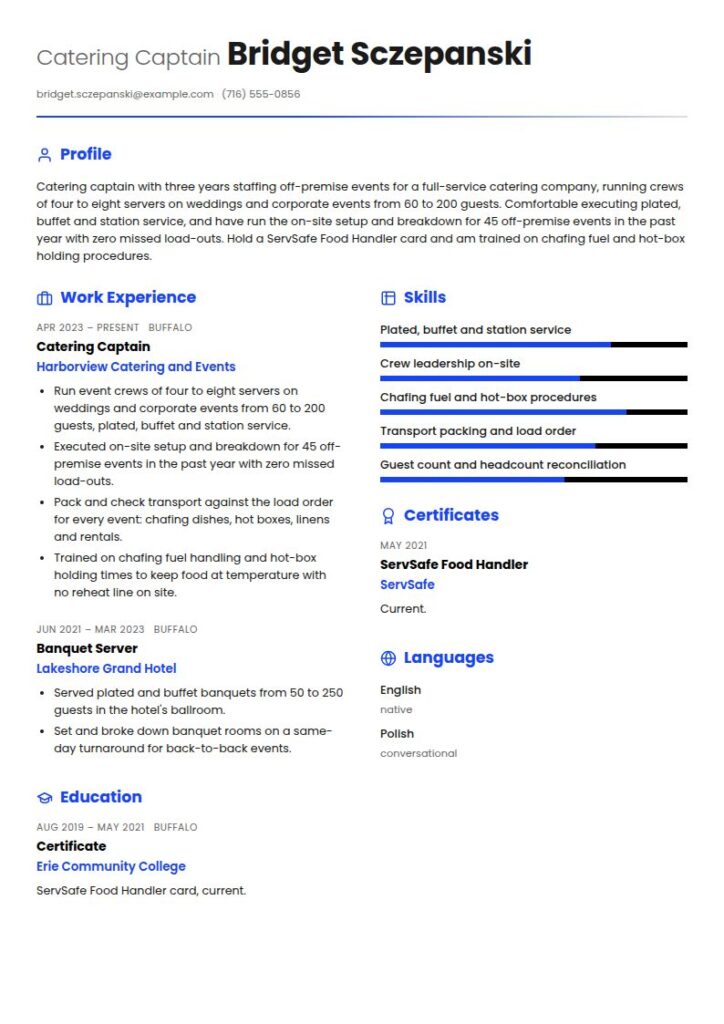
Catering Captain Bridget Sczepanski
Catering Captain
[email protected] | (716) 555-0856 | Buffalo, United States
Profile
Catering captain with three years staffing off-premise events for a full-service catering company, running crews of four to eight servers on weddings and corporate events from 60 to 200 guests. Comfortable executing plated, buffet and station service, and have run the on-site setup and breakdown for 45 off-premise events in the past year with zero missed load-outs. Hold a ServSafe Food Handler card and am trained on chafing fuel and hot-box holding procedures.
Work Experience
04/2023 - Present, Catering Captain, Harborview Catering and Events, Buffalo, United States
- Run event crews of four to eight servers on weddings and corporate events from 60 to 200 guests, plated, buffet and station service.
- Executed on-site setup and breakdown for 45 off-premise events in the past year with zero missed load-outs.
- Pack and check transport against the load order for every event: chafing dishes, hot boxes, linens and rentals.
- Trained on chafing fuel handling and hot-box holding times to keep food at temperature with no reheat line on site.
06/2021 - 03/2023, Banquet Server, Lakeshore Grand Hotel, Buffalo, United States
- Served plated and buffet banquets from 50 to 250 guests in the hotel's ballroom.
- Set and broke down banquet rooms on a same-day turnaround for back-to-back events.
Education
08/2019 - 05/2021, Certificate, Culinary Arts, Erie Community College, Buffalo, United States
ServSafe Food Handler card, current.
Skills
Plated, buffet and station service, 75
Crew leadership on-site, 65
Chafing fuel and hot-box procedures, 80
Transport packing and load order, 70
Guest count and headcount reconciliation, 60
Languages
English, native
Polish, conversational
Certificates
05/2021, ServSafe Food Handler, ServSafe
Current.
Summary
A caterer resume proves you can run an event, not only cook for one. This guide gives you three adaptable versions, the event profile most applicants never write, the banquet event order and staffing ratios that make an event work off-premise, and current Bureau of Labor Statistics pay and outlook.
Caterer resume examples by experience level
A caterer resume is a one to two page document that proves you can plan and run an event, not only cook well for one. A kitchen job ends when the plates are cleared. A catering job ends when the van is repacked, the rented chairs are counted back in, and a room that was empty at 2pm and full of 220 people at 7pm is empty again by midnight.
In short, that is the whole difference between a restaurant resume and a caterer's, and most applicants write the first when the reader is hiring for the second. Indeed, a catering director does not need to be convinced you can cook a good plate one hundred times over. They need to know you can size an event, hold food safely for four hours with no reheat line in sight, and hand a crew a plan tight enough that nobody is improvising at 6:45.
Resume guide for a caterer resume
To start, this guide and the corresponding caterer resume example will cover:
- First, how to write a caterer resume, section by section
- Why the event, not the job title, is the unit a caterer describes
- Then, three adaptable summaries: catering captain, catering coordinator and owner-caterer
- Guest counts, service style, off-premise logistics and the banquet event order
- What the job market looks like, including how common self-employment is in this work
- What you can expect to earn
How to write a caterer resume
Overall, use six sections: contact header, summary, event profile, catering experience, skills, and education and certifications. In general, one page for your first few years staffing events; two once you have run events end to end or built a client book of your own.
The structure follows the way catering actually gets sold and staffed. A client, a planner or a venue is not buying a cook. Instead, they are buying somebody who can take a guest count and a budget and turn it into a room that runs on time.
| Section | What it is answering | Where it goes |
|---|---|---|
| Summary | What kind of events, what size, what service style? | Top, four lines |
| Event profile | Largest event run, typical guest count, off-premise or on-site | Attached to each role |
| Catering experience | Did guest counts, event volume or client retention grow? | Reverse chronological, with numbers |
| Education and certifications | Food safety credential, business or culinary training | Its own block with dates |
Name the largest event you have ever run, on its own line
Most catering resumes bury their best evidence inside a job description. "Prepared food for catered events" could mean a 40-guest office lunch or a 400-guest wedding, and a catering director reading forty applications will not stop to guess which.
Say it directly: "Largest single event: 320-guest wedding reception, plated service, off-premise, two-hour drive to venue." That one line tells the reader your ceiling before they read a single bullet, and it is the fact they are actually screening for.
Run the finished file through the ATS resume checker before you send it. Catering companies and hotel banquet departments increasingly route applications through the same applicant tracking software as everyone else in hospitality.
Choosing the best resume format for a caterer resume
Reverse chronological. One page while you are staffing events for someone else's company; two once you are planning events yourself, running your own business, or have a client retention story worth telling.
In practice, catering careers often move between a few different employers, a stretch of freelance captain work, and sometimes a period of running your own small operation. However, that movement is not a weakness to hide behind a functional format. Keep the dates in order and, where a stint was seasonal or freelance, say so in one clause: "freelance catering captain, wedding season, May to October." A labeled pattern reads as a choice. By contrast, an unlabelled one reads as a gap.
Include your contact information
| ✅ Right | ❌ Wrong |
|---|---|
| Bridget Sczepanski | Bridget Sczepanski |
| Catering Coordinator, Off-Premise Events, Buffalo, NY | Passionate about creating unforgettable food experiences |
| ServSafe Food Protection Manager, current through 2029 | Food safety certified |
| (716) 555-0856, [email protected], Buffalo, NY | (716) 555-0856, [email protected] |
Put your food protection credential in the header if you hold one. A catering director who has ever answered to a health inspector reads that line before anything else on the page.
Make use of a summary
Four lines: the kind of events you run, years in the work, the size and style you are used to, and one number with a period attached.
Catering captain with three years staffing off-premise events for a full-service catering company, running crews of four to eight servers on weddings and corporate events from 60 to 200 guests. Comfortable executing plated, buffet and station service, and have run the on-site setup and breakdown for 45 off-premise events in the past year with zero missed load-outs. Hold a ServSafe Food Handler card and am trained on chafing fuel and hot-box holding procedures.
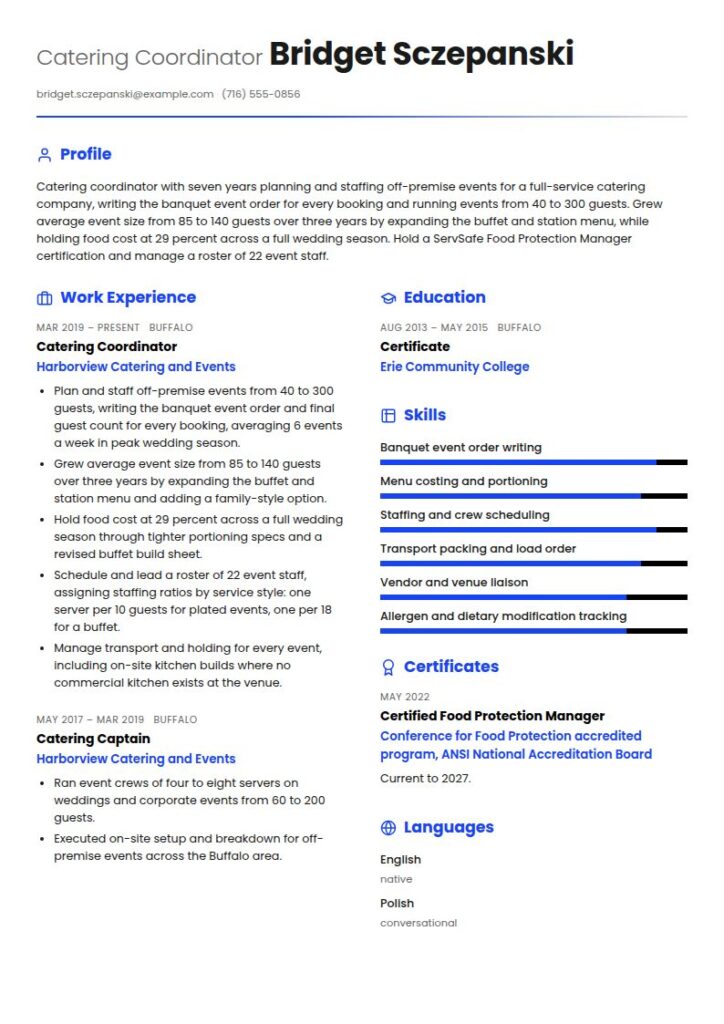
Catering coordinator with seven years planning and staffing off-premise events for a full-service catering company, writing the banquet event order for every booking and running events from 40 to 300 guests. Grew average event size from 85 to 140 guests over three years by expanding the buffet and station menu, while holding food cost at 29 percent across a full wedding season. Hold a ServSafe Food Protection Manager certification and manage a roster of 22 event staff.
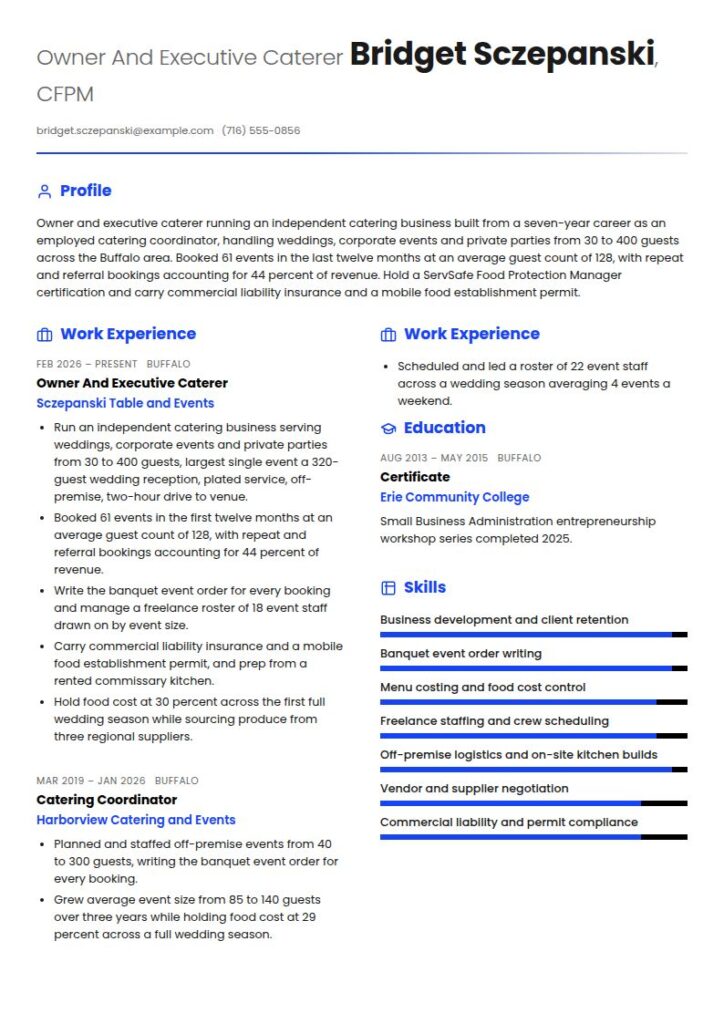
Owner and executive caterer running an independent catering business built from a seven-year career as an employed catering coordinator, handling weddings, corporate events and private parties from 30 to 400 guests across the Buffalo area. Booked 61 events in the last twelve months at an average guest count of 128, with repeat and referral bookings accounting for 44 percent of revenue. Hold a ServSafe Food Protection Manager certification and carry commercial liability insurance and a mobile food establishment permit.
Right vs wrong: the same summary, twice
| ✅ Right | ❌ Wrong |
|---|---|
| Catering coordinator running off-premise events from 40 to 300 guests, writing the banquet event order for every booking. | Experienced catering professional passionate about creating memorable events. |
| Grew average event size from 85 to 140 guests over three years while holding food cost at 29 percent. | Responsible for planning and executing catered events. |
| Booked 61 events in the last twelve months, with repeat and referral bookings at 44 percent of revenue. | Great communication and organizational skills. |
For example, the right column can be staffed against and budgeted. The left column, however, could describe anyone who has ever stood near a chafing dish.
Outline your catering experience
Employer or business name, city, dates, then three to five bullets. Each one names an event type, a guest count or a number, and what changed.
| Instead of | Use |
|---|---|
| Prepared and served food at catered events | Ran plated service for a 180-guest wedding reception with a crew of six servers and two captains |
| Set up and broke down event spaces | Executed on-site setup and breakdown for 45 off-premise events in one year with zero missed load-outs |
| Helped plan menus for clients | Wrote the banquet event order and final headcount for every booking, averaging 6 events a week in peak season |
| Managed catering staff | Scheduled and led a roster of 22 event staff across a wedding season averaging 4 events a weekend |
| Controlled food costs | Held food cost at 29 percent across a full wedding season by rebuilding portioning on the buffet menu |
Catering Coordinator, Harborview Catering and Events, Buffalo, NY, March 2019 to Present
Plan and staff off-premise events from 40 to 300 guests, writing the banquet event order and final guest count for every booking, averaging 6 events a week in peak wedding season.
Grew average event size from 85 to 140 guests over three years by expanding the buffet and station menu and adding a family-style option.
Hold food cost at 29 percent across a full wedding season through tighter portioning specs and a revised buffet build sheet.
Schedule and lead a roster of 22 event staff, assigning staffing ratios by service style: one server per 10 guests for plated events, one per 18 for a buffet.
Manage transport and holding for every event: packed vans, insulated hot boxes and Cambro carriers, and the on-site kitchen build where no commercial kitchen exists at the venue.
Write the event, not the job: guest count, service style and the off-premise checklist
This is the section a restaurant-style resume never has, and it is the one a catering director actually reads first. Every catering job is really a series of one-off events, and the resume should describe them as events rather than as a single ongoing job.
Start with service style, because it decides staffing, timing and equipment before a single dish is chosen. For instance, plated service means a kitchen team plating on a schedule and servers running courses on a timed sequence, and it needs the most staff per guest. Buffet service means the kitchen builds and holds a spread and servers restock and bus, needing fewer staff but tighter temperature control over a longer holding window. Family style sits between the two: platters built at station but served to a seated table. Stations spread the food across several points in the room, working well for cocktail-style events but demanding more small equipment and more spread-out temperature monitoring. Therefore, state which styles you have run and at what guest count, because "catering experience" alone tells a reader nothing about which of these four jobs you actually know.
Off-premise catering logistics to list
Off-premise logistics is the second half of the section, and it is what separates catering from restaurant cooking entirely. In fact, most catering happens somewhere without a working kitchen: a tent, a barn, a hotel ballroom with a small warming kitchen, a private home. That means building a menu around what travels and holds well, packing transport in a defined load order, and running holding equipment, hot boxes, insulated Cambro carriers and chafing fuel, to keep food at a safe temperature for hours with no reheat line available. If you have built an on-site kitchen from folding tables, propane burners and a rented refrigerated truck, say so in exactly those terms; it is a real, describable skill and it is what an off-premise caterer is actually hired to do.
The banquet event order, usually shortened to the BEO, is the document that runs the day: guest count, room layout, service style and timing, menu with any dietary modifications, equipment and rental list, staffing plan and vendor contacts, all in one place the client, the venue and the crew all work from. If you have written BEOs rather than only worked from one somebody else wrote, that is a coordinator-level skill and it belongs on the page by name.
Staffing ratios are the fourth piece, and they turn a vague "led the team" into something a director can plan a budget around. Of course, there is no single correct ratio; it depends on service style, menu complexity and the room. What matters on the resume is that you name the ratio you actually worked to.
Service styles run: plated, buffet, family style and reception stations.
Typical guest count: 40 to 300 guests, largest single event a 320-guest wedding reception, plated service, off-premise, two-hour drive to venue.
Staffing ratios used: one server per 10 guests for plated service, one per 18 for a buffet, one culinary staff member per 40 guests on a stations event.
Off-premise logistics: packed transport in a fixed load order, insulated hot-box and Cambro holding for up to four hours, on-site kitchen build using folding prep tables, propane burners and a rented refrigerated van where no venue kitchen exists.
Documentation: write the banquet event order for every booking, covering guest count, room layout, timing, menu and dietary modifications, equipment and rental list, and staffing assignment.
The last thing worth stating plainly on a catering resume is how common self-employment is in this field. The Bureau of Labor Statistics Occupational Outlook Handbook reports that 31 percent of food service managers, the closest published occupation to caterer, are self-employed, against 55 percent working in food services and drinking places (BLS Occupational Outlook Handbook, food service managers, May 2025 cycle, published 27 August 2026). If you own your own catering business, that is not a side detail; it is the same career path nearly a third of the occupation is on, and it belongs in your summary and your title, not apologized for.
Build a snapshot of your key skills
Ten to fourteen entries in three groups: service and execution, planning and logistics, and food safety.
Service and execution: Plated, buffet, family style and reception station service, Crew leadership on-site, Timed course sequencing, Bar and beverage station setup
Planning and logistics: Banquet event order writing, Guest count and headcount reconciliation, Menu costing and portioning, Transport packing and load order, Rental and equipment coordination, Vendor and venue liaison
Food safety: Temperature holding and monitoring, Chafing fuel and hot-box procedures, Allergen and dietary modification tracking, ServSafe food handling standards
List your education and certifications
Also list food safety credentials first, with the issuing body and the date. The Bureau of Labor Statistics gives a high school diploma or equivalent as the typical entry-level education for food service managers, the closest published occupation to caterer, with less than five years of related work experience typical (BLS Occupational Outlook Handbook, May 2025 cycle).
Certified food protection manager, examination accredited by the ANSI National Accreditation Board under the Conference for Food Protection standard, 2022, current to 2027.
ServSafe Food Handler card, current.
Certificate, Culinary Arts, Erie Community College, Buffalo, NY, 2017.
Commercial driver familiarity: box truck and cargo van, no CDL required for vehicles under 26,000 pounds.
If you own your business, add the practical credentials that go with it: liability insurance, a mobile food establishment permit if your jurisdiction issues one, and a commercial kitchen or commissary arrangement if you use one for prep.
Choose the right layout and design
Single column, 11 or 12 point type, clear headings, no photograph. Applicant tracking software at hotel banquet departments and larger catering companies reads plain, single-column formatting far more reliably than a two-column design with sidebars.
State your largest event and your typical guest count on the page. Name every service style you have run: plated, buffet, family style, stations. Write the banquet event order by name if you have written one. Give your staffing ratio by service style. Describe your off-premise transport and holding equipment specifically.
Do not write "catering experience" with no guest count attached. Do not describe an off-premise event in restaurant language, since there is no kitchen to fall back on. Do not claim a ratio or a food cost figure you did not actually hold. Do not omit your own business if you are self-employed; nearly a third of the closest published occupation is. Do not send two pages before you have run events at scale.
Caterer job market and outlook
Notably, the Bureau of Labor Statistics does not publish a separate Occupational Outlook Handbook profile for caterers. Instead, the closest published occupation is food service managers; the figures below describe the wider occupation that caterers and catering managers sit inside.
| Measure | Value |
|---|---|
| Food service manager jobs, 2025 | 344,300 |
| Projected change, 2025-35 | 6 percent |
| Projected annual openings | About 38,800 |
| Typical entry-level education | High school diploma or equivalent |
| Typical related work experience | Less than 5 years |
| Median annual wage, May 2025 | $69,390 |
Source: U.S. Bureau of Labor Statistics, Occupational Outlook Handbook, food service managers, May 2025 wage data and 2025 to 2035 projections, last modified 27 August 2026.
Nearly a third of this occupation works for itself
The Bureau of Labor Statistics Occupational Outlook Handbook puts 31 percent of food service managers in self-employment, second only to the 55 percent working in food services and drinking places, with traveler accommodation at 3 percent and educational services at 2 percent (BLS Occupational Outlook Handbook, food service managers, May 2025).
Catering is a large share of that self-employed 31 percent, because the barrier to running your own catering business is lower than opening a restaurant: no dining room lease, and a kitchen that can start as a rented commissary. That is why a resume built around an owner-caterer's own client book, event count and revenue mix is not a departure from the occupation; it describes exactly where a third of the people in it actually work.
For context on the culinary side of catering, chefs and head cooks, who plan menus and often run kitchens for catering and event work, had a median annual wage of $62,470 in May 2025, with 7 percent of the occupation self-employed (BLS Occupational Outlook Handbook, chefs and head cooks, May 2025).
What salary you can expect as a caterer
The Bureau of Labor Statistics Occupational Outlook Handbook put the median annual wage for food service managers, the closest published occupation, at $69,390, or $33.36 an hour, in May 2025.
Above all, where the money sits depends heavily on which side of the 31 percent self-employed line you are on. An employed catering coordinator is usually salaried against a defined events calendar. For example, an owner-caterer's income is revenue minus food cost, labor, transport and equipment, and it scales with event count and average guest count rather than with a title.
Three things move the number either way. Average guest count is the first: a business booking 128-guest events earns differently than one booking 40-guest office lunches, even at the same event count. Repeat and referral business is the second, because it lowers the cost of winning each booking; a caterer who can state a defined referral share is showing a business that markets itself. Food cost discipline is the third, because catering margins are thinner than a restaurant's fixed menu; a coordinator or owner who can state a held food cost percentage across a season is showing the number that decides profitability.
Key takeaways for a caterer resume
- Name your largest event and your typical guest count in the first four lines.
- Next, state every service style you have run: plated, buffet, family style, stations.
- Write the banquet event order by name if you have written one, not just worked from one.
- Give your staffing ratio by service style, not a vague "led the team."
- Describe your off-premise transport and holding equipment specifically.
- If you are self-employed, say so plainly; close to a third of the closest published occupation is.
- Finally, keep it single column and parseable for hotel and larger catering company applicant systems.
Build your caterer resume in 15 minutes with our AI resume builder.
Related hospitality and catering resume examples
- Food services manager resume
- Food and beverage director resume
- Chef resume
- Executive chef resume
- Sous chef resume
- Pastry chef resume
- Cook resume
- Line cook resume
- Restaurant manager resume
- Bar manager resume
- Server resume
- Hospitality and catering resume
Pair it with a matching caterer cover letter.
Caterer resume questions, answered
How long should a caterer resume be?
One page while you are staffing events for someone else's company. Two once you are planning events end to end, running your own business, or have a client retention story worth telling in full.
What do I put on a caterer resume with no catering experience?
Any food service or event work with a guest count attached: banquet server, restaurant server on large parties, wedding venue staff, church or community event cooking. State the largest group you have served or cooked for, the service style, and any setup or breakdown work. A ServSafe Food Handler card is worth completing before you apply; it signals you already know the temperature and holding rules a catering director has to enforce.
Should I list my own catering business on my resume?
Yes, in full, with the same detail as an employed role: events booked, average guest count, service styles, and revenue if you are comfortable sharing it. Self-employment is common in this field, close to a third of the closest published Bureau of Labor Statistics occupation, so an owner-caterer's resume should read as a business history, not an apology for not having a boss.
What is a banquet event order, and do I need to know how to write one?
It is the single document a catering event runs from: guest count, room layout, service style and timing, menu and dietary modifications, equipment and rentals, and the staffing plan. Working from one is a captain or server-level skill. Writing one yourself, from a client conversation to a finished document a whole crew can execute, is a coordinator or director-level skill, and stating that you write them is a meaningful step up from stating that you follow them.
How do I show off-premise experience if most of my catering work has been in a hotel or venue with its own kitchen?
Say so plainly and let the resume describe what you actually did: plating, holding, timing and service inside a working kitchen. Off-premise work is a real and different skill set, transport, temperature holding with no reheat line, and building a functioning kitchen from folding tables and rented equipment, and it is fine to state you have not yet done it while showing everything adjacent that you have.
Do I need a food handler or food protection manager certification to work in catering?
Requirements vary by state and by employer, but both credentials are inexpensive, widely recognized and worth holding regardless. A certified food protection manager credential from a program accredited by the ANSI National Accreditation Board under the Conference for Food Protection standard is the stronger of the two to hold if you plan to run events or manage other staff, since it is the credential a catering director or health inspector is most likely to ask for by name.