Assistant Bar Manager Camila Arboleda
Assistant Bar Manager
[email protected] | (303) 555-0916 | Denver, United States
Profile
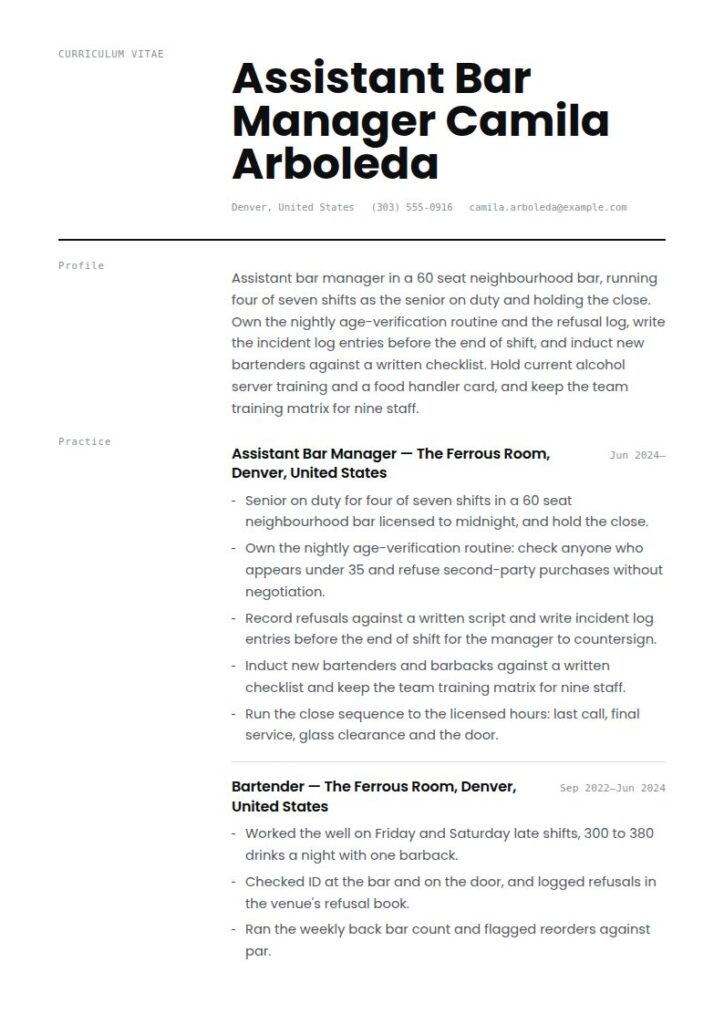
Assistant bar manager in a 60 seat neighbourhood bar, running four of seven shifts as the senior on duty and holding the close. Own the nightly age-verification routine and the refusal log, write the incident log entries before the end of shift, and induct new bartenders against a written checklist. Hold current alcohol server training and a food handler card, and keep the team training matrix for nine staff.
Work Experience
06/2024 - Present, Assistant Bar Manager, The Ferrous Room, Denver, United States
- Senior on duty for four of seven shifts in a 60 seat neighbourhood bar licensed to midnight, and hold the close.
- Own the nightly age-verification routine: check anyone who appears under 35 and refuse second-party purchases without negotiation.
- Record refusals against a written script and write incident log entries before the end of shift for the manager to countersign.
- Induct new bartenders and barbacks against a written checklist and keep the team training matrix for nine staff.
- Run the close sequence to the licensed hours: last call, final service, glass clearance and the door.
09/2022 - 06/2024, Bartender, The Ferrous Room, Denver, United States
- Worked the well on Friday and Saturday late shifts, 300 to 380 drinks a night with one barback.
- Checked ID at the bar and on the door, and logged refusals in the venue's refusal book.
- Ran the weekly back bar count and flagged reorders against par.
05/2021 - 08/2022, Barback, Quicksilver Social Club, Denver, United States
- Stocked and reset two wells in a 200 capacity late-night venue, and cleared glassware through last call.
Education
08/2021 - 05/2025, Bachelor of Science, Hospitality Management, Metropolitan State University of Denver, Denver, United States
Beverage operations, food safety and hospitality law coursework.
Skills
Age verification and document checks, 85
Refusal recording, 80
Incident logging, 75
Close sequence and licensed hours, 85
Induction and training checklists, 70
Back bar counting and par levels, 75
Point of sale and till reconciliation, 80
Languages
English, native
Spanish, native
Certificates
03/2025, Alcohol Server Training, Nationally recognized responsible-server program
Current to 2028.
08/2024, Colorado Food Handler Card, Colorado Department of Public Health and Environment
Current.
Summary
A bar manager resume is a one to two page document showing you can protect a premises license while running a profitable bar. This guide gives you three adaptable versions, the compliance block that almost no applicant writes, the food safety certification the Bureau of Labor Statistics names for food service managers, and current BLS pay and outlook.
Bar Manager resume examples by experience level
A bar manager resume is a one to two page document showing an owner that the thing their business is built on, the license to sell alcohol, is safer with you running the bar than it is now.
Everything else is secondary. Drinks, pour cost, pars and guest experience all matter, and every applicant claims all four. What almost nobody writes down is the part that keeps the doors open: an age-verification routine the team actually follows, refusals that get recorded rather than argued about, an incident log signed before the end of the shift, and a training record proving the staff on tonight were trained for tonight.
Resume guide for a bar manager resume
This guide and the corresponding bar manager resume example will cover:
- How to write a bar manager resume, section by section
- Why the license protection block belongs above your drinks list
- Three adaptable summaries: assistant bar manager, bar manager and group bar manager
- What the Bureau of Labor Statistics says about server training and age rules
- What the job market looks like and what you can expect to earn
How to write a bar manager resume
Six sections: contact header, summary, license and compliance controls, bar management experience, certifications, and systems and skills. One page as an assistant, two once you have held a venue through a full trading year.
| Section | What it is answering | Where it goes |
|---|---|---|
| License and compliance controls | Is this person a risk to my license or a defense of it? | Directly under the summary |
| Bar management experience | What did they run, at what volume, and for how long? | Reverse chronological, with numbers |
| Certifications | Food safety and alcohol server training, with expiry dates | Above education |
| Systems and skills | Point of sale, inventory, scheduling, age verification tooling | Grouped, short |
Bring the training matrix to the interview and say so on the resume
The single most useful document a bar manager owns is not the drinks list. It is a one page matrix with every member of the bar team down the side and, across the top, their alcohol server training, its issue date and its expiry, their food handler card, their induction sign-off and the date of their last refresher.
Keep it current and you can answer the two questions that matter, at any moment: who is clear to work tonight, and whose certificate lapses next month.
Write one line about it: "Maintain the bar team training matrix, 14 staff, certificate expiry tracked and refreshed every six months." It reads as an administrative detail and is really a statement that you have never been surprised by a lapsed certificate on a Friday.
Run the finished file through the ATS resume checker before you send it. Hospitality groups parse applications before a human opens them.
Choosing the best resume format for a bar manager resume
Reverse chronological. One page as an assistant bar manager or in a first venue, two once you have run a bar through a full year or held more than one site.
The reader is following a progression: bartender, bar lead, bar manager, then multiple venues. A functional format hides that ladder, and in an industry where owners phone each other, a hidden timeline reads as one worth hiding.
Put venue type and capacity in each role header. A 60 seat bar closing at midnight and a 200 capacity room with a 2am license are different jobs with the same title, and the compliance load is most of the difference.
Include your contact information
| ✅ Right | ❌ Wrong |
|---|---|
| Camila Arboleda | Camila Arboleda |
| Bar Manager, Food Protection Manager certified | Experienced hospitality professional |
| Alcohol server training current to 2028 | Bar certified |
| (303) 555-0916, [email protected], Denver, CO | (303) 555-0916, [email protected] |
Put the certification expiry dates in the header. An owner scheduling a manager needs to know you are clear to work before they read anything else.
Make use of a summary
Four lines: the venue and its capacity, the size of the team you manage, the compliance controls you own, and one commercial number.
Assistant bar manager in a 60 seat neighbourhood bar, running four of seven shifts as the senior on duty and holding the close. Own the nightly age-verification routine and the refusal log, write the incident log entries before the end of shift, and induct new bartenders against a written checklist. Hold current alcohol server training and a food handler card, and keep the team training matrix for nine staff.
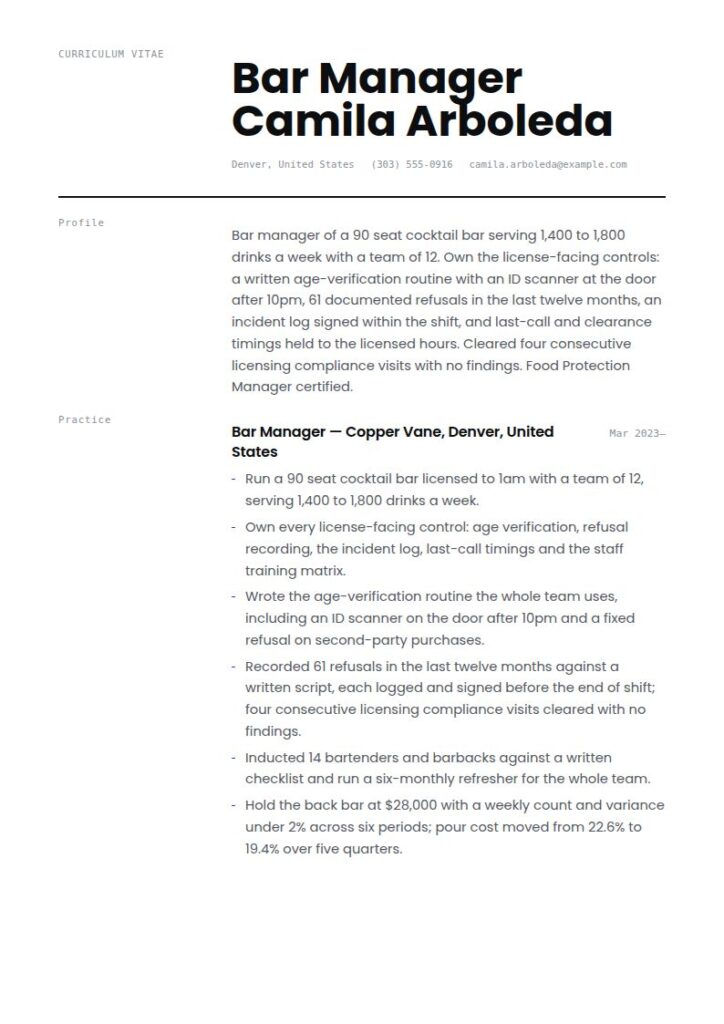
Bar manager of a 90 seat cocktail bar serving 1,400 to 1,800 drinks a week with a team of 12. Own the license-facing controls: a written age-verification routine with an ID scanner at the door after 10pm, 61 documented refusals in the last twelve months, an incident log signed within the shift, and last-call and clearance timings held to the licensed hours. Cleared four consecutive licensing compliance visits with no findings. Food Protection Manager certified.
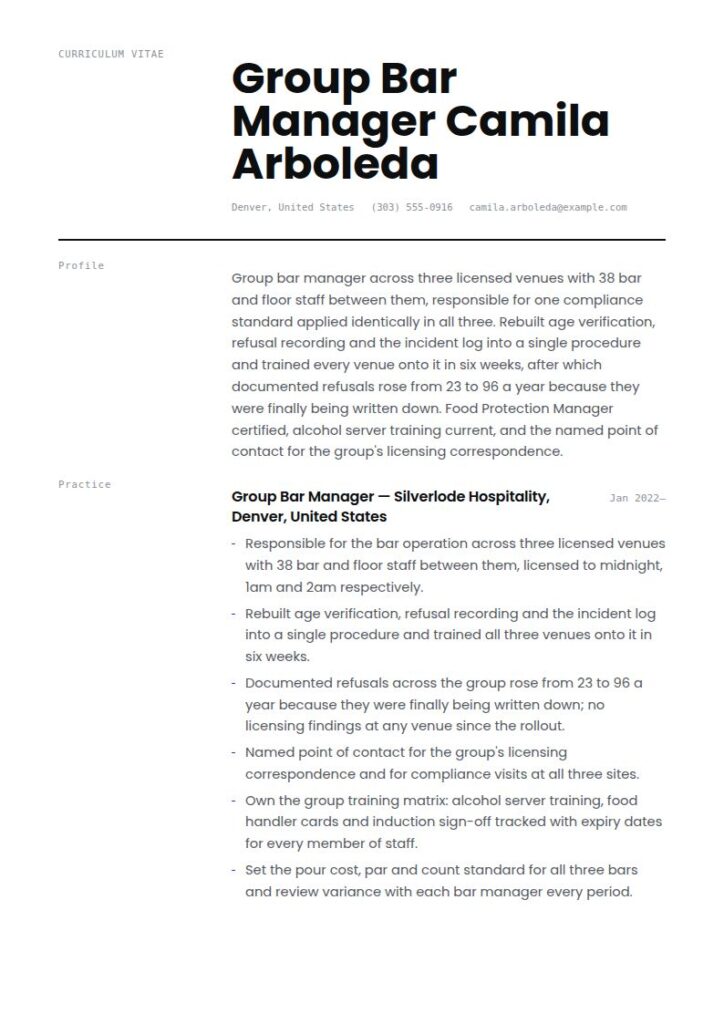
Group bar manager across three licensed venues with 38 bar and floor staff between them, responsible for one compliance standard applied identically in all three. Rebuilt age verification, refusal recording and the incident log into a single procedure and trained every venue onto it in six weeks, after which documented refusals rose from 23 to 96 a year because they were finally being written down. Food Protection Manager certified, alcohol server training current, and the named point of contact for the group's licensing correspondence.
Right vs wrong: the same bar manager summary, twice
| ✅ Right | ❌ Wrong |
|---|---|
| Bar manager of a 90 seat cocktail bar serving 1,400 to 1,800 drinks a week with a team of 12. | Experienced bar manager with a passion for great cocktails and hospitality. |
| Own a written age-verification routine with an ID scanner at the door after 10pm and 61 documented refusals in twelve months. | Ensure responsible service of alcohol and compliance with all regulations. |
| Cleared four consecutive licensing compliance visits with no findings. | Maintain a safe and welcoming environment for all guests. |
The right column is checkable and the left is not. "Ensure compliance with all regulations" names no procedure, no count and no outcome, which is why no owner reads it as a claim.
Outline your bar management experience
Venue, city, capacity or seats, licensed hours, team size, and dates. Then three to five bullets, each naming a control you owned or a number you moved.
| Instead of | Use |
|---|---|
| Ensured responsible service of alcohol | Wrote and ran the age-verification routine: every guest who looks under 35, every guest at the door after 10pm, ID scanner on the door |
| Handled difficult customers | Recorded 61 refusals in twelve months against a written script, each logged and signed before end of shift |
| Maintained records | Own the incident log: entry written within the shift, countersigned by the duty manager, retained for the licensee |
| Trained bar staff | Inducted 14 bartenders and barbacks against a written checklist and ran a six-monthly refresher for the whole team |
| Managed stock | Held back bar inventory at $28,000 with a weekly count and variance under 2% across six periods |
| Responsible for closing | Ran last call and clearance to the licensed hours with a written close sequence, no late-service findings in three years |
Bar Manager, Copper Vane, Denver, CO, 90 seats, licensed to 1am, team of 12, March 2023 to Present
Own every license-facing control in the venue: age verification, refusal recording, the incident log, last-call timings and the staff training matrix.
Wrote the age-verification routine now used by the whole team: check anyone who looks under 35, scan every ID at the door after 10pm, and refuse on a second-party purchase without argument or negotiation.
Recorded 61 refusals in the last twelve months against a written script, each logged and signed before the end of shift; four consecutive licensing compliance visits cleared with no findings.
Inducted 14 bartenders and barbacks against a written checklist and run a six-monthly refresher for the whole team, with certificate expiry tracked on a training matrix.
Hold the back bar at $28,000 with a weekly count, variance under 2% across six periods, and pour cost moved from 22.6% to 19.4% over five quarters.
Rewrote the drinks list four times a year with a specification card for every serve, which is also what makes the pour cost measurable.
Name the control, not the intention: "wrote the age-verification routine" beats "ensured responsible service". And put the licensed hours in the header, because the compliance load of a 1am venue and a 10pm venue are not comparable.
You are the person who protects the license: age checks, refusals and the incident log
This is the block that separates a bar manager resume from a senior bartender resume, and it is missing from almost every application.
A license to sell alcohol is the most valuable asset most bars own and the easiest to lose. The licensee carries that risk, but whoever runs the bar on a Saturday night decides whether it is actually managed. So write the controls down, one by one, the way an owner would want them described if a licensing officer asked.
Age verification: Written routine applied by every member of the team. Check anyone who appears under 35, scan every ID at the door after 10pm, accept only the document types listed in the house procedure, and refuse second-party purchases without negotiation. Routine posted at both wells and covered in every induction.
Refusals: 61 documented refusals in the last twelve months, each against a written script, each entered in the refusal log and signed before end of shift. Refusals are reviewed with the team monthly rather than treated as an incident.
Incident log: Every ejection, injury, refusal escalation and police contact written up within the shift, countersigned by the duty manager, and retained for the licensee. 23 entries in the last year, none unresolved at the point of filing.
Hours of sale: Written close sequence covering last call, final service, glass clearance and the door, held to the licensed hours. No late-service findings in three years.
Training and re-training: Induction checklist for every new bartender and barback, six-monthly refresher for the whole team, and a training matrix tracking alcohol server training and food handler cards with their expiry dates. 14 inductions in the last two years.
Compliance record: Four consecutive licensing compliance visits cleared with no findings. Named contact for licensing correspondence.
Three rules make that block credible.
Write the procedure, not the value. "Committed to responsible service" is a value and it is worth nothing on paper. "Check anyone who appears under 35, scan every ID at the door after 10pm, refuse second-party purchases" is a procedure, and an experienced reader can tell immediately that you have actually run one.
Treat refusals as evidence, not as a blemish. A bar with no recorded refusals is not one where nothing happened; it is one where nothing was written down. The count going up after you arrive is the clearest proof available that your training stuck.
Say nothing you cannot support about the law. Alcohol rules are set state by state and sometimes city by city, and the requirement you learned in one place may not exist in the next. The Bureau of Labor Statistics states that most states require bartenders to be at least 18 years old and that many states and localities require bartenders to complete a responsible-server course (BLS Occupational Outlook Handbook, Bartenders, last modified 27 August 2026). Write your own certification, its issuing program and its expiry, and say that you will complete whatever the hiring state requires. Do not summarize a rule you have not read, because the person reading your file has.
Build a snapshot of your key skills
Twelve to fourteen entries in three groups: compliance, commercial and systems, with compliance first because that is the argument the page makes.
Compliance: Age verification procedure design, ID scanning and document checks, Refusal recording and review, Incident logging and retention, Licensed hours and close sequence, Staff training matrix and certificate tracking, Food safety management
Commercial: Pour cost control, Par levels and ordering, Back bar inventory and variance, Drinks list development with specification cards, Cash handling and till reconciliation, Labor scheduling to a covers forecast
Systems: Point of sale and till reporting, Inventory and ordering software, Scheduling software, ID verification hardware, Reservation and door systems
Keep cocktail vocabulary out of the skills list. A manager who lists twenty spirits categories reads like a bartender promoted on paper.
List your education and certifications
Certifications first, with issue and expiry dates, then any hospitality qualification.
Food Protection Manager Certification, obtained by food safety examination, 2024, current to 2029
Alcohol server training, nationally recognized responsible-server program, issued 2025, current to 2028
Colorado food handler card, current
Bachelor of Science, Hospitality Management, Metropolitan State University of Denver, Denver, CO, 2016
First aid and CPR, American Red Cross, 2026
The food safety certificate is worth understanding before you list it. The Bureau of Labor Statistics states that some states and localities require food service managers to have food safety certification, and names the Food Protection Manager Certification, which is obtained by passing a food safety exam (BLS Occupational Outlook Handbook, Food Service Managers, last modified 27 August 2026). That is a requirement set locally rather than nationally, so write what you hold and where you hold it, and never describe it as a national requirement.
Alcohol server training works the same way. Name the program, give the issue and expiry dates, and if you are applying across a state line, add a line saying you will complete the destination state's requirement before your first shift.
Choose the right layout and design
Single column, 11 or 12 point, clear headings, no photograph, no skill rating bars. Group portals parse before a human reads, and multi-column layouts scramble in the parse.
Put certification expiry dates in the header. Describe the age-verification routine as a procedure with thresholds in it. Give a refusal count and say it is logged. Name the incident log and who countersigns it. State the licensed hours of every venue you have run. Keep a training matrix and say so.
Do not write "ensured compliance with all applicable laws"; it names nothing. Do not quote a state rule you have not checked against that state's own agency. Do not hide refusals or incidents, because an owner reads a clean-looking file with no controls in it as a file with no controls behind it. Do not lead with your cocktail list. Do not claim a pour cost you did not own.
Bar manager job market and outlook
Bar managers sit inside the Bureau of Labor Statistics category for food service managers: steady growth, and an unusually high share of self-employment.
| Measure | Value |
|---|---|
| Food service managers, jobs in 2025 | 344,300 |
| Projected change, 2025-35 | 6% (faster than average), +19,900 |
| Projected annual openings | About 38,800 |
| Typical entry-level education | High school diploma or equivalent |
| Work experience typically required | Less than 5 years |
| Median annual wage, May 2025 | $69,390 ($33.36 per hour) |
Source: U.S. Bureau of Labor Statistics, Occupational Outlook Handbook, Food Service Managers, 2025-35 projections and May 2025 wage data, last modified 27 August 2026.
You will be re-training the bar constantly, which is why the matrix matters
Bartenders held 762,600 jobs in 2025, with employment projected to grow 5 percent through 2035, an increase of 37,900 jobs. Against that, the Bureau of Labor Statistics projects about 121,200 openings for bartenders each year over the decade (BLS Occupational Outlook Handbook, Bartenders, 2025-35 projections, last modified 27 August 2026).
That is roughly 1.2 million openings across ten years against 37,900 of actual growth. Almost every opening exists because somebody left.
The same page states that most states require bartenders to be at least 18 years old and that many states and localities require bartenders to complete a responsible-server course. Put the two facts together and you have the real shape of the bar manager job: a legally gated team with heavy turnover, which means induction and certificate tracking are not administration at the edge of the role. They are the role, and the resume that says so is the one an owner believes.
Where food service managers work:
| Setting | Share of employment | Median annual wage (May 2025) |
|---|---|---|
| Food services and drinking places | 55% | $65,060 |
| Self-employed workers | 31% | Not published |
| Traveler accommodation | 3% | $82,170 |
| Educational services, state, local and private | 2% | $79,450 |
Source: U.S. Bureau of Labor Statistics, Occupational Outlook Handbook, May 2025.
What salary you can expect as a bar manager
The median annual wage for food service managers was $69,390, or $33.36 an hour, as of May 2025 (BLS Occupational Outlook Handbook, last modified 27 August 2026). Bar managers in independent venues normally sit below that median and group-level roles above it, because the category also contains restaurant general managers and contract catering managers.
The comparison worth making is with the team you manage. Bartenders had a median annual wage of $34,340, or $16.51 an hour, in May 2025, with full-service restaurants at $17.07 an hour and drinking places at $16.01 (BLS, May 2025). The step from senior bartender to bar manager is a large one on paper, and what is being paid for is liability rather than technique.
Sector moves the number too. Food services and drinking places, where 55 percent of food service managers work, pays a median of $65,060 against $82,170 in traveler accommodation and $79,450 in educational services. Hotel bar management is the largest pay move available to most bar managers, and hotels hire on multi-outlet coverage, licensed hours across a property and documented compliance.
Key takeaways for a bar manager resume
- Make the license the argument: age checks, refusals, the incident log and the close sequence.
- Write procedures with thresholds in them, never statements of commitment.
- Give a refusal count and say where it is recorded; refusals are evidence, not a blemish.
- Keep a training matrix with certificate expiry dates and put one line about it on the page.
- Put capacity, licensed hours and team size in every role header.
- List certifications with issue and expiry dates, and never describe a local rule as a national one.
- Keep pour cost, pars and the drinks list on the page, but below the controls.
Build your bar manager resume in 15 minutes with our AI resume builder.
Related hospitality and catering resume examples
- Bartender resume
- Restaurant manager resume
- Food and beverage director resume
- Server resume
- Waiter resume
- Waitress resume
- Hostess resume
- Sommelier resume
- Barista resume
- Hotel management resume
- Restaurant resume
- Hospitality catering resume
Pair it with a matching bar manager cover letter.
Bar manager resume questions, answered
How long should a bar manager resume be?
One page as an assistant or in a first venue. Two once you have run a bar through a full trading year or held more than one site. The second page is earned by controls, volumes and a compliance record, never by a longer drinks list.
What is the difference between a bar manager resume and a bartender resume?
A bartender resume argues that you can work a bar. A bar manager resume argues that the license is safer with you running it. Everything a bartender puts on a page can appear on yours, but it belongs underneath a block about age verification, refusals, the incident log and training records, because that is the part an owner cannot delegate to anybody else.
Do I need a certification to be a bar manager?
It depends where you are. The Bureau of Labor Statistics states that some states and localities require food service managers to hold food safety certification and names the Food Protection Manager Certification, and that many states and localities require bartenders to complete a responsible-server course (BLS Occupational Outlook Handbook, last modified 27 August 2026). Check the hiring state's own alcohol authority rather than a job board, list exactly what you hold with its expiry, and offer to complete the local requirement before your first shift.
Should I put refusals and incidents on my resume?
Yes, as counts with the record attached. An owner is not reading a refusal count as trouble; they are reading it as proof that the procedure exists and that the team uses it. A file with no controls and no numbers reads as a venue where nothing was recorded, which is the outcome an owner is actually afraid of.
What do I write if I have never managed a bar?
Write the controls you already run. Most senior bartenders check ID, refuse service, close the venue and induct new starters, and almost none write it down. Count your refusals for a month, note who signs the incident log, describe the close sequence, and list who you have trained. That is an assistant bar manager application, and a far stronger one than a list of cocktails.
How do I show numbers if the bar does not track much?
Take four weeks of till reports before you leave a job: drinks per shift, sales by day part, back bar value at the last count, and your own refusal and incident counts from the logs. None of that needs new software.