Waiter Emeka Nzeadibe
Waiter
[email protected] | (704) 555-0904 | Charlotte, United States
Profile
Waiter with two years in a 90 seat neighborhood restaurant, holding a 44 item menu with six weekly specials and passing the house menu test on the first attempt. Handle gluten free, dairy free and shellfish requests through the kitchen's allergen ticket routine, and know the 14 by-the-glass wines well enough to recommend one with any main course. Hold ServSafe Food Handler and current alcohol server training.
Work Experience
03/2019 - 06/2021, Waiter, Catawba Crossing Grill, Charlotte, United States
- Held a 44 item menu with six weekly specials in a 90 seat neighborhood restaurant, passing the house menu test on the first attempt.
- Handled gluten free, dairy free and shellfish requests through the kitchen's allergen ticket routine.
- Learned the 14 by-the-glass list well enough to recommend a wine with any main course on the menu.
- Worked Friday and Saturday dinner and Sunday brunch through two full years without a missed shift.
Education
08/2018 - 05/2020, Associate of Arts, General studies, Central Piedmont Community College, Charlotte, United States
Studied while working four to five dinner shifts a week.
Skills
Menu memorization, 80
Allergen ticket routine, 75
By-the-glass wine recommendations, 65
Point of sale and check handling, 80
Coursing and pacing, 70
Responsible alcohol service, 80
Nightly specials briefing, 70
Languages
English, native
Igbo, native
Spanish, beginner
Certificates
03/2019, ServSafe Food Handler, National Restaurant Association
Food handler training and examination.
06/2024, Responsible alcohol server training, State-approved training provider
Current. Renewed as required by employer and state.
Summary
A waiter resume is a one page document showing what you can explain at the table without notes: the menu and its preparations, the route an allergy takes from the guest to the kitchen, and the beverages you can pair with the food. This guide gives you three adaptable versions, the allergen block that belongs on every serving resume, and current Bureau of Labor Statistics pay and outlook for waiters and waitresses.
Waiter resume examples by experience level
In short, a waiter resume is a one page document showing what you can explain at a table without looking anything up.
That is the part of the job a restaurant cannot train quickly. Carrying three plates is a week. After all, learning a point of sale is an afternoon. Standing at a four top and describing how the fish is cooked, what is in the sauce, which two dishes contain sesame, what happens if the guest wants it without butter, and which glass of wine to bring with it takes a season, and it is what separates a waiter a manager can put in the dining room on a Friday from one who needs a runner following behind.
Most serving resumes never mention it. However, they describe duties: took orders, served food, handled payments. By contrast, the file that says "40 item seasonal menu, four changeovers a year, I wrote the study sheet" is answering a question the reader did not expect to get answered.
Resume guide for a waiter resume
To that end, this guide and the corresponding waiter resume example will cover:
- First, how to write a waiter resume, section by section
- Then, why menu knowledge is the evidence that separates two serving files
- Next, three adaptable summaries: new waiter, experienced waiter and lead waiter
- Also, the allergen route, written the way a chef would want to read it
- Finally, what the job market looks like and what you can expect to earn
How to write a waiter resume
Overall, five sections: contact header, summary, the menu and allergen block, service experience, and skills with certifications. One page. Two only if you have moved into training or a captain role and have something to say about both.
| Section | What it is answering | Where it goes |
|---|---|---|
| Menu and allergens | What can this person explain and handle without help? | Directly under the summary |
| Service experience | Where have they worked, for how long, and what did they own? | Reverse chronological, with numbers |
| Beverage | What can they sell and pair, and at what level? | Inside the menu block or its own short line |
| Certifications | Alcohol server training, food handling, allergen training | Short block near the end |
Write the menu you knew, with its size and how often it changed
Two numbers make menu knowledge concrete: how many items you had to hold in your head, and how often the list moved under you.
"Held a 40 item menu that changed four times a year" and "held a 22 item menu that changed monthly, plus a nightly list of four specials" describe very different demands on a server, and both are more useful to a reader than "extensive menu knowledge".
Add the preparation detail you actually carried: cuts and cooking temperatures in a steak room, cooking methods and sourcing in a seafood room, provenance in a room with a short list, preparation and heat level in a kitchen cooking one regional cuisine. The specificity is the evidence.
Run the finished file through the ATS resume checker before you send it. Restaurant groups and hotel dining rooms both take applications through systems that read the file before a manager does.
Choosing the best resume format for a waiter resume
In practice: reverse chronological, one page, single column, no photograph.
Restaurants read a serving resume for two things the timeline carries: how long you stay, and what kind of room you were last in. A functional layout hides both. If your history is scattered across short jobs, which is common in this trade, keep the dates honest and let the menu and allergen block give the reader something solid instead.
Include your contact information
| ✅ Right | ❌ Wrong |
|---|---|
| Emeka Nzeadibe | Emeka Nzeadibe |
| Lead Waiter, chef-driven kitchen, monthly menu | Friendly server with years of restaurant experience |
| ServSafe Allergens, 2024; alcohol server training current | Food safety certified |
| (704) 555-0904, [email protected], Charlotte, NC | (704) 555-0904, [email protected] |
The second line should say what kind of room you last worked in and what the menu did there. For example, a reader who sees "chef-driven kitchen, monthly menu" already knows you can learn a list quickly, which is the thing they were going to have to find out in a trial shift.
Make use of a summary
In short, four lines: the room, your years, the menu you carried, and one thing you handled that a new server could not.
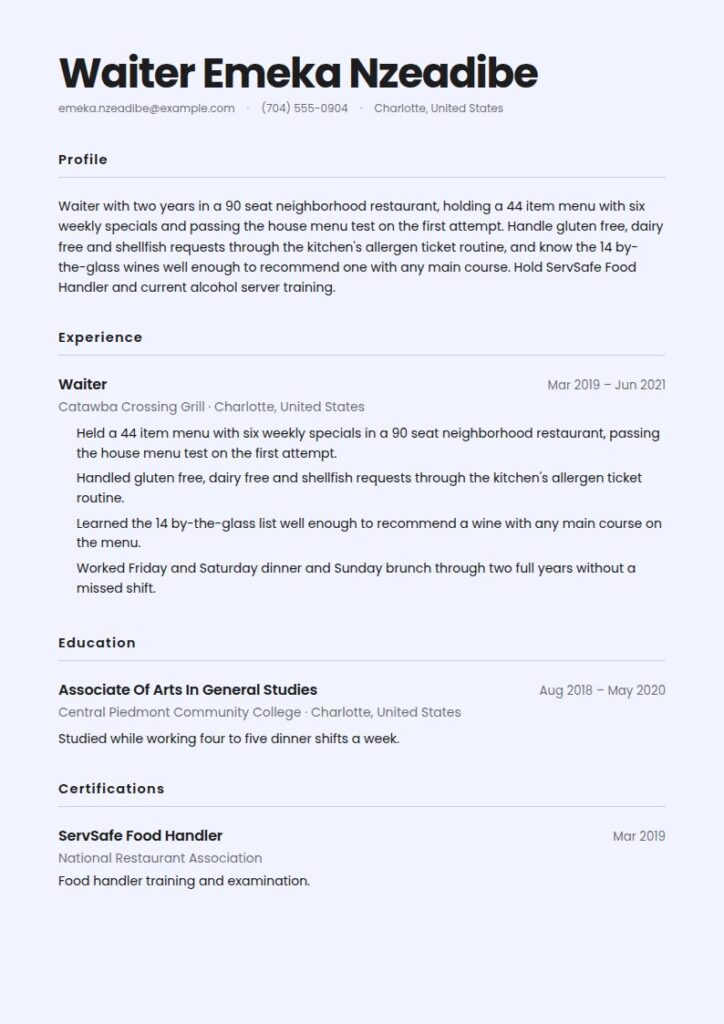
Waiter with two years in a 90 seat neighborhood restaurant, holding a 44 item menu with six weekly specials and passing the house menu test on the first attempt. Handle gluten free, dairy free and shellfish requests through the kitchen's allergen ticket routine, and know the 14 by-the-glass wines well enough to recommend one with any main course. Hold ServSafe Food Handler and current alcohol server training.
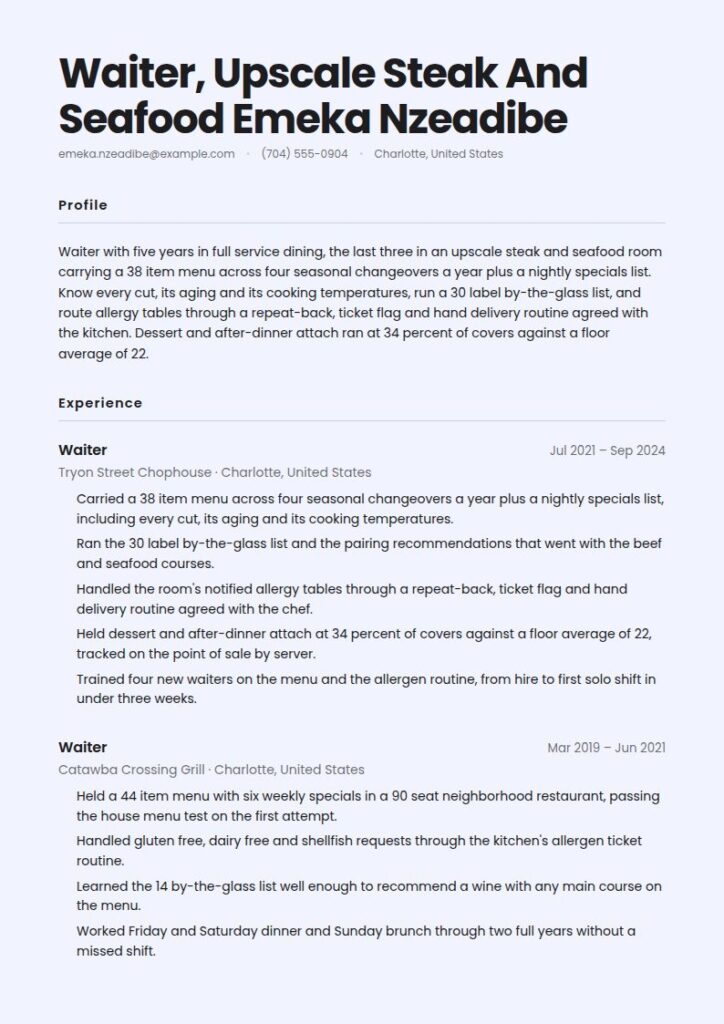
Waiter with five years in full service dining, the last three in an upscale steak and seafood room carrying a 38 item menu across four seasonal changeovers a year plus a nightly specials list. Know every cut, its aging and its cooking temperatures, run a 30 label by-the-glass list, and route allergy tables through a repeat-back, ticket flag and hand delivery routine agreed with the kitchen. Dessert and after-dinner attach ran at 34 percent of covers against a floor average of 22.
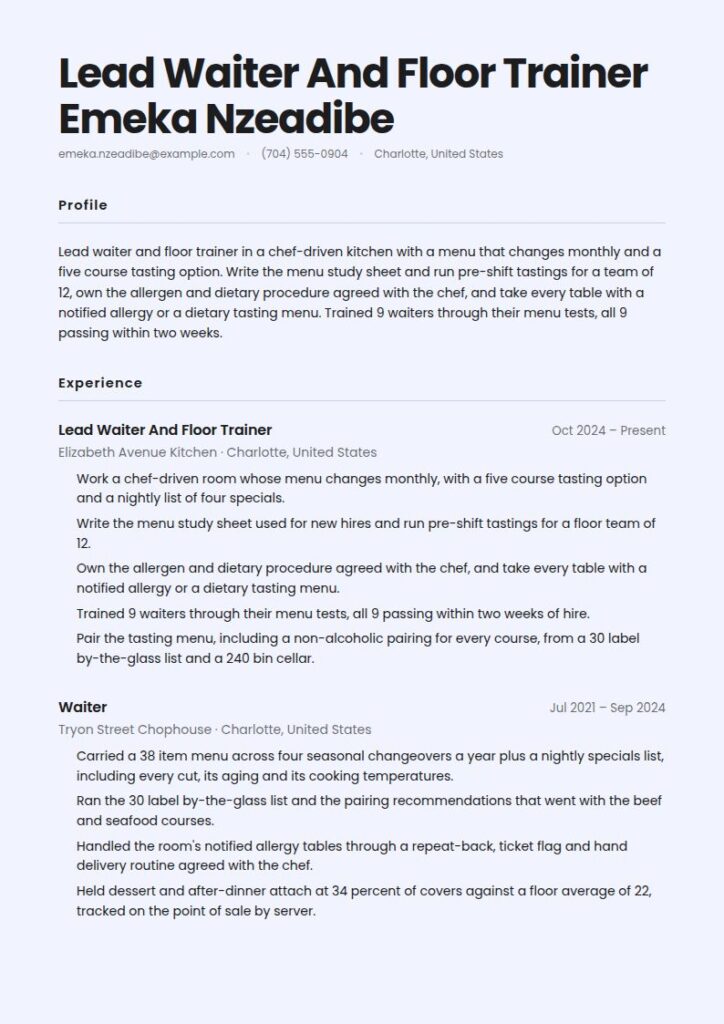
Lead waiter and floor trainer in a chef-driven kitchen with a menu that changes monthly and a five course tasting option. Write the menu study sheet and run pre-shift tastings for a team of 12, own the allergen and dietary procedure agreed with the chef, and take every table with a notified allergy or a dietary tasting menu. Trained 9 waiters through their menu tests, all 9 passing within two weeks.
Right vs wrong: the same waiter summary, twice
| ✅ Right | ❌ Wrong |
|---|---|
| Carrying a 38 item menu across four seasonal changeovers a year plus a nightly specials list. | Extensive knowledge of food and beverage menus. |
| Know every cut, its aging and its cooking temperatures, and run a 30 label by-the-glass list. | Skilled at upselling and recommending menu items. |
| Route allergy tables through a repeat-back, ticket flag and hand delivery routine agreed with the kitchen. | Attentive to guests with special dietary needs. |
Specifically, the right column tells a chef they can send you into their dining room tomorrow. On the other hand, the left column is what everyone writes, and that is why most serving resumes are read in eight seconds.
Outline your table service experience
Restaurant, city, the kind of room, and dates. Then three to five bullets, each naming something you knew or handled, with a number where one exists.
| Instead of | Use |
|---|---|
| Took orders and served food to customers | Carried a 38 item menu through four changeovers a year plus a nightly list of four specials |
| Answered questions about the menu | Passed the house menu test on the first attempt and led pre-shift tastings for a team of 12 |
| Accommodated dietary restrictions | Ran the allergy routine: repeat back, ticket flag, verbal confirm with the kitchen, hand delivery |
| Upsold food and drinks | Held dessert and after-dinner attach at 34 percent of covers against a floor average of 22 |
| Trained new staff | Wrote the menu study sheet and trained 9 waiters through their menu tests, all passing inside two weeks |
Waiter, Tryon Street Chophouse, Charlotte, NC, July 2021 to September 2024. Upscale steak and seafood room, 140 seats.
Carried a 38 item menu across four seasonal changeovers a year plus a nightly specials list, including every cut, its aging and its cooking temperatures.
Ran the 30 label by-the-glass list and the pairing recommendations that went with the beef and seafood courses.
Handled the room's notified allergy tables through a repeat-back, ticket flag and hand delivery routine agreed with the chef.
Held dessert and after-dinner attach at 34 percent of covers against a floor average of 22, tracked on the point of sale by server.
Trained four new waiters on the menu and the allergen routine, taking them from hire to their first solo shift in under three weeks.
What you can explain at the table is what you get hired on: menu, allergens and pairings
This is the block that separates two serving resumes that otherwise read the same, and almost nobody writes it.
Think about what a manager is risking when they hire you. Not a dropped plate. Consider, for instance, a server who stands in front of a guest, cannot answer the question, walks to the kitchen mid service to ask it and comes back with half an answer. In fact, every restaurant has had that server, and the resume showing you are not one is worth a trial shift on its own.
Write it as four labeled lines and put it under your summary.
Menu: 38 item upscale steak and seafood list, four seasonal changeovers a year plus four nightly specials. Every cut, its aging and its cooking temperatures; cooking method and sourcing on the seafood; every sauce and its base.
Allergens and dietary: Repeat the request back at the table, enter it as a point of sale modifier rather than a free text note, flag the allergen ticket, take a verbal confirmation from the kitchen, and deliver that plate by hand. Routinely handle gluten free, dairy free, shellfish, nut, soy and vegan tables, and know which items can be adapted and which cannot.
Beverage: 30 label by-the-glass list, 240 bin cellar, full cocktail list and eight draught lines. Pair to the menu rather than by memorized script, and can offer a non-alcoholic pairing for every course.
Teaching it: Wrote the menu study sheet used for new hires, ran pre-shift tastings for 12, trained 9 waiters through their menu tests.
Four rules for a credible waiter menu block
Four rules make those lines credible.
First, give the menu a size and a rhythm. A 22 item menu changing monthly is harder to hold than a 60 item menu that never moves, and a reader who works in restaurants knows it immediately.
Write the allergen route as a sequence, not as a value. "Allergy aware" is a word. "Repeat back, point of sale modifier, ticket flag, verbal confirm, hand delivery" is a procedure, and it tells a chef exactly how their ticket printer will behave when you are on the floor. Say plainly which requests you have handled often and which ones you have not, because the honest version is what earns the allergy table.
Name what you can adapt. In practice, the most valuable sentence a server can say to a guest with a restriction is which dishes work as written, which can be changed and which cannot. That knowledge lives in the kitchen; therefore, a waiter who has gone and got it is a waiter the kitchen trusts.
Finally, keep the beverage line at your real level. If you know a 14 wine list well, say 14. Overstating beverage knowledge is the fastest way to fail a trial shift, because it gets tested in the first hour.
Openings come from turnover, not growth, so knowledge is your edge
The Bureau of Labor Statistics counts 2,284,400 waiters and waitresses in 2025 and projects 2 percent growth through 2035, slower than average, an increase of 46,500 jobs. Over the same decade it projects about 423,100 openings each year, on average (BLS Occupational Outlook Handbook, Waiters and Waitresses, 2025-35 projections).
Roughly 4.2 million openings across a decade against 46,500 jobs of real growth means the jobs you apply for are almost all replacements, and the people you compete with are almost all experienced.
That is why duties do not sell you. Every applicant in the stack has taken an order. What varies between them is what they can hold in their head and what a chef would trust them to carry to a table with an allergy on it, and those are the two things this block puts on the page.
Build a snapshot of your key skills
Next, twelve to sixteen entries in four groups: menu and kitchen, allergens and dietary, beverage, and service systems. Grouping matters here, because the whole point of your page is that your knowledge is organized.
Menu and kitchen: Menu memorization and study sheets, Cuts, aging and cooking temperatures, Cooking methods and sourcing, Sauce bases and components, Nightly specials briefing, Pre-shift tastings
Allergens and dietary: Allergen ticket routine, Point of sale modifiers, Gluten free and celiac handling, Dairy free and vegan adaptation, Shellfish and nut protocols, Dietary tasting menus
Beverage: By-the-glass list management, Food and wine pairing, Cocktail and spirits knowledge, Draught and bottle beer styles, Non-alcoholic pairings, Responsible alcohol service
Service systems: Point of sale and check handling, Kitchen display and ticket timing, Reservation and guest notes, Coursing and pacing, Training new waiters
Again, keep every line at your honest level. After all, the trial shift is standard in serving, and each of these is testable inside an hour.
List your education and certifications
In addition, there is no educational gate on this work. Indeed, BLS records no formal educational credential, no prior work experience and short-term on-the-job training as typical for entry into waiting tables (BLS Occupational Outlook Handbook, Waiters and Waitresses, 2026). What that means for your page is that certifications carry more weight than schooling, because they are the only externally verified lines on it.
ServSafe Allergens, National Restaurant Association, 2024.
ServSafe Food Handler, National Restaurant Association, 2019.
Alcohol server training, current, as required by my employer and state.
Level 2 Award in Wines, Wine and Spirit Education Trust, 2023.
Associate of Arts, Central Piedmont Community College, Charlotte, NC, 2020.
Two notes. Write alcohol server training as current or expired with the year, never vaguely, since the rules differ by state and locality and a manager needs to know whether you can pour on your first shift. And if you hold a wine qualification, name the body and the level rather than calling yourself knowledgeable about wine.
Choose the right layout and design
One page, single column, 11 or 12 point, no photograph. PDF unless the application portal asks for something else.
Then put the menu and allergen block directly under the summary, as labeled lines. A manager scanning your file is looking for the size of the menu you held, the allergen routine and the beverage level; therefore, all three should be visible without reading a paragraph.
Give the menu a size and say how often it changed. Write the allergen route as a sequence of steps. Name which dietary requests you handle routinely. Keep the beverage line at the level you could defend in a trial shift. Put alcohol server training and food safety certification on the page with years. Say if you wrote study sheets or ran pre-shift tastings, because teaching the menu is the strongest proof you know it.
Do not write "extensive menu knowledge" or "allergy aware", which tell a reader nothing. Do not claim a wine list you cannot talk through. Do not describe a dish as "gluten free" on your resume as though that were a skill; the skill is knowing what can be adapted and what cannot. Do not list duties every server shares. Do not run past one page unless you train the floor.
Waiter job market and outlook
A very large occupation, growing slowly, and hiring constantly because of turnover rather than expansion.
| Measure | Value |
|---|---|
| Waiters and waitresses, 2025 | 2,284,400 |
| Projected change, 2025-35 | 2 percent, slower than average, 46,500 jobs |
| Projected annual average openings | ~423,100 |
| Typical entry-level education | No formal educational credential |
| Prior work experience required | None |
| Typical on-the-job training | Short-term on-the-job training |
| Median annual wage, May 2025 | $35,230 |
| Median hourly wage, May 2025 | $16.94 |
Source: U.S. Bureau of Labor Statistics, Occupational Outlook Handbook, Waiters and Waitresses, May 2025 wage data and 2025-35 projections.
Where the jobs sit:
| Setting | Share of employment | Median hourly wage (May 2025) |
|---|---|---|
| Food services and drinking places | 85% | $16.93 |
| Traveler accommodation | 6% | $17.09 |
| Arts, entertainment, and recreation | 4% | $16.85 |
Source: U.S. Bureau of Labor Statistics, Occupational Outlook Handbook, May 2025.
Those three medians sit within sixteen cents of each other, which is worth absorbing before you decide a hotel or a stadium job is the move. However, changing industry is not by itself a raise here. Instead, what changes is the room, the menu and the check.
It is also worth knowing where waiting tables sits inside the wider group. BLS puts the median for food and beverage serving and related workers as a whole at $15.24 an hour in May 2025, against $16.94 for waiters and waitresses specifically (BLS Occupational Outlook Handbook, May 2025). In other words, the gap is what menu, beverage and full service work is worth relative to counter service, and it is the same gap your resume is arguing about.
What salary you can expect as a waiter
Overall, the median wage for waiters and waitresses was $16.94 an hour, or $35,230 a year, as of May 2025 (BLS Occupational Outlook Handbook, May 2025 wage data).
Even so, the spread around that median is not mostly about the employer's industry code, as the table above shows. Instead, it is about the room you work in and what you can do inside it. In short, three things move your earnings, and the resume can speak to all three.
The first is the check. A room with a $70 average check pays a server more per table than one with a $24 check, and rooms with high checks hire on menu and beverage knowledge because that is what protects the experience they are charging for.
Similarly, the second is what you add to the check once you are there. Dessert and after-dinner attach, a by-the-glass recommendation, a second bottle, a pairing for a tasting menu: every one of those comes out of knowing the list well enough to suggest something specific rather than asking if anyone wants dessert. That is why the attach figure belongs on your resume with the floor average next to it.
Finally, the third is the table you get given. For example, allergy tables, dietary tasting menus, regulars and large parties go to the servers a manager trusts, and those are the tables that pay. The allergen block on your page is how you ask for them before you have met anyone.
Key takeaways for a waiter resume
- To start, give the menu a size and a rhythm: how many items, how often it changed.
- Also write the allergen route as a sequence of steps, not as a value.
- In addition, name which dietary requests you handle routinely, and which you do not.
- Likewise, keep the beverage line at a level you could defend in a trial shift.
- Then put attach or check figures on the page with the floor average beside them.
- Say if you wrote study sheets or ran pre-shift tastings; teaching the menu proves you know it.
- Above all, keep alcohol server training and food safety certification current, with years.
Build your waiter resume in 15 minutes with our AI resume builder.
Related hospitality and catering resume examples
- Server resume
- Waitress resume
- Hostess resume
- Bartender resume
- Sommelier resume
- Busser resume
- Restaurant manager resume
- Food and beverage director resume
- Hotel front desk employee resume
- Caterer resume
- Chef resume
- Restaurant resume
Pair it with a matching waiter cover letter.
Waiter resume questions, answered
How long should a waiter resume be?
One page. Two only if you train the floor or run a captain station and have something specific to say about both. A second page of duties makes an experienced file read as a padded one.
What do I put on a waiter resume with no experience?
Write the knowledge and the reliability you can prove. Any food or retail job with a product you had to learn, a food handler card, alcohol server training if your state and employer require it, and the hours you can work. Then say what you have already memorized: if you have studied the restaurant's posted menu before applying, mention it in the cover letter. Entry into this occupation needs no formal credential and short-term on-the-job training (BLS Occupational Outlook Handbook, 2026), so what you are competing on is how quickly you will stop needing help.
How do I write the allergen part without sounding like a policy document?
Write it as the steps you take, in order, in plain words: repeat the request back at the table, enter it as a modifier, flag the ticket, get a verbal confirmation from the kitchen, deliver the plate by hand. Five short items. Then add one sentence about which requests you handle routinely. A chef reading that knows exactly what you will do on their line.
Do I need to know wine to get a good serving job?
You need to know the list in front of you. A waiter who can talk confidently through 14 by-the-glass wines and pair them with the food is more useful than one who has read widely but cannot recommend anything from the actual list. If you have a formal qualification, name the body and the level; if not, write the size of the list you ran and what you paired with what.
Is "waiter" or "server" the better title to use?
Use the title the job advertisement uses, consistently across your resume, cover letter and application. Both describe the same work, and matching the posting is the simplest way to make sure a keyword-matching system and a busy manager both find what they expect.