Server, 140-Seat Full-Service Restaurant Salvatore Mangione
Server
[email protected] | (401) 555-0934 | Providence, United States
Profile
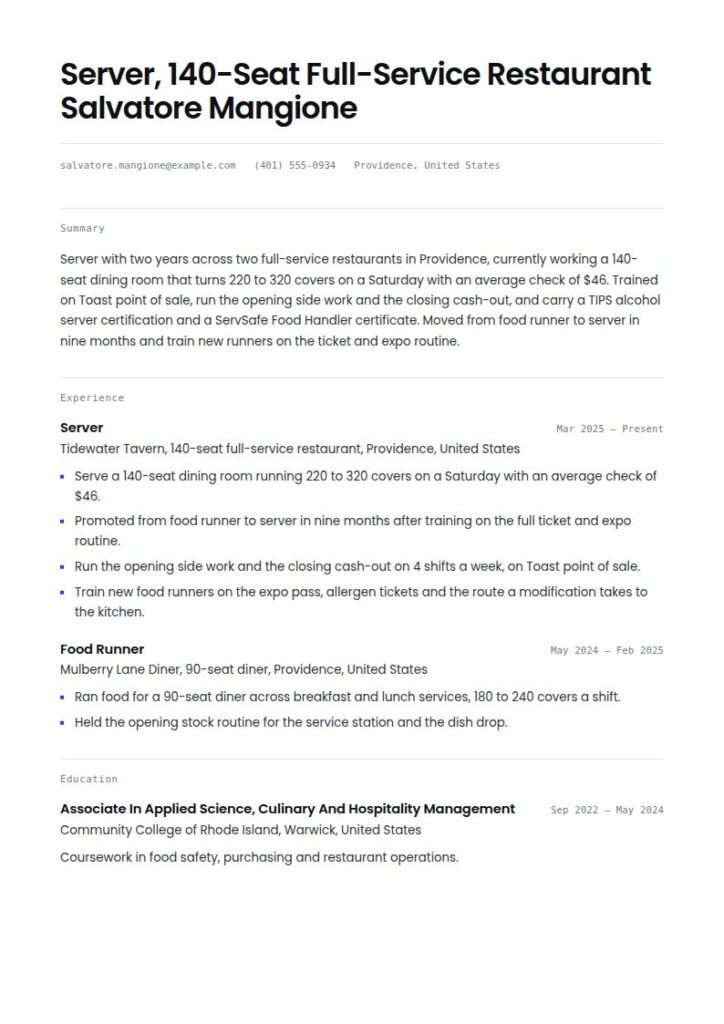
Server with two years across two full-service restaurants in Providence, currently working a 140-seat dining room that turns 220 to 320 covers on a Saturday with an average check of $46. Trained on Toast point of sale, run the opening side work and the closing cash-out, and carry a TIPS alcohol server certification and a ServSafe Food Handler certificate. Moved from food runner to server in nine months and train new runners on the ticket and expo routine.
Work Experience
03/2025 - Present, Server, Tidewater Tavern, 140-seat full-service restaurant, Providence, United States
- Serve a 140-seat dining room running 220 to 320 covers on a Saturday with an average check of $46.
- Promoted from food runner to server in nine months after training on the full ticket and expo routine.
- Run the opening side work and the closing cash-out on 4 shifts a week, on Toast point of sale.
- Train new food runners on the expo pass, allergen tickets and the route a modification takes to the kitchen.
05/2024 - 02/2025, Food Runner, Mulberry Lane Diner, 90-seat diner, Providence, United States
- Ran food for a 90-seat diner across breakfast and lunch services, 180 to 240 covers a shift.
- Held the opening stock routine for the service station and the dish drop.
Education
09/2022 - 05/2024, Associate in Applied Science, Culinary and Hospitality Management, Community College of Rhode Island, Warwick, United States
Coursework in food safety, purchasing and restaurant operations.
Skills
Toast point of sale, 85
Allergen and dietary modifications, 75
Opening side work and closing cash-out, 80
Expo and ticket routine, 80
Cash handling and card reconciliation, 75
Training new runners, 70
Languages
English, native
Italian, intermediate
Certificates
06/2024, ServSafe Food Handler, National Restaurant Association
Held since the first restaurant role.
01/2025, TIPS On-Premise Alcohol Server Certification, Health Communications, Inc.
Summary
A restaurant resume is read by someone who has never eaten in your restaurant, so it has to be written in the part of your experience that travels: certifications, named systems, covers and volume, station and section range, and supervisory years. This guide gives you three adaptable versions, a translation table for house-specific work, and current Bureau of Labor Statistics pay and outlook for the occupations restaurants hire into.
Restaurant resume examples by experience level
In short, a restaurant resume is a one to two page document written for a reader who has never eaten in your restaurant, does not know your menu and will not recognize anything you call by its house name.
That is the whole problem. Restaurant work is intensely local. At first, you learn one menu, one kitchen, one point of sale, one set of regulars and one private vocabulary, and after two years most of what you are good at is expressed in terms that mean nothing outside the building. Then the restaurant changes hands, or the concept changes, or you move.
So the useful question here is not what you did. It is which parts of it will still be legible in a different dining room.
Resume guide for a restaurant resume
To that end, this guide and the corresponding restaurant resume example will cover:
- First, how to write a restaurant resume, section by section
- Then, which parts of your experience travel to the next restaurant and which do not
- Next, three adaptable summaries: front of house starter, supervisor and general manager
- Also, how to translate house-specific work into evidence a stranger can read
- Finally, what the job market and pay look like across the occupations restaurants hire into
How to write a restaurant resume
Overall, five sections: contact header with a scope line, summary, experience, systems and skills, and certifications and education. In general, one page for the first few years, then two once you are supervising.
In practice, the page is read in two passes. To begin with, the first pass, about eight seconds, checks scope: what size of operation, what volume, how many people. The second reads the bullets. If the scope line is missing, there is no second pass.
| Section | What it is answering | Where it goes |
|---|---|---|
| Header and scope line | What size of room, what volume, how many staff | Top, under your name |
| Summary | Role, years, systems, one number with a period | Directly under the header |
| Experience | What you held and what changed, restaurant by restaurant | Reverse chronological |
| Systems and skills | The named products and processes you can use on day one | Its own block |
| Certifications and education | Food safety and alcohol service first, with issuing bodies | Near the end |
Put the volume in the header, not in a bullet halfway down
"Server, four years" tells a hiring manager nothing about whether you can work in their room. "Server, 140-seat full-service restaurant, 220 to 320 covers on a Saturday, average check $46" tells them everything, including whether you will be surprised by the pace.
Volume is the most portable fact you own. Seats, covers per service, average check, weekly sales, staff on the floor: these mean the same thing in every restaurant in the country, which is why they belong in the first two lines rather than in a bullet.
Run the finished file through the free Rezoom ATS resume checker before you send it, because restaurant groups and hotel companies increasingly parse applications before a person reads them.
Choosing the best resume format for a restaurant resume
Therefore: reverse chronological, single column, one page for your first few years and two once you are running a building.
Two things tempt restaurant people into a functional format, and both are mistakes. For example, the first is short stints: seasonal work, a restaurant that closed, a concept change that released the whole team. Those read as normal in this industry; however, hiding them does not. Instead, write the reason in four words, such as "restaurant closed, January 2025".
The second is range. People who have worked both sides of the pass often write a skills-first page so neither history dominates. Write the sequence instead and use the systems block to show the range.
Include your contact information
| ✅ Right | ❌ Wrong |
|---|---|
| Salvatore Mangione | Sal Mangione |
| Restaurant General Manager | Restaurant professional |
| 160 seats, 1,900 covers a week, 34 staff, $4.2M annual sales | Extensive experience in the restaurant industry |
| (401) 555-0934, [email protected], Providence, RI | (401) 555-0934, [email protected] |
Above all, the third line is the scope line, the highest-value line on a restaurant resume. In other words: four facts, no adjectives, and every one means the same thing in any restaurant.
Make use of a summary
In short, four lines: role and level, years and how many restaurants, the systems you run, and one number attached to a period of time.
Server with two years across two full-service restaurants in Providence, currently working a 140-seat dining room that turns 220 to 320 covers on a Saturday with an average check of $46. Trained on Toast point of sale, run the opening side work and the closing cash-out, and carry a TIPS alcohol server certification and a ServSafe Food Handler certificate. Moved from food runner to server in nine months and train new runners on the ticket and expo routine.
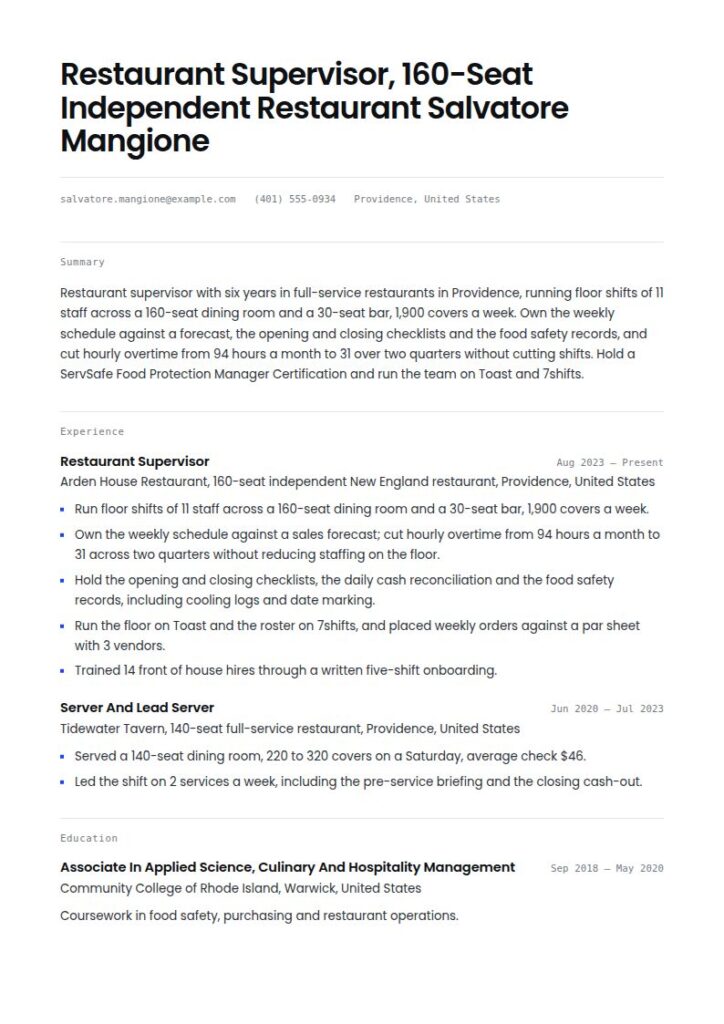
Restaurant supervisor with six years in full-service restaurants in Providence, running floor shifts of 11 staff across a 160-seat dining room and a 30-seat bar, 1,900 covers a week. Own the weekly schedule against a forecast, the opening and closing checklists and the food safety records, and cut hourly overtime from 94 hours a month to 31 over two quarters without cutting shifts. Hold a ServSafe Food Protection Manager Certification and run the team on Toast and 7shifts.
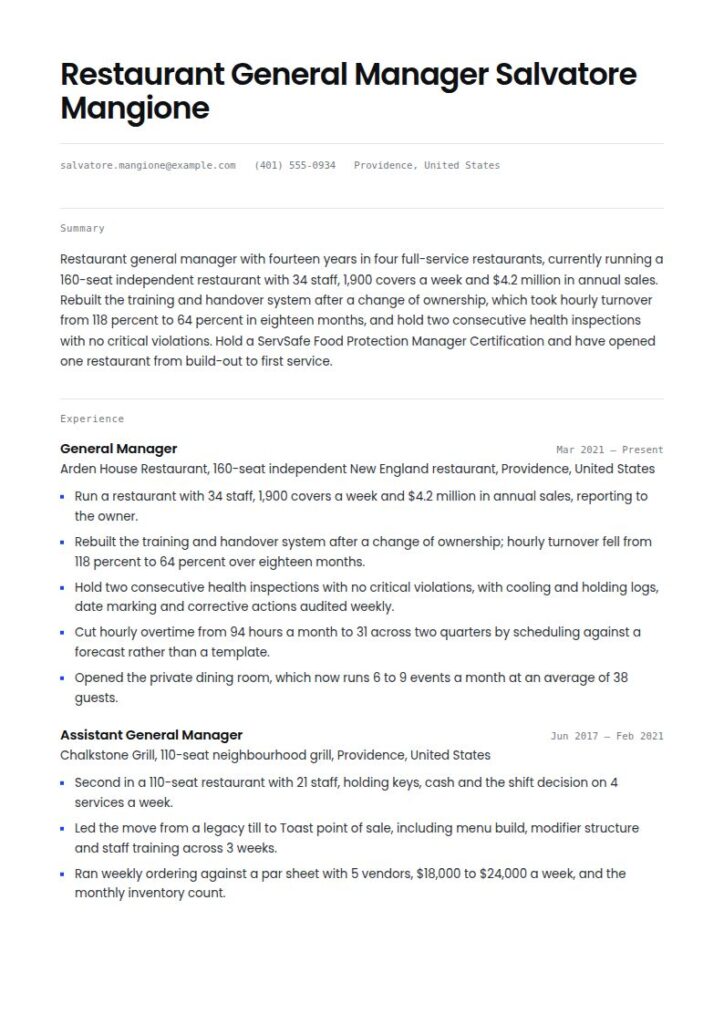
Restaurant general manager with fourteen years in four full-service restaurants, currently running a 160-seat independent restaurant with 34 staff, 1,900 covers a week and $4.2 million in annual sales. Rebuilt the training and handover system after a change of ownership, which took hourly turnover from 118 percent to 64 percent in eighteen months, and hold two consecutive health inspections with no critical violations. Hold a ServSafe Food Protection Manager Certification and have opened one restaurant from build-out to first service.
Right vs wrong: the same restaurant summary, twice
| ✅ Right | ❌ Wrong |
|---|---|
| Running a 160-seat independent restaurant with 34 staff and 1,900 covers a week. | Experienced restaurant manager with a proven track record. |
| Took hourly turnover from 118 percent to 64 percent in eighteen months. | Skilled at building and motivating high-performing teams. |
| Two consecutive health inspections with no critical violations. | Committed to the highest standards of quality and safety. |
| Hold a ServSafe Food Protection Manager Certification. | Extensive knowledge of food safety practices. |
However, every line on the right could be said by anyone in the industry. In contrast, every line on the left is a fact a stranger can picture, compare against their own building and check by phone.
Outline your restaurant experience
Then list: restaurant, city, concept and size, your role, dates. Then three to five bullets, each with a number. Name the concept and size on the same line as the restaurant, because the reader will not know it.
| Instead of | Use |
|---|---|
| Worked as a server in a busy restaurant | Served a 140-seat dining room, 220 to 320 covers on a Saturday, average check $46 |
| Responsible for opening and closing duties | Held opening keys and the closing cash-out for a $4.2M restaurant, 5 shifts a week |
| Helped train new staff | Trained 22 front of house hires over three years through a written 5-shift onboarding |
| Improved the guest experience | Moved the restaurant's public review average from 3.9 to 4.5 over 14 months |
| Reduced costs | Cut hourly overtime from 94 hours a month to 31 over two quarters without cutting shifts |
General Manager, Arden House Restaurant, Providence, RI, 160-seat independent New England restaurant with a 30-seat bar, March 2021 to Present
Run a restaurant with 34 staff, 1,900 covers a week and $4.2 million in annual sales, reporting to the owner.
Rebuilt the training and handover system after a change of ownership; hourly turnover fell from 118 percent to 64 percent over eighteen months.
Hold two consecutive health inspections with no critical violations, with cooling and holding logs, date marking and corrective actions audited weekly.
Cut hourly overtime from 94 hours a month to 31 across two quarters by scheduling against a forecast rather than a template, with no reduction in staffing on the floor.
Opened the restaurant's private dining room, which now runs 6 to 9 events a month at an average of 38 guests.
What carries to the next restaurant, and what stays behind
Here is the test. If your restaurant closed tomorrow and you applied across town on Monday, which lines on your page would still mean something to a stranger? Everything that survives is portable. Everything else, by contrast, is house knowledge: real skill that cannot be read by someone who was not there.
| Carries to the next restaurant | Stays behind |
|---|---|
| Certifications with an issuing body and a date | Internal titles and levels, such as "trainer, tier 3" |
| Named systems: the point of sale, scheduling, inventory and reservation products | Your menu, and how well you can describe 40 dishes |
| Volume: seats, covers, average check, weekly sales, staff on the floor | Your regulars and the relationships behind them |
| Stations you can work and sections you can carry | House shorthand: table numbers, abbreviations, the call order |
| Supervisory years and headcount | Seniority, your shifts and your position on the schedule |
| Ordering, par sheets, inventory counts and vendor relationships as a process | Which purveyor delivers on which morning in your town |
| Food safety records, inspection outcomes, allergen procedure | The trust you built with one chef or one owner |
| Training numbers and retention outcomes | The way your kitchen expedites, which differs everywhere |
| Languages spoken on the floor | Your knowledge of which tables never get sat |
Translate house knowledge for a new restaurant
The right column is not worthless. It is roughly half of what makes you good at the job, and it is why the first three weeks anywhere new are humbling. But it cannot go on a resume, because the reader cannot evaluate it, and a page full of it reads as a page with no evidence.
Therefore, the move is translation: take each house-specific line and rewrite it as the general thing it is an instance of.
| House-specific | Portable version |
|---|---|
| Ran the Tuesday wine dinner | Planned and executed a monthly 60-cover prix fixe service with a fixed timeline and a separate beverage pairing |
| Level 3 trainer on the floor plan | Trained 22 front of house hires through a written 5-shift onboarding; 17 were still employed at six months |
| Knew the whole menu and every modifier | Handled allergen and dietary modifications on a 44-item menu, including the ticket route to the kitchen and the confirmation back |
| Covered for the manager on his days off | Held keys, cash and the shift decision on 2 services a week for 18 months, including refusals and comps up to $75 |
| Did the ordering for the bar | Placed weekly orders against a par sheet with 3 vendors, $18,000 to $24,000 a week, and ran the monthly count |
Translation is what makes a long stay at one restaurant readable
Long service in one building is an asset and the hardest history to write, because after six years almost everything you know is expressed in house terms.
Work backwards from the systems. For each year, write down the products you used, the volume you handled, the number of people you trained or supervised, and any certification you gained. That list is your portable spine, and it is usually longer than people expect.
Then add the thing only long service can prove: what changed while you were there. A change of ownership, a concept change, a kitchen rebuild, a move to a new point of sale, a first liquor license. A stranger cannot picture your dining room, but they can picture a restaurant changing hands.
Build a snapshot of your key skills
Next, twelve to sixteen entries in four groups: systems, operations, team and compliance. Products by name, never by category.
Systems: Toast point of sale, 7shifts scheduling, MarginEdge invoice and inventory, OpenTable reservations, QuickBooks Online
Operations: Scheduling against a sales forecast, Weekly ordering and par sheets, Inventory counts, Cash handling and daily reconciliation, Opening and closing procedure, Service recovery and comps
Team: Hiring and onboarding, Written training programs, Performance conversations, Shift briefings, Scheduling for a mixed full-time and part-time roster
Compliance: Food safety records and corrective actions, Allergen handling and communication, Alcohol service and refusal, Health inspection preparation
Above all, the first group is what hiring managers scan for. If they run Toast and you have run Toast, your training time drops from three weeks to three days, and everyone in the room knows it.
List your education and certifications
Certifications first, with issuing body and date, because they are the most portable things you own. Education after, briefly.
ServSafe Food Protection Manager Certification, National Restaurant Association, 2024
TIPS On-Premise alcohol server certification, Health Communications, Inc., 2019
Associate in Applied Science, Culinary and Hospitality Management, Community College of Rhode Island, Warwick, RI, 2014
For example, the Bureau of Labor Statistics states that some states and localities require food service managers to have food safety certification, and names the Food Protection Manager Certification, obtained by passing a food safety exam (BLS Occupational Outlook Handbook, food service managers, published 27 August 2026). If you supervise, or want to, hold it before the interview rather than after.
Later, a culinary or hospitality qualification is worth one line once you have five years behind you. BLS records a high school diploma or equivalent as the typical entry-level education for both food service managers and chefs and head cooks (BLS Occupational Outlook Handbook, published 27 August 2026). Nothing here outranks scope and certification.
Choose the right layout and design
In addition: single column, 11 or 12 point, one page up to about five years of experience and two beyond it. No photograph, no icons, no columns.
Write each restaurant's concept and size next to its name, because half your history will be independents a reader has never heard of. "Arden House Restaurant, Providence, RI, 160-seat independent New England restaurant" takes eight extra words and turns an unknown name into a known quantity.
Put a scope line under your name: seats, covers, staff, sales. Name every system by product. Translate house-specific work into the general thing it is an instance of. Give certifications with issuing body and date. Name the concept and size beside each restaurant. Explain a closure or concept change in four words rather than leaving a gap.
Do not use house shorthand, internal levels or table numbering that only made sense in your building. Do not write "fast-paced environment", which appears on every resume in the stack. Do not hide short stints behind a functional format. Do not claim a certification that has lapsed without saying so. Do not list the menu you can describe; list the volume you can handle.
Restaurant job market and outlook
At the same time, the sector's trade body and the Bureau of Labor Statistics describe the same picture from two directions.
The National Restaurant Association projects total restaurant and foodservice sales of $1.55 trillion in 2026, employment of 15.8 million people, more than 100,000 jobs added during the year and more than 1 million restaurant and foodservice outlets nationally (National Restaurant Association, 2026 State of the Restaurant Industry, 12 February 2026).
However, there is no BLS occupation called restaurant worker. Instead, a restaurant hires into several published occupations at once, and the honest way to read the market is across all of them.
| Occupation | Jobs, 2025 | Projected change, 2025-35 | Annual openings | Median annual wage, May 2025 |
|---|---|---|---|---|
| Food and beverage serving and related workers | 5,143,000 | 5%, +280,800 | ~1,078,500 | $31,710 |
| Cooks | 2,705,800 | 7%, +183,200 | ~393,200 | $36,640 |
| Waiters and waitresses | 2,284,400 | 2%, +46,500 | ~423,100 | $35,230 |
| Bartenders | 762,600 | 5%, +37,900 | ~121,200 | $34,340 |
| Food service managers | 344,300 | 6%, +19,900 | ~38,800 | $69,390 |
Source: U.S. For reference: Bureau of Labor Statistics, Occupational Outlook Handbook, May 2025 wage data and 2025 to 2035 projections, published 27 August 2026.
Two million openings a year is why portability is the whole skill
Add the annual openings across those five occupations and restaurants are hiring into roughly two million positions a year: about 1,078,500 for food and beverage serving and related workers, 393,200 for cooks, 423,100 for waiters and waitresses, 121,200 for bartenders and 38,800 for food service managers (BLS Occupational Outlook Handbook, published 27 August 2026). Growth accounts for only a small share of that, because none of those occupations is projected to grow more than 7 percent over the decade.
The rest is movement, against a base the National Restaurant Association puts at 15.8 million jobs across more than 1 million outlets in 2026 (National Restaurant Association, 12 February 2026).
That is the argument for portable terms. Where almost every opening exists because someone moved, your reader is comparing you with strangers from restaurants they have never visited, and the only common language is certifications, systems and numbers.
What salary you can expect in a restaurant
As a result, there is no single restaurant salary, and the gap inside one building is wide. For example, in May 2025 the median annual wage was $31,710 for food and beverage serving and related workers, $34,340 for bartenders, $35,230 for waiters and waitresses, $36,640 for cooks and $69,390 for food service managers (BLS Occupational Outlook Handbook, published 27 August 2026).
In other words, the step into management is the one large jump most restaurant careers contain, and it is roughly a doubling. BLS records a high school diploma or equivalent and less than five years of related experience as typical for food service managers, so the gate is not academic; it is evidence of scope.
Setting moves the number too. Meanwhile, for food service managers the median was $82,170 in traveler accommodation and $79,450 in educational services against $65,060 in food services and drinking places (BLS, May 2025). Similarly, hotels, schools and contract operations pay above independent restaurants for the same title.
Ultimately, what a resume moves is which band you are read into. For instance, a page showing 34 staff, $4.2 million in sales and a manager-level food safety certification is read for a management post. By contrast, a page showing four years of good service with no volume, no systems and no certification is read for the post you already have.
Key takeaways for a restaurant resume
- To start, put a scope line under your name: seats, covers, staff and sales.
- Then write for a reader who has never been to your restaurant and knows none of its vocabulary.
- Translate house-specific work into the general thing it is an instance of.
- Name systems by product; that is what shortens your training time.
- Also lead the credentials block with food safety and alcohol service, with issuing bodies and dates.
- In addition, name the concept and size beside every restaurant you list.
- Finally, do not hide short stints; closures and concept changes read as normal in this industry.
Build your restaurant resume in 15 minutes with our AI resume builder.
Related hospitality and catering resume examples
- Chef resume
- Sous chef resume
- Line cook resume
- Pastry chef resume
- Server resume
- Bartender resume
- Hostess resume
- Restaurant manager resume
- Bar manager resume
- Food services manager resume
- Caterer resume
- Hospitality and catering resume
Pair it with a matching restaurant cover letter.
Restaurant resume questions, answered
How long should a restaurant resume be?
One page for your first five years, two once you are supervising a building or have worked in four or more restaurants. A general manager with fourteen years has earned a second page; a server with two years has not.
How do I write short stints without it looking bad?
Write them plainly with the reason attached in four words: "restaurant closed, January 2025" or "concept change, team released". Closures and ownership changes are ordinary here, and a reader who works in the sector knows it. What reads badly is an unexplained gap or a format that hides dates.
I have only ever worked at one restaurant. Is that a problem?
No, it is an advantage once you translate it. Long service is rare in an industry with roughly two million annual openings across its main occupations (BLS Occupational Outlook Handbook, published 27 August 2026). Write the systems, the volume, the people you trained and what changed while you were there, and the page reads as depth rather than as a single room.
Which certification is worth having first?
A manager-level food safety certification. BLS names the Food Protection Manager Certification, obtained by passing a food safety exam, and notes that some states and localities require food service managers to hold food safety certification (BLS Occupational Outlook Handbook, published 27 August 2026). After that, your state's alcohol service certification if you work near a bar.
Should I put back of house and front of house on the same resume?
Yes, if both are real, and in date order. Range is valuable in restaurants. Use the systems and skills block to show both sides, and write the summary for the role you are applying to rather than for your whole history.
What do I put on a restaurant resume with no experience?
Any work with a shift, a schedule and a till: retail, a school kitchen, catering, a concession stand, a family business. Write it at full scale, with volume and hours, add a food handler certificate, and state the hours you can genuinely hold. Reliability is what an entry level restaurant hire is bought on.