Pastry Cook Anneliese Brandt
Pastry Cook
[email protected] | (414) 555-0802 | Milwaukee, United States
Profile
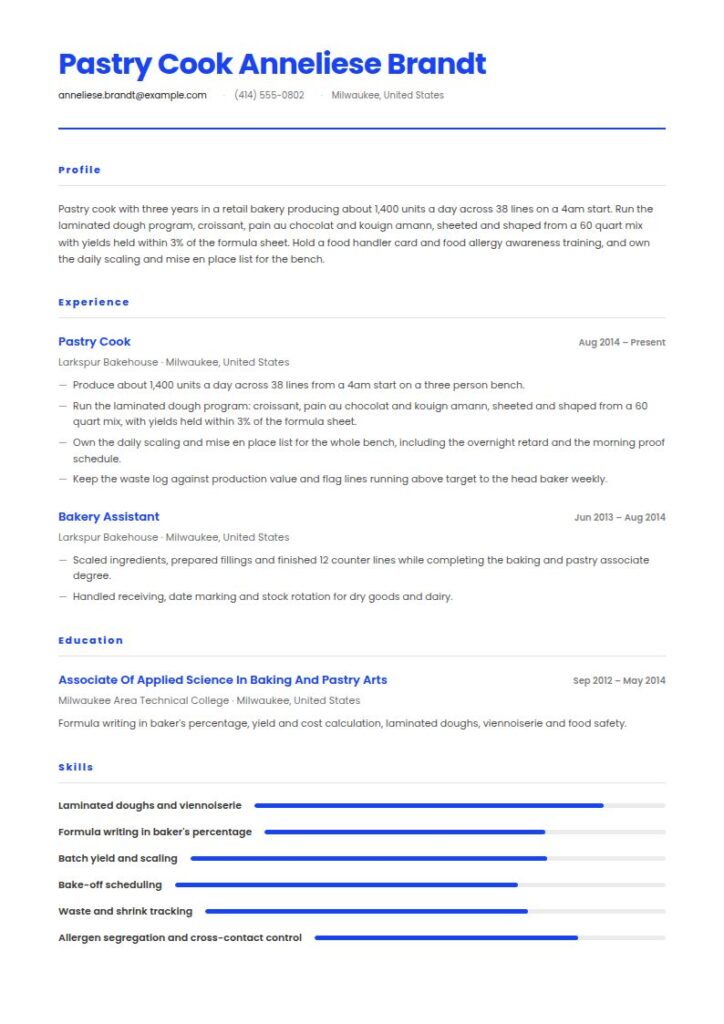
Pastry cook with three years in a retail bakery producing about 1,400 units a day across 38 lines on a 4am start. Run the laminated dough program, croissant, pain au chocolat and kouign amann, sheeted and shaped from a 60 quart mix with yields held within 3% of the formula sheet. Hold a food handler card and food allergy awareness training, and own the daily scaling and mise en place list for the bench.
Work Experience
08/2014 - Present, Pastry Cook, Larkspur Bakehouse, Milwaukee, United States
- Produce about 1,400 units a day across 38 lines from a 4am start on a three person bench.
- Run the laminated dough program: croissant, pain au chocolat and kouign amann, sheeted and shaped from a 60 quart mix, with yields held within 3% of the formula sheet.
- Own the daily scaling and mise en place list for the whole bench, including the overnight retard and the morning proof schedule.
- Keep the waste log against production value and flag lines running above target to the head baker weekly.
06/2013 - 08/2014, Bakery Assistant, Larkspur Bakehouse, Milwaukee, United States
- Scaled ingredients, prepared fillings and finished 12 counter lines while completing the baking and pastry associate degree.
- Handled receiving, date marking and stock rotation for dry goods and dairy.
Education
09/2012 - 05/2014, Associate of Applied Science, Baking and Pastry Arts, Milwaukee Area Technical College, Milwaukee, United States
Formula writing in baker's percentage, yield and cost calculation, laminated doughs, viennoiserie and food safety.
Skills
Laminated doughs and viennoiserie, 85
Formula writing in baker's percentage, 70
Batch yield and scaling, 75
Bake-off scheduling, 70
Waste and shrink tracking, 70
Allergen segregation and cross-contact control, 75
Languages
English, native
German, conversational
Certificates
06/2013, Food handler certification, State-approved food handler training program
Current.
02/2016, Food allergy awareness training, Employer food safety program
Covers the major food allergens named in the FDA Food Code.
Summary
A pastry chef resume is a one to two page document showing that you own a production book: a costed set of recipes with yields that scale, a bake-off schedule that lands on time, and an allergen routine that holds. This guide gives you three adaptable versions, the American Culinary Federation pastry ladder, and current Bureau of Labor Statistics pay for the two occupations the job is actually measured against.
Pastry Chef resume examples by experience level
A pastry chef resume is a one to two page document proving you own a production book rather than a repertoire.
Of course, anyone reading it assumes you can bake. What they cannot assume is that you can hold thirty items in production at once, scale a formula from a 20 quart bowl to a 60 without breaking it, land a bake-off so the laminated pastry is out before service, and keep a nut-free item nut-free while you do it. That is production management with a whisk attached, and the file that shows the management part is the one that gets called.
Resume guide for a pastry chef resume
To start, this guide and the corresponding pastry chef resume example will cover:
- First, how to write a pastry chef resume, section by section
- Then, why your production book belongs on the page, and what to say about it
- Also, three adaptable summaries: pastry cook, pastry chef and executive pastry chef
- The ACF pastry ladder and the allergen rules that get checked
- Finally, what the job market looks like and what you can expect to earn
How to write a pastry chef resume
Overall, use six sections: contact header, summary, pastry experience, the production book, education and certifications, and skills. In general, one page for a pastry cook or a single-section pastry chef, two once you run a department across outlets. Experience comes first because a pastry chef is bought on the operation they have run, and every operation has a setting, a volume, a menu size and a team a reader can price at a glance.
| Section | What it is answering | Where it goes |
|---|---|---|
| Summary | Which of the three settings, and at what volume? | Top, four lines |
| Pastry experience | What did they produce, for how many, with how many hands? | Reverse chronological, with numbers |
| Production book | Do they own costed formulas that scale, or only make things? | Its own block |
| Certifications | Is the ACF and food safety paperwork current? | Below education, with dates |
Name your setting before you name your desserts
Pastry is three jobs sharing one title, and a reader needs to know which one you have done inside four seconds.
Restaurant pastry is small batch, plated to order, high skill per plate, low unit count. Hotel and banquet pastry is volume against a deadline: 600 covers plated in twenty minutes, plus breakfast viennoiserie and amenity work. Retail bakery is daily production against a sell-by: thirty to fifty lines, a pre-dawn start, and waste measured against the counter.
So open with the setting: "Executive pastry chef, 220 room hotel, three outlets plus banquet to 600". A hiring chef who has to guess which of the three you are will move on to a file that told them.
Run the finished file through the ATS resume checker first. Hotel groups and bakery companies parse applications into software before any chef reads them.
Choosing the best resume format for a pastry chef resume
Reverse chronological. In short, one page for a pastry cook or a first pastry chef role, two once you run a department, cost it and hire into it.
In practice, pastry careers include seasonal work, stages and a holiday season some people work as a contract. Still, keep the timeline and label each short run: "seasonal contract, October to January", "stage, two months". After all, a labeled short stint is a credential; an unexplained gap is a question the reader answers themselves.
Include your contact information
| ✅ Right | ❌ Wrong |
|---|---|
| Anneliese Brandt | Anneliese Brandt |
| Executive Pastry Chef, hotel and banquet, 600 covers | Passionate pastry artist with a love of chocolate |
| ACF Certified Executive Pastry Chef (CEPC), Food Protection Manager to 2029 | Certified pastry professional |
| (414) 555-0802, [email protected], Milwaukee, WI | (414) 555-0802, [email protected] |
Next, put the certification and the expiry in the header. That is because a food and beverage director who has sat through an inspection reads that line first.
Make use of a summary
Then write four lines: your setting and its volume, years in pastry, the size of the book you own, and one number with a direction and a period.
Pastry cook with three years in a retail bakery producing about 1,400 units a day across 38 lines on a 4am start. Run the laminated dough program, croissant, pain au chocolat and kouign amann, sheeted and shaped from a 60 quart mix with yields held within 3% of the formula sheet. Hold a food handler card and food allergy awareness training, and own the daily scaling and mise en place list for the bench.
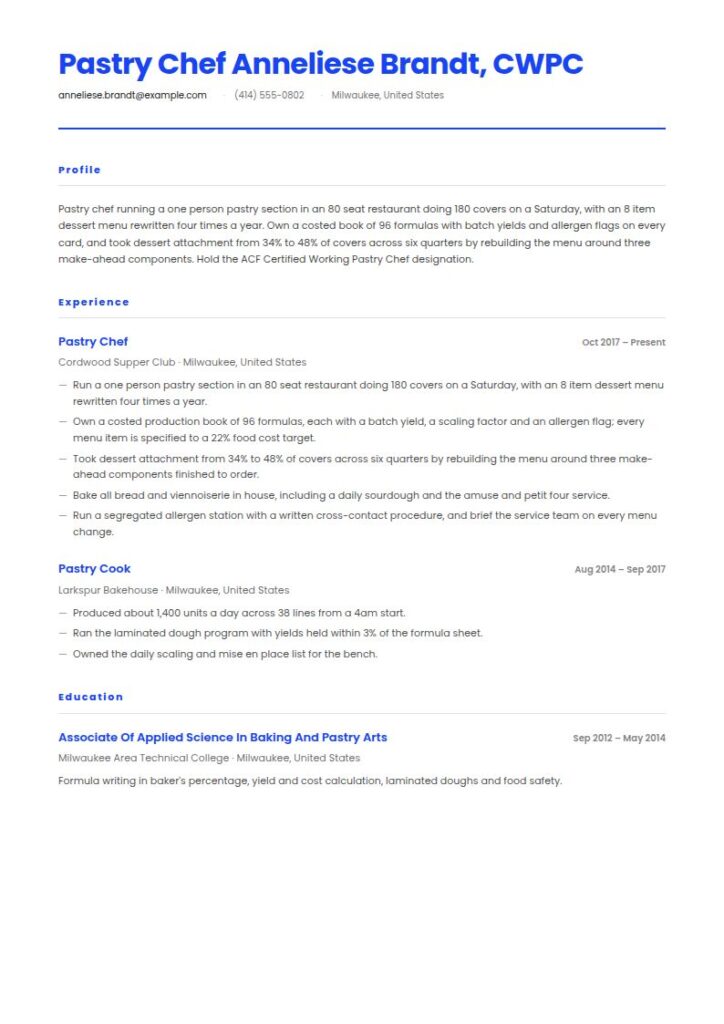
Pastry chef running a one person pastry section in an 80 seat restaurant doing 180 covers on a Saturday, with an 8 item dessert menu rewritten four times a year. Own a costed book of 96 formulas with batch yields and allergen flags on every card, and took dessert attachment from 34% to 48% of covers across six quarters by rebuilding the menu around three make-ahead components. Hold the ACF Certified Working Pastry Chef designation.
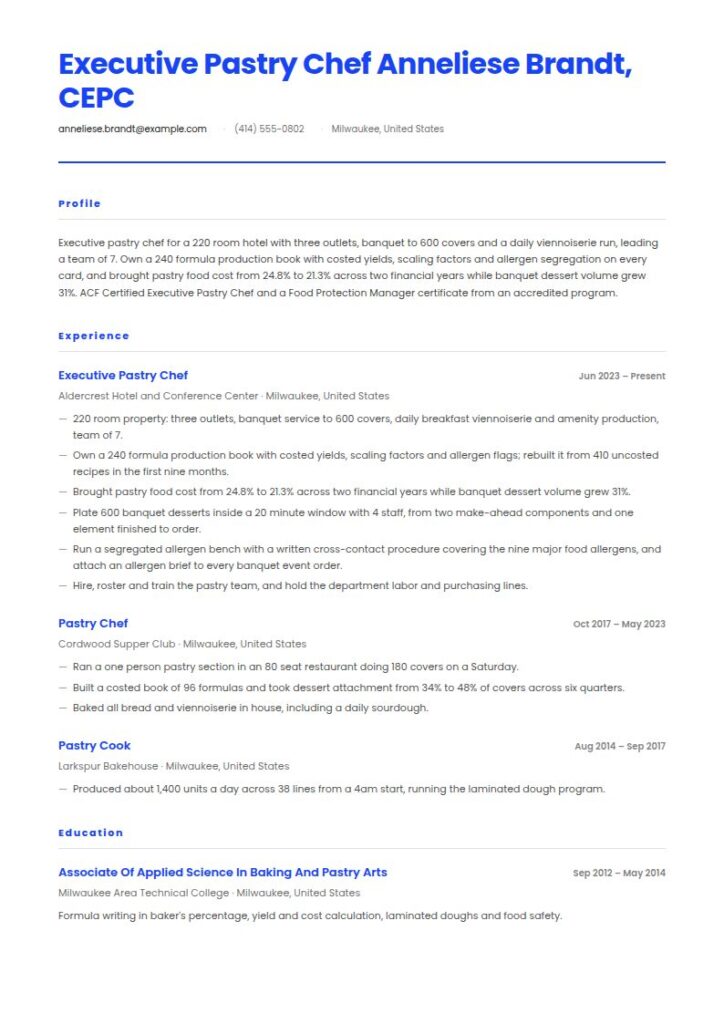
Executive pastry chef for a 220 room hotel with three outlets, banquet to 600 covers and a daily viennoiserie run, leading a team of 7. Own a 240 formula production book with costed yields, scaling factors and allergen segregation on every card, and brought pastry food cost from 24.8% to 21.3% across two financial years while banquet dessert volume grew 31%. ACF Certified Executive Pastry Chef and a Food Protection Manager certificate from an accredited program.
Right vs wrong: the same pastry chef summary, twice
| ✅ Right | ❌ Wrong |
|---|---|
| Pastry chef running a one person section in an 80 seat restaurant doing 180 covers on a Saturday. | Creative pastry professional with a passion for beautiful desserts. |
| Own a costed production book of 96 recipes with batch yields and allergen flags on every card. | Experienced in a wide variety of pastry techniques and recipes. |
| Took dessert attachment from 34% to 48% of covers across six quarters. | Helped increase dessert sales and guest satisfaction. |
In other words, the right column can be costed and rostered; the left is a mood board. The chef reading forty files before a service is doing arithmetic.
Outline your pastry experience
Venue, city, dates, the operation in one clause, then three to five bullets. Every bullet carries a number, and at least one is a money or waste number.
| Instead of | Use |
|---|---|
| Prepared a variety of desserts daily | Produced about 1,400 units a day across 38 lines from a 4am start, single bench |
| Created seasonal dessert menus | Rewrote the 8 item dessert menu four times a year, each item costed to a 22% target |
| Managed pastry inventory | Held pastry food cost at 21.3% with a weekly count and a scaling sheet per formula |
| Ensured food safety compliance | Ran a segregated allergen bench and a written cross-contact procedure for the nine major food allergens |
Executive Pastry Chef, Aldercrest Hotel and Conference Center, Milwaukee, WI, June 2023 to Present
220 room property: three outlets, banquet service to 600 covers, daily breakfast viennoiserie and amenity production, team of 7.
Own a 240 formula production book with costed yields, scaling factors and allergen flags; rebuilt it from 410 uncosted recipes in the first nine months.
Brought pastry food cost from 24.8% to 21.3% across two financial years while banquet dessert volume grew 31%.
Plate 600 banquet desserts inside a 20 minute window with 4 staff, from two make-ahead components and one element finished to order.
Run a segregated allergen bench with a written cross-contact procedure covering the nine major food allergens, and train every new pastry cook on it in week one.
Your production book: yields, scaling and the allergen line
However, this is the section that separates a pastry chef from a talented baker, and almost nobody writes it.
Specifically, a production book is the set of formulas your operation runs on: each costed, each with a yield, each scalable, each flagged for allergens. Therefore, whoever owns it owns the kitchen's ability to make the same thing on a Tuesday in March and a Saturday in December with different people on the bench. Say how big yours is and what state it was in when you arrived.
| What to state | Why the reader cares | A worked example |
|---|---|---|
| Size and format of the book | Whether you inherited recipes or built a system | 240 formulas, each with a cost card, a batch yield and an allergen flag |
| Batch yields | You produce to a number, not to a feeling | Croissant dough at a 6,000 g flour batch yielding 96 pieces at 62 g |
| Scaling method | You can change equipment without breaking a formula | Baker's percentage on every dough, scaling factors to the 20 and 60 quart bowls |
| Bake-off timing | This is the actual job in a hotel or a bakery | Sheeted the day before, retarded overnight, proofed from 4am, out by 6.30am |
| Waste and shrink | The number that decides whether the section makes money | Waste from 6.2% to 3.1% of production value across four quarters |
| Allergen segregation | The compliance line that gets audited | Separate bench, color-coded tools, written cross-contact procedure |
Pastry chef scaling and allergen evidence
Scaling is worth its own sentence, because it is what an interviewer will test. Instead, write the method, not the claim: "every dough written in baker's percentage with a scaling factor to the 20 and 60 quart bowls" tells a chef you can take a formula into a different room, and "able to scale recipes" tells them nothing.
Then the allergen line, which is not a soft skill. Since 1 January 2023 sesame has been the ninth major food allergen recognized in the Federal Food, Drug, and Cosmetic Act and the 2022 FDA Food Code, joining milk, egg, fish, crustacean shellfish, tree nuts, wheat, peanuts and soybeans. Congress named the first eight in the Food Allergen Labeling and Consumer Protection Act of 2004; the FASTER Act later added sesame (U.S. Food and Drug Administration).
The FDA also states that employee food safety training must include allergy awareness of the nine major food allergens, referencing Food Code sections 2-102.11 and 2-103.11 (U.S. Food and Drug Administration). In particular, pastry is where that lands hardest: nuts, dairy, egg, wheat, soy and sesame are not contaminants in a pastry kitchen, they are the ingredients. So write what you do about it:
Production book: 240 formulas, each with a cost card, a batch yield, a scaling factor and an allergen flag. Rebuilt from 410 uncosted recipes over nine months.
Scaling: every dough written in baker's percentage with scaling factors to the 20 and 60 quart bowls; yields held within 3% of the formula sheet.
Bake-off: laminated doughs sheeted the day before, retarded overnight, proofed from 4am and out by 6.30am for three outlets and breakfast banquet.
Allergen control: segregated bench, color-coded tools, a written cross-contact procedure covering the nine major food allergens, allergen flags on every formula card and an allergen brief on every banquet event order.
Waste: held at 3.1% of production value, down from 6.2% over four quarters.
What each pastry setting hires on
Name your setting, because the three hire on different evidence:
| Setting | What the resume has to prove | The number they look for |
|---|---|---|
| Restaurant pastry | Plating skill, menu writing, working alone | Covers, menu size, dessert attachment rate |
| Hotel and banquet pastry | Volume against a fixed clock, and a team | Banquet covers per window, outlets supported, headcount |
| Retail bakery | Daily production against a sell-by, and waste | Units a day, lines produced, waste as a share of production |
If you have worked two of the three, say so. It is rare, and that is why a hotel will interview a bakery candidate.
Build a snapshot of your key skills
Generally, list ten to fourteen entries in four groups: production, technique, systems and compliance. In fact, a grouped list gets scanned; an alphabetical one gets skipped.
Production: Formula writing in baker's percentage, Batch yield and scaling, Bake-off scheduling, Mise en place planning, Production costing
Technique: Laminated doughs, Sugar and chocolate work, Entremets and mousse, Plated desserts, Viennoiserie
Systems: Recipe and cost card software, Banquet event orders, Purchase ordering, Inventory counts, Labor scheduling
Compliance: Allergen segregation and cross-contact control, HACCP, Temperature and cooling logs, Date marking and rotation
List your education and certifications
Certifications first if they are current, then baking or culinary training, then degrees. A pastry diploma helps in the first years and matters less by year eight; the certifications keep mattering, because they get checked.
In addition, the American Culinary Federation runs the pastry ladder the profession recognizes, and each rung means something specific. Certified Fundamentals Pastry Cook is a cook with fundamental knowledge and no commercial baking experience; Certified Pastry Culinarian is the entry-level working position; Certified Working Pastry Chef supervises a pastry section or a shift; Certified Executive Pastry Chef is the department head; Certified Master Pastry Chef is the top of the ladder (American Culinary Federation, accessed September 2026). Also write the designation, the body and the date, and never paraphrase a certification into a skill.
Likewise, a Food Protection Manager certificate is worth what its accreditation is worth. The Conference for Food Protection states that its Standards for Accreditation of Food Protection Manager Certification Programs provide the framework for universal acceptance of the resulting credentials, and that certificates from an accredited program meet the FDA Food Code knowledge requirement, with the directory maintained by the ANSI National Accreditation Board (Conference for Food Protection, accessed September 2026). Say which program yours came from.
ACF Certified Executive Pastry Chef (CEPC), American Culinary Federation, 2023
Food Protection Manager, program accredited by the ANSI National Accreditation Board, renewed 2024, valid to 2029
Food allergy awareness training covering the nine major food allergens, 2025
Associate of Applied Science, Baking and Pastry Arts, Milwaukee Area Technical College, Milwaukee, WI, 2014
Choose the right layout and design
Finally, use a single column, 11 or 12 point body type, plain headings, no photograph and no piping bag graphic. This matters because hotel companies and bakery groups run applicant tracking systems, and two columns, text boxes and icons are where the parse breaks. A portfolio link is the one exception worth adding, on a single line next to your email, because pastry is visual and the reader will look. Similarly, use a clean URL, not an embedded image.
Name the setting beside every title: restaurant, hotel and banquet, or retail bakery. State how many formulas are in the book you own and whether they are costed. Give batch yields and the scaling method. Write the bake-off schedule as a timeline. Say what your allergen procedure actually is. Give food cost or waste as a movement across a stated period, and write the ACF designation with its body and date.
Do not list every dessert you can make. Do not write "creative" or "artistic" anywhere. Do not claim a cost figure you did not own. Do not say "allergy aware" without describing the procedure. Do not use a two-column template with a photograph of a cake. Do not hide a seasonal contract, and do not send two pages before you have run a department.
Pastry chef job market and outlook
Notably, the Bureau of Labor Statistics publishes no separate Occupational Outlook Handbook profile for pastry chefs. That is a quirk of how the Handbook groups food preparation work, and it matters because it decides which figures you are compared against.
Two published occupations sit either side of the job. Chefs and Head Cooks is the primary one, because a pastry chef who writes a menu, costs it, orders against it and supervises a section is doing what the Handbook describes there. Bakers is the adjacent one, and the closer match for retail bakery or wholesale production, where the work is daily output against a sell-by rather than menu and cost ownership.
| Measure | Chefs and Head Cooks (primary) | Bakers (adjacent) |
|---|---|---|
| Jobs, 2025 | 220,300 | 262,400 |
| Projected change, 2025-35 | 7% (much faster than average) | 6% |
| Projected annual openings | About 25,200 | About 36,500 |
| Typical entry-level education | High school diploma or equivalent | No formal educational credential |
| Median annual wage, May 2025 | $62,470 | $37,160 |
| Median hourly wage, May 2025 | $30.03 | $17.86 |
Source: U.S. Bureau of Labor Statistics, Occupational Outlook Handbook, Chefs and Head Cooks and Bakers, 2025-35 projections and May 2025 wage data, last modified 27 August 2026.
The gap between the two occupations is $25,310
The median annual wage was $62,470 for chefs and head cooks and $37,160 for bakers in May 2025 (BLS Occupational Outlook Handbook, last modified 27 August 2026). That is a difference of $25,310 for work that, in a pastry kitchen, can look almost identical from the outside.
What separates them on paper is ownership: menu authorship, costing, ordering, supervision and a team. Those are what the Handbook attaches to chefs and head cooks, and exactly what a pastry resume leaves out in favor of technique.
Both occupations are growing, at 7% and 6% between 2025 and 2035 (BLS, 2025-35 projections), so this is not a question of which field has work. It is a question of which band your file places you in.
For example, within the primary occupation, food services and drinking places employ 64% of chefs and head cooks at a median of $60,580, traveler accommodation 8% at $74,380 and amusement, gambling and recreation 5% at $72,830 (BLS Occupational Outlook Handbook, Chefs and Head Cooks, May 2025).
What salary you can expect as a pastry chef
There is no published median for pastry chefs specifically, so the honest answer is a range set by which of the two occupations your work resembles: $62,470 a year for chefs and head cooks and $37,160 for bakers as of May 2025 (BLS Occupational Outlook Handbook, last modified 27 August 2026).
Meanwhile, inside the chef band, setting is the next lever. For instance, traveler accommodation pays chefs and head cooks a median of $74,380 against $60,580 in food services and drinking places (BLS, May 2025), a gap of nearly $14,000. Hotels, resorts and clubs pay more because the operation is larger, banquet volume is forecastable and the profit and loss is formal, and that is also where pastry departments with more than one person exist. By contrast, inside the baker band the spread is narrower: special food services, covering caterers and contract operations, carries the highest published median at $41,040 (BLS, May 2025).
The resume moves two things: which band you are read into, decided by whether the page shows ownership, and the size of operation you look credible for, set by volume, outlets and banquet covers. Both are facts about your last job, and neither shows up unless you write them down.
Key takeaways for a pastry chef resume
- First, name your setting: restaurant pastry, hotel and banquet pastry, or retail bakery.
- State the size of your production book and whether the formulas are costed.
- Then give batch yields and the scaling method, in baker's percentage if that is how you work.
- Also write the bake-off schedule as a timeline; it is the part of the job nobody else describes.
- In addition, describe the allergen procedure, not the attitude, and name the nine major food allergens.
- Finally, give food cost or waste as a movement across a named period.
- Show ownership, with the ACF designation and dates, because that is what moves you from the baker band into the chef band.
Build your pastry chef resume in 15 minutes with our AI resume builder.
Related hospitality and catering resume examples
- Baker resume
- Chef resume
- Sous chef resume
- Executive chef resume
- Line cook resume
- Cook resume
- Caterer resume
- Food services manager resume
- Food service worker resume
- Hotel management resume
- Dishwasher resume
- Hospitality and catering resume
Pair it with a matching pastry chef cover letter.
Pastry chef resume questions, answered
How long should a pastry chef resume be?
One page for a pastry cook or a first pastry chef role. Two once you run a department across outlets and hire into the section. A long pastry resume is usually a list of desserts that should have been a production book.
Does the Bureau of Labor Statistics publish pastry chef salary data?
Not as a separate occupation. There is no Handbook profile for pastry chefs, so the published comparators are Chefs and Head Cooks, at a median of $62,470 in May 2025, and Bakers, at $37,160 (BLS Occupational Outlook Handbook, last modified 27 August 2026). Which one you are measured against depends on whether your file shows menu, cost and team ownership.
Is ACF certification worth it for a pastry chef?
It is worth listing because it is verifiable and each rung has a defined meaning: Certified Working Pastry Chef supervises a section or a shift, Certified Executive Pastry Chef is a department head (American Culinary Federation, accessed September 2026). It counts for most in hotels, clubs, contract catering and education, where a credential ladder matches how the organization thinks about roles.
What should I say about allergens on a pastry chef resume?
Describe the procedure. Since 1 January 2023 there have been nine major food allergens recognized in the Federal Food, Drug, and Cosmetic Act and the 2022 FDA Food Code, and the FDA states that employee food safety training must include allergy awareness of all nine (U.S. Food and Drug Administration). Write what you run: a segregated bench, color-coded tools, allergen flags on formula cards, an allergen brief on every banquet event order.
How do I move from a retail bakery into hotel or restaurant pastry?
Rewrite the file around the parts that transfer, which is more than most bakers think. Volume, bake-off timing, scaling, waste control and working to a fixed clock all read directly into hotel pastry. Add menu and cost ownership wherever it is true, then say plainly which setting you are moving into.