Bartender Siobhan Doherty
Bartender
[email protected] | (617) 555-0790 | Boston, United States
Profile
Bartender with two years behind a 90 seat neighbourhood alehouse, promoted from barback after eight months. Work the Friday and Saturday late shifts, putting out 240 to 300 drinks a service on a 24 tap draught wall plus a short spirits list. Hold a current nationally recognized alcohol server certification and a Massachusetts food handler card, run the keg rotation and weekly draught line cleaning, and close the bar alone four nights a week.
Work Experience
05/2017 - Present, Bartender, Fort Point Alehouse, Boston, United States
- Work the Friday and Saturday late shifts on a 90 seat room with a 24 tap draught wall, putting out 240 to 300 drinks a service.
- Close the bar alone four nights a week, including cash-up, the nightly spill and breakage log and the opening prep list for the following day.
- Run the keg rotation and the weekly draught line cleaning schedule across 24 taps.
- Check identification and refuse service under the venue policy; keep the refusal log the general manager reviews each month.
09/2016 - 05/2017, Barback, Fort Point Alehouse, Boston, United States
- Stocked two service wells, turned glassware and changed kegs across a 24 tap system on services of up to 600 guests.
- Took the weekly delivery, checked it against the order and rotated the cellar stock.
Education
09/2015 - 05/2017, Certificate, Hospitality Administration, Bunker Hill Community College, Boston, United States
Coursework in beverage operations, food safety and hospitality cost control.
Skills
High-volume well service, 80
Draught beer service and line care, 85
Identification checking and refusal of service, 80
Cash and card handling, 75
Toast point of sale, 75
Opening and closing compliance checks, 80
Languages
English, native
Irish, conversational
Certificates
09/2016, Alcoholic beverages server training certification, Nationally recognized alcohol server training program
Renewed 2025, valid to 2028.
09/2016, Massachusetts food handler card, Local board of health
Current.
Summary
A bartender resume is a one page document proving two things: that you are legally clear to pour in the state the job is in, and that you ran a bar program rather than only worked one. This guide gives you three adaptable versions, the permit rules for six states from their own agencies, the pour cost and inventory numbers that belong on the page, and current Bureau of Labor Statistics pay and outlook for bartenders.
Bartender resume examples by experience level
A bartender resume is a one page document that answers two questions before anything else. First, can this person legally pour in my state, today. In addition, did they run a bar, or only work behind one.
Everything else is secondary. After all, speed is assumed, hospitality is assumed, and the shake-versus-stir conversation belongs to the trial shift. What a general manager cannot find out in a trial shift is whether your paperwork is in order and whether you have ever been responsible for a pour cost, a stock count and a list of drinks that had to sell.
Resume guide for a bartender resume
Overall, this guide and the corresponding bartender resume example will cover:
- How to write a bartender resume, section by section
- What your state requires before you can serve, with the agencies that say so
- Three adaptable summaries: first bar job, service bartender and bar manager
- The four numbers that turn a bartender into a bar program owner
- What the job market looks like and what you can expect to earn
How to write a bartender resume
First, use six sections: contact header, summary, permits and certifications, bar experience, program numbers, and skills. Generally, one page for almost everyone; a second only once you have opened a venue or carried a group beverage target.
The order matters. Permits sit high because they are a gate rather than an achievement: in several states an unpermitted applicant is not a weaker candidate, they are an applicant the venue may not roster until the paperwork clears.
| Section | What it is answering | Where it goes |
|---|---|---|
| Permits and certifications | Can I legally put this person on the schedule on Friday? | Header or the block under the summary |
| Bar experience | What kind of room, what volume, what style of drinks? | Reverse chronological, with numbers |
| Program numbers | Menu, pour cost, inventory, waste: did they own any of it? | Its own block, or folded into each role |
| Skills | Which systems, which service styles, which certifications | Grouped, near the foot |
Write the room before you write the title
Bartender titles carry almost no information. A bartender in a 20-seat cocktail room and a bartender in a 400-capacity stadium club share a job title and nothing else.
So put the room beside the title: seats and standing capacity, the busiest service you work, the drinks you put out on it, the average check, the size of the list, and whether you run service tickets for a dining room as well as a bar counter.
"Bartender, 48 seat cocktail room, 180 covers Friday, $52 average check, 14 cocktail list" is a room a hiring manager can price in four seconds. "Bartender, busy downtown bar" is not.
Run the finished file through the ATS resume checker before you send it. Hotel groups, casino operators and multi-site restaurant companies all parse applications into software before a bar manager opens one.
Choosing the best resume format for a bartender resume
Reverse chronological. In short, keep it to one page, and resist the urge to make it two.
Of course, bar careers look choppy on paper: a summer in a resort, a year at a place that closed, a stint at a bar that changed hands twice. A functional format tries to hide the sequence and instead reads as though the sequence is the problem. Therefore, keep the dates and give each short run a clause: "seasonal contract, May to September", "venue closed under new ownership", "moved states". After all, a labeled short stint is a fact; an unlabelled gap is a question.
Include your contact information
| ✅ Right | ❌ Wrong |
|---|---|
| Siobhan Doherty | Siobhan Doherty |
| Bartender, cocktail and high-volume service, Boston | Energetic mixologist with a passion for craft cocktails |
| Nationally recognized alcohol server certification, current to 2028 | Alcohol certified |
| (617) 555-0790, [email protected], Boston, MA | (617) 555-0790, [email protected] |
Above all, put the certification and its expiry in the header, not at the foot. In fact, a general manager who has ever had a compliance visit reads that line first.
Similarly, if you are applying across a state line, say whether you already hold that state's permit or how fast you can get one. Indeed, that clause is often the whole difference.
Make use of a summary
Specifically, write four lines: the kind of bar you work, years behind it, the volume you handle at peak, and one number with a direction and a period attached.
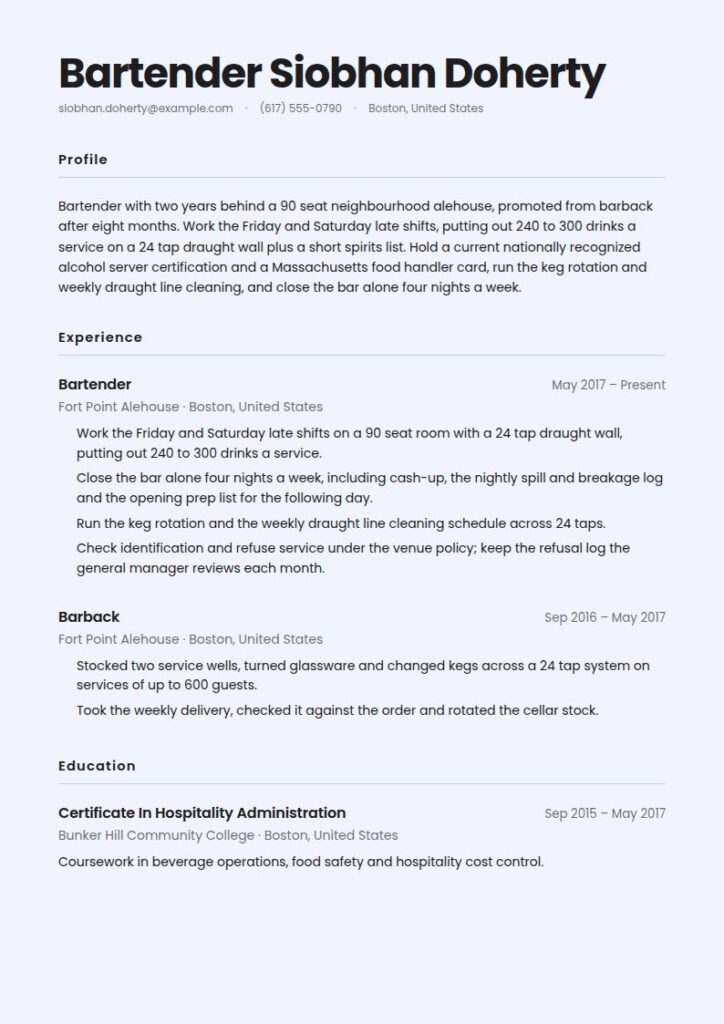
Bartender with two years behind a 90 seat neighbourhood alehouse, promoted from barback after eight months. Work the Friday and Saturday late shifts, putting out 240 to 300 drinks a service on a 24 tap draught wall plus a short spirits list. Hold a current nationally recognized alcohol server certification and a Massachusetts food handler card, run the keg rotation and weekly draught line cleaning, and close the bar alone four nights a week.
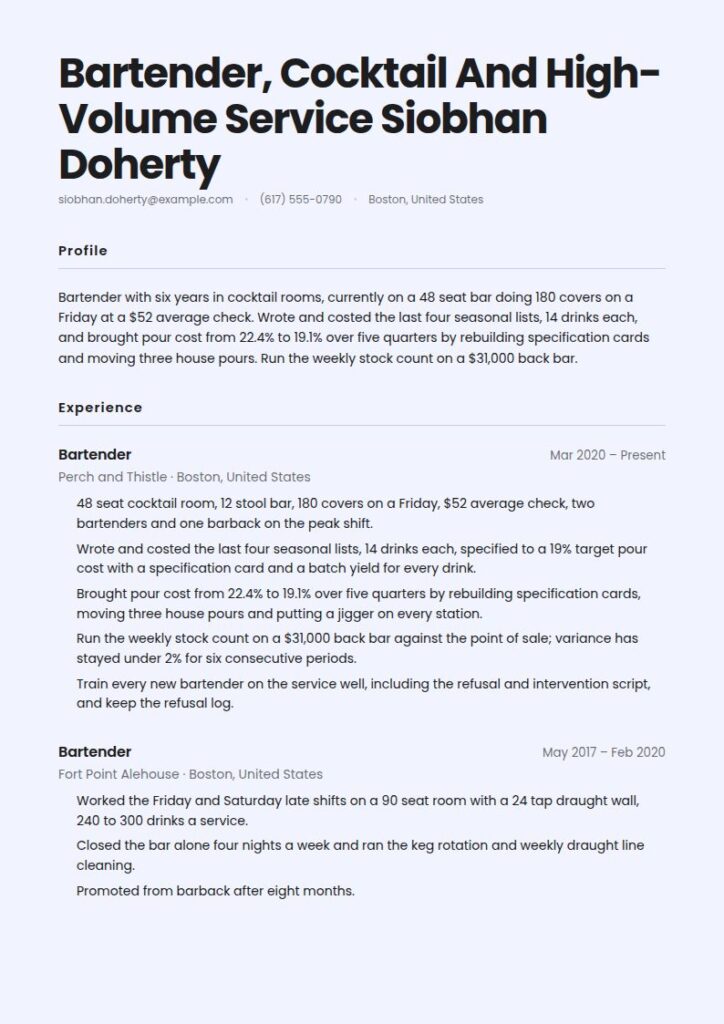
Bartender with six years in cocktail rooms, currently on a 48 seat bar doing 180 covers on a Friday at a $52 average check. Wrote and costed the last four seasonal lists, 14 drinks each, and brought pour cost from 22.4% to 19.1% over five quarters by rebuilding specification cards and moving three house pours. Run the weekly stock count on a $31,000 back bar.
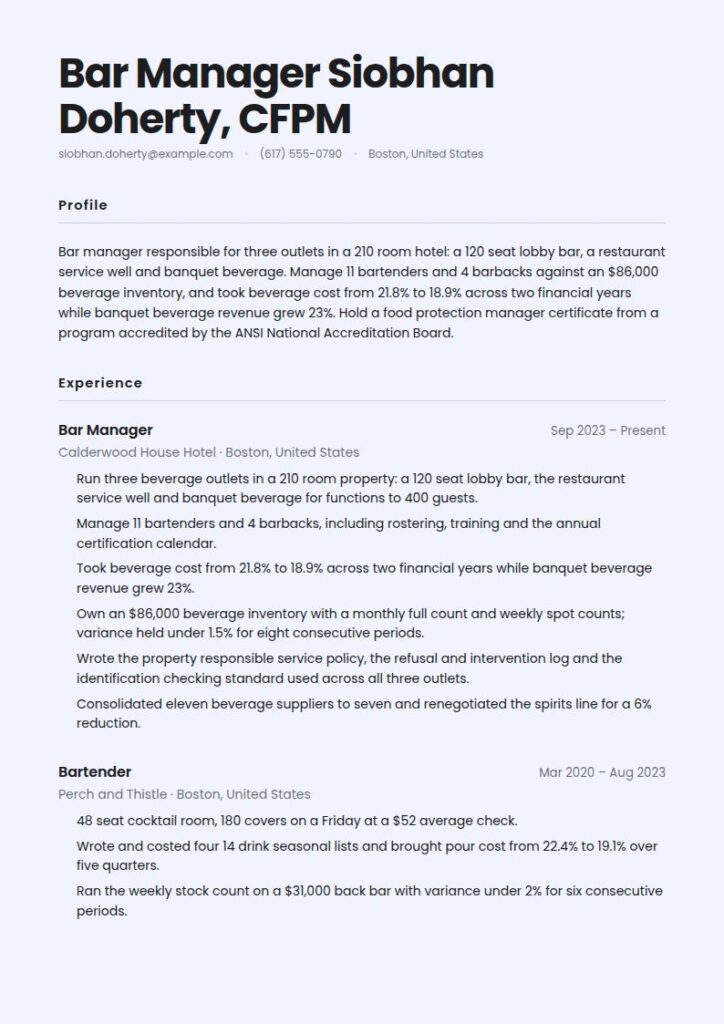
Bar manager responsible for three outlets in a 210 room hotel: a 120 seat lobby bar, a restaurant service well and banquet beverage. Manage 11 bartenders and 4 barbacks against an $86,000 beverage inventory, and took beverage cost from 21.8% to 18.9% across two financial years while banquet beverage revenue grew 23%. Hold a food protection manager certificate from a program accredited by the ANSI National Accreditation Board.
Right vs wrong: the same bartender summary, twice
| ✅ Right | ❌ Wrong |
|---|---|
| Bartender with six years in cocktail rooms, currently on a 48 seat bar doing 180 covers on a Friday. | Passionate mixologist with a love for craft cocktails and great guest experiences. |
| Wrote and costed the last four seasonal lists, 14 drinks each. | Created innovative seasonal cocktail menus. |
| Brought pour cost from 22.4% to 19.1% over five quarters. | Helped improve bar profitability. |
In short, the right column can be rostered and costed. In contrast, the left column is a mood. After all, a general manager filling a Friday slot is doing arithmetic, not reading poetry.
Outline your bar experience
Venue, city, dates, the room in one clause, then three to five bullets. Every bullet carries a number, and at least one is a money number.
| Instead of | Use |
|---|---|
| Made cocktails for guests in a fast-paced environment | Put out 240 to 300 drinks across a Friday late shift on a two-well bar |
| Responsible for bar inventory | Ran the weekly count on a $31,000 back bar with variance held under 2% for six consecutive periods |
| Created seasonal cocktail menus | Wrote and costed four 14 drink seasonal lists, each specified to a target pour cost of 19% |
| Trained new staff | Trained 9 new bartenders on the service well, including the specification cards and the refusal-of-service script |
Bartender, Perch and Thistle, Boston, MA, March 2020 to Present
48 seat cocktail room, 12 stool bar, 180 covers on a Friday, $52 average check, two bartenders and one barback on the peak shift.
Wrote and costed the last four seasonal lists, 14 drinks each, specified to a 19% target pour cost with a specification card and a batch yield for every drink.
Brought pour cost from 22.4% to 19.1% over five quarters by rebuilding specification cards, moving three house pours and putting a jigger on every station.
Run the weekly stock count on a $31,000 back bar against the point of sale; variance has stayed under 2% for six consecutive periods.
Train every new bartender on the service well, including the refusal and intervention script, and keep the refusal log.
The permit map: what your state requires before you can pour
This is the section almost every bartender resume leaves out, and the one that decides whether you can be rostered at all.
To begin with, there is no national bartending license. Instead, what exists is a patchwork of state rules, and the National Institute on Alcohol Abuse and Alcoholism's Alcohol Policy Information System, which tracks these provisions state by state as of 1 January 2023, sorts them into two shapes. A program is mandatory where state provisions require at least one specified category of person, such as servers, managers or licensees, to attend training. It is voluntary where there is no penalty for skipping it and the state offers incentives instead: a defense in a dram shop lawsuit, a discount on liquor liability insurance, mitigation of fines, or protection of the license.
For example, in a mandatory state your certificate is a condition of employment. On the other hand, in a voluntary state it is what protects your employer's license and insurance. Even so, both are worth putting on a resume; they are simply different arguments.
Bartender permit rules in six states
Six states, taken from their own agencies:
| State | What the state requires of a person serving on premises | Authority |
|---|---|---|
| California | Responsible Beverage Service training and the ABC server certification exam, required of on-premises servers and their managers since 1 July 2022 under Assembly Bills 1221 and 82. Certify within 60 days of the first date of employment, pass the exam within 30 days of training, recertify every three years. | California Department of Alcoholic Beverage Control |
| Washington | A MAST permit is required by law to serve, mix, sell or supervise the sale of alcohol for on-premises consumption. Class 12 at 21 and over, Class 13 at 18 to 20. Moreover, it is good for five years and not renewable. | Washington State Liquor and Cannabis Board |
| Oregon | Similarly, everyone mixing, serving or selling alcohol on a licensed on-premises location needs an Alcohol Service Permit: an approved server education class and the OLCC test within 45 days of applying. Valid five years, minimum age 18. | Oregon Liquor and Cannabis Commission |
| Utah | Every person who serves alcohol in a restaurant, club, bar or tavern must complete an alcohol training and education seminar before they serve, and again at least every three years. | Utah Office of Substance Use and Mental Health |
| Texas | However, there is no requirement to be certified under state law. In addition, certification lasts two years, and an employer qualifies for safe harbor only where everyone selling, serving or delivering alcohol and their immediate managers are certified within 30 days of hire. | Texas Alcoholic Beverage Commission |
| Massachusetts | All agents and employees of a licensed caterer who serve alcoholic beverages must be certified by a nationally recognized server training program. A licensee may employ a person 18 or older to directly handle or sell alcoholic beverages. | Massachusetts General Laws Chapter 138, Sections 12C and 34 |
Which alcohol certification to name
All six are different rules. Therefore, do not assume the one you learned travels, and do not write "alcohol certified" and hope the reader guesses which you mean. What to write on the page:
Alcohol server training: Nationally recognized alcoholic beverages server training certification, issued 2025, valid to 2028
Food safety: Food Protection Manager certificate, program accredited by the ANSI National Accreditation Board, 2024. Massachusetts food handler card, current.
Other states: prepared to complete California Responsible Beverage Service certification within the 60 day window on relocation.
Responsible service: Wrote the refusal and intervention log used across three outlets; 41 documented refusals in the last twelve months, no compliance findings at the last two visits.
That last line is the one managers remember. Moreover, refusals are evidence that the training was used, not a blemish, and the bartender who kept the log is the one a manager wants on the late shift.
Bar program numbers to include
The other half of this section is the bar program you ran.
| Program element | What to state | A worked example |
|---|---|---|
| The list | How many drinks, how often rewritten, who specified them | 14 drinks, rewritten four times a year, each with a specification card |
| Pour cost | Start, finish, period, and what you changed | 22.4% to 19.1% over five quarters through specification cards and house pour moves |
| Inventory | Back bar value, count frequency, variance held | $31,000 back bar, weekly count, variance under 2% for six periods |
| Volume at peak | Drinks per service and the shape of the shift | 240 to 300 drinks on a Friday late shift, two wells, one barback |
In fact, most of those lines will be new to whoever reads your file, because most bartender resumes stop at "made drinks and provided excellent service".
Build a snapshot of your key skills
Similarly, list ten to fourteen entries in four groups: service, program, systems and compliance. Grouping matters more than length; the reader is scanning for a category.
Service: High-volume well service, Cocktail preparation to specification, Wine service by the glass, Draught beer service and line care
Program: Menu writing and costing, Specification cards and batch yields, Pour cost management, Inventory and variance control, Supplier negotiation
Systems: Toast and Square point of sale, BevSpot inventory, Cash and card handling, Tip declaration and pooling administration
Compliance: Responsible beverage service, Identification checking and refusal of service, Intervention and incident logging, Food safety and allergen awareness
For instance, name the point of sale by its actual name; a bartender who already knows the terminal is cheaper to onboard.
List your education and certifications
Above all, list certifications first, each with its issuing body and its date. Education after, and briefly. The Bureau of Labor Statistics gives the typical entry-level education for bartenders as no formal educational credential (BLS Occupational Outlook Handbook, Bartenders, last modified 27 August 2026), so the education block should be short and the certification block exact.
Nationally recognized alcoholic beverages server training certification, 2025, valid to 2028
Food Protection Manager, program accredited by the ANSI National Accreditation Board, 2024
Massachusetts food handler card, current
WSET Level 2 Award in Wines, 2023
Certificate, Hospitality Administration, Bunker Hill Community College, Boston, MA, 2018
However, never write a certification as a skill. In other words, a named program with a year is verifiable; "trained in responsible alcohol service" is a sentence anyone can type.
Choose the right layout and design
Likewise, use a single column, 11 or 12 point body type, plain headings, no photograph, no cocktail glass icon. Furthermore, restaurant groups, hotel companies and casino operators screen through applicant tracking software, and two columns, text boxes and graphics are where that parse breaks.
Put your alcohol server certification and its expiry in the header, and name the state whose rule you satisfy. Describe the room beside every title: seats, peak covers, drinks per service, average check. Give pour cost as a movement across a stated period. State the inventory value you counted and the variance you held.
Do not write "mixologist" unless the advertisement used the word first. Do not list every cocktail you can make. Do not claim a cost figure you did not own. Do not say "alcohol certified" without naming the program and the state. Do not hide a short run. Do not send two pages, and do not attach a photograph.
Bartender job market and outlook
A large occupation with steady growth and heavy turnover, so openings are plentiful and the competition is for the good rooms rather than for work.
| Measure | Value |
|---|---|
| Bartender jobs, 2025 | 762,600 |
| Projected change, 2025-35 | 5% |
| Projected annual openings | About 121,200 |
| Typical entry-level education | No formal educational credential |
| Median annual wage, May 2025 | $34,340 |
| Median hourly wage, May 2025 | $16.51 |
Source: U.S. Bureau of Labor Statistics, Occupational Outlook Handbook, Bartenders, 2025-35 projections and May 2025 wage data, last modified 27 August 2026.
Overall, about 121,200 openings a year against 762,600 jobs tells you what the resume is really competing for. In short, almost nobody is short of bartending work. Instead, what people are short of is the venue with the volume, the check average and the tip pool worth staying for.
The venue type sets the pay band before you do
Full-service restaurants employ 41% of bartenders and drinking places 25%, but traveler accommodation, at 7% of employment, pays the highest median of the five largest settings at $17.57 an hour, against $13.65 in civic and social organizations (BLS Occupational Outlook Handbook, Bartenders, May 2025).
That is a spread of nearly $4 an hour on the published wage for the same job title, and it moves with the sector rather than with the individual. To reach the top of it the resume has to make you credible for a hotel, a resort or a large restaurant: volume, banquet beverage, multiple outlets, a formal inventory routine and a compliance record. Those are not what a cocktail-heavy resume usually says.
Where bartenders work:
| Setting | Share of employment | Median hourly wage (May 2025) |
|---|---|---|
| Full-service restaurants | 41% | $17.07 |
| Drinking places (alcoholic beverages) | 25% | $16.01 |
| Traveler accommodation | 7% | $17.57 |
| Amusement, gambling and recreation | 6% | $15.05 |
| Civic and social organizations | 5% | $13.65 |
Source: U.S. Bureau of Labor Statistics, Occupational Outlook Handbook, Bartenders, May 2025.
What salary you can expect as a bartender
The median annual wage for bartenders was $34,340 as of May 2025, or $16.51 an hour (BLS Occupational Outlook Handbook, Bartenders, last modified 27 August 2026).
The sector gap is the first lever, and it is larger than most bartenders assume: traveler accommodation pays a median of $17.57 an hour against $13.65 in civic and social organizations (BLS, May 2025). Moving from a club bar to a hotel bar is a bigger pay event than another three years in the same room.
The second is the shift. For example, within one venue the gap between a Tuesday day shift and a Friday late shift is usually larger than the gap between two bartenders' hourly rates, and shifts are allocated on reliability, closing competence and whether you can be left alone on the bar. As a result, a resume that says "close the bar alone four nights a week" and "run the weekly stock count" is a resume that gets the Friday.
Finally, the third is the move into a program role. In particular, bar manager and beverage manager postings are filled from the pool of bartenders who already have a cost number, an inventory routine and a written responsible service policy on file. If you have ever set a pour cost target, rebuilt a specification card or trained a refusal script, that belongs on the page now, not after the promotion.
Key takeaways for a bartender resume
- Above all, put the alcohol server certification and its expiry in the header, and name the state whose rule you satisfy.
- Moreover, check the rule for the state you are applying into; California, Washington, Oregon and Utah require training, Texas does not.
- Describe the room beside every title: seats, peak covers, drinks per service, average check.
- Likewise, give pour cost as a movement across a named period, with what you changed to move it.
- In addition, state the inventory value you counted, how often, and the variance you held, and say how many drinks were on your list.
- Finally, keep the refusal log on the page; documented refusals are evidence, not a blemish.
- One page, single column and parseable, because the group screens through software first.
Build your bartender resume in 15 minutes with our AI resume builder.
Related hospitality and catering resume examples
- Bar manager resume
- Server resume
- Waiter resume
- Waitress resume
- Sommelier resume
- Barista resume
- Hostess resume
- Busser resume
- Restaurant manager resume
- Food and beverage director resume
- Restaurant resume
- Hospitality and catering resume
Furthermore, pair it with a matching bartender cover letter.
Bartender resume questions, answered
Do I need a license to be a bartender?
It depends on the state, and there is no national bartending license. Washington requires a MAST permit by law to serve, mix, sell or supervise the sale of alcohol on premises (Washington State Liquor and Cannabis Board), and California has required Responsible Beverage Service training and the ABC server certification exam since 1 July 2022 (California Department of Alcoholic Beverage Control). Texas states plainly that there is no requirement to be certified under state law (Texas Alcoholic Beverage Commission). Check the agency for the state you are applying into.
How long should a bartender resume be?
One page. Two only if you have opened a venue, run multiple outlets, or carried a beverage cost target across a group. A long bartender resume is almost always a list of cocktails that should have been a list of numbers.
What do I put on a bartender resume with no experience?
Write the barback or server job as the bar job it partly was: keg changes, well stocking, glassware turnaround, covers on your busiest shift, the point of sale you used. Then put the certification at the top, because in a mandatory state that alone moves you ahead of uncertified applicants. Volume experience transfers even when the drinks do not.
Should I put pour cost on my resume?
Yes, if you owned it, with the starting point, the finishing point and the period. There is no universally correct pour cost: a draught-led alehouse and a spirits-led cocktail room run structurally different numbers. What transfers is the movement and the method.
How do I move from a bar into a hotel or casino bar?
Rebuild the file around volume, outlets and compliance rather than the drinks list. Hotels and gaming venues run banquet beverage, room service and several outlets off overlapping teams, so lead with peak drinks per service, banquet capacity, inventory value, variance and your responsible service documentation. The pay case is real: traveler accommodation pays bartenders a median of $17.57 an hour against $16.01 in drinking places (BLS, May 2025).