Server, Quick Casual Emeka Obiora
Server
[email protected] | (704) 555-0796 | Charlotte, United States
Profile
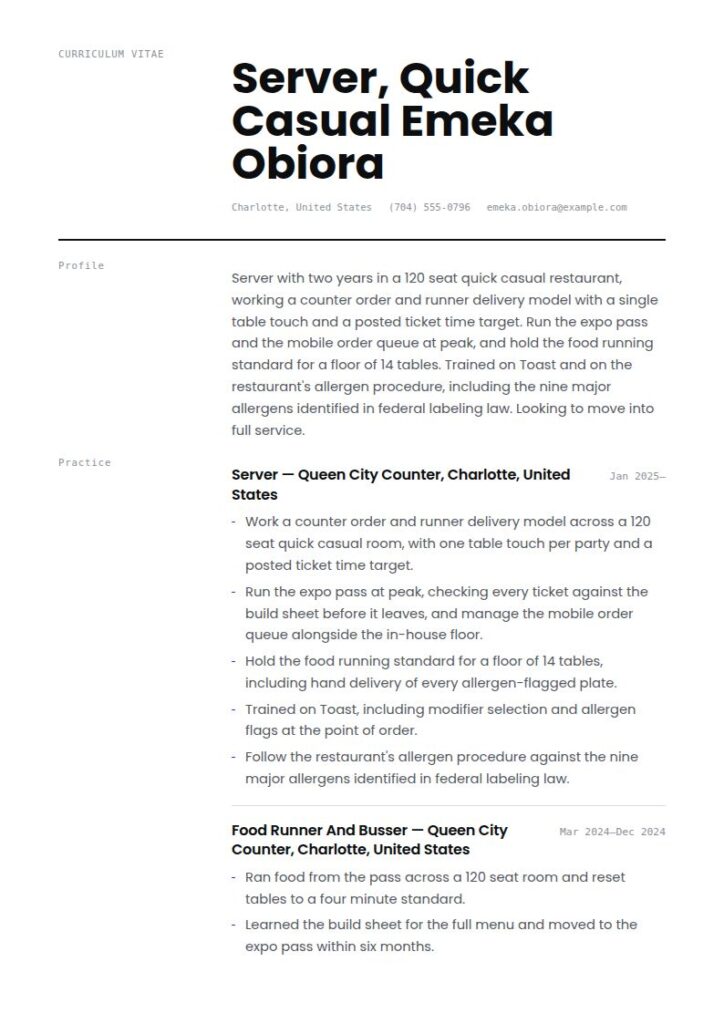
Server with two years in a 120 seat quick casual restaurant, working a counter order and runner delivery model with a single table touch and a posted ticket time target. Run the expo pass and the mobile order queue at peak, and hold the food running standard for a floor of 14 tables. Trained on Toast and on the restaurant's allergen procedure, including the nine major allergens identified in federal labeling law. Looking to move into full service.
Work Experience
01/2025 - Present, Server, Queen City Counter, Charlotte, United States
- Work a counter order and runner delivery model across a 120 seat quick casual room, with one table touch per party and a posted ticket time target.
- Run the expo pass at peak, checking every ticket against the build sheet before it leaves, and manage the mobile order queue alongside the in-house floor.
- Hold the food running standard for a floor of 14 tables, including hand delivery of every allergen-flagged plate.
- Trained on Toast, including modifier selection and allergen flags at the point of order.
- Follow the restaurant's allergen procedure against the nine major allergens identified in federal labeling law.
03/2024 - 12/2024, Food Runner and Busser, Queen City Counter, Charlotte, United States
- Ran food from the pass across a 120 seat room and reset tables to a four minute standard.
- Learned the build sheet for the full menu and moved to the expo pass within six months.
Education
08/2020 - 06/2024, High School Diploma, General Studies, West Mecklenburg High School, Charlotte, United States
Skills
Expo pass and ticket accuracy, 80
Mobile order queue management, 80
Food running standard, 80
Allergen handling at speed, 75
Toast point of sale, 80
Counter service and guest recovery, 70
Languages
English, native
Igbo, native
Certificates
03/2025, Responsible Alcohol Seller/Server training, North Carolina ABC Commission
North Carolina requires proof of this training from applicants for a retail ABC permit before a temporary permit is issued.
Summary
A server resume is a one page document naming the service model you were trained in, the standard that model runs to, and the systems you used inside it. This guide gives you three adaptable versions across quick casual, upscale casual and fine dining, the allergen and wine protocols each format expects, and current Bureau of Labor Statistics pay and outlook.
Server resume examples by experience level
In short, a server resume is a one page document that names the service model you trained in, the standard that model runs to, and the systems you ran inside it.
After all, "server" is one word covering at least six jobs. A counter server in a quick casual restaurant, a server in a neighbourhood full service room, a server in an upscale casual room, a fine dining front server working under a captain, a banquet server plating for 300 and an in-room dining server at a hotel are all servers. In fact, employers hire them on different evidence, and they rarely move sideways between formats without retraining.
Consequently, a resume that does not say which of those six you come from forces the reader to guess, and readers guess in favor of the format they know.
Resume guide for a server resume
To start, this guide and the corresponding server resume example will cover:
- First, how to write a server resume, section by section
- Then, the six service models, and what each one is really hiring for
- Also, three adaptable summaries: quick casual, upscale casual and fine dining
- What the allergen and wine protocols look like on a page
- Finally, what the job market looks like and what you can expect to earn
How to write a server resume
Overall, use five blocks: contact header, summary, service model, floor experience, and skills with certifications. One page.
Put the service model block directly under the summary, because the reader reads every other line through it. For example, "Handled a six table station" means one thing in a diner and another in a room with a 40 label by-the-glass list.
| Block | What it is answering | Where it goes |
|---|---|---|
| Service model | Which format was this person trained in, and to what standard? | Directly under the summary |
| Floor experience | What did they run inside that format, and for how long? | Reverse chronological |
| Skills | Point of sale, sequence of service, wine, allergens, banquet paperwork | A grouped block |
| Certifications | Alcohol training, food protection, wine credentials | Last, with authorities and dates |
Write the standard, not the adjective
Every format has a written standard behind it, and naming yours proves you were trained rather than thrown on a floor.
In fine dining that might be a coursed sequence with a synchronised drop and a captain calling the table. In upscale casual, a three-course sequence with a two-minute table touch and crumbing. In banquet it is the banquet event order: the count, the timing, the plate-up and the room diagram. In room service it is the delivery window, the tray setup and the folio posting.
Write one sentence naming the standard you worked to and who called it. That tells a reader more than a paragraph of description.
Run the finished file through the ATS resume checker before you send it. Hotel groups and restaurant groups both screen applications through software.
Choosing the best resume format for a server resume
Reverse chronological, one page, single column. Next, put the venue type in the job line: "Server, 160 seat upscale casual" or "Banquet Server, 400 seat ballroom". In other words, the venue is the context for everything underneath it.
If you have worked across formats, do not hide it. Quick casual to full service to fine dining is a career, and a reader who can see the progression reads your most recent format as earned rather than accidental.
Include your contact information
| ✅ Right | ❌ Wrong |
|---|---|
| Emeka Obiora | Emeka Obiora |
| Server, upscale casual and fine dining | Hospitality professional with a passion for service |
| Certified Food Protection Manager, ANAB-CFP accredited program, 2025 | Food safety trained |
| (704) 555-0796, [email protected], Charlotte, NC | (704) 555-0796, [email protected] |
Likewise, the headline names the format, not the job. "Server" alone tells a reader nothing they did not get from the file name.
Make use of a summary
Then write three or four lines: years, the format, the standard you ran to, and one system or protocol you owned.
Server with two years in a 120 seat quick casual restaurant, working a counter order and runner delivery model with a single table touch and a posted ticket time target. Run the expo pass and the mobile order queue at peak, and hold the food running standard for a floor of 14 tables. Trained on Toast and on the restaurant's allergen procedure, including the nine major allergens identified in federal labeling law. Looking to move into full service.
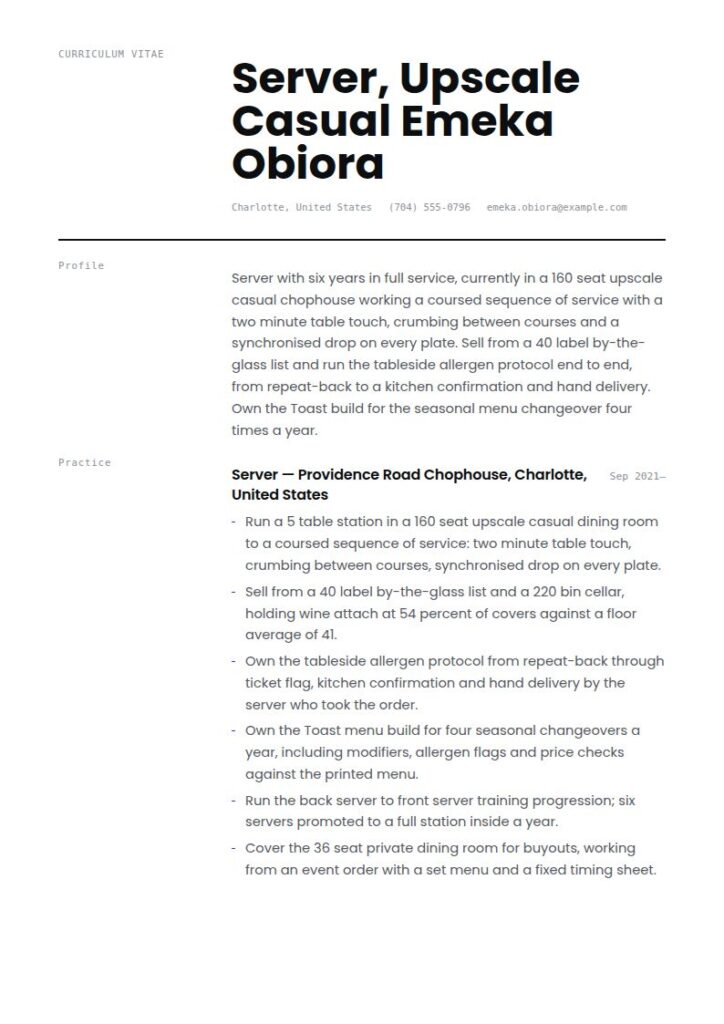
Server with six years in full service, currently in a 160 seat upscale casual chophouse working a coursed sequence of service with a two minute table touch, crumbing between courses and a synchronised drop on every plate. Sell from a 40 label by-the-glass list and run the tableside allergen protocol end to end, from repeat-back to a kitchen confirmation and hand delivery. Own the Toast build for the seasonal menu changeover four times a year.
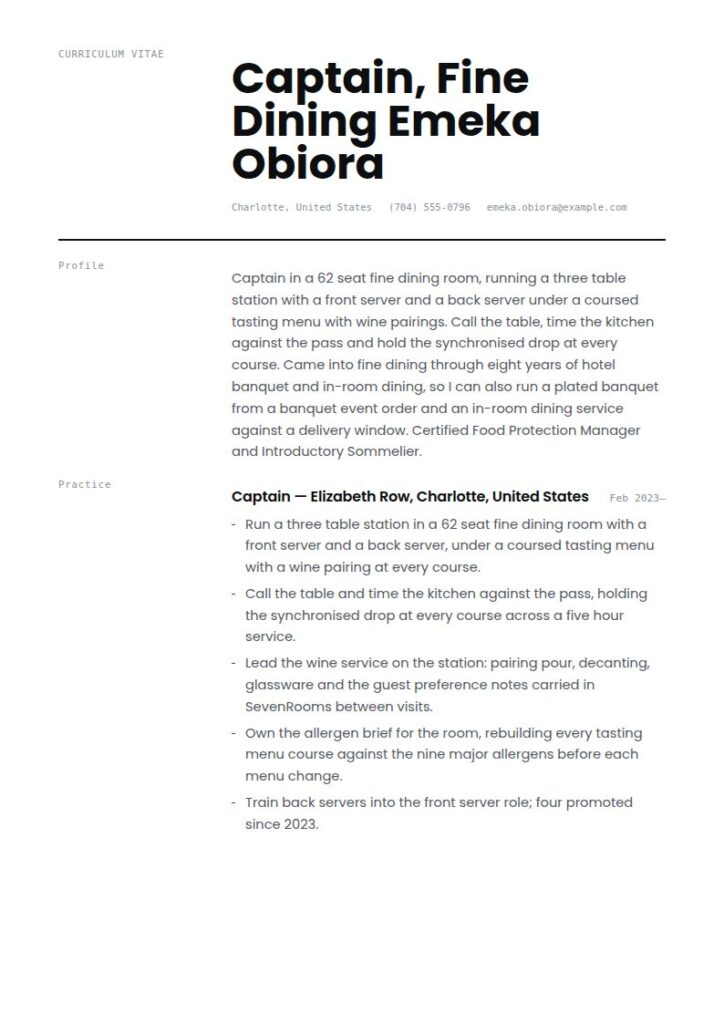
Captain in a 62 seat fine dining room, running a three table station with a front server and a back server under a coursed tasting menu with wine pairings. Call the table, time the kitchen against the pass and hold the synchronised drop at every course. Came into fine dining through eight years of hotel banquet and in-room dining, so I can also run a plated banquet from a banquet event order and an in-room dining service against a delivery window. Certified Food Protection Manager and Introductory Sommelier.
Right vs wrong: the same server summary, twice
| ✅ Right | ❌ Wrong |
|---|---|
| Six years in full service, currently a 160 seat upscale casual chophouse. | Experienced server with a strong work ethic. |
| Coursed sequence of service, two minute table touch, crumbing, synchronised drop. | Provided outstanding service to all guests. |
| Sell from a 40 label by-the-glass list and run the tableside allergen protocol end to end. | Knowledgeable about food and beverage offerings. |
In practice, the right column tells a hiring manager which parts of their training they can skip. By contrast, the left tells them nothing they can act on.
Outline your service experience
Venue, seat count, format, title and dates, then three or four bullets. In addition, every bullet ties to something the format measures.
| Instead of | Use |
|---|---|
| Provided excellent service to restaurant guests | Ran a 5 table station in a 160 seat upscale casual room to a coursed sequence with a synchronised drop |
| Knowledgeable about the menu and wine list | Sold from a 40 label by-the-glass list, holding wine attach at 54 percent of covers |
| Handled special dietary requests | Ran the tableside allergen protocol: repeat back, ticket flag, kitchen confirmation, hand delivery by the taking server |
| Worked banquets and private events | Served plated banquets from the banquet event order, 28 guests per server, plate-up to the room diagram |
| Used the restaurant computer system | Own the Toast menu build for four seasonal changeovers a year, including modifier and allergen flags |
| Helped train new servers | Ran the back server to front server progression; six servers promoted inside a year |
Server, Providence Road Chophouse, 160 seats, upscale casual, Charlotte, NC, September 2021 to Present
Run a 5 table station in the main dining room to a coursed sequence of service: two minute table touch, crumbing between courses, synchronised drop on every plate.
Sell from a 40 label by-the-glass list and a 220 bin cellar, holding wine attach at 54 percent of covers against a floor average of 41.
Own the tableside allergen protocol from repeat-back through ticket flag, kitchen confirmation and hand delivery by the server who took the order.
Own the Toast menu build for four seasonal changeovers a year, including modifiers, allergen flags and price checks against the printed menu.
Run the back server to front server training progression; six servers promoted to a full station inside a year.
Cover the private dining room of 36 for buyouts, working from an event order with a set menu and a fixed timing sheet.
Say which service model you were trained in
This is the section that decides whether a reader can place you, and almost no server resume includes it. In fact, the six models below are different jobs wearing the same title, and a hiring manager in each is checking for something the others do not care about.
| Service model | The standard you were trained in | What that employer is checking |
|---|---|---|
| Quick casual | Counter order, runner delivery, one table touch, posted ticket time | Throughput, expo accuracy, mobile order queue, allergen handling at speed |
| Casual full service | Three course sequence, larger station, two turns a shift | Station size, timing across many tables at once, sidework discipline |
| Upscale casual | Coursed sequence, table touch, crumbing, by-the-glass selling | Wine attach, check average, allergen protocol, menu literacy |
| Fine dining | Captain with front and back server, synchronised drop, coursed tasting menu | Brigade role, guest recall, wine and pairing service, silence and pace |
| Banquet | Banquet event order, plate-up to a room diagram, timed service | Counts, timing, plate carrying, working to a diagram under a captain |
| In-room dining | Delivery window, tray or trolley setup, folio posting, knock protocol | Accuracy, timing, cash and folio handling, working alone in guest space |
Next, write your own model in three labeled lines.
Model and standard: Upscale casual, 160 seats. Coursed sequence of service with a two minute table touch, crumbing between courses and a synchronised drop on every plate. Five table station, private dining room of 36 on buyouts.
Beverage: 40 label by-the-glass list, 220 bin cellar. Wine attach at 54 percent of covers against a floor average of 41. Trained on the deductive tasting method through the Introductory Sommelier course.
Allergens and systems: Tableside allergen protocol, repeat back to ticket flag to kitchen confirmation to hand delivery. Toast point of sale, including the menu build for four seasonal changeovers a year. SevenRooms for reservations and guest notes.
Also trained in: Plated banquet from a banquet event order, 28 guests per server. In-room dining against a 30 minute delivery window with folio posting.
Three rules for your server service model
Three rules make that block credible.
First, name the format the way the industry names it. "Upscale casual" and "fine dining" are not interchangeable, and using them loosely is the fastest way to look untrained to somebody who works in one.
Keep what you have run separate from what you have been trained in. A banquet server who wants a fine dining room should say so; the honest version reads as ambition, the blurred version as a claim that will not survive a trial.
Third, attach one number to each format you claim: guests per server on a plated banquet, covers on a station, wine attach, ticket time, delivery window. Above all, one number per format is the part nobody can copy from a template.
Say which allergens you were trained on, because the list changed
Federal labeling law now recognizes nine major food allergens: milk, eggs, fish, crustacean shellfish, tree nuts, peanuts, wheat, soybeans and sesame. Sesame was added by the FASTER Act, signed in April 2021, with the requirements applying from 1 January 2023 (U.S. Food and Drug Administration, food allergies).
That matters because a server trained before 2023 may have learned an eight allergen list, and the ninth is the one most likely to be missed in a bread basket or a crusted protein.
Write the protocol rather than the words "allergy-aware": repeat the request back at the table, flag it on the ticket, get a verbal confirmation from the kitchen, and deliver that plate by hand rather than by a runner.
Build a snapshot of your key skills
Generally, list twelve to sixteen entries in four groups: service, beverage, compliance, and systems.
Service: Coursed sequence of service, Synchronised drop, Table touch and crumbing, Station timing, Banquet event order service, In-room dining delivery, Guest recall and preference notes
Beverage: By-the-glass selling, Deductive tasting method, Wine pairing at the table, Decanting and glassware, Cocktail and aperitif service
Compliance: Responsible alcohol service and refusal, Identification checking, Tableside allergen protocol, Food protection management, Tip reporting and certification
Systems: Toast, Aloha and Oracle Micros, Menu builds and modifier setup, SevenRooms and OpenTable, Handheld ordering, Folio posting
List your education and certifications
Formal education is not a gate. The Bureau of Labor Statistics lists no formal educational credential as the typical entry-level requirement for waiters and waitresses (BLS Occupational Outlook Handbook, last modified 27 August 2026). Credentials still matter, for a different reason: in the upper formats they signal training rather than permission.
Certified Food Protection Manager, exam from an ANAB-CFP accredited program, 2025
Introductory Sommelier Course and Examination, Court of Master Sommeliers Americas, 2024
Responsible Alcohol Seller/Server training, North Carolina ABC Commission, 2025
High School Diploma, West Mecklenburg High School, Charlotte, NC, 2014
Keep three notes in mind, however; all of them are state or authority specific.
To begin with, each state sets its own alcohol rules, and they are not the same shape. In North Carolina the requirement sits on the business: applicants for a retail ABC permit must provide proof of Responsible Alcohol Seller/Server training before a temporary permit is issued, and the ABC Commission runs free classes. For example, the minimum age to serve is 21 for mixed beverages and 18 for malt beverages or wine (North Carolina ABC Commission, quick guide for retail permittees). Other states instead require the individual server to hold a permit from the state agency. Therefore, check the agency where you are applying, and name it on the page.
Food protection certification is a manager-level credential, so holding it as a server is a differentiator. Similarly, North Carolina requires the person in charge of a food establishment to be a certified food protection manager, certified through an accredited program (North Carolina Division of Public Health, Environmental Health Section, certified food protection manager requirement). In turn, the ANSI National Accreditation Board accredits those programs against the Conference for Food Protection standards (ANAB, Conference for Food Protection accreditation).
Wine credentials have a published ladder. In addition, the Court of Master Sommeliers Americas runs four levels in order: Introductory Sommelier Course and Examination, Certified Sommelier Examination, Advanced Sommelier Course and Examination, and Master Sommelier Diploma Examination (Court of Master Sommeliers Americas, certification levels). Also name the exact level and the year.
Choose the right layout and design
Single column, 11 point type, no photograph, PDF unless the form says otherwise. One page: if it runs long, cut the oldest venue, not the service model block.
Name the service model in the headline and in every job line. Put the seat count and the format beside the venue. Describe the standard you worked to, including who called the table. Write the allergen protocol as four steps. Give the wine credential its exact level and awarding body.
Do not use "fine dining" for an upscale casual room; people who work in one can tell. Do not write "fast-paced" or "passion for hospitality". Do not claim a wine list you never sold from. Do not write "food safety certified" without the program or accreditation. Do not submit two columns or a photograph, since groups parse applications before a person reads them.
Server job market and outlook
Note first that the Bureau of Labor Statistics counts servers as waiters and waitresses. The occupation is large and grows slowly, but where you work changes what you are paid.
| Setting | Share of employment | Median hourly wage (May 2025) |
|---|---|---|
| Food services and drinking places | 85% | $16.93 |
| Traveler accommodation | 6% | $17.09 |
| Arts, entertainment, and recreation | 4% | $16.85 |
Source: U.S. Bureau of Labor Statistics, Occupational Outlook Handbook, Waiters and Waitresses, May 2025.
| Measure | Value |
|---|---|
| Waiters and waitresses, 2025 | 2,284,400 |
| Projected change, 2025-35 | 2 percent, slower than average |
| Projected annual average openings | ~423,100 |
| Typical entry-level education | No formal educational credential |
| Median annual wage, May 2025 | $35,230 |
Source: U.S. Bureau of Labor Statistics, Occupational Outlook Handbook, May 2025 wage data and 2025-35 projections.
Hotels pay the highest published median, and hotels are where two formats live
Traveler accommodation employs 6 percent of waiters and waitresses at a median of $17.09 an hour, the highest of the three settings the Handbook publishes, against $16.93 in food services and drinking places, which employs 85 percent, and $16.85 in arts, entertainment, and recreation (BLS Occupational Outlook Handbook, Waiters and Waitresses, May 2025 wage data, last modified 27 August 2026).
The median gap is small; the composition is what matters. Banquet and in-room dining barely exist outside hotels, and both run to a written document rather than a floor plan: a banquet event order in one case, a delivery window and a folio in the other.
The resume lines that open that door are the ones about working to a document: counts, timings, room diagrams, folio posting, cash handling in a guest room.
What salary you can expect as a server
Specifically, the median wage for waiters and waitresses was $16.94 an hour, or $35,230 a year, as of May 2025 (BLS Occupational Outlook Handbook, May 2025 wage data). That figure blends base pay with tips; that is why it rarely matches the rate on a pay stub.
In short, for a server, the format is the pay decision. A quick casual counter role and a fine dining captaincy sit inside the same occupation code and are not the same income, because the average check behind them is different by an order of magnitude. Nothing on your resume moves your pay as much as the format you can credibly claim, which is why the service model block deserves the best space on the page.
Moreover, tip reporting rules differ by state too. North Carolina applies the federal tipped minimum cash wage of $2.13 an hour but additionally requires employers to obtain a signed certification from each employee of the amount of tips received (U.S. Department of Labor, Wage and Hour Division, minimum wages for tipped employees, table revised 1 July 2026).
The other lever is format mobility. A server who can work an upscale casual station on Friday, a plated banquet on Saturday and an in-room dining shift on Sunday is scheduled more, and on better services, than one who can only do the first. Write all three if all three are true.
Key takeaways for a server resume
- Name the service model in the headline and in every job line.
- As a rule, put the seat count and the format beside the venue name.
- Describe the standard you worked to, including who called the table.
- Then write the allergen protocol as four steps, and know that the list is nine allergens.
- Also give the wine credential its exact level and the awarding body.
- Keep what you have run separate from what you have been trained in.
- Finally, keep it to one page, single column, format visible in the first four seconds.
Build your server resume in 15 minutes with our AI resume builder.
Related hospitality and catering resume examples
- Waitress resume
- Waiter resume
- Hostess resume
- Bartender resume
- Sommelier resume
- Bar manager resume
- Food and beverage director resume
- Hotel front desk employee resume
- Caterer resume
- Busser resume
- Line cook resume
- Hospitality and catering resume
Pair it with a matching server cover letter.
Server resume questions, answered
How long should a server resume be?
One page. The service model block, three venues and a certifications list fill a page already, and a second page is where duty descriptions go to hide.
What is the difference between a server and a waiter or waitress resume?
Mostly the title on the contract; the Bureau of Labor Statistics counts all of them as waiters and waitresses. In practice "server" is the operational term in most restaurant groups and hotels, so use whichever word the posting uses and keep it consistent.
How do I move from quick casual into fine dining?
In two steps, not one. Almost nobody hires straight from a counter into a coursed room. Move into full service first, learn the sequence of service and a by-the-glass list, then upscale casual, then fine dining as a back server. Write the move you are making into your summary.
Should I get a sommelier certification as a server?
It is worth it in upscale casual and fine dining, and it is the cheapest way to make a resume look trained. The Court of Master Sommeliers Americas runs four levels, starting with the Introductory Sommelier Course and Examination (Court of Master Sommeliers Americas, certification levels). Name the level and the year rather than "wine certified", and pair it with a wine attach number if your venue tracks one.
What do I write on a server resume with no restaurant experience?
Apply to quick casual or casual full service first, and write the capacity you have: any job with a queue, a till, a timing target or a food safety rule. Then say what you have done to remove obstacles, which is whatever alcohol training your state or their permit requires, and which shifts you can work. Name the format you are applying to so the file reads as deliberate.
Does banquet experience count on a restaurant server resume?
Yes, and it is undervalued. Banquet service proves you can work to a document and a clock: counts, timings, a room diagram, a plate-up under a captain. Write it with numbers attached, such as guests per server on plated service, and managers read it as evidence you will not fall apart on a full book.