Salvatore Mangione Restaurant General Manager Providence, 02906, United States [email protected] · (401) 555-0934
11 September 2026
Ms. Nadia Feldstein Owner The Sailmaker's Room Newport, United States
Application for General Manager, The Sailmaker's Room
Dear Ms. Feldstein,
I am applying for the general manager post at The Sailmaker's Room. I currently run a 160-seat independent restaurant in Providence with 34 staff, 1,900 covers a week and $4.2 million in annual sales, and I have worked in four restaurants over fourteen years, front of house throughout.
The work I would most want to bring with me is what happened after our change of ownership in 2021. We lost most of the front of house team in the first six months, so I wrote the onboarding and the shift handover from scratch, put every new hire through a five-shift training with a named trainer, and made the handover a written document rather than a conversation at the pass. Hourly turnover fell from 118 percent to 64 percent over eighteen months, and we have held two consecutive health inspections with no critical violations since.
I am moving because the owner is selling the restaurant in the spring and the incoming buyer is bringing their own management. I am looking for an independent restaurant rather than a group, and yours is close to the size I know best, with a bar that actually trades and a private room, which is the part I have most recently built. I run Toast, 7shifts and MarginEdge, so I would not need three weeks to be useful.
I hold a ServSafe Food Protection Manager Certification and a TIPS on-premise certification, and I can give four weeks' notice. Thank you for reading this.
Sincerely, Salvatore Mangione
Summary
A restaurant cover letter has one job a resume cannot do: explain the move and translate the house-specific parts of your experience for a reader who has never been in your dining room. This guide gives you a full adaptable letter, the sentence that explains a closure or a concept change, and the portable facts that carry from one restaurant to the next.
Restaurant cover letter examples by experience level
A restaurant cover letter is a short letter to an owner, a general manager or a chef, and it does the two things a resume cannot: it says why you are leaving the restaurant you are in, and it translates what you did there into something a stranger can evaluate. Those are the two questions in the reader's head from the first line.
Guide to a restaurant cover letter
This guide and the corresponding restaurant cover letter example will cover:
- How to structure the letter, paragraph by paragraph
- Why the move itself needs one honest sentence
- A full adaptable letter you can change for each restaurant
- How to translate house-specific work for a stranger
How to write a restaurant cover letter
Four paragraphs, 250 to 350 words, addressed to a person. Restaurant hiring is fast, and the letter competes with a phone that keeps ringing.
| Paragraph | Its job | Length |
|---|---|---|
| Opening | The role, their restaurant, and your scope in one line | 2 to 3 sentences |
| Evidence | One number, one period of time, one thing you changed | 3 to 4 sentences |
| Move and fit | Why you are leaving, and why this restaurant | 3 sentences |
| Close | Certification, notice period, thank you | 2 sentences |
Open with scope, because it is the only thing that means the same in both restaurants
The reader does not know your dining room; they know theirs. The first sentence has to use units you both share: seats, covers, staff, sales, average check.
"I run a 160-seat independent restaurant with 34 staff, 1,900 covers a week and $4.2 million in annual sales" tells a stranger whether you are a size up, a size down or a match. "An experienced restaurant manager with a passion for hospitality" tells them nothing, and they have read it eleven times this week.
A restaurant cover letter example you can adapt
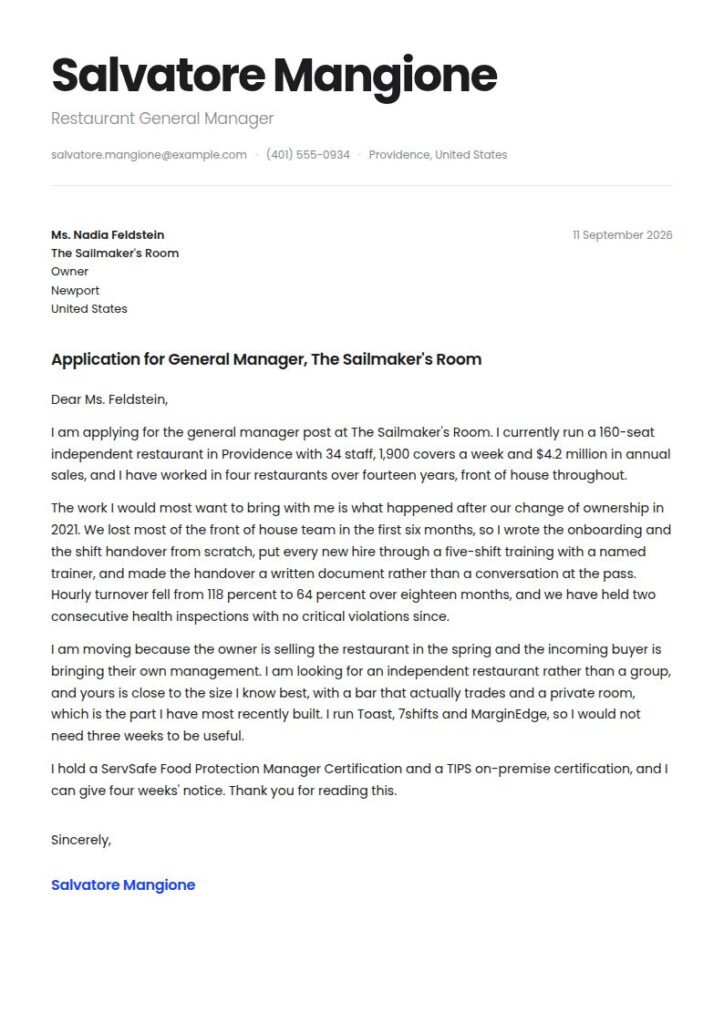
Dear Ms. Feldstein,
I am applying for the general manager post at The Sailmaker's Room. I currently run a 160-seat independent restaurant in Providence with 34 staff, 1,900 covers a week and $4.2 million in annual sales, and I have worked in four restaurants over fourteen years, front of house throughout.
The work I would most want to bring with me is what happened after our change of ownership in 2021. We lost most of the front of house team in the first six months, so I wrote the onboarding and the shift handover from scratch, put every new hire through a five-shift training with a named trainer, and made the handover a written document rather than a conversation at the pass. Hourly turnover fell from 118 percent to 64 percent over eighteen months, and we have held two consecutive health inspections with no critical violations since.
I am moving because the owner is selling the restaurant in the spring and the incoming buyer is bringing their own management. I am looking for an independent restaurant rather than a group, and yours is close to the size I know best, with a bar that actually trades and a private room, which is the part I have most recently built. I run Toast, 7shifts and MarginEdge, so I would not need three weeks to be useful.
I hold a ServSafe Food Protection Manager Certification and a TIPS on-premise certification, and I can give four weeks' notice. Thank you for reading this.
Sincerely, Salvatore Mangione
Openings that work
| Instead of | Use |
|---|---|
| I am an experienced hospitality professional with a passion for service | I run a 160-seat independent restaurant with 34 staff and 1,900 covers a week |
| I have a proven track record of building strong teams | Hourly turnover fell from 118 percent to 64 percent over eighteen months |
| I am familiar with restaurant technology | I run Toast, 7shifts and MarginEdge |
Say why you are moving, in one sentence
Restaurant readers ask this before anything else, because they have all been burned by a hire who left in eight weeks. Answer it and it stops being a suspicion. One honest sentence is enough.
| The reason | How it reads in a letter |
|---|---|
| The restaurant closed or is closing | The restaurant closes in March when the lease ends |
| The restaurant changed hands | The owner is selling in the spring and the buyer is bringing their own management |
| No room above you | The general manager has been in post nine years, and I am ready for the next step |
| Hours | I am looking for a restaurant with a lunch trade rather than a 2 a.m. close |
What fails is silence, or a line about seeking new challenges, which reads as the absence of a reason. So does writing about what was wrong with the last place. Say the fact, not the grievance.
Translate the house-specific parts before you send it
Most first drafts are written in the private language of one restaurant. The reader cannot picture the room, the menu or the shorthand, so those lines land as noise. Rewrite each as the general thing it is an instance of.
| What you wrote | What they can read |
|---|---|
| I ran the pass on our busiest nights | I expedited a 140-seat dining room at 320 covers with 11 staff on the floor |
| I did the ordering | I ordered weekly against a par sheet with 5 vendors, $18,000 to $24,000 a week |
| I helped open the new place | I opened a restaurant from build-out to first service, including hiring 26 staff and the point of sale build |
Open with scope in units any restaurant uses. Give one number with a period of time attached. Say why you are moving in one plain sentence. Name the systems you run. Name one specific thing about their restaurant, taken from their own menu, site or reviews. Address a person by name.
Do not use house shorthand, internal levels or table numbering. Do not criticise your current restaurant or its owner. Do not write "fast-paced environment", "passion for hospitality" or "proven track record". Do not send the same letter to a 40-seat cafe and a 300-seat hotel restaurant. Do not attach a letter longer than one page.
Almost every opening in this sector exists because somebody moved
The Bureau of Labor Statistics projects roughly 1,078,500 annual openings for food and beverage serving and related workers, 393,200 for cooks, 423,100 for waiters and waitresses and 38,800 for food service managers, against projected growth of no more than 7 percent in any of them over 2025 to 2035 (BLS Occupational Outlook Handbook, published 27 August 2026).
The National Restaurant Association puts the sector at 15.8 million jobs across more than 1 million outlets in 2026, with more than 100,000 jobs forecast to be added that year (National Restaurant Association, 2026 State of the Restaurant Industry, 12 February 2026).
Together those say that movement, not growth, creates the job you are applying for. Which is why the letter answers the reader's two questions: why are you moving, and will what you did somewhere else work here.
Length, format and sending it
One page, 250 to 350 words, PDF, named for yourself and the role, with the same header as your resume.
Address a person. Independents publish the owner or general manager on their own site more often than groups do, and an unaddressed letter to a small restaurant reads as one sent to twenty.
If the posting is on a job board, apply there and take a printed copy in during the quiet mid-afternoon; in this industry that is normal rather than pushy. Keep the figures identical to your restaurant resume example, because the reader will compare them.
Key takeaways
- Open with scope: seats, covers, staff, sales.
- Give one number with a period attached, and one thing you changed.
- Explain the move in one plain sentence, without criticising anyone.
- Translate house-specific work into units a stranger can read.
- Name the systems you run; it is the shortest route to week-one usefulness.
- Name one real detail about their restaurant.
- One page, addressed to a person, figures matching your resume.
Write your restaurant cover letter in 10 minutes with our AI cover letter builder.
Restaurant cover letter questions, answered
Do restaurants actually read cover letters?
Independents often do, because the owner reads the applications personally and has two questions a resume does not answer: why you are leaving and whether your experience transfers. Groups read them less consistently, but the letter costs ten minutes and is the only place you control the framing.
What do I say if I was let go?
Say it plainly: the restaurant closed, the concept changed, the team was released after a sale. Those are ordinary events here. A short factual sentence closes the question; an omission leaves it open.
How do I write this letter with no restaurant experience?
Write the nearest thing you have in restaurant units: the shifts you held, the volume you handled, the till you ran, the hours you can work. Add a food handler certificate and one honest sentence about why you want this work. Entry level hiring turns on reliability, in an occupation with about 1,078,500 annual openings (BLS Occupational Outlook Handbook, published 27 August 2026).
Should the letter mention pay?
Only if the posting asks. If it does, give a range tied to the scope you are taking on rather than a single figure. BLS put the median annual wage for food service managers at $69,390 in May 2025, which is a reasonable anchor for a management post (BLS Occupational Outlook Handbook, published 27 August 2026).
How much should I tailor it for each restaurant?
Change three things every time: the restaurant's name, the sentence about why that restaurant, and the scope comparison if their size differs from yours. That is a five-minute edit, and it is the difference between a letter and a circular.