Rachid Zerhouni Executive Chef, CEC Chicago, 60622, United States [email protected] · (312) 555-0940
11 September 2026
Ms. Harriet Baugh Food and Beverage The Norwood Arms Evanston, United States
Application for Executive Chef, The Norwood Arms
Dear Ms. Baugh,
I am applying for the executive chef post at The Norwood Arms. I run food for a 210-room hotel in Chicago with a 120-seat restaurant, a bar and 9,000 square feet of banquet space, a brigade of 24 across three kitchens, and I author nine menus a year across those outlets. I hold Certified Executive Chef status with the American Culinary Federation.
The work I would bring is the banquet rebuild. When I arrived, events ran from a 40-item legacy list that had never been costed as a whole and existed mostly in two people's heads. I rewrote it as a 24-item menu in three price tiers, costed every dish at yield-tested portion weight before sign-off, and standardized it into one spec book with yields, plating photographs and allergen lines. New cooks now reach the line in nine days rather than three weeks, and we have run eleven changeovers with no service delay past the first night.
I have read your dinner menu and your banquet package. The dinner list is tight and I would not want to arrive and rewrite it; what struck me is that the banquet package runs eighteen items at a single price, which is the shape ours had before the rebuild. If that is a problem you are already thinking about, it is the work I have just finished, and I would want to see your covers and event mix before proposing anything specific.
I hold a ServSafe Food Protection Manager Certification, I can cook a tasting at whatever notice suits your calendar, and I can give six weeks. Thank you for your time.
Sincerely, Rachid Zerhouni, CEC
Summary
An executive chef cover letter is a short letter about menus: the ones you have written, the cadence you can hold, and one specific observation about the menu the property is running now. This guide gives you a full adaptable letter, the openings that work, how to write about a tasting, and the published ACF requirements worth citing at this level.
Executive Chef cover letter examples by experience level
An executive chef cover letter is a one-page letter about menus: yours, theirs, and what would happen to theirs if you took the job.
That is the advantage this trade has over almost every other: you can read your future employer's product before you apply. Their menu is published, their prices are published, and their reviews describe what arrives at the table. Almost no chef uses it.
Guide to an executive chef cover letter
This guide and the corresponding executive chef cover letter example will cover:
- How to structure the letter, paragraph by paragraph
- Why your menu record belongs in the first two sentences
- A full adaptable letter you can change per property
- How to write about their menu without insulting the chef who wrote it
How to write an executive chef cover letter
Four paragraphs, 300 to 400 words. Longer than a line cook's letter, because scope and output both have to fit, and no longer than that.
| Paragraph | Its job | Length |
|---|---|---|
| Opening | The post, your scope, your menu cadence | 3 sentences |
| Record | One menu you developed end to end, with numbers | 4 to 5 sentences |
| Their menu | One respectful observation and what you would do | 3 to 4 sentences |
| Close | Certification, tasting availability, notice period | 2 sentences |
Lead with cadence, because it is the number that predicts the job
"Executive chef with eighteen years" says nothing about your development capacity. "Nine menus a year across restaurant, bar and banquet, 20 written from a blank page since 2019" says what you produce, at what rate.
Cadence is what a general manager quietly worries about. Most have been through a menu that took four months to land, or a chef who cooked beautifully but could not get a new list onto the line without a fortnight of long tickets. A candidate who states a rhythm and describes the rollout has done it repeatedly.
An executive chef cover letter example you can adapt
Dear Ms. Baugh,
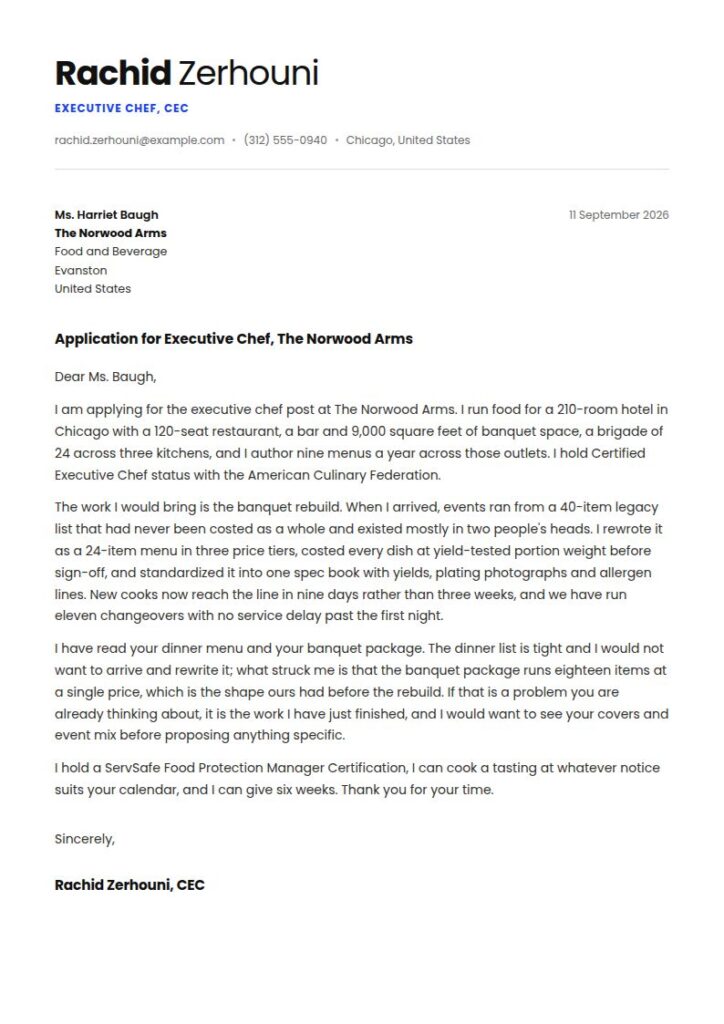
I am applying for the executive chef post at The Norwood Arms. I run food for a 210-room hotel in Chicago with a 120-seat restaurant, a bar and 9,000 square feet of banquet space, a brigade of 24 across three kitchens, and I author nine menus a year across those outlets. I hold Certified Executive Chef status with the American Culinary Federation.
The work I would bring is the banquet rebuild. When I arrived, events ran from a 40-item legacy list that had never been costed as a whole and existed mostly in two people's heads. I rewrote it as a 24-item menu in three price tiers, costed every dish at yield-tested portion weight before sign-off, and standardized it into one spec book with yields, plating photographs and allergen lines. New cooks now reach the line in nine days rather than three weeks, and we have run eleven changeovers with no service delay past the first night.
I have read your dinner menu and your banquet package. The dinner list is tight and I would not want to arrive and rewrite it; what struck me is that the banquet package runs eighteen items at a single price, which is the shape ours had before the rebuild. If that is a problem you are already thinking about, it is the work I have just finished, and I would want to see your covers and event mix before proposing anything specific.
I hold a ServSafe Food Protection Manager Certification, I can cook a tasting at whatever notice suits your calendar, and I can give six weeks. Thank you for your time.
Sincerely, Rachid Zerhouni, CEC
Openings that work
| Instead of | Use |
|---|---|
| I am a passionate chef with a love of seasonal ingredients | I author nine menus a year across a restaurant, a bar and banquet, for a brigade of 24 |
| I have extensive experience leading kitchen teams | I have written 20 menus from a blank page since 2019 and led 11 changeovers |
| I am known for creativity and attention to detail | I standardized 260 recipes into one spec book across three kitchens |
| I am confident I would be a great fit for your team | I have read your dinner menu and your banquet package, and one of them is the job |
Read their menu before you write a word
Half an hour with a property's published material beats any amount of company research.
| What to look at | What it tells you |
|---|---|
| The dinner menu | Section balance, price points, how often it changes, how ambitious the kitchen is |
| The banquet or event package | Whether it was costed as a whole, and how many items the kitchen carries |
| The bar or lunch offering | Whether the outlets share prep, which is where cost usually leaks |
| Recent reviews | Which dishes get named, and whether consistency is a theme |
Then write one observation, carefully. You are commenting on the work of a chef who may still be in post, and anyone reading a letter that trashes the current menu will assume you would talk about them that way too.
Lead with scope and menu cadence. Name one menu you developed end to end, with counts and a rollout outcome. Make one specific observation about their published material, framed as a question rather than a verdict. Offer a tasting and give your notice period.
Do not criticise the current chef or the current menu. Do not attach photographs or a menu written for someone else without permission. Do not describe your cooking with adjectives. Do not claim an ACF level you do not hold; it is verifiable. Do not promise a food cost figure before you have seen their invoices.
What to say about the tasting
Most executive chef processes end in a tasting, so acknowledge it rather than waiting to be asked.
Say three things in one sentence: that you are happy to cook, what you would show, and what you would need. "I would cook four dishes that show how I write a section rather than a showpiece, and I would need your product list and a sense of your price point" tells the reader how you think.
Certification and experience are what the profession counts at this level
For Certified Executive Chef, the American Culinary Federation requires "five years as a chef de cuisine, executive sous chef or chef in charge of food production in a foodservice operation", supervision of "at least five fulltime people in the preparation of food", experience within the past ten years, written and practical exams, and renewal every five years (American Culinary Federation, retrieved 16 September 2026).
The Bureau of Labor Statistics records five years or more of related work experience as typical for chefs and head cooks, an occupation of 220,300 jobs in 2025 with about 25,200 openings a year and a median annual wage of $62,470 in May 2025 (BLS Occupational Outlook Handbook, published 27 August 2026).
Both measure the same thing: years in charge of production, and people supervised. Make both countable in your first paragraph, because that is the arithmetic the reader is doing.
Length, format and sending it
One page, 300 to 400 words, PDF, same header as your resume. Address whoever decides: an owner, a general manager, a director of food and beverage or a group culinary director.
Send the resume and the menu portfolio block in one file rather than separate attachments, since hotel systems drop extras. Give any portfolio as a plain URL in the closing line.
Keep the numbers identical to your executive chef resume example; a mismatch in menu counts reads badly.
Key takeaways
- Open with scope and menu cadence, not with years.
- Describe one menu end to end: brief, counts, costing, approval, rollout.
- Read their published menus before writing a word.
- Make one observation, framed as a question, never a verdict.
- Say what you would want to see before proposing changes.
- Offer the tasting and say what you would want to show.
- One page, addressed to the decision maker, numbers matching your resume.
Write your executive chef cover letter in 10 minutes with our AI cover letter builder.
Executive chef cover letter questions, answered
How long should an executive chef cover letter be?
One page, 300 to 400 words. Slightly longer than an entry-level restaurant letter because scope, menu record and one observation all have to fit, but a second page is never read.
Should I propose menu changes in the letter?
Propose a direction, not a menu. You have not seen their invoices, covers, event mix or equipment, and a specific proposal without those reads as presumptuous. Naming the area you would look at first, and what you would want to see before deciding, shows the same thinking without the overreach.
Do I mention money?
Only if asked. If a range is requested, tie it to scope and use the published anchor: BLS put the median annual wage for chefs and head cooks at $62,470 in May 2025, and $74,380 in traveler accommodation (BLS Occupational Outlook Handbook, published 27 August 2026). Executive posts in hotels sit above the occupation median.
Is ACF certification worth mentioning in the letter?
Yes, in one clause, with the level. It is verifiable, requires five years at chef de cuisine, executive sous chef or chef in charge of food production plus supervision of at least five full-time people, and renews every five years (American Culinary Federation, retrieved 16 September 2026). Most applicants do not hold it.
How do I write this letter for a first executive chef post?
Write the development you already own: the sections you rewrote, the specials program you authored, the recipes you standardized, any menu you carried through an owner's approval. Then state the gap plainly and say what you would want in support, such as a strong sous chef or an existing spec book. Honesty about the step up reads better than pretending there is no step.