Are You 18 or Older on Job Application Forms? How to Answer
The 18 or older on job application question is a minimum-age check. See how to answer yes or no, what 16- and 17-year-olds can do, and when a No ends it.

On this pageWhy do employers ask "Are you 18 or older?"
The "Are you 18 or older?" question is a yes/no minimum-age check, not a request for your birth date. Answer it truthfully. Yes means federal child labor rules no longer limit your hours or tasks. No is fine for many jobs: 16- and 17-year-olds can work any hours under federal law, but not in hazardous jobs, and many states require a work permit.
The 18 or older on job application question is a simple minimum-age check. Answer yes or no truthfully. If you are under 18, a No does not always end your chances, because many jobs hire 16- and 17-year-olds.
Employers ask because federal and state child labor rules limit what minors can do at work. So the question tells them which rules apply to you. It does not ask your exact age, and it is not about older workers.
Quick answers by situation
| Your situation | What to say/do | Example line |
|---|---|---|
| You are 18 or older | Select Yes and move on | "Yes" |
| You turn 18 before the start date | Answer for today, then mention the date | "No. I turn 18 on June 3, before your June 10 start." |
| You are 16 or 17 | Select No; check if the job hires minors | "No. I'm 17 and can get a work permit if needed." |
| You are 14 or 15 | Select No; look for jobs that list 14+ | "No. I'm 15 and available after school until 7 p.m." |
| The form rejects No | Don't change your answer; contact the store | "I'm 17. Do you hire minors for this role?" |
| The job involves driving | Expect a firm 18+ or 21+ rule | "No. I can apply for an in-store role instead." |
Why do employers ask "Are you 18 or older?"
Employers ask because federal child labor rules stop applying at 18. Under 18, the law limits hours for 14- and 15-year-olds and bans everyone under 18 from hazardous jobs. Some roles, like driving or running a meat slicer, need an 18+ worker. The yes/no question lets them sort applicants by which rules apply.
The Department of Labor's Fact Sheet #431 sets the line at 18. Once you turn 18, the federal youth employment rules no longer cover you.
Once a youth reaches 18 years of age, he or she is no longer subject to the Federal youth employment provisions.
U.S. Department of Labor, Wage and Hour Division, Fact Sheet #43
That is why the question is yes or no. The employer does not need your birth date at this step. It needs to know if it can schedule you for any shift and any task.
The three reasons behind the question
- Legal hours: 14- and 15-year-olds have strict hour limits, so a store must schedule them differently.
- Hazardous tasks: no one under 18 can do certain jobs, like using a box baler or driving on public roads.
- Permits and paperwork: many states need a work permit for minors, so the employer plans for it.
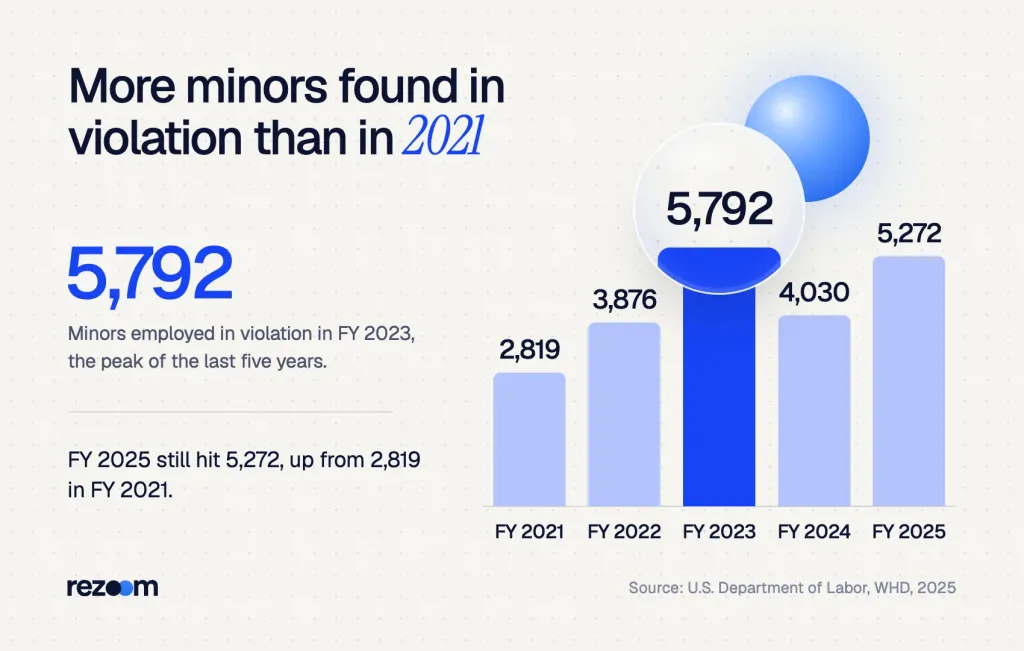
Employers also face real costs for mistakes. In fiscal year 2025, the Wage and Hour Division found 5,272 minors employed in violation3 of child labor laws, up from 2,819 in 2021. The peak came in 2023, at 5,792.
Penalties in fiscal year 2025 totaled $37.2 million, so employers check age early.
Legally authorized to work in the US? See how to answer both job-application questions by status, from green card to OPT, H-1B, H-4 EAD and DACA.
How do you answer 18 or older on job application forms?
Answer for your age on the day you apply, not on the start date. If you are 18 or older, select Yes. If you are under 18, select No, even if you turn 18 soon. Then use a cover letter, a notes field or a quick call to add context, like your birthday or a work permit.
Most forms show the question as a yes/no drop-down or radio button. Some phrase it as "Are you at least 18 years of age?" or "Are you over the age of 18?" They all mean the same thing.
- Read the job postLook for a minimum age, like "must be 18+" or "16 and older welcome."
- Answer for todayPick Yes or No based on your age right now.
- Add context if neededUse a notes field or cover letter to share a birthday that falls before the start date.
- Follow upIf you are under 18, call or visit to ask if the role hires minors.
Sample answers by situation
Are you 18 years of age or older? Yes
"I'm [age] now and turn 18 on [date], which is before your listed start date of [date]. I'm available [days and hours] and can start right away in any role open to [16 / 17]-year-olds."
If you turn 18 next month, the honest answer today is still No. Put the date in your notes or cover letter instead. A hiring manager can wait two weeks, but a false Yes can cost you the job.
What if you are 16 or 17?
At 16 or 17, you can work unlimited hours under federal law, as long as the job is not on the hazardous list. That covers many retail, food service and office jobs. But you can't drive for work in most cases or run certain machines, and your state may require a work permit first.
Federal law gives 16- and 17-year-olds a lot of room. They "may be employed for unlimited hours in any occupation other than those declared hazardous," Fact Sheet #431 says. The rules for 14- and 15-year-olds are much tighter.
| Age | Hours under federal law | What you can't do |
|---|---|---|
| 14 and 15 | 3 hours on a school day, 18 in a school week; 8 on a non-school day, 40 in a non-school week; 7 a.m. to 7 p.m. (9 p.m. June 1 to Labor Day) | Hazardous jobs, plus most manufacturing, construction and warehousing |
| 16 and 17 | No federal hour limits | Hazardous jobs, like driving, forklifts and power saws |
| 18 and older | No federal youth limits | None under the youth rules |
Which jobs are off-limits under 18
The DOL's list of jobs off-limits for minors2 names 16 kinds of dangerous work. These are the ones that show up most in first jobs:
- Meat slicers: running, setting up or cleaning meat-cutting machines, as in a deli.
- Balers and compactors: loading or running the cardboard baler in the back room.
- Forklifts: driving a forklift, skid-steer or similar lift.
- Driving: most driving on public roads, plus riding as a driver's helper.
- Power saws and bakery machines: common in hardware stores and bakeries.
Federal rules allow 17-year-olds to drive only in narrow cases, in daylight and for limited time. So delivery jobs often say 18+ or 21+.
Work permits and state rules
Federal law does not require working papers, but many states do. When state and federal rules differ, employers must follow the stricter one.
New Jersey is a clear example. Its labor department says all workers under 18 who accept a job offer need working papers in New Jersey4. Minors apply only after they get an offer, and a parent or caregiver must approve the application online.
Look up your state's work permit steps before you apply. Then you can tell a manager, "I can have my permit within a few days of an offer." That line answers their biggest worry about hiring someone under 18.
Is it legal for employers to ask if you are 18 or older?
Yes, in most cases. Federal age discrimination law, the ADEA, protects people 40 and older, not younger workers. A yes/no minimum-age question helps employers follow child labor rules. Asking your exact birth date before an offer is riskier for them, and some states limit age questions more strictly.
The Age Discrimination in Employment Act covers applicants and employees age 40 and older. An EEOC informal discussion letter5 from 2005 says the law "does not specifically prohibit" asking an applicant's age or date of birth. But the EEOC also says it "closely scrutinizes" forms that ask for it.
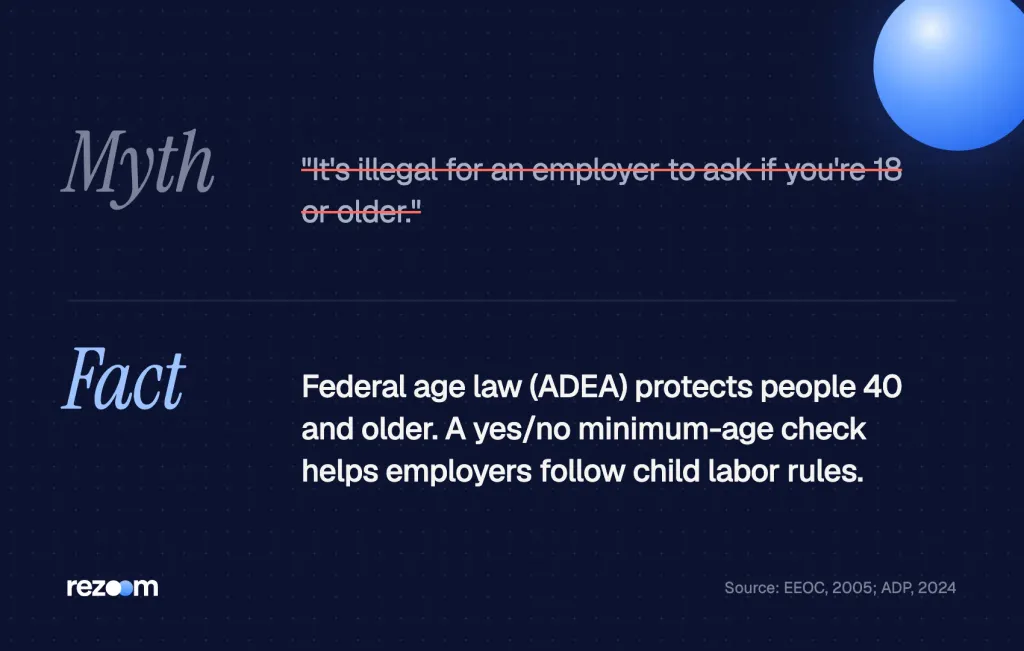
So many HR guides draw a line. Payroll firm ADP6 advises employers to avoid birth dates before hiring. When a legal minimum age applies, ADP suggests a yes/no question like "Are you at least 18 years old?"
Questions that cross a line
- "What is your date of birth?" on an early form, with no legal reason.
- "What year did you graduate?" when it only serves to guess your age.
- "Are you under 40?" or any question aimed at older applicants.
Some states go further than federal law and limit age questions. This is general information, not legal advice. If a question feels off, check with your state labor office.
Free ATS score, the text the software extracts and your missing keywords. No sign-up.
What if the form won't accept "No"?
A form that ends the application when you select No uses a knockout question, which means the role has a firm 18+ rule. Don't change your answer to Yes. Check the company's careers page for roles open to 16- or 17-year-olds, or call the store and ask a manager directly.
Many applicant systems use knockout questions. If your answer doesn't match the job's rule, the form ends or shows a message. That usually means this role needs an adult, often because of hazardous tasks, alcohol sales or driving.
Why lying doesn't work
A false Yes rarely survives hiring. Your I-9 documents, a background check or a state work permit can all show your age. And the employer may have to remove you from the role to avoid a child labor fine.
Do
- Answer truthfully for your age today.
- Search the same company for roles open to minors.
- Call or visit and ask for the hiring manager.
Don’t
- Change No to Yes to get past the form.
- Leave the question blank and hope no one checks.
- Apply for driving or forklift jobs before you turn 18.
What to say if they push back
- "This job is 18 and up." Ask about other roles: "Do you have any openings for 17-year-olds, like cashier or stocking?"
- "We don't hire minors." Thank them and ask when to come back: "I turn 18 in March. Can I reapply then?"
- "Can you work late?" Know your limits: "At 17 I have no federal hour limits, but I'll check my state's rules."
Manager: "The online form says the job is 18 and older."
"I understand. I'm 17, and I have my work permit ready. Do you have any roles open to 17-year-olds, like cashier or front end?"
Manager: "Cashier, yes. But you can't use the baler."
"That works for me. Should I apply for the cashier role online, or can I drop off a resume today?"
"I'm 16 and available weekends and after school. I'd like to be considered for any role open to my age group."
Other form fields matter, too. Our guide to the highest level of education on a job application shows what to pick if you're still in high school.
Highest level of education on job application forms: what to pick for a GED, some college, a degree in progress, a certificate or a foreign degree, and why.
How do you show you're ready for your first job?
Back up your answer with a short, one-page resume and a brief cover letter. List school, volunteer work, clubs and any paid gigs. State your availability clearly, since shift fit matters as much as age. For retail and food service, show you're reliable, friendly and good with numbers.
Retail is one of the most common first jobs, and many stores hire at 16. Browse these retail resume examples to see how first-job seekers list school, availability and customer skills.
For the closest match, these retail cashier resume examples show how to list cash handling, accuracy and shift hours on one page.
Retail cashier resume example
A first-job resume that fits on one page.
Still in school with no work history? These high school student resume examples use clubs, sports and volunteer work instead. Our guide on how to make a resume for your first job walks through each section.
Add a short cover letter
A short letter helps when the form leaves no room for context. This retail cashier cover letter example shows how to mention your age, permit and availability in a few lines.
Retail cashier cover letter example
A short letter for a first retail job.
You can find more styles in these retail cover letter examples. And when a form asks when you can begin, our guide to the earliest start date on a job application helps you pick a date you can keep.
SAM CARTER
Dayton, OH | (937) 555-0144 | sam.carter@email.com
Available weekdays 3 to 9 p.m. and weekends, work permit on file
Handled $500+ in cash per shift at school concession stand
Volunteer, food bank: sorted and stocked 200+ items per week
Final check before you apply
Before you answer the age question
Our AI resume builder can turn school, clubs and volunteer work into a clean first resume.
Tailored to the job post, checked against ATS.
Frequently asked questions
What does "Are you 18 years of age or older?" mean on a job application?
It asks if you are at least 18 today. It's a yes/no check so the employer knows which child labor rules apply to you.
Should I say yes if I turn 18 before the start date?
No. Answer for your age on the day you apply. Then add your birthday in a notes field or cover letter so the employer can plan.
Can a 16-year-old work at a store?
Yes, many stores hire at 16. Federal law allows unlimited hours at 16 and 17, but not hazardous tasks like running a baler or meat slicer.
Is it legal to ask if I'm 18 or older?
In most cases, yes. The ADEA protects workers 40 and older, and a yes/no minimum-age question helps employers follow child labor rules.
What happens if I lie about being 18?
Your ID, I-9 documents or a background check can show your real age. The employer may then pull the offer or remove you from the job.
Do I need a work permit at 17?
It depends on your state. Federal law doesn't require one, but states like New Jersey require working papers for every worker under 18.
What does 18 or older on job application mean?
The 18 or older on job application question checks that you meet the minimum age for the role. Answer it truthfully; if you are 16 or 17, many employers can still hire you for jobs that allow minors.
Sources
We opened and read each page below. The small numbers in the text point here. Pages that carry no publication date show n.d.
- U.S. Department of Labor, Wage and Hour Division2016
Federal youth employment rules stop at 18, and 16- and 17-year-olds may work unlimited hours in non-hazardous jobs.
- U.S. Department of Labor, Wage and Hour Divisionn.d.
The DOL lists 16 kinds of hazardous work, including balers, meat slicers, forklifts and driving, that are off-limits under 18.
- U.S. Department of Labor, Wage and Hour Division2025
In fiscal year 2025, investigators found 5,272 minors employed in violation (2,819 in FY 2021, 5,792 in FY 2023) and $37.2 million in child labor penalties.
- New Jersey Department of Labor and Workforce Developmentn.d.
All New Jersey workers under 18 who accept a job offer need working papers, applied for after the offer.
- U.S. Equal Employment Opportunity Commission2005
The ADEA does not specifically prohibit asking an applicant's age, but the EEOC closely scrutinizes forms that ask.
- ADP2024
ADP advises employers to avoid asking birth dates before hiring and to use a yes/no question when a legal minimum age applies.
Mohammad has spent more than ten years designing consumer products and leads product at Rezoom, deciding what gets built and what gets left out. His guides cover the whole job search, from resume sections and cover letters to interview answers and career moves.
Goodi, M. (2026, November 13). Are You 18 or Older on Job Application Forms? How to Answer. Rezoom. https://rezoom.io/are-you-18-or-older-on-job-application/