

Summary
Put the dean's list in your education section, on its own line under your degree: "Dean's List: Fall 2024, Spring 2025, Fall 2025" or "Dean's List (6 of 8 semesters)." Use an Honors and Awards section only if you have three or more academic honors. Count semesters when you earned it three or more times, and name the terms when it was once or twice. Remove it once you have two to three years of relevant work experience.
List the dean's list inside your education section, directly under your degree, with the terms you earned it: "Dean's List: Fall 2024, Spring 2025." That is how to put dean's list on resume in one line. The rest is choosing the right format for your record and knowing when to cut it.
Most guides give one example and move on. This one gives you a format for every situation (one semester, many semesters, quarter systems, every term), explains why the honor means different things at different schools, and gives a clear rule for when it should leave your resume.
What does the dean's list mean to an employer?
The honor is not standardized, which is why context helps. Here is how four universities define it:
| School | Dean's list requirement | Extra condition |
|---|---|---|
| UNC-Chapel Hill | 3.5 semester GPA | 12+ letter-grade hours, no grade below C (UNC Registrar) |
| Iowa State | 3.5 semester GPA | 12+ graded or S-F credits (Iowa State Registrar) |
| University of Washington | 3.5 quarterly GPA | 12+ graded credits; separate Annual Dean's List (UW Registrar) |
| Notre Dame | Top 30% of students in each college | 12 graded credits; cutoffs roughly 3.76 to 3.95 (Notre Dame Registrar) |
A recruiter usually won't know your school's rule. When your list is unusually selective, you can say so in a few words, such as "Dean's List (top 30% of college), 5 semesters."
Where do you put the dean's list on a resume?
The education section keeps the honor next to the school that awarded it, so the reader never has to connect the two. For the rest of that entry, see our full guide to listing education on your resume.
Use a separate Honors and Awards section when you have enough to fill it: scholarships, department awards, honor societies and the dean's list together. One honor alone in its own section looks thin.
Section order depends on your stage. Students and new graduates put education near the top; our guide to resume formats for freshers shows the layout. Experienced candidates put education after work history.
How do you format the dean's list on a resume?
Pick the format that makes your record look as strong as it honestly is.
University of Michigan, Ann Arbor, MI | Expected May 2027
Bachelor of Science in Biology
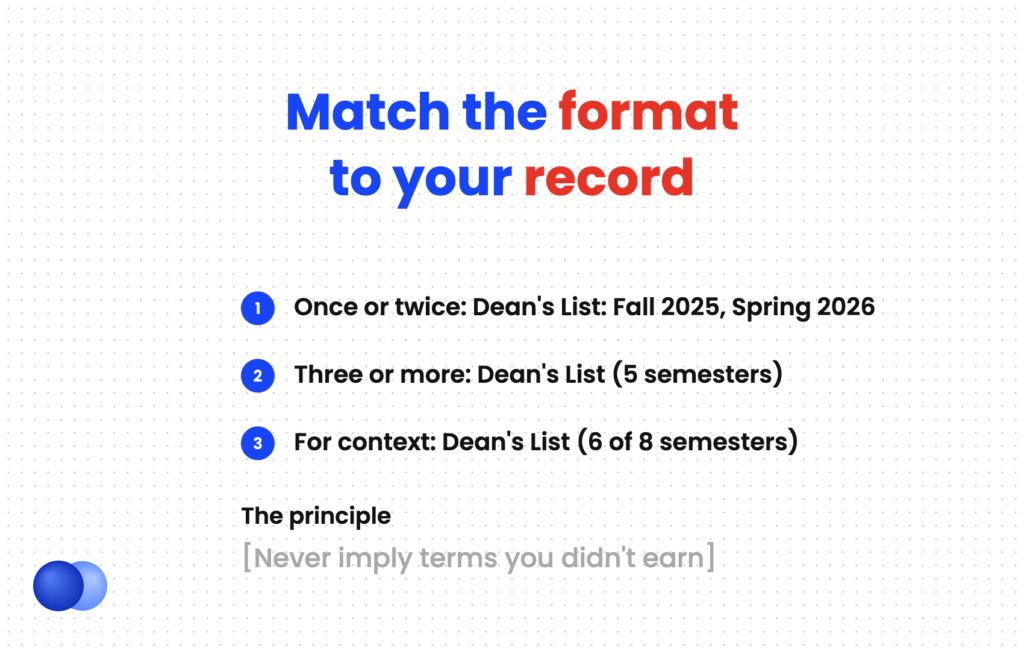
Dean's List: Fall 2025, Spring 2026
Iowa State University, Ames, IA | May 2026
Bachelor of Science in Mechanical Engineering
GPA: 3.7/4.0 | Dean's List (6 of 8 semesters)
Dean's List, all semesters (Fall 2022–Spring 2026)
Annual Dean's List, 2024–2025 and 2025–2026 (University of Washington)
Dean's List (top 30% of college), 5 semesters
A few rules keep the line clean:
- Spell it out. Write "Dean's List," not "DL." Recruiters and applicant tracking systems both search for the full term.
- Use your school's term names. Quarter schools say "quarters." Don't convert them to semesters.
- Pair it with GPA only if the GPA helps. Our sibling guide, should I put GPA on my resume, covers the cutoff.
- Add a still-enrolled note if you're a student. Our guide on how to list an expected graduation date on resume shows the wording.
Write "Dean's List (5 semesters)" when you earned it three or more times. do: Name specific terms when you earned it once or twice. do: Keep it on one line inside the degree entry. do: Use the exact honor name your school uses, such as President's List.
Write "Dean's List" with no terms, which reads as every term. dont: Give a single honor its own resume section. dont: List the dean's list for terms you did not earn it. dont: Keep it on a resume for a senior-level role.
Should you put the dean's list on your resume if you made it only once?
Some guides say to drop a single dean's list entirely. That advice fits a senior with a full page of internships. It does not fit a first-year student applying for a first job.
Use this decision rule:
- Freshman or sophomore: list it, even once. It may be your newest achievement.
- Junior or senior: list it if you earned it two or more times, or if it was your most recent term. A strong upward trend is a story worth telling.
- Recent graduate with internships: list it only if you earned it three or more times.
If your resume is short on material, our guide to writing a resume with no experience shows what else can fill the space.
Does the dean's list still matter as employers move away from GPA?
The shift is clear in employer data. NACE reports that 42% of employers screen by GPA, a steep fall from 73% in 2019. Meanwhile, 70% say they use skills-based hiring, up from 65% a year earlier.
That changes how you should use the honor. About two in five employers still screen by GPA, so the dean's list is worth a line. But it should sit beside proof of skills, not replace it.
Pair it with evidence of what you can do: projects, internships, research and relevant coursework. Our guide on how to include an internship in your resume covers the most common proof point for students.
Turn the honor into a skills signal
A dean's list line shows discipline over time. Make that visible by putting it on the same line as a demanding load: "Dean's List (5 semesters) while working 20 hours per week." That single clause answers a question employers care about: can you manage competing priorities?
How is the dean's list different from Latin honors?
Latin honors summarize your entire degree, so they usually carry more weight once you graduate. Our sibling guide on how to list Latin honors on resume covers the formatting.
Many schools also run a President's List or Chancellor's List with a higher bar. At Iowa State, the President's List requires a 4.0 GPA across the two most recent semesters. If you earned a higher list, name it instead of, or in addition to, the dean's list.
When should you remove the dean's list from your resume?
Recruiters spend little time on each resume, as our guide on how long recruiters look at a resume explains. Every line must earn its space. After a few years, an achievement at work beats a college honor.
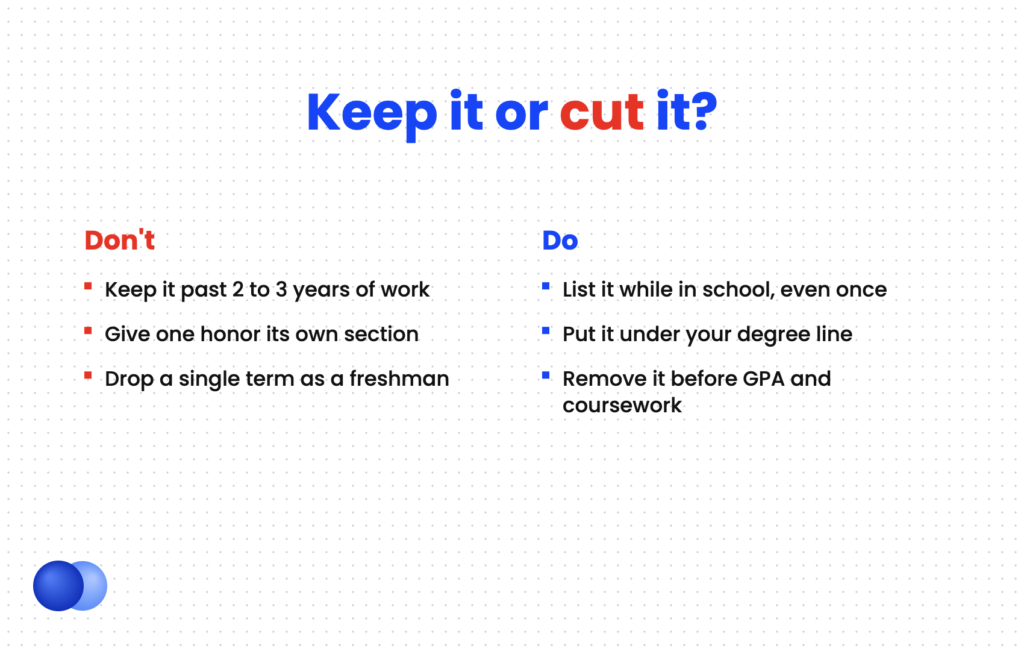
When you update, remove the dean's list first, then the GPA, then coursework. Keep the degree, school and graduation year. To rebuild the education section quickly, the Rezoom AI resume builder lets you edit or drop each line without breaking the layout.
Frequently asked questions
Is it Dean's List or dean's list on a resume?
Capitalize it on the resume as a named honor: "Dean's List." In running text, such as a cover letter, lowercase "dean's list" is also acceptable. Pick one style and use it consistently.
Should I list the dean's list if I'm still in college?
Yes. Current students have the most to gain from it. List the terms you have earned so far and your expected graduation date.
How many semesters of dean's list is impressive?
There is no fixed number. Earning it in most of your terms, or in every term, shows consistency. A ratio such as "6 of 8 semesters" lets the reader judge for themselves.
Can I put the dean's list on my resume without my GPA?
Yes. The dean's list stands on its own, so you can list it even if you leave out a cumulative GPA that doesn't help you.
Should I list the dean's list from community college?
Yes, if it is recent and relevant. List it under the community college entry. Once you finish a bachelor's degree, keep only the honors from the degree-granting school unless space allows.
Do employers verify the dean's list?
Employers can, through transcripts or education background checks. Many schools also publish dean's list names, although students with privacy restrictions may be left off, as UNC notes. List only terms you actually earned.



Comments