

Summary
A summary of qualifications is a short bulleted list of three to six of your strongest, job-matched credentials placed directly under your resume header. Unlike a paragraph resume summary, it lets a recruiter scan proof points in seconds. Use it when you have several distinct selling points, such as certifications, measurable wins or transferable skills, and tailor every bullet to the posting.
A summary of qualifications is a bulleted list of three to six credentials that make you a strong match for one specific job. It sits right under your resume header and replaces a paragraph summary when you have several distinct selling points to show.
The format exists for speed. In a Ladders eye-tracking study, recruiters spent an average of 7.4 seconds on an initial resume scan. Bullets at the top of the page put your best evidence where that scan begins.
This guide explains how the format differs from a resume summary, when to pick it, how to build each bullet, and copy-ready examples for five common situations.
What is a summary of qualifications?
A summary of qualifications is a resume introduction written as three to six bullet points. Each bullet states one credential that matches the job: years of relevant experience, a license or certification, a measurable achievement, or a key technical skill. It appears directly below your contact details and is rewritten for every application.
Think of it as the highlight reel of your resume. Each bullet should be strong enough to stand alone if the recruiter reads nothing else.
Career centers describe it in similar terms. Johnson County Community College advises three to five concise bullets, with the most impressive or applicable information first. Seattle Central College's career center likewise recommends bullets over paragraphs, with each point covering a distinct strength.
You will also see it called "qualifications summary," "highlights of qualifications" or "career highlights." The label matters less than the content.
How is a summary of qualifications different from a resume summary?
A resume summary is a two-to-four sentence paragraph that tells a career story. A summary of qualifications is a bulleted list of separate proof points with no connecting narrative. Both sit in the same spot, under the header, so you choose one, never both. Bullets suit candidates with several distinct wins; a paragraph suits a clear, linear career.
The two formats do the same job in different shapes. A paragraph shows how your experience fits together. Bullets let a reader pick out individual facts at a glance.
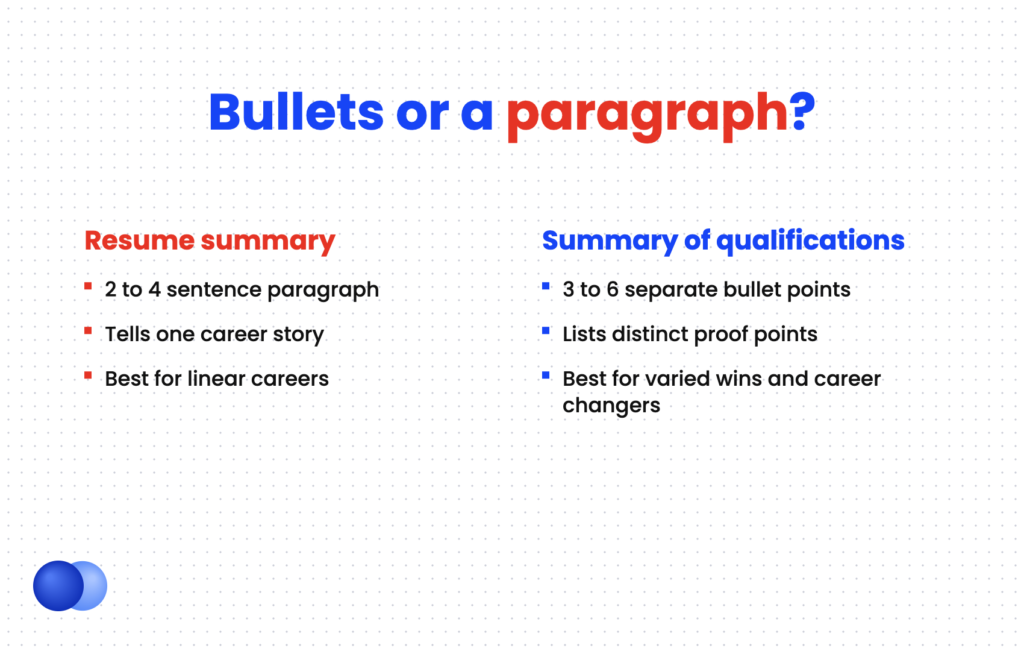
| Feature | Summary of qualifications | Resume summary | Resume objective |
|---|---|---|---|
| Format | 3–6 bullet points | 2–4 sentence paragraph | 1–2 sentences |
| Focus | Separate, provable credentials | Career story and value | Goal for the next role |
| Best for | Varied wins, certifications, career changers | Linear careers, senior roles | Entry-level, students |
| Scan speed | Fastest | Moderate | Fast but thin |
| Keyword room | High, one theme per bullet | Moderate | Low |
If you want the paragraph route, our full resume summary guide walks through structure and examples. For the narrower choice between a goal statement and a summary, see resume objective vs summary.
The introduction itself carries weight. In a 2024 Resume Genius survey of 625 hiring managers, 42% ranked the resume introduction among their top three sections, and 20% called it the most important.
When should you use a summary of qualifications?
Use the bulleted format when you have three or more distinct credentials that match the posting, such as a license, a measurable result and a specialized skill. It works especially well for career changers, people with varied job histories, and roles with strict requirements. Skip it if one clear paragraph tells your story better.
A simple decision rule helps. Count the credentials in your background that the posting asks for directly. If you reach three or more, and they do not form one tidy story, use bullets.
Good fits include:
- Career changers. Bullets let you pull transferable skills forward without explaining every past job.
- Licensed or certified roles. Nurses, accountants and IT staff can lead with the credentials a screener checks first.
- Varied or freelance histories. Bullets pull wins from different jobs into one place.
- Federal and technical postings. These often list specific qualifications, and bullets can mirror them line by line.
- Long careers. Bullets surface results that sit deep in the experience section.
A paragraph is usually better when your career follows one path, or when you are a student with little to highlight yet. In that case, an objective for your resume or the approach in our guide to writing a resume with no experience may serve you better.
How do you format a summary of qualifications?
Place a heading such as "Summary of Qualifications" under your header, then write three to six bullets. Open with your title and years of experience, follow with one or two quantified achievements, add credentials and key skills, and close with a role-specific strength. Keep each bullet to one or two lines and mirror the posting's keywords.
Use this four-part order. It moves from who you are to what you have proven.
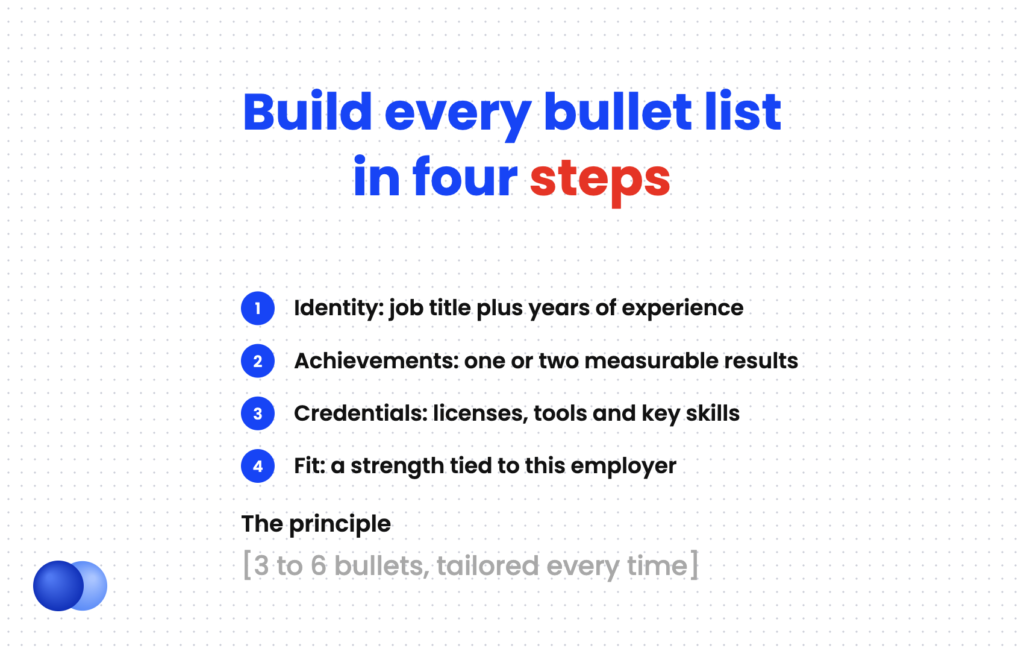
- Identity bullet. Job title plus years of experience in the relevant setting. "Registered nurse with 6 years in Level I trauma care."
- Achievement bullets. One or two measurable results. Use numbers, scale or time saved.
- Credential or skill bullet. Licenses, certifications, tools or languages the posting names.
- Fit bullet. A strength tied to this employer's needs, such as a specific system, client type or schedule.
Keep the heading plain so applicant tracking systems recognize it. "Summary of Qualifications" or "Qualifications Summary" both work. Use standard round bullets, and keep the section to about a fifth of the page.
SUMMARY OF QUALIFICATIONS
• Certified Public Accountant with 8 years in corporate accounting for manufacturing firms
• Cut month-end close from 10 days to 6 by automating 14 reconciliations in NetSuite
• Led 3 clean external audits with zero material findings (2023–2025)
• Advanced Excel (Power Query, pivot models) and SQL reporting for a $120M P&L
• Experienced training staff accountants; mentored 4 hires to senior roles
Notice that every bullet holds a different kind of proof. None repeats a claim made by another. That variety is what makes the bullet format worth using over a paragraph.
Write the bullets last
Draft your experience section first, then pull your three to five strongest, posting-matched results into the summary. You will write tighter bullets, and the summary will never claim anything your experience section cannot back up. Our guide to highlighting skills on your resume shows how to pick which ones.
Summary of qualifications examples by situation
Tailor the bullet mix to your situation. Career changers lead with transferable results, recent graduates lead with training and projects, returners lead with current skills, and senior candidates lead with scope and business impact. In every case, each bullet should answer a requirement from the posting rather than describe you in general terms.
The structure stays the same across situations. What changes is which credentials go first.
CAREER CHANGER (teacher to instructional designer) • 7 years designing curriculum for 150+ students per year across 3 grade levels • Built 40 self-paced lessons in Articulate Rise during a 2025 district pilot • Completed ATD Instructional Design Certificate (2025) • Skilled at turning complex material into clear, measurable learning objectives
RECENT GRADUATE (marketing coordinator) • B.S. in Marketing, 2026; capstone campaign grew a client's Instagram following 35% • Google Analytics 4 and HubSpot Inbound Marketing certified • Managed social content for a 2,000-member student organization for 2 years
RETURNING TO WORK (administrative assistant) • 5 years supporting C-suite executives at a 300-person logistics firm • Refreshed skills in 2026: Microsoft 365, Asana and Zoom Webinar administration • Coordinated 12 board meetings per year, including travel and materials
For a senior candidate, raise the scale of each bullet: team size, budget, revenue and organization-wide results. Recent graduates can find more models in our college student resume guide, and anyone can browse job-by-job layouts in our resume examples library.
Some candidates also want a short block of skill keywords. If you want that block on its own, see our guide to core competencies on a resume.
What mistakes weaken a summary of qualifications?
The most common mistakes are generic traits instead of evidence, too many bullets, repeating the experience section word for word, and failing to tailor bullets to the posting. Pair the section with a paragraph summary and you waste space. Every bullet should hold a specific, checkable fact a recruiter could ask you about.
Write "Reduced patient wait times 22% by redesigning triage intake"
Write "Results-driven professional with a proven track record" do: Keep the list to 3–6 bullets of one or two lines each dont: Stack 10 bullets that push your experience below the fold do: Rewrite the bullets for each posting's top requirements dont: Use one generic bullet list for every application do: Choose either bullets or a paragraph summary dont: Include both a summary paragraph and a qualifications list
Watch for vague trait words. "Hard-working" and "detail-oriented" add nothing without proof. If you need stronger phrasing, our list of words to describe yourself pairs each term with evidence ideas.
Once your draft is ready, the Rezoom AI resume builder can tailor your qualifications bullets to a specific posting and flag missing keywords.

Frequently asked questions
What is the difference between a summary of qualifications and a professional summary?
A professional summary is a short paragraph. A summary of qualifications presents the same kind of information as separate bullet points, which makes individual credentials easier to scan.
How many bullet points should a qualifications summary have?
Three to six is standard. Fewer than three looks thin, and more than six starts to repeat your experience section.
Where does a qualifications summary go on a resume?
Directly below your [resume header](https://rezoom.io/resume-header/) and above your experience or education section. It should be the first content a recruiter reads.
Can I use a summary of qualifications with no experience?
Yes, if you have at least three relevant credentials such as a degree, certifications, projects or volunteer work. Otherwise, a short objective usually works better.
Should qualifications bullets use full sentences?
No. Use concise fragments that start with a title, a number or a strong verb, and skip "I" and "my."
Is a summary of qualifications ATS-friendly?
Yes, when you use a plain heading, standard bullets and keywords taken from the posting. Avoid placing it in a text box or a separate column.



Comments