

Summary
Analytical skills are the abilities to gather information, examine it and draw a conclusion someone can act on. Employers rank analytical thinking among the most wanted skills, with the World Economic Forum reporting that seven in 10 companies consider it essential. On a resume, list the specific methods and tools in your skills section, then prove the skill in bullets that name the data, the method, the finding and the decision it drove.
The best analytical skills for resume use are specific ones: data analysis, research, critical thinking, forecasting and the tools you use to do them. Name those in your skills section, then prove them in bullets that show what you examined, what you found and what changed because of it.
Employers clearly want this. The World Economic Forum's Future of Jobs Report 2025 calls analytical thinking the most sought-after core skill, with seven out of 10 companies considering it essential. The catch is that "strong analytical skills" on its own tells a recruiter nothing.
This guide explains how analysis differs from problem-solving, which ones to list, and a four-part bullet formula with examples for different jobs and career stages.
What are analytical skills on a resume?
Analytical skills are the abilities to collect information, break it into parts, spot patterns and reach a sound conclusion. On a resume they include data analysis, research, critical thinking, forecasting, auditing and reporting, plus the tools behind them, such as Excel, SQL or Tableau. Employers look for them in almost every professional role.
Indeed defines them as the traits that let you observe, research and interpret a subject to develop complex ideas and solutions. In practice, that splits into two layers.
- Thinking skills: critical thinking, research, pattern recognition, root-cause analysis, logical reasoning.
- Technical skills: Excel modeling, SQL, Python, statistics, dashboards, financial analysis, A/B testing.
The thinking layer is a soft skill, so it needs proof. The technical layer is a hard skill, so it can sit in a list. Our guide to technical skills for your resume covers that second layer in depth.
How are analytical skills different from problem-solving skills?
Analytical skills explain what is happening and why. Problem-solving skills decide what to do about it and carry it out. Analysis is the diagnosis: reading data, testing assumptions, finding the cause. Problem-solving is the treatment. Strong resume bullets often show both, but an analytical bullet must make the finding visible.
The two get blurred constantly, yet recruiters read them differently. An analyst who finds why churn rose has shown analysis. A manager who then redesigns onboarding to fix it has shown problem-solving.
| Analytical skills | Problem-solving skills | |
|---|---|---|
| Core question | What is happening, and why? | What should we do, and did it work? |
| Typical verbs | Analyzed, modeled, audited, forecast, identified | Resolved, redesigned, implemented, fixed |
| Evidence in a bullet | The data, the method and the finding | The fix and the result |
| Common tools | Excel, SQL, Python, Tableau, surveys | Process maps, pilots, project plans |
| Example | Identified 3 SKUs driving 60% of returns | Replaced packaging on those SKUs, cutting returns 25% |
If the job posting stresses fixing things under pressure, lead with our guide to problem-solving skills for your resume. If it stresses data, research or reporting, lead with the analysis.
Which analytical skills should you put on a resume?
Choose the skills the job posting names, then add the tools you actually use for them. Common picks are data analysis, research, critical thinking, forecasting, budgeting, reporting, root-cause analysis and data visualization. Pair each general skill with a concrete method or tool, because "Excel modeling" is searchable and believable while "analytical" is neither.
Demand is broad. In NACE's Job Outlook 2025 survey, more than two-thirds of employers said they look for analytical/quantitative skills on college graduates' resumes. The Bureau of Labor Statistics also lists analytical and critical-thinking skills as an important quality for accountants and auditors, who must "critically evaluate data, identify issues in documentation, and suggest solutions."
A practical shortlist, grouped by type:
- Data: data analysis, data cleaning, statistical analysis, data visualization, dashboard reporting
- Business: forecasting, budgeting, variance analysis, market research, competitive analysis
- Reasoning: critical thinking, root-cause analysis, research, hypothesis testing, risk assessment
- Tools: Excel (pivot tables, XLOOKUP), SQL, Python, Tableau, Power BI, Google Analytics
For spreadsheet work specifically, see our sibling guide to Excel skills for your resume. To pull the exact terms from a posting, use the method in our resume keywords guide.
How do you show analytical skills in resume bullets?
Use a four-part formula: the data you examined, the method you used, the finding, and the decision or result it drove. A bullet such as "Analyzed 14 months of support tickets in SQL, traced 38% to one billing bug, and prioritized the fix" proves analysis without ever using the word analytical.
Most top-ranking advice stops at "add numbers." Numbers help, but analysis needs one more thing: the finding. Without it, the reader sees activity, not insight.
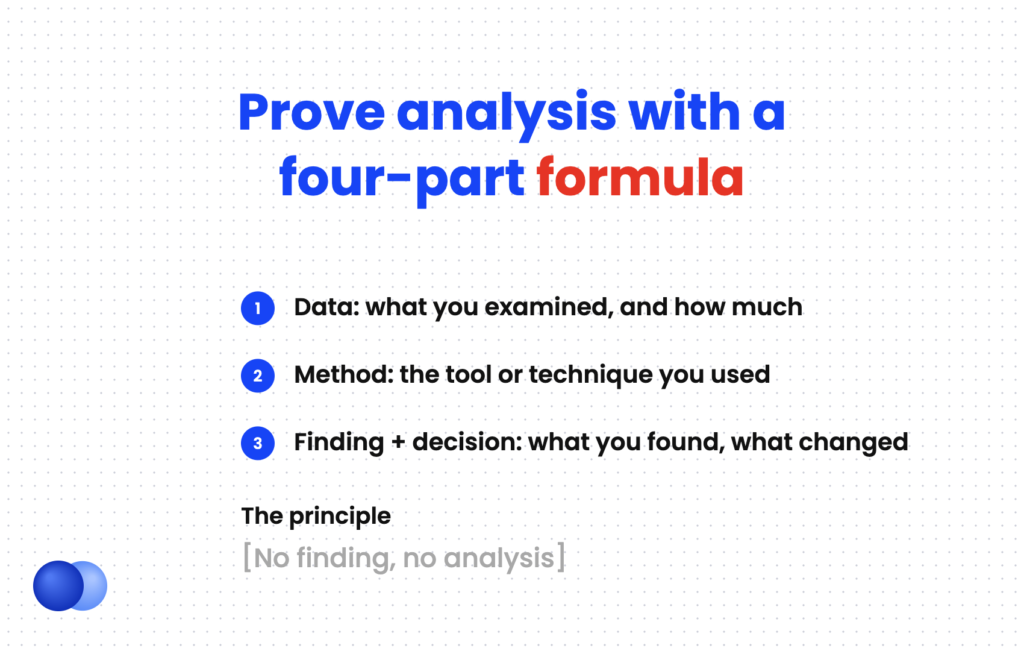
The analysis formula: data + method + finding + decision.
- Data: what you looked at, and how much ("12,000 customer records," "3 years of sales").
- Method: how you examined it ("cohort analysis in SQL," "built a regression model").
- Finding: what you discovered ("weekend orders had twice the error rate").
- Decision: what someone did with it, and the outcome.
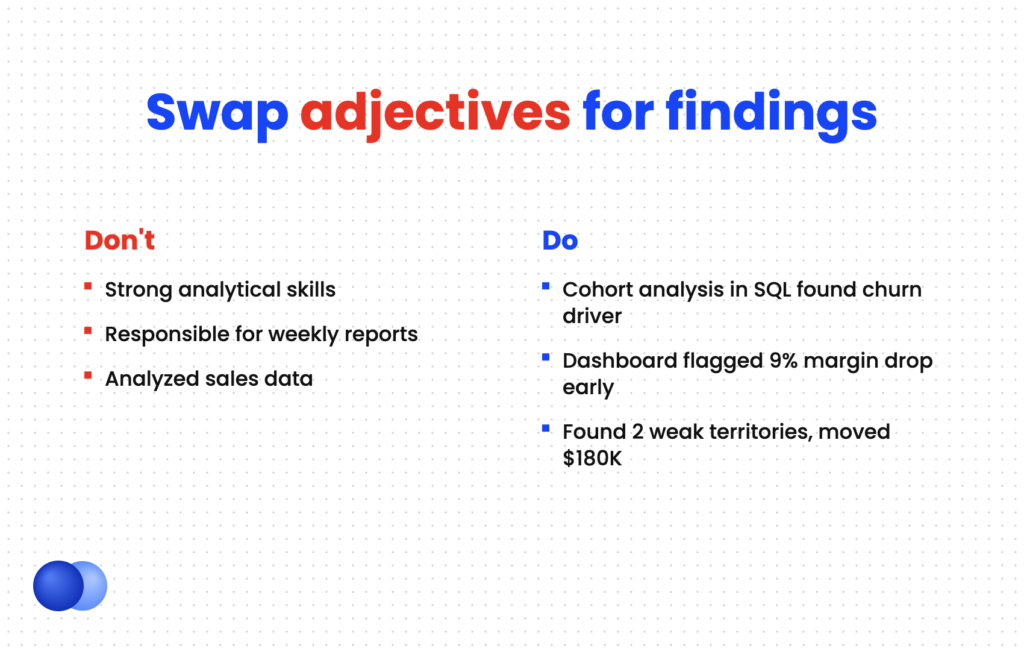
Before: Strong analytical skills; analyzed sales data After: Analyzed 3 years of regional sales data in Excel and Power BI, found 2 territories underperforming on repeat orders, and redirected $180K in marketing spend toward them
Before: Responsible for reporting After: Built a weekly KPI dashboard in Tableau from 4 data sources, flagging a 9% margin drop 3 weeks before month-end close
Before: Did research for projects After: Surveyed 220 users and coded open-ended answers, identifying onboarding confusion as the top churn driver; findings shaped the Q3 product roadmap
Keep the numbers honest. If you cannot share figures, use scale instead ("for a 40-store region") or the decision itself ("adopted by the leadership team"). Our guide on how to quantify your resume covers estimating responsibly, and how to write resume bullet points covers structure.
Make the finding the middle of the sentence
Read each bullet and underline the finding. If nothing qualifies, you have described a task, not an analysis. Add the "found that" clause, even if it is small: "found that 70% of late shipments came from one carrier" is the part a hiring manager will ask about in the interview.
Analytical skills examples by job and career stage
Every field uses analysis differently. Marketers analyze campaigns, nurses analyze patient data, engineers analyze system performance, and students analyze research. Match the example to your role, and if you lack work experience, draw on coursework, capstones, research or volunteer projects that show data, method and a conclusion.
The method stays the same across roles. Only the data changes.
| Job | Analytical skills to highlight | Bullet idea |
|---|---|---|
| Marketing coordinator | Campaign analysis, A/B testing, Google Analytics | Tested 6 email subject lines; winning format lifted open rate from 21% to 29% |
| Financial analyst | Forecasting, variance analysis, Excel modeling | Rebuilt the quarterly forecast model, cutting variance to actuals from 8% to 3% |
| Registered nurse | Patient assessment, trend monitoring, charting review | Spotted a rising early-warning score trend and escalated, leading to an early ICU transfer |
| Operations supervisor | Root-cause analysis, process data, scheduling analysis | Traced overtime spikes to Monday shift gaps; new rota saved 120 hours a month |
| Software engineer | Performance profiling, log analysis, debugging | Profiled API latency and found an N+1 query, cutting p95 response time 45% |
Demand for heavily analytical roles is still growing. The BLS projects data scientist employment to grow 35% from 2025 to 2035, far faster than average.
Capstone Project, Consumer Behavior Research | State University | Spring 2026 - Collected and cleaned 1,400 survey responses in Excel; ran regression analysis in R to test 3 pricing hypotheses - Found that bundle discounts drove purchase intent twice as strongly as free shipping; presented to a local retailer's owner, who piloted a bundle offer
Skills: Data analysis, R, Excel (pivot tables, XLOOKUP), survey design, data visualization
Students can also borrow structure from our college student resume guide and the sibling article on quick learner on resume phrasing.
Where should analytical skills go on your resume?
Put analytical skills in three places. List tools and named methods in the skills section, prove the thinking in experience or project bullets, and mention your strongest analytical result in the summary. Avoid adjectives like "analytical" or "detail-oriented" in the summary unless a result sits right beside them.
Each section does a different job:
- Skills section: concrete, searchable terms such as SQL, forecasting or Tableau. Keep it to what you could defend in a technical screen.
- Experience or projects: two or three bullets per role that follow the data, method, finding, decision formula.
- Summary: one headline result. For structure, see our resume summary guide or the sibling guide to a summary of qualifications.
Name the tool and method, like "cohort analysis in SQL"
Write "strong analytical skills" with no evidence anywhere do: State the finding in each analytical bullet dont: Describe reports you "were responsible for" without saying what they showed do: Match the posting's exact terms, like "variance analysis" dont: List tools you only used once in a tutorial do: Show the decision your analysis influenced dont: Stack critical thinking, problem-solving and analytical in one line
Before you apply, run the draft through the Rezoom ATS resume checker to confirm the analytical terms from the posting actually appear on the page.

Frequently asked questions
What are examples of analytical skills for a resume?
Data analysis, research, critical thinking, forecasting, budgeting, root-cause analysis and data visualization are common examples. Pair each with a tool such as Excel, SQL or Tableau to make it concrete.
How do I describe analytical skills on a resume?
Describe what you analyzed, how you did it, what you found and what changed. For example, "Analyzed 6 months of returns data, found one supplier caused 40% of defects, and renegotiated the contract."
Is analytical thinking a hard skill or a soft skill?
Both. Reasoning and critical thinking are soft skills, while methods and tools like regression analysis or SQL are hard skills.
Should I write "analytical" in my resume summary?
Only with proof attached. "Analyst who cut forecast error from 8% to 3%" shows the skill better than "highly analytical professional."
Which jobs need strong analytical thinking?
Finance, data, marketing, operations, healthcare, engineering and research roles all rely on them. BLS lists analytical and critical-thinking skills as an important quality for accountants and auditors, for example.
How can I show analysis skills with no experience?
Use class projects, capstones, research assistant work or volunteer roles. Show the data you collected, the method you used and the conclusion you reached.



Comments