

Summary
To answer "What is your greatest accomplishment?", pick one recent, job-relevant win with a measurable result and tell it as a STAR story in about 60 to 90 seconds. Spend most of the time on the actions you personally took, then close with the number and why it matters for this role. Avoid bragging, team credit you cannot explain, and achievements unrelated to the job you want.
The best answer to "What is your greatest accomplishment?" is one specific, recent win that matches the job, told as a short story with a measurable result. Your greatest accomplishment is not your biggest life event; it is the proof that you can do the work this employer needs done.
Interviewers use this question to see what you value, how you get results, and whether you can talk about success without bragging. Below you will find a selection rule, a 60-second STAR structure, seven copy-ready sample answers by role, and the mistakes that cost candidates offers.
Why do interviewers ask "What is your greatest accomplishment?"
The question is not a trap. Pomona College's career office puts it plainly: interviewers want to know "what it is that makes you stand out from the crowd."
It also tests three things at once:
- Values. What you choose shows what you are proud of: speed, quality, people, revenue or service.
- Process. How you set a goal, handled obstacles and made decisions.
- Self-awareness. Whether you can describe your role honestly, without inflating or underselling it.
Employers are also hiring more on demonstrated skills. In NACE's Job Outlook 2026 survey, 70% of responding employers said they use skills-based hiring, up from 65% the year before. An accomplishment story is the clearest way to show a skill in action.
How do you choose your greatest accomplishment?
Choose your greatest accomplishment with three filters: it is relevant to the target job, it has a measurable or observable result, and it happened recently, ideally in the last two or three years. If two stories pass, pick the one where your personal actions drove the outcome.
Most candidates pick the biggest win. A better rule is to pick the most useful one. Brainstorm five wins, then score each against the filters below.
| Filter | Ask yourself | Strong signal | Weak signal |
|---|---|---|---|
| Relevance | Does it use a skill named in the job description? | Same skill, similar setting | Unrelated hobby or field |
| Measurable result | Can I state a number or a visible change? | %, $, time saved, ratings, volume | "It went well" |
| Recency | Did it happen recently? | Last 2–3 years | A college win when you have 8 years of experience |
| Ownership | What did I personally do? | You led or drove a key step | You were one of 20 contributors |
The job description is your answer key. NACE reports that more than 80% of employers highlight the key skills needed in their job descriptions. Underline those skills, then pick the accomplishment that proves the top one.
If you already wrote strong bullets, start there. Your resume accomplishments are a ready-made shortlist, and each one can become a 60-second story.
No big number? Use a visible change
Not every result has a dollar sign. Use a before-and-after you can verify: a process that now takes two steps instead of six, a policy your team adopted, a client who renewed, or a manager who gave you the project permanently. Our guide on how to quantify your resume shows how to estimate honestly.
How do you structure a greatest accomplishment answer with STAR?
Use STAR: Situation, Task, Action, Result. MIT's career office suggests roughly 20% situation, 10% task, 60% action and 10% result. Aim for 60 to 90 seconds, end with one concrete number, and add one sentence linking the win to the job you are interviewing for.
STAR keeps your story tight. MIT CAPD recommends spending about 60% of a STAR answer on the actions you personally took, with roughly 20% on the situation and 10% each on the task and result. That split stops the most common problem: a long setup and a rushed ending.
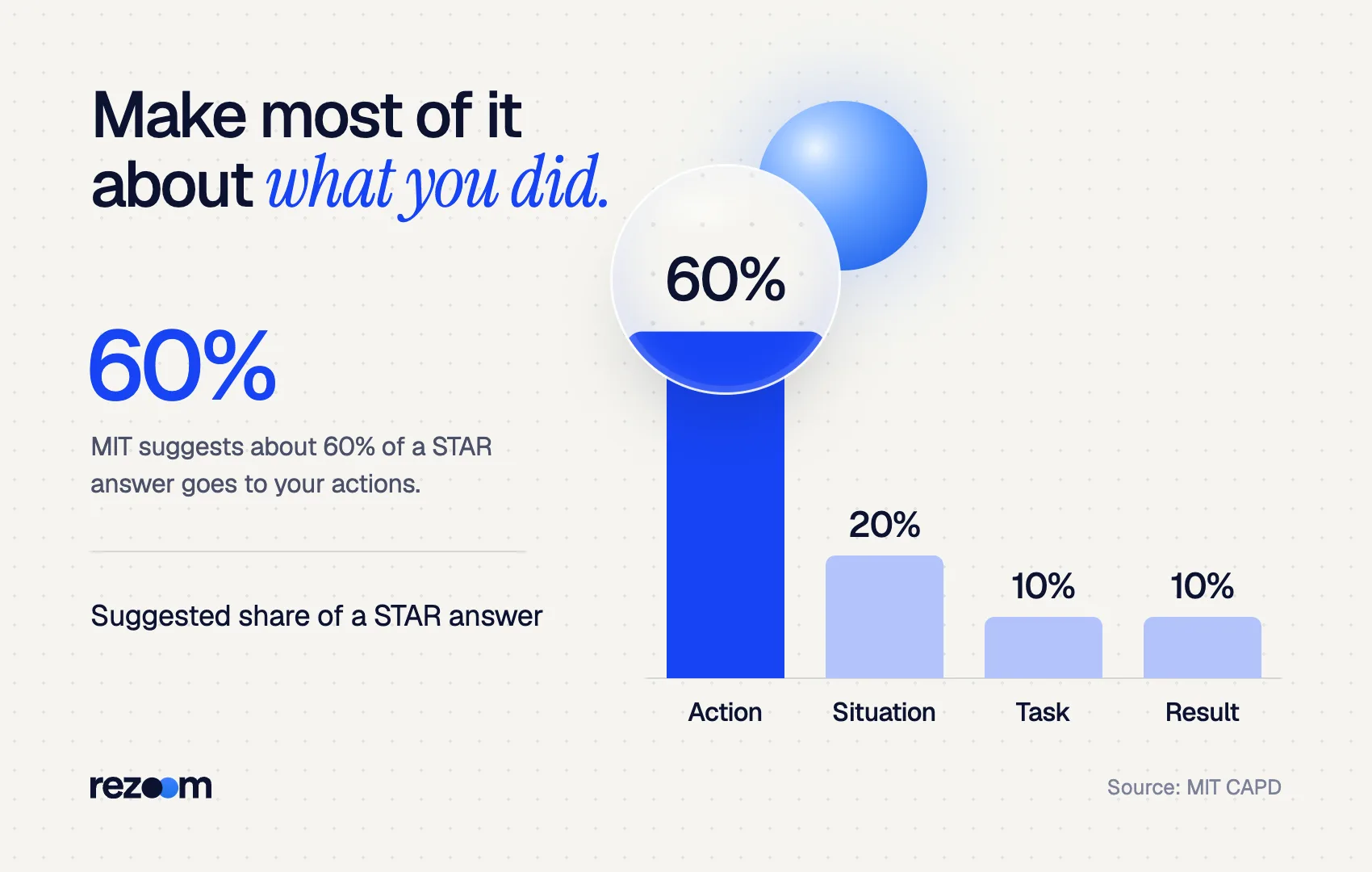
Use this four-line skeleton when you draft:
- Situation (1–2 sentences): Where you were and what was at stake.
- Task (1 sentence): Your goal or responsibility.
- Action (3–4 sentences): The specific steps you took, using "I."
- Result (1–2 sentences): The number, plus why it matters for this role.
For a deeper walkthrough, see our full STAR method guide.
"My greatest accomplishment so far was [result] at [company or setting]. We were facing [problem], and I was responsible for [task]. I [action one], then [action two], and [action three]. Within [time frame], [metric moved from X to Y]. I'm proud of it because it shows [skill from the job description], which is exactly what this role needs."
What is your greatest accomplishment? 7 sample answers
Strong sample answers share one pattern: a clear problem, two or three specific actions, and a measurable result tied to the target job. Adapt the structure rather than the details. Swap in your own numbers, and keep each answer under 90 seconds when spoken aloud.
Each example below is written to be spoken. Replace the details with your own; never borrow numbers you cannot defend.
"My greatest accomplishment was rebuilding our marketing club's event program in my junior year. Attendance had dropped to about 15 people per event, and I volunteered to lead programming. I surveyed members, found they wanted employer contact more than lectures, and booked four local companies for small-group sessions. I also moved promotion from flyers to a class group chat. By spring, average attendance was 48, and two members got internships through those sessions. It taught me to start with what the audience needs, which I'd bring to this coordinator role."
"Last year I took over a territory that had missed quota three quarters in a row. I reviewed 18 months of lost deals and saw we were losing on implementation fears, not price. So I built a one-page onboarding plan and brought a customer success lead into late-stage calls. I also re-contacted 40 closed-lost accounts with that plan. I finished the year at 112% of quota and won back six of those accounts. That's the kind of turnaround I'd want to repeat in your mid-market segment."
"On my med-surg unit, patient falls were a recurring problem on night shift. I joined our unit's safety committee and led a small project: hourly rounding with a simple checklist and bed alarms for every high-risk patient. I trained 14 night-shift nurses and audited compliance every week for two months. Over the next six months, our unit's reported falls dropped by about half. I'm proud of it because it was a team habit change, not a one-time fix, and patient safety is central to this role."
"My greatest accomplishment was cutting our checkout page load time. Our p95 latency was over four seconds, and the product team linked it to drop-off. I profiled the page, found three blocking API calls, and moved two of them to run in parallel. I added caching for the third and set up a performance budget in CI so it wouldn't regress. P95 dropped to 1.6 seconds, and checkout completion rose 9% the next quarter. I'd bring the same measure-first habit to your platform team."
"In my second year teaching eighth-grade math, only 52% of my students were meeting the fall benchmark. I started weekly small-group reteaching based on exit tickets, so each group worked on the exact skill it missed. I also sent a short weekly note to families with one practice problem. By the spring benchmark, 74% of my students were on grade level. It showed me that frequent, simple data beats a big end-of-unit test, and I'd use that approach with your students."
"When I became operations manager, our team had 35% annual turnover, and new hires were quitting in their first 90 days. I interviewed everyone who had left, rebuilt onboarding into a structured two-week plan, and paired each new hire with a peer mentor. I also started monthly one-on-ones with every direct report. A year later, turnover was down to 18%, and first-90-day exits fell from nine to two. My greatest accomplishment as a manager is building a team people want to stay on."
"Before moving into project management, I was a restaurant general manager. My greatest accomplishment there was opening our second location on schedule. I built the timeline, coordinated five contractors, hired and trained 22 staff, and ran weekly status meetings with the owners. We opened on the planned date and 4% under the build-out budget. It's why I pursued my PMP: I realized coordinating people, budgets and deadlines is the work I'm best at, and it's the core of this role."

What mistakes should you avoid when answering?
The costliest mistakes are bragging, taking credit for team results you cannot explain, choosing an irrelevant or outdated win, rambling through the setup, and putting coworkers down. In a CareerBuilder survey, 59% of hiring managers said appearing arrogant or entitled would rule a candidate out.
Tone matters as much as content. In a Harris Poll survey for CareerBuilder of 1,014 hiring managers, 59% said appearing arrogant or entitled would immediately rule out a candidate. Another 52% named a lack of accountability.
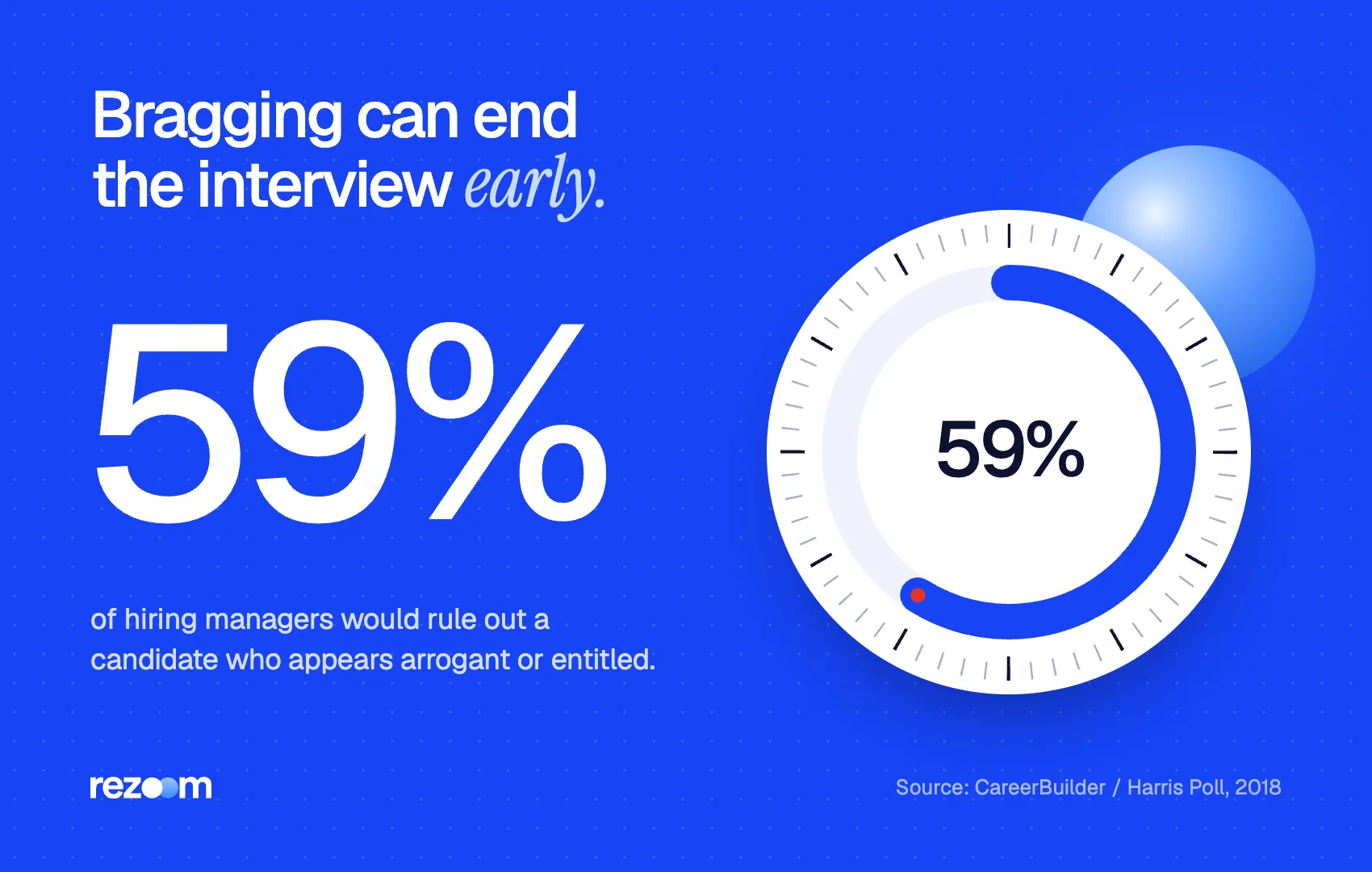
That means you should present results confidently, credit your team briefly, and own your specific part.
Pick one win that proves a skill named in the job description do: State your personal actions with "I," then credit the team in one line do: End with a number or a visible before-and-after do: Keep the answer to 60–90 seconds and stop after the result
Say "I don't really have one" or switch stories mid-answer dont: Claim a team result as yours alone if you cannot explain your part dont: Pick a win from ten years ago when you have recent ones dont: Make your story look better by criticizing a former colleague
Two quieter mistakes also hurt. First, choosing a personal milestone such as running a marathon when you have strong work examples. Second, overprepping a script so it sounds memorized. Pomona's career office warns that a long-winded answer signals you are unprepared.
How do you handle follow-up questions about your accomplishment?
Expect two or three follow-ups: what you would do differently, what obstacles you hit, and how you measured the result. Prepare one honest answer for each before the interview. Follow-ups test whether the story is yours, so know the numbers, the timeline and who else was involved.
Strong interviewers probe. Prepare short answers to these:
- "What was the hardest part?" Name one real obstacle and how you handled it.
- "How did you measure that?" Know where the number came from.
- "What would you do differently?" Give one genuine improvement.
- "Who else was involved?" Name roles, not just "the team."
If the follow-up drifts into a setback, it may turn into a failure question. Our sibling guide on tell me about a time you failed covers that answer. This question also overlaps with what are your strengths, so make sure your accomplishment proves the strength you plan to name.
Then rehearse out loud. You can run this question and its likely follow-ups in Rezoom's AI mock interview, which gives feedback on structure and length. For the rest of your prep, start with our list of common interview questions.
Frequently asked questions
How long should my answer be?
Aim for 60 to 90 seconds when spoken. That is enough for a brief setup, three actions and a result. Stop after the result and let the interviewer ask follow-ups.
Can my greatest accomplishment be personal instead of professional?
Yes, if you lack relevant work examples or the interviewer asks for one. SHRM's student guidance suggests talking about [accomplishments you are proud of, including volunteer work](https://www.shrm.org/in/membership/students/how-to-answer-common-interview-questions) that aligns with the role. Pick a personal win that shows a transferable skill, such as discipline, planning or leadership, and connect it to the job in your last sentence.
What if I don't have any big accomplishments?
Use a smaller win with a clear before-and-after: a process you fixed, a customer you kept, or a project you finished early. Relevance and ownership matter more than size.
Should I use the same accomplishment in every interview?
Not automatically. Keep three or four prepared stories and choose the one that matches each job description. Reuse a story only when it fits the role.
How recent should the accomplishment be?
Ideally within the last two or three years. Older wins work if they are clearly your strongest and most relevant, but explain why they still apply.
Is it OK to talk about a team accomplishment?
Yes. Say what the team achieved, then focus on the specific actions you took. Interviewers want to know your part, not the group's.



Comments