

Summary
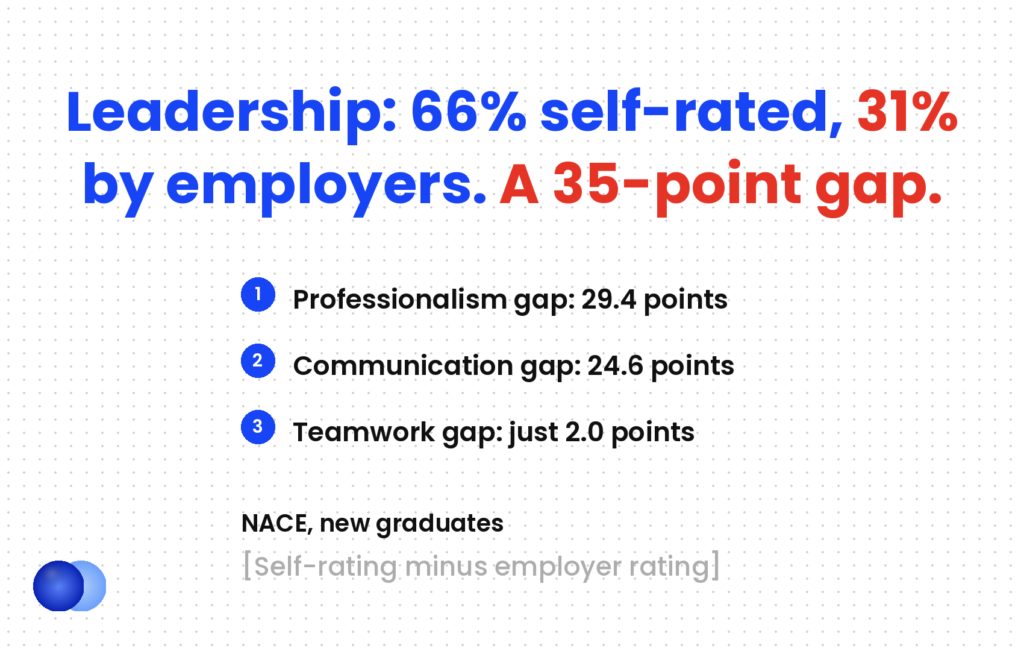
The strengths question is the mirror of the weakness question: a consistency check. Employers ask your references almost the same thing, and NACE data shows candidates overrate themselves most on the strengths they claim most often, such as leadership (66% self-rated against 31% from employers). Pick one strength your resume already proves, that a former manager would name unprompted, and that the posting needs. Then prove it with one result.
When an interviewer asks what are your strengths, the interview has not handed you a free compliment. In fact, it has opened a comparison with your resume and with the call your references will take later.
Moreover, that call often contains nearly the same question. Indeed's standard list of reference-check questions includes, word for word, "In your opinion, what are this candidate's greatest strengths?" Your answer becomes a claim the hiring team can check against two other witnesses.
Similarly, this is the same logic behind the greatest weakness interview answer: a claim nobody can confirm scores nothing. Below: how to pick a strength that survives that check, and sample answers by job type.
What is the "what are your strengths" interview question really testing?
Candidates treat it as a sales moment. However, hiring teams treat it as calibration: does this person see themselves as others do?
Your resume is the first witness. For instance, claim analytical depth above bullets that only list duties, and the interviewer spots the mismatch.
Your later answers are the second. Name "stakeholder management" and your behavioural stories should show it within twenty minutes.
Finally, your references are the third. SHRM guidance from Paul Falcone suggests asking references for the candidate's greatest strength "in terms of standing out among her peers". As a result, a matching answer lifts your credibility everywhere else.
So the real test in any what are your strengths interview moment is simple: will three sources agree? Your answer to what are your strengths should be one the interview panel will hear again from your references.
Which strengths do candidates overclaim?
Leadership, professionalism, critical thinking and communication. In NACE data, the gap between how new graduates rate themselves and how employers rate them runs roughly 25 to 35 points on those four. Teamwork shows almost no gap, and technology runs the other way.
The clearest evidence comes from NACE, which asked more than 20,000 students and 237 employers to rate new graduates' proficiency across eight competencies.
| Competency | Students rating themselves proficient | Employers rating new grads proficient | Gap (points) |
|---|---|---|---|
| Leadership | 66.0% | 31.0% | 35.0 |
| Professionalism | 79.7% | 50.3% | 29.4 |
| Critical thinking | 80.8% | 55.9% | 24.9 |
| Communication | 78.1% | 53.5% | 24.6 |
| Career and self-development | 61.5% | 43.2% | 18.3 |
| Equity and inclusion | 79.5% | 63.3% | 16.2 |
| Teamwork | 83.5% | 81.5% | 2.0 |
| Technology | 60.5% | 72.0% | –11.5 |
The popular strengths carry the most scepticism. "Leadership" and "communication" fill sample answers online, and they are exactly where employers most doubt the candidate. Claim one without proof and you walk into disbelief the interviewer already holds.
Some strengths get undersold. Graduates underrate their technology skills, so real fluency with the role's tools may be the safer claim.
One caveat: NACE measured new graduates, so the exact numbers do not transfer to experienced hires. The mechanism does. Self-ratings run ahead of outside ratings, most on the flattering words.
How do you choose which strength to name?
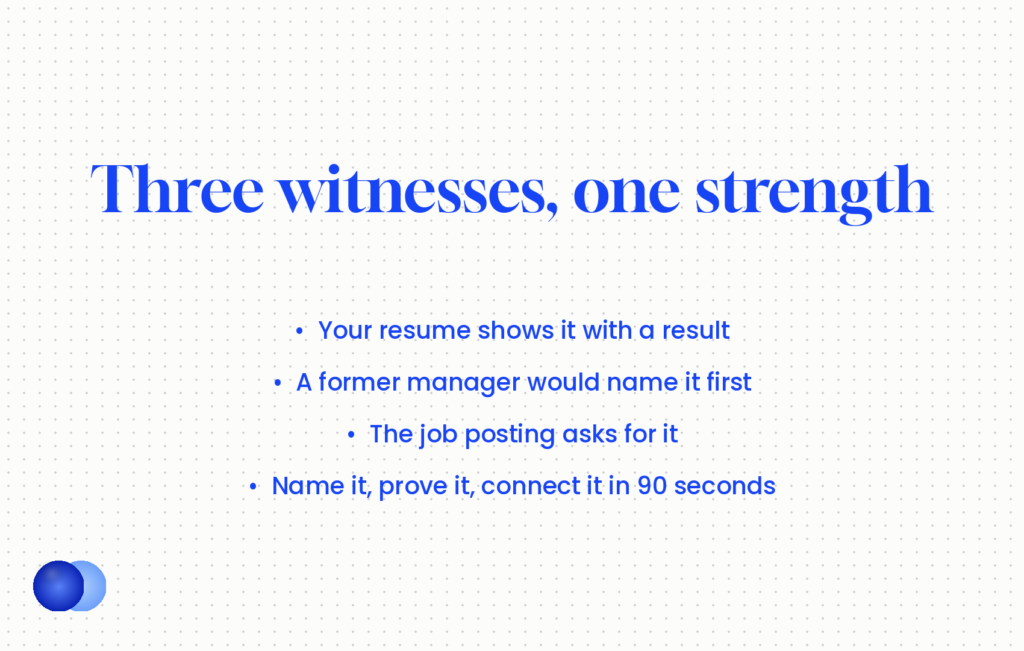
Run every candidate strength through three filters. Your resume already shows it with a result, a former manager would name it without prompting, and the job posting asks for it. Only a strength that passes all three belongs in your answer.
Filter one: the resume test. Point to the bullet that proves it. If you cannot, either the strength is weak or the resume undersells it. Fix one before the interview.
Filter two: the reference test. Imagine your last manager answering "what are this candidate's greatest strengths?" cold. Whatever they would say first is your best option; if unsure, ask a former colleague.
Filter three: the posting test. NACE's Job Outlook 2026 Spring Update found employers rank teamwork, problem-solving and communication as the top attributes they seek. The posting tells you which verified strength this team will value.
A strength that fails only the third filter is still true. It just belongs in a different interview.
Brief your references on the same strength
Before the offer stage, send each reference a short note: the role, what the team cares about, and one project you shared that shows the strength. You are not scripting them. You are reminding them of a real example so it comes to mind first when the call arrives. Ten minutes turns three separate accounts into one consistent one, which is what a resume reference page is for.
How should you structure the answer?
Name one strength, prove it with one specific result, and connect it to the role in a single sentence. Aim for 60 to 90 seconds. One strength with evidence beats three strengths without it, because the evidence is the part the interviewer writes down.
A usable formula is name, prove, connect.
Name it precisely. "Explaining technical trade-offs to non-technical buyers" beats "communication".
Prove it with one result. A short version of a STAR method interview answer works: the situation in a clause, what you did, and a number or visible outcome.
Connect it in one sentence to the posting or something the interviewer said.
If asked for more than one, give a second in the same shape but shorter. A list of five adjectives signals you have not decided which one is true.
Claimed: "I'd say my biggest strengths are leadership, communication and being a hard worker. I'm a real people person and I always go the extra mile."
Proved: "My main strength is getting a stalled project moving again. At Hartwell Logistics our warehouse scanner rollout had slipped three months. I set up a weekly fifteen-minute check-in with the four site leads, cut the open issues from 41 to 6, and we went live in seven weeks. Your posting mentions a delayed ERP migration, which is why I led with that."
The first uses three words from the high-gap end of the NACE table and no evidence. The second gives a former manager something concrete to confirm.
What are your strengths? Sample answers by job type
The structure stays constant; the evidence changes by role. Technical roles reward measurable outcomes, people-facing roles reward observed behaviour and feedback. Each sample below uses illustrative numbers and employers that you would replace with your own.
Treat these as shapes, not scripts. Borrowed details fail the reference test immediately.
Software engineer
"My strongest skill is debugging production issues other people have given up on. Last year I traced an intermittent checkout failure to a race condition in our payment retry logic. Fixing it cut failed payments by about 30%. Your platform is high-volume, so that patience with messy systems transfers directly."
Registered nurse
"I stay calm and organised when a shift gets chaotic. On a night with two call-outs on a 28-bed medical ward, I reorganised assignments by acuity rather than room number, and we finished with every medication pass on time. My charge nurse noted it in my review, and she is one of my references."
Sales representative
"I qualify hard and early. Tightening my discovery questions raised my close rate from 18% to 26% over two quarters, even though my pipeline got smaller. With your long sales cycles, that saves the most time."
Customer service or retail
"I turn upset customers around. At my store I handled most escalated returns, and our district manager started sending new starters to shadow me on Saturdays. I repeat the problem back before offering anything, so the customer knows I have understood."
Which sample answers fit other roles?
The same three-part shape works for project managers, teachers, marketers and career changers. Entry-level candidates can prove a strength with a project or part-time job; career changers should name a strength that already transfers rather than one they hope to develop.
Project manager or operations
"My strength is spotting dependency risks before they turn into delays. On a 14-month office move I built a single dependency map that the IT, facilities and legal leads all updated. We caught a lease-date conflict ten weeks out instead of two, and moved on schedule."
Teacher
"I am good at using data to decide who needs what. After our autumn reading assessments I regrouped my Year 5 class every three weeks rather than once a term, and the share of pupils reading at expected level rose from 61% to 78% by summer. My head of year observed those sessions."
Marketing
"I write copy that tests well. Last quarter I rewrote the onboarding email sequence for a subscription client, ran it as an A/B test for six weeks, and the new version lifted trial-to-paid conversion from 9% to 12%. I would want to start with the same kind of test on your welcome flow."
Graduate or career changer
"My strength is learning a new system quickly and then teaching it. In my final-year project I learned Tableau from scratch in three weeks, then ran two workshops for my cohort. In my retail job, I trained four new colleagues on the stock system. Your graduate scheme rotates every six months, so fast ramp-up matters."
Career changers should translate a strength they already have rather than promise one they will develop. Where do you see yourself in 5 years is the right place for ambitions; the strengths question wants evidence.
What mistakes sink a strengths answer?
Generic adjectives, perfectionism, and a strength that contradicts your resume. The last costs the most, because a panel that catches one mismatch starts doubting every other answer you give in the same interview, including the true ones.
Generic adjectives. "Hard-working", "passionate", "people person". Unfalsifiable means unconfirmable.
Perfectionism. It fails as a strength for the same reason it fails as a weakness: no reference will ever mention it.
Contradiction. Claiming attention to detail with a typo in your resume summary, or leadership with no project you ran. The panel resolves contradictions in the less flattering direction.
Choose the strength a former manager would name first, then prove it with one result the interviewer can write down.
Recite three flattering adjectives from a sample-answer list, because the interviewer has heard that list many times this week already.
It's important for students to reflect on their academic, experiential, extracurricular, and work experiences to identify the skills they have sharpened.
That reflection is the real work; the answer itself takes ninety seconds.
What can a strong answer not fix?
It cannot manufacture evidence that does not exist. If your resume shows nothing that supports the strength and no reference would name it, a polished answer only widens the gap. Fix the evidence first, or choose a smaller strength you can prove.
A good answer to the what are your strengths interview question will not rescue a thin resume. If your bullets read as duties, your strength arrives without proof. Rewrite the bullets first; an AI resume checker run against the posting shows whether the resume supports the claim.
It also cannot control what a reference says. You can remind people of real examples; scripting them backfires.
What the answer can do is make the three witnesses agree. Rezoom's interview preparation tools let you rehearse it against a real job posting before the day.
Frequently asked questions
How many strengths should I give in an interview?
One, unless asked for more; give any others a sentence each.
What is the best strength to say in an interview?
The one a former manager would name first, that your resume shows and that the posting asks for. No strength is universally best.
Is "hard-working" a good strength?
Not on its own. Every candidate says it and nobody can verify it. Name the specific behaviour, such as clearing a backlog, with a number.
Should my strength match the job description?
Yes, but only among strengths you can prove. Never borrow a strength from the posting that your resume cannot support.
Can I use leadership as a strength with no management experience?
Yes, if you describe behaviour, not title: leading a project or training colleagues. Employers doubt leadership claims most, so be specific.
How long should my answer be?
About 60 to 90 seconds: name the strength, prove it with one example, connect it to the role.
Do employers really ask references about strengths?
Commonly, yes. Indeed's standard reference-check list includes "what are this candidate's greatest strengths?", and SHRM guidance suggests asking how the candidate stood out among peers.
How does this relate to the greatest weakness question?
They are two halves of one consistency check. Both answers get compared with your resume and references, so choose ones a former manager would recognise.



Comments