

Summary
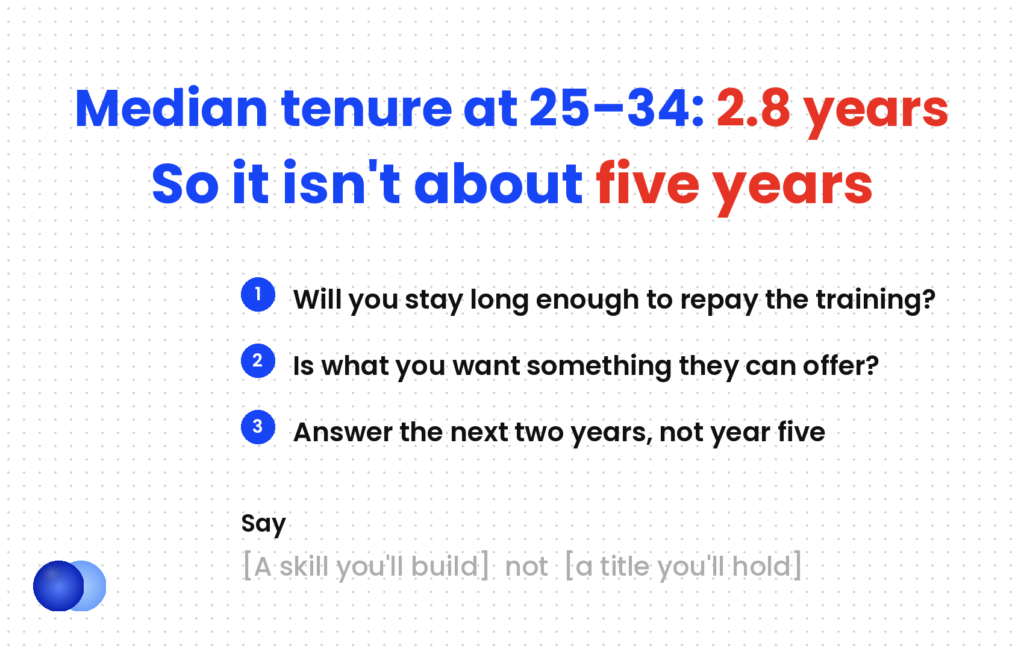
BLS data puts median tenure for workers aged 25 to 34 at 2.8 years, so the question is not really about five years — both sides know most people will have moved by then. It measures whether you will stay long enough to repay the cost of training you, and whether what you want is something the company can actually offer. Answer with direction and the next two years, not a title.
"Where do you see yourself in 5 years?" is a question built on a premise neither side believes.
The Bureau of Labor Statistics puts median tenure for workers aged 25 to 34 at 2.8 years. At large technology companies it runs two to three. The interviewer asking about five years knows that most candidates in the room will have moved on well before then — and so does the candidate.
So where do you see yourself in 5 years is not a request for a prediction. It is measuring two other things, and once you see what they are, the answer becomes straightforward to give honestly.
What does the question actually measure?
Two things beneath the surface. Whether you will stay long enough to repay what the company spends hiring and training you, and whether what you want is something this company can realistically offer. The five-year frame is a proxy for both.
| What it sounds like | What it is measuring |
|---|---|
| "Where will you be in five years?" | Will you stay long enough to repay the training? |
| "What are your long-term goals?" | Do your ambitions fit what we can offer? |
| "What's your career plan?" | Have you thought seriously about your direction? |
Retention. Hiring and training cost real money, and a company wants that investment returned through contribution rather than departure.
Fit between ambition and opportunity. If you want something the organisation cannot offer — a technical ladder in a role that has none, a management track at a flat startup — you will leave, and they would rather know now. The opposite problem exists too: aim far above the role and you may read as overqualified or likely to lose interest.
Intentionality. Whether you have a direction at all, or are drifting from job to job — the same question the STAR method helps you answer with evidence rather than intention.
Who asks it, and why does that matter?
Employers who invest most in training you. It is most common in graduate schemes, Big 4 accountancy, consulting, banking and quant firms — places that spend 12 to 18 months developing an analyst and need that investment repaid. At large tech firms it is asked less, though the underlying signal is still probed.
Who asks where you see yourself in 5 years tells you how much weight to give your answer.
Where it matters most. A firm that spends 12 to 18 months training an analyst in a structured programme needs confidence that the investment will be repaid. In graduate recruitment, professional services and finance, a vague answer can genuinely cost you, because retention is the thing they are pricing.
Where it matters less. Many large technology employers ask it rarely now, partly because the five-year premise sits awkwardly against two-to-three-year tenures. They probe the same signal with better questions: "What are you optimising for in your next role?" or "What kind of work do you want more of?"
Startup founders. They often ask it for a different reason — to see whether your horizon is compatible with their own multi-year plan.
The underlying signal is the same everywhere. What changes is how much weight it carries.
Answer the next two years, not the fifth
You cannot credibly predict year five, and trying to sounds rehearsed. But you can describe what you want to be excellent at in the next eighteen months to two years, and why this role is the right place to build it. That is concrete, honest and checkable against the role — and it answers the retention question implicitly, because it describes a reason to stay.
How do you answer "where do you see yourself in 5 years"?
Three parts, in order:
1. The direction (one sentence). What you want to get good at, framed as capability rather than title. "I want to be the person who can look at growth data and immediately see why it's stalling."
2. Why this role builds it (one or two sentences). Connect your direction to something specific about the job. This is where research shows.
3. The contribution (one sentence). How that growth benefits them. It turns an answer about you into one about the team.
Skills over titles. A title invites the question of whether the company can provide it on your timeline. A skill does not, and it shows you are thinking about substance rather than status.
Generic: "In five years I see myself in a more senior role, probably managing a team and taking on more strategic responsibility. I'm ambitious and want to keep growing and advancing my career."
Specific: "In five years I'd like to be the go-to person for product growth — someone who can look at user data and spot immediately why growth is stalling and what to fix. That's why this role caught my attention. You're moving from founder-led growth to systematic growth, which means building repeatable processes, and that's exactly the skill I want to spend the next two years developing."
Every candidate gives the first answer. The second names a capability, ties it to something specific about this company's stage, and implies a reason to stay — without mentioning a title once.
What are the two ways to get it wrong?
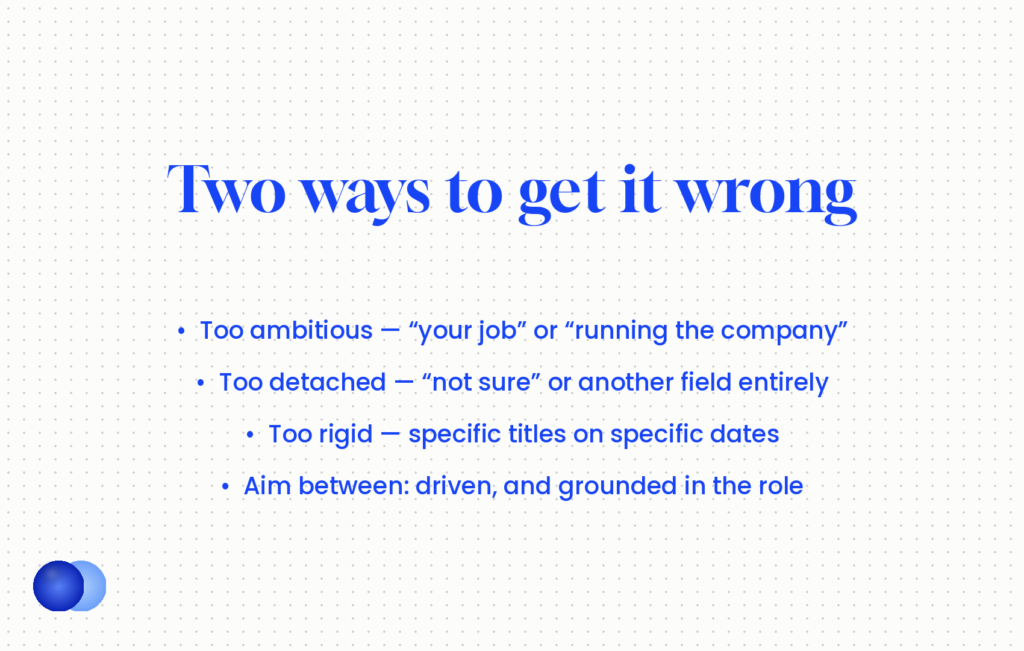
Too ambitious and too detached. "Running the company" or "your job" reads as unrealistic or threatening. "Not sure" or a plan in another field reads as a flight risk. The target sits between — ambitious enough to show drive, grounded enough to fit the role.
Both failures are common, and they fail for opposite reasons.
Over-reach. "I'll be CEO" or "I'd like your job." At best unrealistic, at worst it signals you will be frustrated by a normal progression. Aim well above the role and you may read as overqualified — a candidate who will get bored quickly.
Under-reach or exit signals. "I'm not really sure." "Honestly, I'd like to have my own business by then." "I'm hoping to move into a different field." Any of these tells a retention-focused interviewer that they are training you for someone else.
Inflexibility. A rigid five-year script with specific titles at specific dates. It sounds rehearsed and ignores the reality that roles change.
Research the company's actual growth paths before the interview — how people progress, whether there's a technical ladder, what the team is scaling towards. An answer aligned with a path that exists is far stronger than one aligned with a path you imagined.
Say you want to change fields or start your own company, even if it is true. It may be honest, but it answers the retention question in the one way that costs you the offer.
What if you genuinely don't know?
Most people have no answer to where they see themselves in 5 years, and pretending otherwise is more obvious than admitting it.
The honest version works because the question was never really about year five. It was about direction and fit — and you can speak to both without a title or a timeline.
What you do know. The kind of work you want more of. The skill you are trying to build. What drew you to this specific role.
What you can commit to. Being genuinely engaged in the role for the period it takes to get good at it.
That combination — honest uncertainty about the destination, clear intent about the direction — reads as more self-aware than a polished plan, and it holds up if the interviewer probes it.
A firm that spends 12–18 months training an analyst wants confidence that the investment will be repaid through continued contribution, not departure.
How should you prepare?
Find out how people progress at this company, pick one capability you genuinely want to build, and connect the two in under a minute. Then rehearse it aloud so it sounds considered rather than recited.
Preparing for where do you see yourself in 5 years takes four steps:
1. Research the paths. How do people grow here? Is there a technical ladder, a management track, cross-functional movement?
2. Choose one capability. Something real you want to get better at, relevant to the role.
3. Connect them. Why this role, at this company, is where that capability gets built.
4. Rehearse aloud. Thirty to sixty seconds. Pair it with your greatest weakness interview answer — both are credibility questions, and they should tell a consistent story about who you are and where you are going.
The same thinking carries into second interview questions, where fit and trajectory get probed more deeply by more people — and your answer here should still hold when a different interviewer asks it a different way.
Frequently asked questions
How do you answer "where do you see yourself in 5 years"?
Describe the skills you want to develop and the impact you want to make rather than a specific job title, then connect that direction to what this role offers. Keep it to 30 to 60 seconds.
Why do interviewers ask this question?
To gauge whether you will stay long enough to repay the cost of training you, and whether what you want is something the company can offer. The five-year frame is a proxy for both.
Is it realistic to stay somewhere five years?
Often not — BLS data puts median tenure for workers aged 25 to 34 at 2.8 years. Interviewers generally know this, which is why the question is about direction rather than a literal prediction.
Should I mention a specific job title?
Better not to. A title invites the question of whether the company can provide it on your timeline, while a skill or capability shows you are thinking about substance rather than status.
What if I don't know where I'll be in five years?
Say so honestly, then redirect to what you do know — the kind of work you want more of and why this role is the right place to build it.
Can I say I want your job?
Avoid it. It can read as unrealistic or as a signal you will be frustrated by a normal progression, and it rarely lands the way candidates intend.
Should I mention wanting to start my own business?
Not in this answer, even if true. It tells a retention-focused interviewer that they would be training you for someone else.
Which employers ask this question most?
Graduate schemes, Big 4 accountancy, consulting, investment banking and quant firms — organisations that invest heavily in training and need that investment repaid.



Comments