

Summary
Second interview questions shift from "can you do this job" to "what would working with you be like" — because most new-hire failures come from fit rather than skill. The structural change matters more than the question set: round one is usually one recruiter's pass-or-fail, while round two involves several evaluators and one lukewarm review can sink a candidacy the others liked. Odds jump from roughly 2% to somewhere between 33% and 50%.
Before you rehearse a single second interview question, understand what the invitation means. Typically only two or three candidates reach this stage, and the probability of an offer jumps from around 2% to somewhere between 33% and 50%.
Then most preparation advice tells you to expect harder versions of the same questions. That is true and it misses the more consequential change: round one was usually one person deciding pass or fail. Round two is several people, and any one of them can sink you.
That structural difference should reshape how you prepare, so start there.
What changes between the first and second interview?
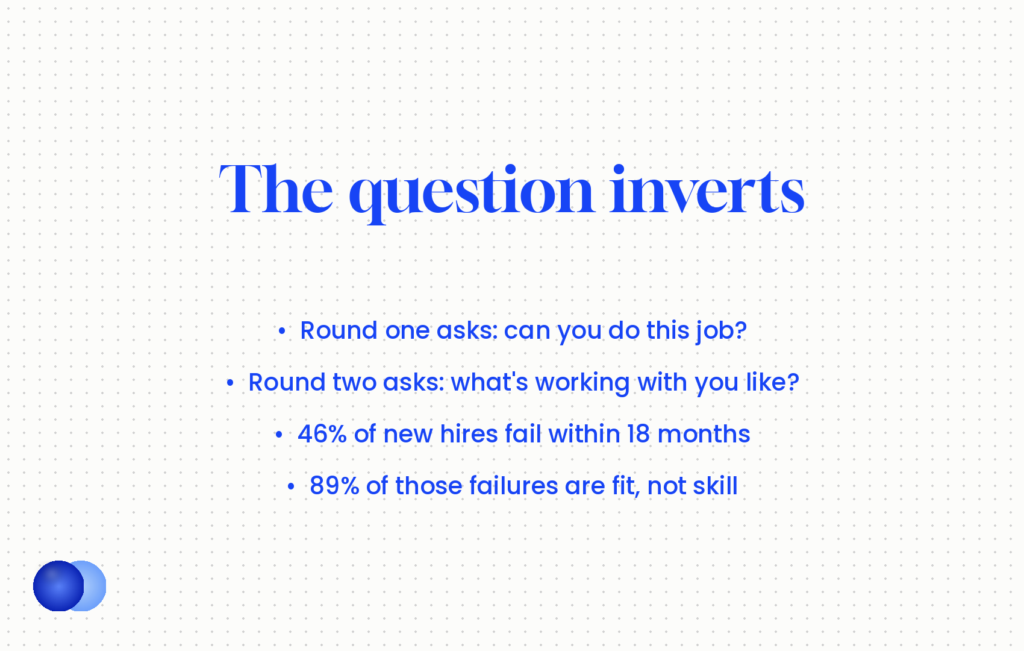
The question changes. Round one asks whether you can do the job. Round two asks what working with you would actually be like — because most new-hire failures come from fit rather than capability. Leadership IQ found 46% of new hires fail within 18 months, and 89% of those failures trace to attitude and fit rather than skills.
In fact, that statistic explains why second rounds exist at all.
If nine out of ten failed hires fail on fit rather than competence, then a process that only screens for competence is optimising the wrong variable. The second interview is the correction — and it is why the questions get less factual and more situational, and why the people asking them change.
| First interview | Second interview | |
|---|---|---|
| Asks | Can you do this job? | What would working with you be like? |
| Run by | A recruiter, usually | Hiring manager, peers, skip-level, cross-functional |
| Length | 30–45 minutes | One to two hours, sometimes a full day |
| Decision | Pass or fail on a checklist | Consensus, with individual vetoes |
| Format | Conversation | Often includes a presentation, case or work sample |
Who is in the room, and who can veto?
Typically the hiring manager, one or two peers, sometimes a skip-level leader and a cross-functional partner. Most structured processes collect independent feedback from each, so a single lukewarm review can end a candidacy the rest of the panel liked.
Above all, this is the part that changes the tactics, and it gets very little coverage.
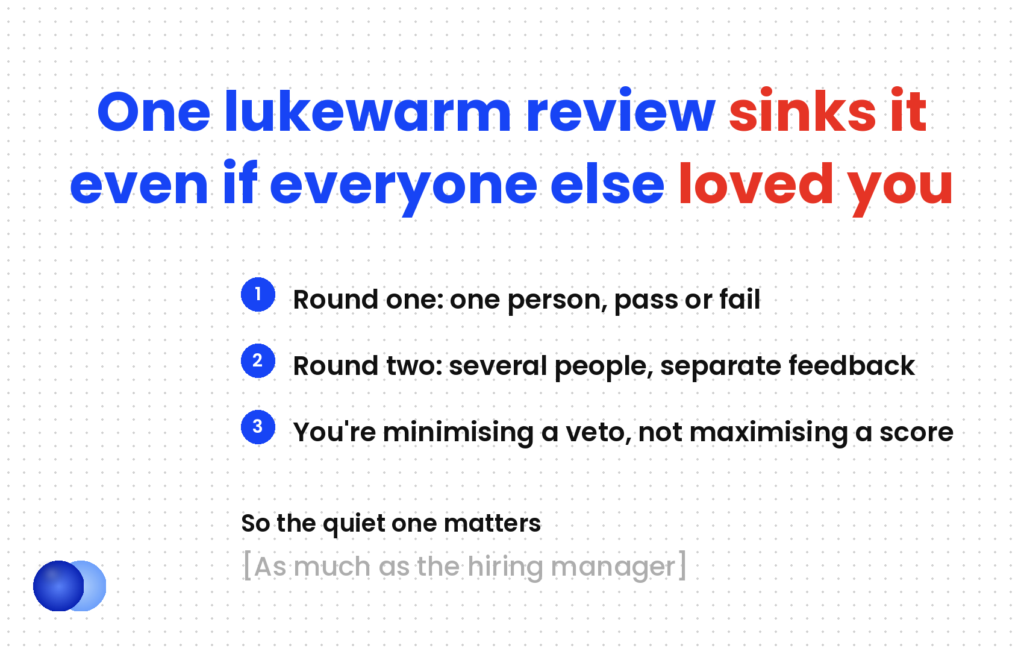
In round one, you have one evaluator with one question. In round two, you have several evaluators submitting separate feedback, and most hiring processes treat a clear objection as decisive rather than averaging it away. One "I'm not sure" from a peer outweighs three enthusiastic yeses more often than candidates expect.
The practical consequence: you are not optimising for an average score, you are minimising the chance anyone leaves lukewarm.
So the quiet person in the corner matters as much as the hiring manager who is clearly on your side. The peer who asks two questions and then says nothing often writes the most cautious feedback, simply because they have the least data on you.
Give the quiet interviewer something to write
Panel feedback forms usually ask for specifics, and an evaluator with nothing concrete to write tends to write something neutral — which reads as a soft no. If someone has barely engaged, address an answer to them directly: "You'd be closest to this day to day — how does that work on your team currently?" One exchange gives them something to write about, and neutral is the outcome you are trying to avoid.
What second interview questions should you expect?
Situational and forward-looking rather than factual. Expect questions about your first ninety days, conflict and disagreement, failure and what you learned, working style, and why this company specifically. The underlying test is whether your answers stay consistent under closer examination.
Grouped by what each second interview question is actually measuring:
| Question | What they are measuring |
|---|---|
| What would your first 90 days look like? | Whether you understand the role, not whether you have a plan |
| Tell me about a time you disagreed with a decision | Whether you can hold a position without being difficult |
| What's a project that failed, and what did you do? | Whether you take ownership or distribute blame |
| How do you prefer to be managed? | Genuine compatibility — this one is not a trick |
| Why this company rather than a competitor? | Whether you did more research since round one |
| What questions do you have for me? | Whether you thought about the role between rounds |
| How would your last manager describe you? | Consistency with what a reference will eventually say |
| What would make you turn down this role? | Honesty, and whether you have actually thought about it |
Why consistency beats correctness
Notice that most of these do not have a right answer. They have a consistent answer — and four interviewers comparing notes afterwards are testing exactly that consistency.
Generic: "In the first 30 days I'd focus on learning, in 60 I'd start contributing, and by 90 I'd be fully up to speed and delivering value."
Specific: "First thirty days I'd want to sit with the two analysts and find out where the reporting actually breaks, because you mentioned the warehouse migration slipped twice. By sixty I'd expect to have one thing fixed that people notice. Ninety is too far out to be honest about — I'd rather commit to the first two."
The second answer admits a limit, which makes the rest credible. The first could describe any role at any company.
What has to be different from round one?
Your research and your specifics. Interviewers explicitly watch for candidates who arrive with the same general knowledge they had in the first round, since that indicates no additional investment between conversations. New information, better questions, and stories you did not already use.
Recruiters name this as a signal directly: a candidate who shows up with no more knowledge than they had two weeks ago has not put anything into the gap.
Specifically, three things to change:
Research something new. A recent product change, a piece of company news, something one of the first-round interviewers mentioned that you then went and read about. Reference it once, naturally.
Use different stories. If you used your best example in round one, the notes from that round are in the room. Repeating it wastes your strongest material and suggests a thin experience base — the same reason STAR stories should never be reused more than twice.
Ask better questions. Round one questions are about the role. Round two questions should be about the work: what is currently hardest, what the last person struggled with, how they measure success.
Ask each interviewer something only they could answer. A peer knows what the day is actually like; a skip-level knows where the team sits in the company's plans. Tailoring shows you understand the structure of the room.
Ask the same question four times. Panels compare notes, and an identical question to everyone reads as a script rather than genuine curiosity.
When should you discuss compensation?
When they raise it, which in a second round they often will. Employers increasingly confirm alignment here rather than after an offer, because discovering a mismatch at offer stage wastes everyone's time. Give a range with real numbers, the same as in the screen.
Here the dynamic differs from the phone screen. There, salary was a knockout filter. Here, it is alignment-checking before they invest in an offer package.
If they raise it, answer directly with a range. If they do not, leave it — you are still demonstrating value, and initiating the conversation before an offer exists trades away position for no gain.
One useful reframe: by this stage the balance has shifted. Two or three candidates remain and the company has spent real hours on you. That does not mean negotiating hard mid-process, but it does mean answering honestly rather than defensively.
One lukewarm review from anyone in the room can sink your candidacy — even if everyone else loved you.
How should you prepare?
Research each interviewer, prepare stories you have not used, develop one question per person, and prepare for a presentation or case if the invitation mentions one. Assume every person in the room submits separate feedback, because most of them do.
Preparing for second interview questions takes five steps, and the first is the one people skip:
1. Find out who you are meeting. Ask the recruiter for names and roles. This is a normal request and they will usually tell you.
2. Look each of them up. Not deeply — enough to know what they do and what they would care about.
3. Prepare one question per person. Tailored to their role. This is the single highest-return preparation for a panel.
4. Pick fresh stories. Different from round one, mapped to fit and working style rather than raw capability.
5. Prepare the exercise. If the invitation mentions a presentation, case study or work sample — common in consulting, marketing, sales and management roles — that is the main event, not a formality.
Finally, send individual notes rather than one message to everyone. Panels compare afterwards, and a copy-pasted email undoes the impression you just built — the interview follow-up email covers the format, including how to use it to repair an answer that landed badly. And if the wait afterwards is uncomfortable, signs an interview went well explains why silence is usually structural rather than about you.
Frequently asked questions
What is the difference between a first and second interview?
The first asks whether you can do the job and is usually run by one recruiter. The second asks what working with you would be like, involves several evaluators, and typically runs one to two hours.
What are the chances of getting the job after a second interview?
Typically only two or three candidates reach this stage, and the probability of an offer rises from around 2% to somewhere between 33% and 50% depending on the process.
What questions are asked in a second interview?
Situational and forward-looking ones: your first 90 days, a disagreement you handled, a failure you owned, how you prefer to be managed, and why this company specifically rather than a competitor.
Can one person block me in a second interview?
Often, yes. Most structured processes collect independent feedback from each interviewer and treat a clear objection as decisive, so a single lukewarm review can end a candidacy the rest of the panel supported.
Should I use the same stories from my first interview?
No. Notes from round one are usually in the room, and repeating your strongest example wastes it while suggesting a narrow experience base. Prepare fresh stories mapped to fit and working style.
Should I bring up salary in a second interview?
Only if they raise it, which in a second round they often do. Answer with a real range. Initiating the conversation before an offer exists gives up position for nothing.
What should I ask in a second interview?
Something only that person could answer. A peer knows what the day is actually like; a skip-level leader knows where the team fits in the company's plans. One tailored question per interviewer.
Do I need to do more research before a second interview?
Yes, and interviewers watch for it. A candidate arriving with the same general knowledge they had in round one signals no additional investment between the two conversations.



Comments