

Summary
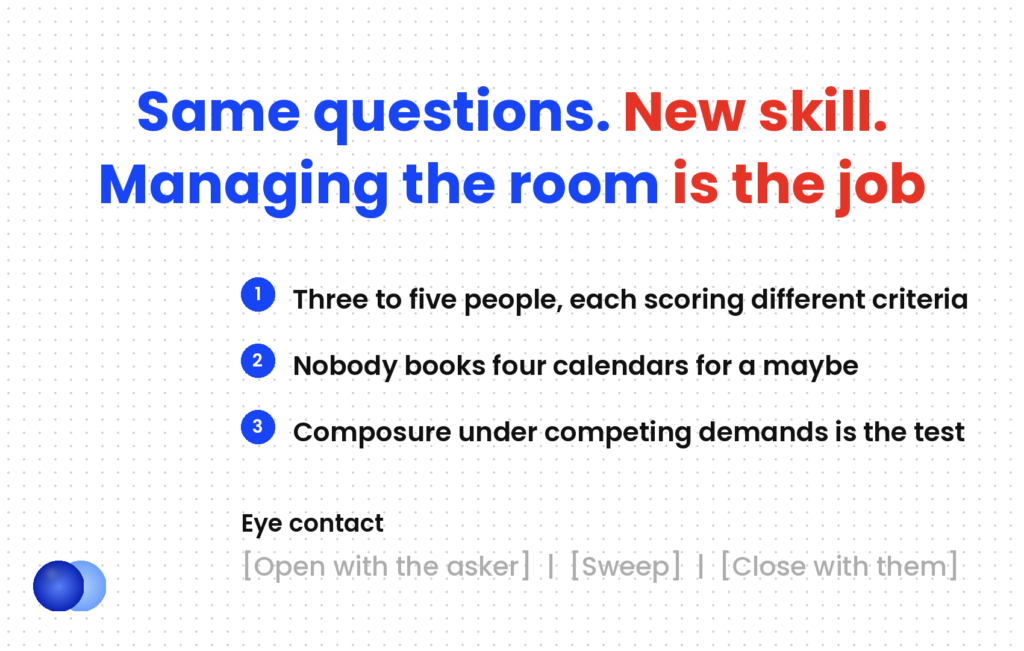
Panel interviews ask largely the same questions as one-on-one rounds. The difference is that handling several stakeholders at once is itself being evaluated — which is exactly what the job requires. Three to five panellists is standard, each assessing against different criteria, and the format is a positive signal because nobody books four busy calendars for a maybe.
A panel interview puts four people across a table from you, and the format intends a little discomfort. That is part of the point.
But the questions in a panel interview are mostly the same ones you would get one-on-one. What changes is that you now manage a group conversation while answering — and that, rather than the questions, is what they score.
Which is a more useful frame than "how do I cope with four people", because managing several stakeholders at once is not an interview skill. It is the job.
Who is usually on a panel?
Three to five people is standard — typically the hiring manager, a peer, a cross-functional partner, and sometimes an HR representative or a senior leader. Each assesses against different criteria, which is why the same answer lands differently around the table.
| Panellist | What they are usually assessing |
|---|---|
| Hiring manager | Can you do the work, and would they manage you well |
| Peer | What it would be like to work alongside you daily |
| Cross-functional partner | Whether you communicate outside your own function |
| HR or recruiter | Consistency, process, culture signals |
| Skip-level or senior leader | Trajectory, judgement, whether you scale |
Panels of two are really joint interviews. Panels of six or more are rare and usually reserved for senior hires or academic positions.
The practical consequence of that table: a purely technical answer to the technical lead alienates everyone else. Layer your responses so each one offers something to more than one person in the room.
Is a panel interview a good sign?
Usually. Companies do not pull three to five busy people into a room for a candidate they are lukewarm about. Panels also consolidate what would otherwise be several separate rounds, which typically means a streamlined process approaching a decision.
In practice, worth knowing before you walk in, because the format reads as intimidating and the signal is the opposite.
Coordination is expensive. Four calendars, one hour each, plus the debrief. Nobody spends that on a maybe.
It compresses the timeline. A panel often replaces three separate conversations, which usually means you are closer to a decision than the stage number suggests.
This is the same test that makes signs an interview went well readable — the reliable signals are the ones that cost the employer something, and a panel is among the most expensive things they schedule.
Where do you look?
Start with the person who asked, hold it briefly, sweep the others during the middle of your answer, then return to the asker for your conclusion. Do not try to reach everyone in every sentence — that reads as forced rather than inclusive.
Unfortunately, most advice here is vague. The executable version is a three-part pattern:
1. Open with the asker. First sentence or two, held on the person who asked the question.
2. Sweep during the middle. Natural glances that include the rest of the table while you develop the answer.
3. Close with the asker. Return for your conclusion, which signals you answered their question rather than performing to the room.
Two failures sit either side of that. Locking onto one person makes everyone else feel invisible — particularly the senior leader who has not asked anything yet and is still evaluating. Bouncing between faces every sentence looks like a ping-pong ball and reads as anxiety.
The quiet one is still scoring you
There is almost always a panellist who says little. The instinct is to focus on whoever is engaging, which leaves the quiet person with nothing specific to write on their feedback form — and a blank form tends to produce a neutral rating, which reads as a soft no. Direct one comment or question to them by name: "Priya, you'd be closest to this day to day — how does that work on your team currently?" One exchange gives them something to say in the debrief.
What changes on video?
The eye-contact rule breaks, because looking at faces means looking away from the camera. Use the camera for the opening and closing of each answer, and use names far more often than you would in person — grid layouts destroy directional eye contact entirely.
Around 67% of organisations now run at least half their interviews virtually, so this is the default case rather than the exception.
Camera at eye level, gallery view directly beneath it. That is the closest approximation to natural eye contact available.
Camera for openings and closings, faces in between. The reverse of the in-person pattern, because the camera is where "looking at someone" actually happens.
Names do the work eye contact cannot. In a grid, nobody can tell who you are looking at. Saying "to Priya's earlier point" or "Sam, that connects to what you asked" is the only reliable way to direct a remark.
The rest of the setup — lighting, framing, audio — matters the same way it does in any Zoom interview, which covers the four technical things worth getting right.
What are the specific failure modes?
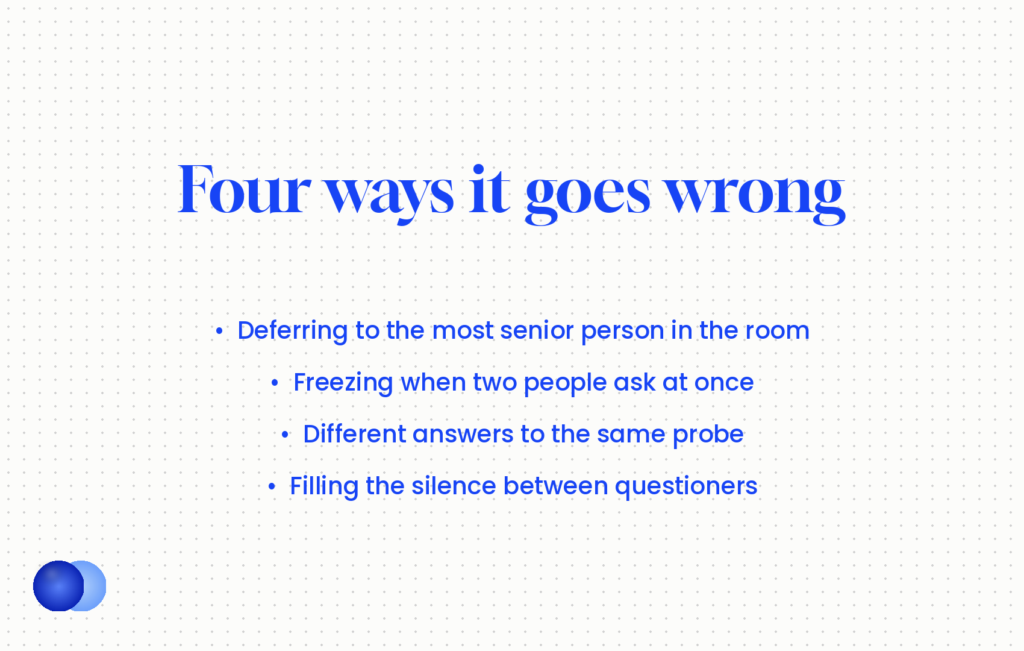
Directing everything to the most senior person, freezing when two people talk at once, giving inconsistent answers when the same topic is probed from different angles, and filling the silence during handovers between questioners.
Four things go wrong in a panel interview and almost never in a one-on-one:
Deferring to the most senior person. Natural, and noticed. The peer and the cross-functional partner both submit feedback, and both notice when you treated them as scenery.
Cross-talk. Two people ask at once. The recovery is simple and most candidates miss it: pause, then ask calmly who would like to go first. That is composure, which is precisely what the format tests.
The two that cost most
Inconsistency under multi-angle probing. Panellists frequently approach the same topic from different directions. Your answers need to agree with each other, because four people comparing notes afterwards will notice if they do not — the same consistency test second interview questions are built around.
Rambling through the handover. When one questioner finishes and the next picks up, there is an awkward beat. Do not fill it. Conclude clearly and wait. Brevity after a strong answer is a strength.
Flustered: "Oh — sorry — I can, um, do you want me to — I'll answer the first one, or actually the second, whichever—"
Composed: (brief pause) "Happy to take both. Sam, shall I start with yours?"
Nine words. The panel just watched you handle simultaneous competing demands without losing composure, which is a live demonstration of the thing they invited you here to assess.
Write the names down in the first minute. If introductions happen at the start, note each name and role on your pad. Using them correctly for an hour is worth more than any prepared answer, and misremembering one is the error people notice most.
Build private rapport with one panellist. A running joke with the peer while the others watch reads as excluding the room. Panels reward consistent engagement rather than one-on-one intimacy.
How do you prepare?
Ask the recruiter for names and roles, map each person to a likely concern, prepare one question per panellist, and rehearse with more than one observer so the sensation of being watched from several angles is not new on the day.
Preparing for a panel interview takes five steps, and candidates skip the first one:
1. Ask who will be there. Names and roles. This is a normal request and recruiters usually answer it.
2. Map each to a concern. Technical fit, collaboration, leadership, communication, culture. Knowing whether a technical specialist is in the room shapes how much depth to bring.
3. Prepare one question per person. Tailored to their role. A peer knows what the day is actually like; a skip-level knows where the team sits in the plan. Generic questions waste the one format that gives you several expert perspectives at once.
4. Build the story bank. Eight to ten real situations with numbers, structured with the STAR method so answers stay tight when a follow-up interrupts you.
5. Rehearse with observers. Being watched from several angles at once is genuinely disorienting if the first time is the real thing. A mock panel with two or three people normalises the feeling.
The panel is evaluating something extra: how you handle a multi-stakeholder setting. Which, if you think about it, is exactly what the job will require.
What about the follow-up?
Individual notes within 24 hours, each referencing something specific that person asked. Two or three personalised sentences per panellist beats any group email — and panels compare notes, so a copy-pasted message is visible immediately.
Finally, the follow-up is where panel candidates most often undo an hour of good work.
Individual, not group. One note each. If you do not have their addresses, send one to the recruiter naming each panellist and asking them to pass your thanks along.
Reference something specific. "Your question about the migration sequencing" rather than "our conversation". It proves you were listening to them rather than performing to the room.
Within 24 hours. Before the debrief calcifies into a decision. The interview follow-up email covers the structure, including how to use it to repair an answer that landed badly.
Two or three sentences each is enough. Four near-identical emails arriving in four inboxes at a company where those four people talk daily is worse than sending nothing.
Frequently asked questions
What is a panel interview?
A format where two or more interviewers assess one candidate at the same time. Three to five panellists is standard, usually the hiring manager, a peer, a cross-functional partner, and sometimes HR or a senior leader.
Is a panel interview a good sign?
Generally yes. Companies do not coordinate three to five busy calendars for a candidate they are lukewarm about, and panels often consolidate several rounds into one, meaning a decision is close.
Where should I look during a panel interview?
Start with the person who asked, sweep the others during the middle of your answer, and return to the asker for your conclusion. Do not attempt eye contact with everyone in every sentence.
How do I handle a virtual panel interview?
Camera at eye level with gallery view beneath it, camera for the opening and closing of each answer, and names used far more often — grid layouts make directional eye contact impossible.
What if two people talk at once?
Pause, then ask calmly who would like to go first. The recovery is short and it demonstrates composure under competing demands, which is what the format is designed to test.
How many people are usually on a panel?
Three to five. Two is really a joint interview, and six or more is rare outside senior hires and academic positions.
Should I send separate thank-you notes?
Yes — individual notes within 24 hours, each referencing something specific that person asked. Panels compare notes, so four near-identical emails are immediately visible.
How do I prepare differently for a panel?
Ask the recruiter for names and roles, map each person to a likely concern, prepare one question per panellist, and rehearse in front of two or three observers so the sensation is not new.



Comments