

Summary
Case interview prep for product, strategy, operations and finance roles should not copy the consulting playbook. In-house interviewers expect you to know their business, define the user before structuring, and pick the metric an owner would watch. Framework-first answers are the classic cross-over mistake. Learn the company, practise the case type your role uses, and rehearse the recommendation out loud.
Most case interview prep material was written for one audience: candidates heading into McKinsey, BCG or Bain. Interviewing for a product, strategy, operations or finance role at a company that sells something? That material teaches habits your interviewer is trying to screen out.
A consulting interviewer wants to see you crack an unfamiliar industry cold, so frameworks and speed win. An in-house interviewer wants to see whether you could own their problem on Monday, so knowledge of the business, the user and the right metric wins. StrategyCase names the failure directly: consultants who impose a framework before they have defined the user.
Below: what changes when the case comes from an employer, how the four in-house case types differ, and a two-week plan.
What is case interview prep for non-consultants actually preparing you for?
A conversation with a future colleague about a real problem the company has, or one very close to it. You still need structure and clear maths, but the interviewer also scores business knowledge, judgement about trade-offs and whether your recommendation could ship. The benchmark is an owner, not an adviser.
IGotAnOffer lists business operations and strategy teams at Google, DoorDash and Uber among the users of operations cases, alongside product operations roles. Stripe, according to Hacking the Case Interview, runs case rounds for almost every business-facing and analytical role, from product and strategy to business development, finance and data.
Those companies make one assumption consulting firms do not. RocketBlocks, which trains strategy and business operations candidates, puts it plainly: many companies expect you to know the business or industry they operate in.
So effective case interview prep for these roles has two halves, and most candidates only do the first:
The transferable half. Structure, mental maths and a top-down recommendation. Consulting books teach this well.
The company half. How the business makes money, who the user is and which metric leadership watches. That comes from the annual report, the product and the job description.
Why does the consulting playbook backfire in-house?
Because it optimises for speed and generic structure, while in-house interviewers reward problem definition and context. Opening with a memorised profitability framework signals that you have not thought about this company. Prep sites describe framework-first answers as the most common mistake when consultants cross over.
StrategyCase draws the line sharply: consulting candidates form a point of view early and test it, but in a product interview the same speed works against you.
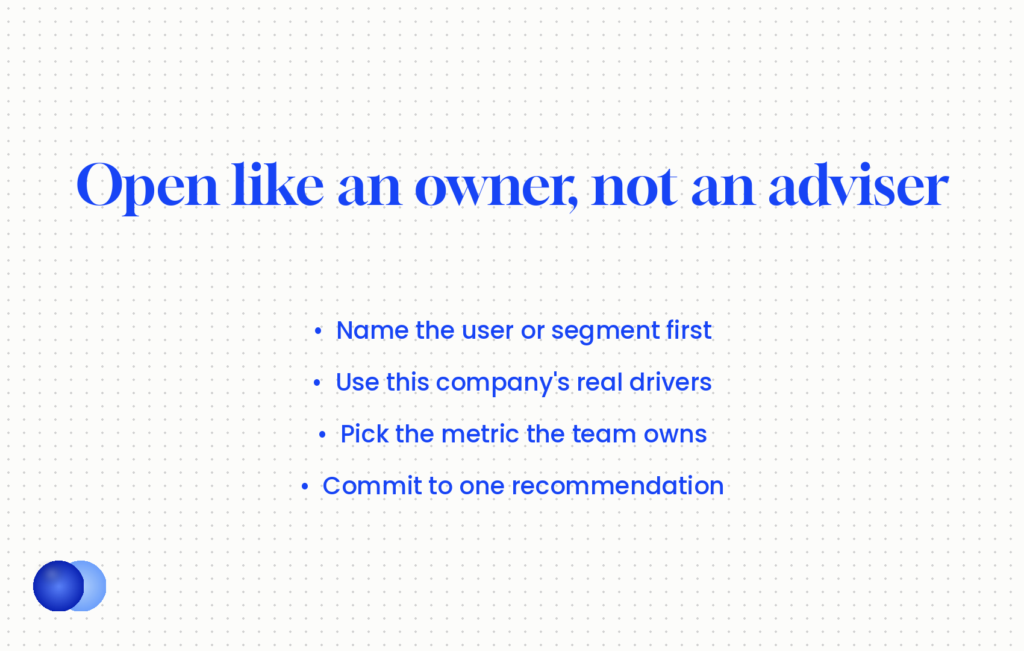
Three consulting habits cause most of the damage:
The universal framework. "Revenue minus costs" fits any company, so it tells an in-house interviewer nothing. They want their drivers: take rate for payments, utilisation for logistics, retention for subscriptions.
The detached adviser voice. Consultants recommend; owners commit. Stripe's case rounds, per Hacking the Case Interview, reward candidates who reason like the owner of a payments product rather than candidates who follow textbook frameworks.
Skipping the user. Hacking the Case Interview lists jumping to solutions and neglecting the user among the seven most common product case mistakes.
The single biggest cross-over mistake is consultants imposing a framework before they have defined the user.
Structure still matters. It should come out of the business in front of you, not sit on top of it.
How do product, strategy, operations and finance cases differ?
Product cases centre on users, prioritisation and success metrics. Strategy cases ask which direction the company should take. Operations cases diagnose inefficiency inside existing constraints and lean on KPIs. Finance cases test valuation and investment judgement, usually interviewer-led and numbers-first. Prepare for the type your role uses.
| Role family | Typical prompt | What gets weighed most | Format reported |
|---|---|---|---|
| Product | Improve or launch a feature; diagnose a metric drop | User empathy, prioritisation, metrics | Live 15–45 min, or take-home of 2–7 days |
| Strategy / BizOps | Enter a market, choose between options | Structure, business judgement, communication | Live conversation, or take-home plus presentation |
| Operations | Fix throughput, cost or delivery time | KPIs such as utilisation, downtime, unit cost | Live, data-heavy |
| Finance / investing | Value a company, buy or sell, LBO | Numerical accuracy, assumptions, judgement | Mostly interviewer-led, 20–45 min |
Sources: Hacking the Case Interview (product and Stripe guides), RocketBlocks, IGotAnOffer, PrepLounge.
What each type rewards
Product. Define the user and problem first, name a success metric, and discuss the trade-off. Hacking the Case Interview estimates 60% of companies run these live and 40% as take-homes, one prep site's estimate rather than a census.
Strategy. Frame the choice, weigh two or three real alternatives, and land on one. RocketBlocks describes these cases as more straightforward, with fewer twists than a consulting case, and more specific to the company's actual problems.
Operations. IGotAnOffer describes operations cases as more data-heavy, built around KPIs like throughput, utilisation, downtime or unit costs.
Finance. PrepLounge describes finance cases as mostly interviewer-led, covering valuation, buy-or-sell decisions, LBOs and small modelling tasks.
Are in-house cases lighter on maths or heavier?
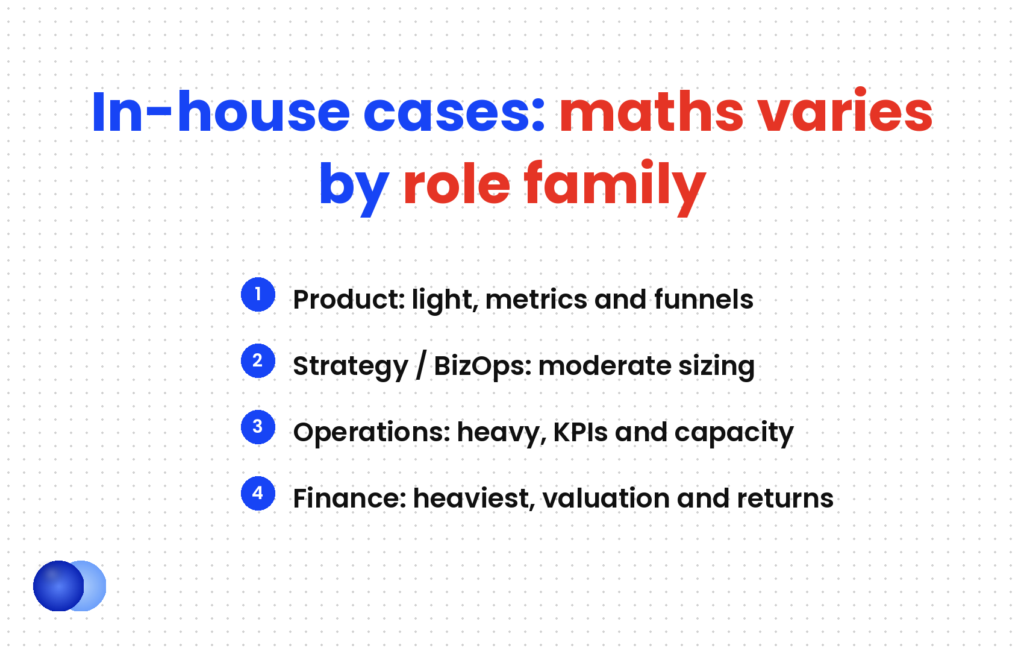
Both claims appear in prep guides, and both are true for different case types. Strategy and BizOps cases tend to use fewer charts and less calculation than consulting cases. Operations and finance cases tend to use more. Your role family, not the word "case", tells you how much maths to practise.
RocketBlocks says strategy and BizOps cases are less likely to go deep into graphs, charts and maths than consulting cases. IGotAnOffer says operations cases are more data-heavy and maths-intensive. Read side by side, they look like a contradiction.
They describe different exercises. A strategy case asks which way to go, and the maths mostly sizes the options. An operations case asks why the machine is slow, and the answer lives in the numbers. Finance goes further still, scoring arithmetic accuracy directly. So weight your practice: light for product, moderate for strategy, heavy for operations and finance.
Read the job description for the metric
Most in-house job descriptions name the metric the team owns: "improve fulfilment cost per order", "grow net revenue retention", "reduce time to resolution". That metric is the most likely centre of your case. Build a driver tree for it, three levels deep, before the interview. When the case arrives, you will already know which branch to open first.
How should you handle a take-home case?
Treat it as a work sample, not an exam. Scope the question in writing, put the recommendation on the first slide, show assumptions openly and keep the deck short. The live review that follows usually matters as much as the document, so rehearse the questions your weakest assumption invites.
Consulting guides barely cover take-homes. Hacking the Case Interview reports product take-homes of two to seven days and 10 to 15 slides, and Stripe pairing one with a live presentation for strategy and operations candidates.
Confirm scope first. One email asking who the audience is and how long you present saves hours.
Lead with the answer. Slide one carries the recommendation and its reasons.
Label every assumption. One stated openly reads as judgement; one buried in a formula reads as a mistake.
Rehearse the attack, not the talk. Pick your weakest assumption and prepare the answer to "what if that's wrong?" That exchange, not the slides, usually decides the round.
What does a two-week case interview prep plan look like?
One week on the company and the role's case type, one week of live practice with feedback. Spend the first days on how the business earns money and which metric the team owns, then run at least four timed cases out loud, ideally with someone from the target function.
Week one: the company half
Days 1–2. Read the annual report, or for a private company its pricing page and press. Write one paragraph on how it makes money.
Days 3–4. Use the product as a customer would. Note three things you would change and the metric each would move.
Days 5–7. Build a driver tree for the metric in the job description, then learn the basics of your case type from the table above.
Week two: the transferable half
Days 8–11. Run four or more timed cases out loud, matched to your role family, and record them.
Days 12–13. Practise the recommendation alone: 60 seconds, answer first, then reasons, then the main risk.
Day 14. Rest, and draft two or three questions to ask in an interview from your research.
Prompt: "Weekly active restaurants on our delivery app fell 8% last quarter. What would you look at?"
Consulting-book opening: "I'd like to use a profitability framework and look at revenue and costs, starting with price and volume."
Owner opening: "Before structuring, can I check which restaurants we mean? If the drop sits in independents rather than chains, I'd suspect our commission change or onboarding. If it's spread evenly, I'd look at demand first, since restaurants churn when orders dry up. I'd measure orders per restaurant per week alongside the active count."
Same logic, but the second starts from the user, the business model and a metric the team already tracks.
Ask one clarifying question that shows business knowledge, such as which customer segment or region the problem sits in, before you propose any structure.
Announce a named consulting framework out loud; interviewers outside consulting tend to hear it as a sign you prepared for a different job.
Where does the case sit in the wider interview loop?
Usually alongside behavioural rounds, not instead of them. Most in-house loops pair one or two case rounds with experience-based questions and a final round, so a strong case cannot rescue weak stories. Split your preparation rather than spending every hour on cases.
Stripe's process, per Hacking the Case Interview, runs four to eight weeks with rounds of 45 to 60 minutes, and the case is one round among several. Your stories still need work: see behavioral interview questions for the five to eight worth building and the STAR method interview for telling them. A late case usually means a final round interview, which compares finalists rather than testing a fixed bar.
Rezoom's interview preparation tools let you rehearse case answers and behavioural stories against the real job description.
What can case interview prep not fix?
A mismatch between you and the role. Prep improves how you show judgement, but it cannot supply domain knowledge the job genuinely needs, and interviewers in product and finance roles probe that quickly. If the case exposes a real gap, that is useful information about fit.
Case interview prep sharpens structure, maths and delivery. It does not turn a strategy generalist into a credible operations lead in two weeks, and in-house interviewers know their own business well enough to notice.
The sources here are also mostly prep companies, with an interest in making cases sound hard. Their formats and time ranges agree with one another, but they are observations, not studies; treat any percentage as an estimate.
What reliably transfers is the owner's stance: define the problem, respect the business model, name the metric, and commit to a recommendation you would be willing to run.
Frequently asked questions
Do non-consulting companies use case interviews?
Yes. Prep guides report case rounds for product, strategy, operations, finance and data roles at companies including Google, Meta, Amazon, Stripe, DoorDash and Uber.
Should I use consulting frameworks in a product or strategy case?
Use the logic, not the label. In-house interviewers expect structure to come from their business model and user, not from a memorised framework.
How long should case interview prep take for an in-house role?
About two weeks: one learning the company and its metric, one running timed cases out loud. Allow longer for finance or operations if your maths is rusty.
Are in-house case interviews easier than consulting cases?
Strategy and BizOps cases usually have fewer twists and less maths, according to RocketBlocks, but they expect company knowledge. Operations and finance cases go deeper into numbers.
What is a take-home case interview?
A written exercise, usually a short deck, followed by a live presentation. One prep site reports product take-homes running two to seven days with 10 to 15 slides.
How much maths is in a product manager case?
Usually light: metric definitions, funnel conversion and quick sizing. The weight sits on judgement about users and priorities.
What do interviewers score in a finance case?
PrepLounge lists analytical thinking, structure, numerical skills, communication and business judgement. Most run 20 to 45 minutes, interviewer-led.
Can case practice replace behavioural preparation?
No. In-house loops usually pair the case with behavioural rounds, so prepare five to eight experience stories as well.



Comments