Substance Use Counselor, Level 3.5 Residential Marisol Bettencourt
Substance Use Counselor, Level 3.5 Clinically Managed High-Intensity Residential
[email protected] | (401) 555-2106 | Providence, United States
Profile
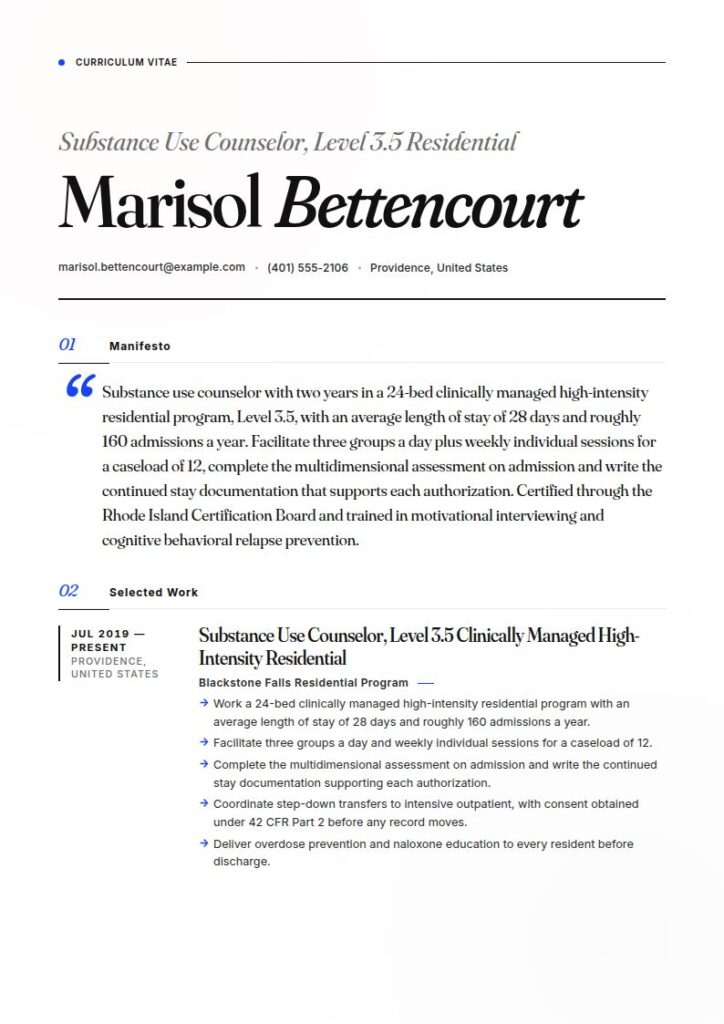
Substance use counselor with two years in a 24-bed clinically managed high-intensity residential program, Level 3.5, with an average length of stay of 28 days and roughly 160 admissions a year. Facilitate three groups a day plus weekly individual sessions for a caseload of 12, complete the multidimensional assessment on admission and write the continued stay documentation that supports each authorization. Certified through the Rhode Island Certification Board and trained in motivational interviewing and cognitive behavioral relapse prevention.
Work Experience
07/2019 - Present, Substance Use Counselor, Level 3.5 Clinically Managed High-Intensity Residential, Blackstone Falls Residential Program, Providence, United States
- Work a 24-bed clinically managed high-intensity residential program with an average length of stay of 28 days and roughly 160 admissions a year.
- Facilitate three groups a day and weekly individual sessions for a caseload of 12.
- Complete the multidimensional assessment on admission and write the continued stay documentation supporting each authorization.
- Coordinate step-down transfers to intensive outpatient, with consent obtained under 42 CFR Part 2 before any record moves.
- Deliver overdose prevention and naloxone education to every resident before discharge.
Education
09/2012 - 05/2016, Bachelor of Science, Psychology, Rhode Island College, Providence, United States
Minor in public health. Volunteer on a campus overdose prevention program.
Skills
Group facilitation, 85
Multidimensional assessment, 70
Continued stay documentation, 65
Motivational interviewing, 75
Cognitive behavioral relapse prevention, 70
Overdose prevention and naloxone training, 85
Crisis de-escalation, 75
42 CFR Part 2 consent practice, 65
Electronic health record documentation, 75
Languages
English, native
Portuguese, fluent
Spanish, intermediate
Certificates
06/2019, Certified Alcohol and Drug Counselor, Rhode Island Certification Board, an International Certification and Reciprocity Consortium member board
Entry credential for substance use counseling practice in Rhode Island.
02/2026, Overdose Prevention and Naloxone Administration, Rhode Island Department of Health
Refreshed annually and delivered to residents and staff.
Summary
A drug and alcohol counselor resume is a one to two page document that names the level of care behind every role, the program hours and caseload at that level, and the confidentiality rules the setting runs under. This guide gives you three adaptable versions, the level of care block most applicants leave out, and current Bureau of Labor Statistics pay and outlook data.
Drug and Alcohol Counselor resume examples by experience level
In short, a drug and alcohol counselor resume is a one to two page document that names the level of care each job sat at, the program hours and caseload at that level, and the confidentiality rules the setting ran under.
Without the level of care, the resume is unreadable. "Substance use counselor, three years, 40 clients" could describe a residential counselor running three groups a day in a locked-door building, a clinician seeing people nine hours a week in intensive outpatient, or a dosing-window counselor in an opioid treatment program. However, those are different jobs with different skills, and a clinical director hiring for one of them cannot tell which you did.
Resume guide for a drug and alcohol counselor resume
For that reason, this guide and the corresponding drug and alcohol counselor resume example will cover:
- First, how to write a drug and alcohol counselor resume, section by section
- Then, why the level of care belongs on every job entry
- Also, three adaptable summaries: residential, intensive outpatient and clinical supervisor
- In addition, the confidentiality rule that applies to this field and nowhere else
- Finally, what the job market looks like and what you can expect to earn
How to write a drug and alcohol counselor resume
Overall, six sections: contact header, summary, levels of care, clinical experience, education and credentials, and modalities and systems. One page for your first three years, two once you have worked at more than two levels.
Above all, the levels of care block sits directly under the summary. It is the fastest way for a clinical director to work out whether your experience matches the vacancy, and it costs five lines.
| Section | What it is answering | Where it goes |
|---|---|---|
| Levels of care | Which settings has this person actually worked in? | Directly under the summary |
| Clinical experience | What caseload, what program hours, what modality? | Reverse chronological, with numbers |
| Education and credentials | Do they hold the state credential the post requires? | After experience |
| Modalities and systems | Which evidence-based practices, which electronic record? | Grouped, near the end |
Put the level of care on the job title line
Write "Substance Use Counselor, Level 2.1 intensive outpatient" rather than "Substance Use Counselor". One phrase does three things at once: it names the setting, it fixes the program intensity, and it signals that you think in the framework the field uses for placement and utilization review.
That last part matters more than it looks. Counselors write level of care into every authorization request and every continued stay review they file. A resume that uses the same vocabulary reads as somebody who has already argued a case with a payer.
If your program did not use the framework, say the program hours instead: "nine hours of structured programming a week, three groups and one individual session."
Run the finished file through the ATS resume checker before you send it. Behavioral health providers parse applications into a system before a clinical director opens one.
Choosing the best resume format for a drug and alcohol counselor resume
Reverse chronological, because the arc through levels of care is the argument. A counselor who worked residential, then intensive outpatient, then an opioid treatment program has seen the same population at three intensities, and that sequence is worth more than any individual job on it.
In contrast, a functional format hides the sequence and, worse, hides recency. A director hiring for a residential post wants to know whether you have been in a building with beds in the last two years, because the pace and the acuity are different from outpatient and the skill decays.
Generally, two pages once you have three settings, a supervision role or a credential list that runs long.
Include your contact information
| ✅ Right | ❌ Wrong |
|---|---|
| Marisol Bettencourt, MA, LCDP | Marisol Bettencourt |
| Substance Use Counselor, Levels 2.1 and 1.0 | Compassionate addiction professional |
| Rhode Island LCDP #CDP-04128 | Licensed counselor |
| (401) 555-2106, [email protected], Providence, RI | (401) 555-2106, [email protected] |
Also, put the credential number on the page. It is verified before an offer in every licensed program, and a file that lets a human resources coordinator check it in ten seconds moves ahead of one that does not.
Make use of a summary
In practice, four sentences: your level or levels of care, years, caseload and program hours, and one retention or completion figure with a period attached.
Substance use counselor with two years in a 24-bed clinically managed high-intensity residential program, Level 3.5, with an average length of stay of 28 days and roughly 160 admissions a year. Facilitate three groups a day plus weekly individual sessions for a caseload of 12, complete the multidimensional assessment on admission and write the continued stay documentation that supports each authorization. Certified through the Rhode Island Certification Board and trained in motivational interviewing and cognitive behavioral relapse prevention.
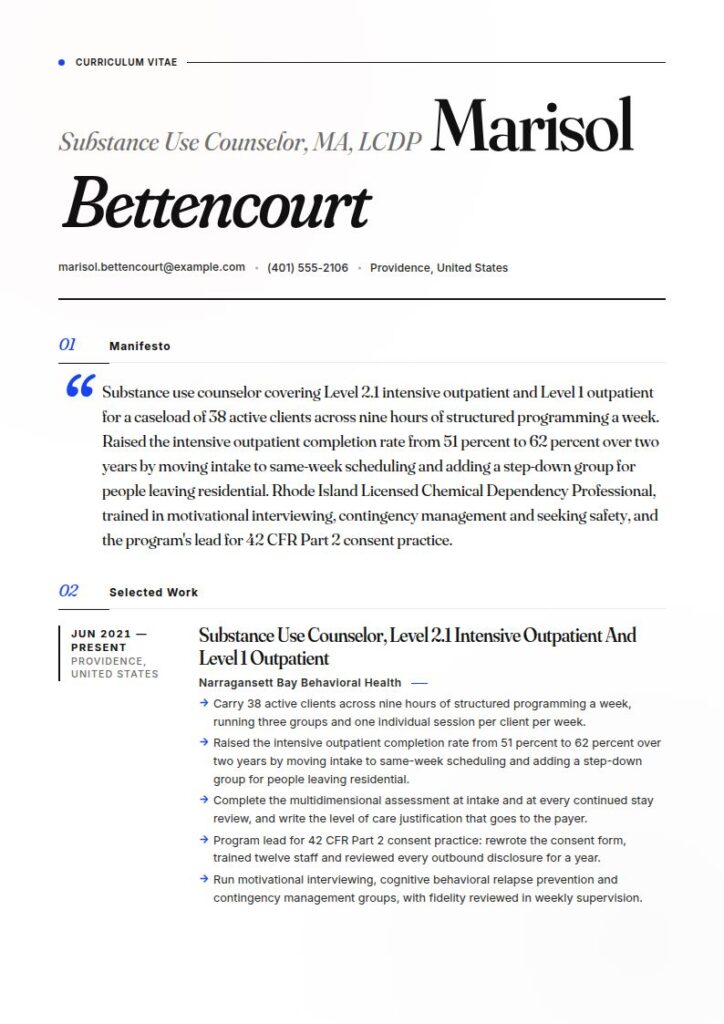
Substance use counselor covering Level 2.1 intensive outpatient and Level 1 outpatient for a caseload of 38 active clients across nine hours of structured programming a week. Raised the intensive outpatient completion rate from 51 percent to 62 percent over two years by moving intake to same-week scheduling and adding a step-down group for people leaving residential. Rhode Island Licensed Chemical Dependency Professional, trained in motivational interviewing, contingency management and seeking safety, and the program's lead for 42 CFR Part 2 consent practice.
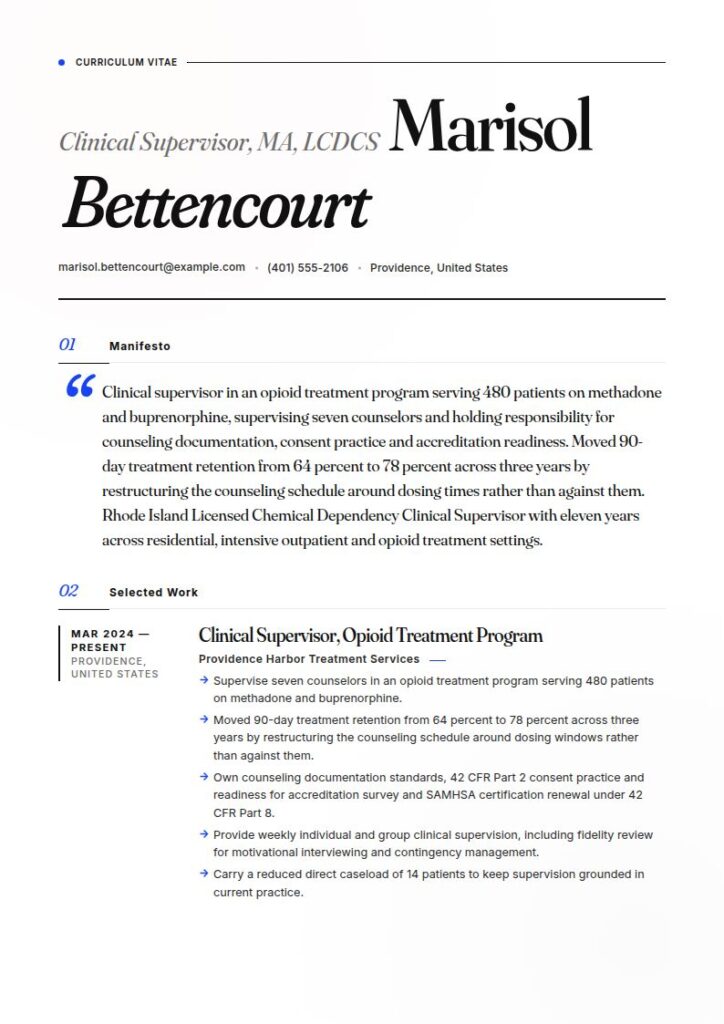
Clinical supervisor in an opioid treatment program serving 480 patients on methadone and buprenorphine, supervising seven counselors and holding responsibility for counseling documentation, consent practice and accreditation readiness. Moved 90-day treatment retention from 64 percent to 78 percent across three years by restructuring the counseling schedule around dosing times rather than against them. Rhode Island Licensed Chemical Dependency Clinical Supervisor with eleven years across residential, intensive outpatient and opioid treatment settings.
Right vs wrong: the same drug and alcohol counselor summary, twice
| ✅ Right | ❌ Wrong |
|---|---|
| Covers Level 2.1 intensive outpatient and Level 1 outpatient for 38 active clients across nine program hours a week. | Provides counseling to individuals struggling with addiction. |
| Raised the intensive outpatient completion rate from 51 percent to 62 percent over two years. | Committed to helping clients achieve lasting recovery. |
| Program lead for 42 CFR Part 2 consent practice. | Maintains confidentiality at all times. |
On the other hand, every line in the right column can be checked against something the program already reports. Meanwhile, the left column is what the other forty applicants wrote.
Outline your experience
Program, level of care, bed count or caseload, city and dates on the header line. Then three to five bullets carrying volume, modality and outcome.
| Instead of | Use |
|---|---|
| Provided individual and group counseling | Facilitated three groups a day plus weekly individual sessions in a 24-bed Level 3.5 residential program |
| Completed assessments | Completed the multidimensional assessment on admission and wrote continued stay documentation supporting each authorization |
| Helped clients stay in treatment | Moved 90-day treatment retention from 64 percent to 78 percent across three years in an opioid treatment program |
| Used evidence-based practices | Ran motivational interviewing, cognitive behavioral relapse prevention and contingency management, with fidelity checks in supervision |
| Coordinated with outside providers | Arranged 84 step-down transfers from residential to intensive outpatient, with consent obtained under 42 CFR Part 2 before any record moved |
| Documented client progress | Documented in an electronic health record against level of care criteria, with no documentation findings across two accreditation surveys |
Substance Use Counselor, Level 2.1 Intensive Outpatient and Level 1 Outpatient, Narragansett Bay Behavioral Health, Providence, RI, June 2021 to Present
Carry 38 active clients across nine hours of structured programming a week, running three groups and one individual session per client per week.
Raised the intensive outpatient completion rate from 51 percent to 62 percent over two years by moving intake to same-week scheduling and adding a step-down group for people leaving residential.
Complete the multidimensional assessment at intake and at every continued stay review, and write the level of care justification that goes to the payer.
Program lead for 42 CFR Part 2 consent practice: rewrote the consent form, trained twelve staff, and reviewed every outbound disclosure for a year.
Run motivational interviewing, cognitive behavioral relapse prevention and contingency management groups, with fidelity reviewed in weekly supervision.
Write your experience in levels of care
Even so, this is the section that makes a substance use counselor's resume legible, and most applicants skip it.
To begin with, the American Society of Addiction Medicine publishes the criteria the field uses to match a patient to a setting. The continuum runs from Level 1 outpatient, through Level 2 at intensive outpatient and higher-intensity outpatient, Level 3 residential at increasing intensity, to Level 4 medically managed inpatient. In the Fourth Edition, released digitally in October 2023 and in print in December 2023, withdrawal management was folded into the main continuum at the x.7 levels rather than kept as a separate track (American Society of Addiction Medicine, criteria pages, retrieved 17 September 2026).
In practice, placement is decided on a multidimensional assessment. The Fourth Edition names the dimensions as intoxication, withdrawal and addiction medications; biomedical conditions; psychiatric and cognitive conditions; substance use-related risks; recovery environment interactions; and a sixth dimension covering person-centered considerations (American Society of Addiction Medicine, retrieved 17 September 2026).
In fact, you use this framework every working day. Put it on the resume.
Level 3.5, clinically managed high-intensity residential: 24 beds, average length of stay 28 days, roughly 160 admissions a year, caseload of 12, three groups a day. 2019 to 2021.
Level 2.1, intensive outpatient: 38 active clients, nine structured program hours a week, three groups and one individual session per client. 2021 to present.
Level 1, outpatient continuing care: weekly and biweekly individual sessions, step-down caseload of 16 alongside the intensive outpatient panel. 2021 to present.
Opioid treatment program, Levels 1 and 1.7 equivalents: 480 patients on methadone and buprenorphine, counseling scheduled around dosing windows, seven counselors supervised. 2024 to present.
Not yet worked: Level 4 medically managed inpatient, Level 3.7 medically managed residential.
That last line is worth including. After all, saying plainly what you have not done reads as clinical honesty, and it saves a director from interviewing you for a detox post you cannot fill.
Confidentiality rules for substance use records
The rule that applies here and nowhere else. Substance use treatment records are governed by 42 CFR Part 2, which is stricter than HIPAA and unfamiliar to most people outside the field. Under Part 2, a program that holds itself out as providing and provides substance use disorder diagnosis, treatment or referral for treatment may use or disclose patient records only as the regulation permits, and those records may not otherwise be used or disclosed in civil, criminal, administrative or legislative proceedings (Electronic Code of Federal Regulations, 42 CFR 2.11 and 2.13, retrieved 17 September 2026). The restriction on using a record to initiate or substantiate criminal charges against a patient follows the record to anyone who obtains it.
Written consent under Part 2 has specific required elements, including the parties, the information to be disclosed, the purpose, the right to revoke, an expiration event and a statement about redisclosure (42 CFR 2.31). The February 2024 final rule, effective 16 April 2024 with compliance required by 16 February 2026, allows a single consent for future uses and disclosures for treatment, payment and health care operations, valid until the patient revokes it in writing (Federal Register, Confidentiality of Substance Use Disorder Patient Records final rule, retrieved 17 September 2026).
Opioid treatment program experience
If you worked in an opioid treatment program, add the other regulation that shaped your job. Under 42 CFR Part 8, an opioid treatment program must hold current SAMHSA certification and current accreditation from an approved accreditation body, and must provide adequate substance use disorder counseling and psychoeducation to each patient as clinically necessary and mutually agreed, with refusal of counseling not preventing a patient from receiving medication (Electronic Code of Federal Regulations, 42 CFR Part 8, retrieved 17 September 2026). As a result, a counselor who can write that accurately has told a hiring director a great deal in one sentence.
Put the level of care on every job title line. Give caseload and program hours together, because one without the other is meaningless. Name the modalities you deliver and say where fidelity was checked. Say which credential you hold and which state issued it. Mention consent practice and accreditation survey work, since both are scarce and checkable.
Do not write "substance abuse counselor, 40 clients" and leave the setting to the reader's imagination. Do not describe a patient, a substance, a relapse or a family situation in any form, because in this field that is a Part 2 problem as well as a taste problem. Do not claim a modality you have attended one training in and never delivered. Do not list recovery status on a resume; it is your decision to disclose and an application is the wrong place. Do not use "clean" or "dirty" about a drug screen anywhere on the page.
Build a snapshot of your key skills
Twelve to fourteen entries, grouped so the clinical work and the regulated work are both visible.
Assessment and placement: Multidimensional assessment, Level of care determination, Continued stay review, Utilization review documentation, Screening for co-occurring conditions
Modalities: Motivational interviewing, Cognitive behavioral relapse prevention, Contingency management, Seeking safety, Group facilitation, Family session facilitation
Regulatory: 42 CFR Part 2 consent and disclosure, Opioid treatment program requirements under 42 CFR Part 8, Accreditation survey readiness, Mandated reporting
Clinical operations: Medication for opioid use disorder support, Overdose prevention and naloxone training, Crisis de-escalation, Electronic health record documentation
List your education and credentials
Degree, then the state credential with its number, then national certification and training.
Master of Arts, Counseling, Rhode Island College, Providence, RI, 2021
Bachelor of Science, Psychology, Rhode Island College, Providence, RI, 2016
Licensed Chemical Dependency Professional (LCDP) #CDP-04128, Rhode Island Department of Health, current
Certified Alcohol and Drug Counselor, Rhode Island Certification Board, an International Certification and Reciprocity Consortium member board, 2019
National Certified Addiction Counselor, Level II, NAADAC, the Association for Addiction Professionals, 2023
Motivational Interviewing Network of Trainers foundational training, 32 hours, 2022. Overdose prevention and naloxone administration, 2026.
Credentialing in this field is state by state and the abbreviations differ, so write your credential exactly as your state issues it and name the issuing body. Rhode Island, for example, licenses both a Licensed Chemical Dependency Professional and a Licensed Chemical Dependency Clinical Supervisor through the Department of Health, with 6,000 hours of supervised practice behind the professional license (216-RICR-40-05-6, Rhode Island Department of State, retrieved 17 September 2026).
Choose the right layout and design
In short, single column, 11 or 12 point body type, plain headings, no photograph, no graphics. That is because behavioral health providers run standard applicant systems, and a two-column template is the most common reason a good file parses badly.
Keep the levels of care block as short labeled lines so it survives parsing, and name the file for yourself and the post: marisol-bettencourt-substance-use-counselor-resume.pdf.
Drug and alcohol counselor job market and outlook
In particular, this is one of the fastest-growing occupations in the Bureau of Labor Statistics community and social service group.
| Measure | Value |
|---|---|
| Substance abuse, behavioral disorder and mental health counselor jobs, 2025 | 533,400 |
| Projected change, 2025-35 | 18 percent |
| Projected annual openings | about 50,500 |
| Typical entry-level education | Bachelor's degree for substance abuse and behavioral disorder counselors |
| Median annual wage, May 2025 | $59,350 |
Source: U.S. Bureau of Labor Statistics, Occupational Outlook Handbook, May 2025 wage data as well as 2025 to 2035 projections, retrieved 17 September 2026.
Growth is real, and it is concentrated in outpatient
Employment of substance abuse, behavioral disorder and mental health counselors is projected to grow 18 percent from 2025 to 2035, with about 50,500 openings a year on average over the decade (BLS Occupational Outlook Handbook, 2025 to 2035 projections, retrieved 17 September 2026).
The employment is concentrated outside hospitals: offices of other health practitioners hold 20 percent of the jobs, outpatient mental health and substance abuse centers 16 percent, individual and family services 15 percent, residential mental health and substance abuse facilities 8 percent, and hospitals 7 percent (BLS Occupational Outlook Handbook, 2025 employment data).
Two things follow for a resume. Outpatient experience is the most transferable thing you can hold, because that is where most of the vacancies are. And residential experience, at 8 percent of employment, is scarce enough to be worth naming precisely: the bed count, the length of stay and the admissions volume, not just the phrase.
Where the pay sits:
| Setting | Median annual wage (May 2025) |
|---|---|
| Hospitals; state, local, and private | $63,310 |
| Outpatient mental health and substance abuse centers | $58,750 |
| Individual and family services | $58,440 |
| Offices of other health practitioners | $58,240 |
| Residential mental health and substance abuse facilities | $49,660 |
Source: U.S. Bureau of Labor Statistics, Occupational Outlook Handbook, May 2025, retrieved 17 September 2026.
What salary you can expect as a drug and alcohol counselor
The median annual wage for substance abuse, behavioral disorder and mental health counselors was $59,350 as of May 2025 (BLS Occupational Outlook Handbook, retrieved 17 September 2026). By setting, hospitals pay the highest median of the five largest settings at $63,310, while residential facilities pay the lowest at $49,660, a spread of about $13,650.
Consequently, that gap explains a career pattern the field knows well. Residential work is where many counselors accumulate hours toward a credential, and it is also the lowest-paid setting on the list. Moving to outpatient or an opioid treatment program after licensure is usually a pay rise as well as a change of pace, and the resume that makes the move easiest is the one that already reads in levels of care.
Similarly, the other lever is the credential itself. The Bureau of Labor Statistics notes that substance abuse and behavioral disorder counselors typically need at least a bachelor's degree, while counselors in private practice must be licensed, which requires a master's degree, a specified number of supervised clinical hours, an exam and continuing education (BLS Occupational Outlook Handbook, May 2025). In particular, supervisory credentials, where a state issues one, move you into a different pay band entirely.
Key takeaways for a drug and alcohol counselor resume
- First, put the level of care on every job title line; it is what makes the page readable.
- Then give caseload and weekly program hours together, never one alone.
- Next, add bed count, length of stay and admissions volume for residential roles.
- Also, name your modalities and say where fidelity was checked.
- Show you understand 42 CFR Part 2 consent, because almost no applicant does.
- Therefore, write your state credential exactly as issued, with the number and the issuing body.
- Finally, keep every patient, substance and relapse off the page entirely.
Build your drug and alcohol counselor resume in 15 minutes with our AI resume builder.
Related social work resume examples
- Counselor resume
- Juvenile counselor resume
- Case manager resume
- Social worker resume
- Social work resume
- Healthcare social worker resume
- Community outreach coordinator resume
- Geriatric social worker resume
- Youth services specialist resume
- Caregiver resume
- Life coach resume
- Nanny resume
Pair it with a matching drug and alcohol counselor cover letter.
Drug and alcohol counselor resume questions, answered
How long should a drug and alcohol counselor resume be?
One page for your first three years. Two pages once you have worked at more than two levels of care or hold a supervisory credential. The levels of care block earns the space because it replaces three paragraphs of description with five lines.
Should I put my own recovery on my resume?
No. Whether to disclose is entirely your decision and there are good reasons people do, but a resume is not the place. It is read by human resources before it reaches a clinician, it becomes part of a file you do not control, and it invites judgments about fitness that have nothing to do with your competence. If you want to signal lived experience, a peer recovery credential does it factually.
What if my program never used ASAM levels?
Give the mechanics instead. Bed count and average length of stay for residential, program hours a week and group count for outpatient, panel size and visit interval for continuing care. A director will map those onto the framework themselves. The point is to stop a reader guessing, and either route does that.
How do I show outcomes when so much is outside my control?
Use process and retention measures rather than sobriety claims. Completion rate, 30 or 90-day retention, step-down transfer volume, intake-to-first-session interval, group attendance and no-show rate are all real, all tracked, and none of them ask you to take credit for someone else's life. Give the before, the after and the period.
Do I need a master's degree to work as a drug and alcohol counselor?
Not to start. The Bureau of Labor Statistics states that substance abuse and behavioral disorder counselors typically need at least a bachelor's degree, while private practice requires licensure with a master's degree, supervised clinical hours, an exam and continuing education (BLS Occupational Outlook Handbook, May 2025, retrieved 17 September 2026). State credentialing tiers vary, so check your own board before you plan a route.