Healthcare Social Worker, Skilled Nursing Sunita Balakrishnan
Social Work Care Coordinator, Skilled Nursing
[email protected] | (216) 555-2104 | Cleveland, United States
Profile
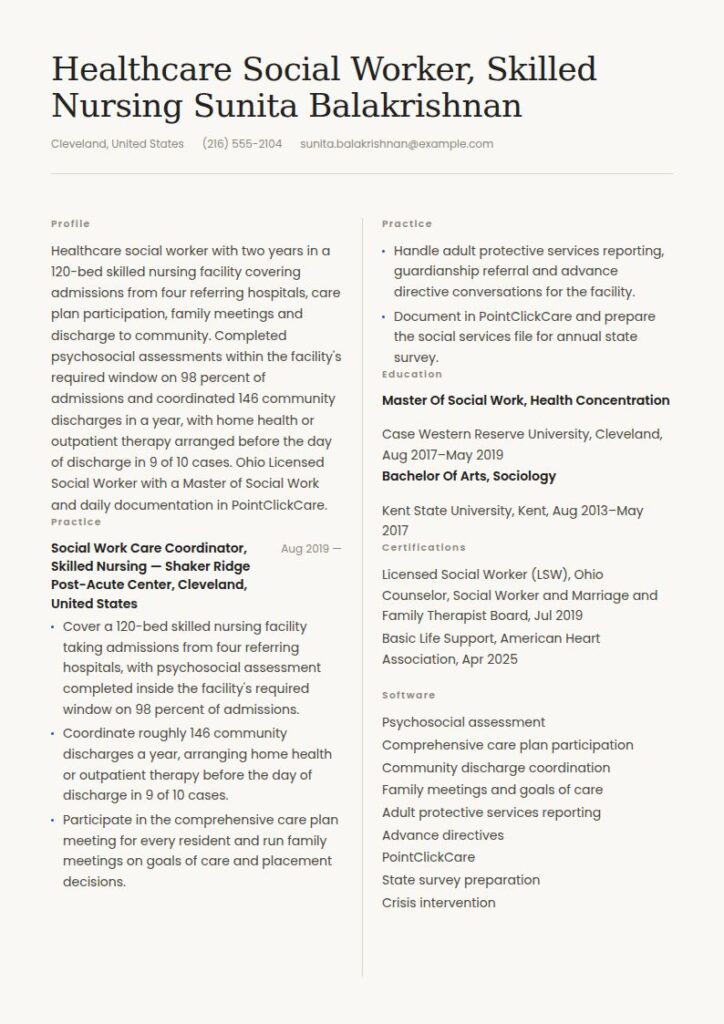
Healthcare social worker with two years in a 120-bed skilled nursing facility covering admissions from four referring hospitals, care plan participation, family meetings and discharge to community. Completed psychosocial assessments within the facility's required window on 98 percent of admissions and coordinated 146 community discharges in a year, with home health or outpatient therapy arranged before the day of discharge in 9 of 10 cases. Ohio Licensed Social Worker with a Master of Social Work and daily documentation in PointClickCare.
Work Experience
08/2019 - Present, Social Work Care Coordinator, Skilled Nursing, Shaker Ridge Post-Acute Center, Cleveland, United States
- Cover a 120-bed skilled nursing facility taking admissions from four referring hospitals, with psychosocial assessment completed inside the facility's required window on 98 percent of admissions.
- Coordinate roughly 146 community discharges a year, arranging home health or outpatient therapy before the day of discharge in 9 of 10 cases.
- Participate in the comprehensive care plan meeting for every resident and run family meetings on goals of care and placement decisions.
- Handle adult protective services reporting, guardianship referral and advance directive conversations for the facility.
- Document in PointClickCare and prepare the social services file for annual state survey.
Education
08/2017 - 05/2019, Master of Social Work, Health Concentration, Case Western Reserve University, Cleveland, United States
900-hour field placement split between an acute medical floor and a hospital outpatient clinic.
08/2013 - 05/2017, Bachelor of Arts, Sociology, Kent State University, Kent, United States
Minor in public health. Volunteer patient navigator in a free clinic.
Skills
Psychosocial assessment, 80
Comprehensive care plan participation, 75
Community discharge coordination, 80
Family meetings and goals of care, 70
Adult protective services reporting, 75
Advance directives, 70
PointClickCare, 85
State survey preparation, 65
Crisis intervention, 70
Languages
English, native
Tamil, fluent
Hindi, intermediate
Certificates
07/2019, Licensed Social Worker (LSW), Ohio Counselor, Social Worker and Marriage and Family Therapist Board, S.1904822
Ohio social work license held from graduation, superseded by independent licensure in 2022.
04/2025, Basic Life Support, American Heart Association
Valid through 2027.
Summary
A healthcare social worker resume is a one to two page document describing the discharge planning record you produce: the evaluations, the post-acute choice list, the placements by setting and the delay days you removed. This guide gives you three adaptable versions, the discharge block most applicants leave out, and current Bureau of Labor Statistics pay and outlook data.
Healthcare Social Worker resume examples by experience level
A healthcare social worker resume is a one to two page document that describes the discharge planning record you produce: how many evaluations you complete, how you build the post-acute choice list, which settings your patients go to, and what happens to them afterwards.
Most applicants write a caseload number instead, and stop there. Fifteen patients tells a hospital nothing. What a care management director needs to know is whether you can complete a discharge planning evaluation that holds up, present a compliant choice list, and get a complex patient out of a bed that the emergency department is waiting on.
Resume guide for a healthcare social worker resume
For that reason, this guide and the corresponding healthcare social worker resume example will cover:
- First, how to write a healthcare social worker resume, section by section
- Then, why the discharge planning record beats the caseload number
- Also, three adaptable summaries: post-acute, acute care and lead
- In addition, what the Medicare discharge planning rule expects you to document
- Finally, what the job market looks like and what you can expect to earn
How to write a healthcare social worker resume
Overall, six sections: contact header, summary, discharge planning and transitions record, clinical experience, education and licensure, and systems and skills. One page for your first three or four years, two once you have worked across more than one level of care.
Above all, the transitions record goes directly under the summary. It is the section that makes you comparable to every other applicant, because it uses numbers a hospital already tracks.
| Section | What it is answering | Where it goes |
|---|---|---|
| Discharge planning and transitions | Can this person move a complex patient safely and quickly? | Directly under the summary |
| Clinical experience | What unit, what census, what acuity, what population? | Reverse chronological, with numbers |
| Education and licensure | Do they hold the license the post requires? | After experience |
| Systems | Which electronic record and which referral platform? | Grouped, near the end |
Give the unit, the census and the daily volume on one line
"Healthcare social worker, 34-bed medical and surgical unit, average daily census 28, 10 to 14 discharge planning evaluations a day" is a sentence a care management director can convert straight into staffing.
Three numbers do that work: the size of the unit, how full it usually runs, and how much assessment you actually turn out in a shift.
Add the acuity signal if you have it. A unit with a high proportion of patients who have no insurance, no housing or no willing receiving facility is a different job from one that discharges mostly to home with family, and saying so protects you from being compared against the wrong benchmark.
Run the finished file through the ATS resume checker before you apply. Hospital systems parse every application into a structured record before a recruiter opens it.
Choosing the best resume format for a healthcare social worker resume
Reverse chronological. Hospital care management is read as a progression through levels of care, and the sequence is the point: a candidate who has worked in a skilled nursing facility, then an acute medical floor, then transitions of care has seen the same patient from three sides.
Functional formats break that. They also hide the thing a director checks first, which is whether your most recent role was inpatient, outpatient or post-acute, because those are three different skill sets sharing one job title.
However, two pages is normal once you have two settings and a certification list. Keep the second page substantive.
Include your contact information
| ✅ Right | ❌ Wrong |
|---|---|
| Sunita Balakrishnan, MSW, LISW | Sunita Balakrishnan |
| Healthcare Social Worker, Acute Medical and Step-Down | Healthcare professional and advocate |
| Ohio LISW #I.2207431, ACM-SW | Licensed social worker |
| (216) 555-2104, [email protected], Cleveland, OH | (216) 555-2104, [email protected] |
Also, put the license number on the page. Hospital credentialing verifies it before an offer goes out, and a file that lets them do it immediately moves faster than one that does not.
Make use of a summary
In practice, four sentences: your setting and level of care, years, the volume you carry, and one transitions number with a period attached.
Healthcare social worker with two years in a 120-bed skilled nursing facility covering admissions from four referring hospitals, care plan participation, family meetings and discharge to community. Completed psychosocial assessments within the facility's required window on 98 percent of admissions and coordinated 146 community discharges in a year, with home health or outpatient therapy arranged before the day of discharge in 9 of 10 cases. Ohio Licensed Social Worker with a Master of Social Work and daily documentation in PointClickCare.
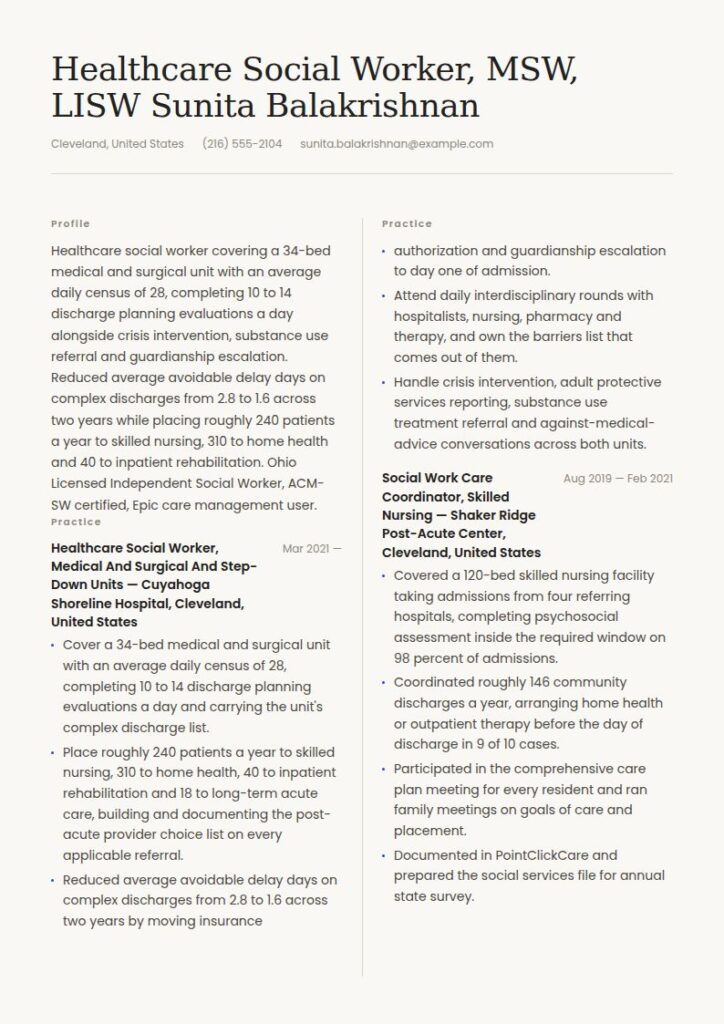
Healthcare social worker covering a 34-bed medical and surgical unit with an average daily census of 28, completing 10 to 14 discharge planning evaluations a day alongside crisis intervention, substance use referral and guardianship escalation. Reduced average avoidable delay days on complex discharges from 2.8 to 1.6 across two years while placing roughly 240 patients a year to skilled nursing, 310 to home health and 40 to inpatient rehabilitation. Ohio Licensed Independent Social Worker, ACM-SW certified, Epic care management user.
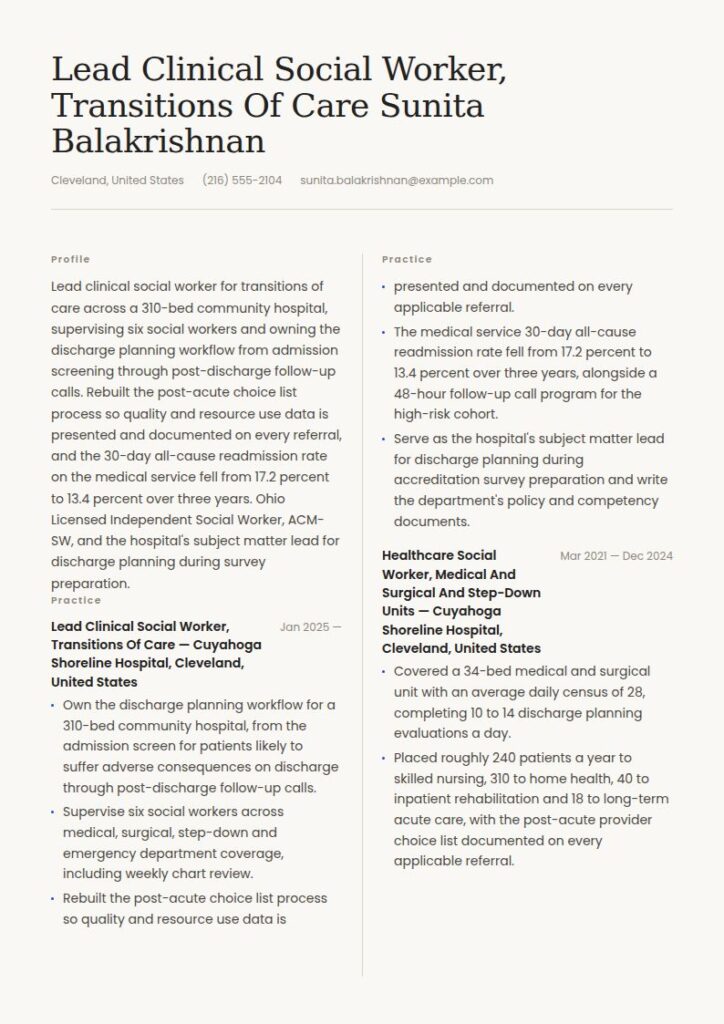
Lead clinical social worker for transitions of care across a 310-bed community hospital, supervising six social workers and owning the discharge planning workflow from admission screening through post-discharge follow-up calls. Rebuilt the post-acute choice list process so quality and resource use data is presented and documented on every referral, and the 30-day all-cause readmission rate on the medical service fell from 17.2 percent to 13.4 percent over three years. Ohio Licensed Independent Social Worker, ACM-SW, and the hospital's subject matter lead for discharge planning during survey preparation.
Right vs wrong: the same healthcare social worker summary, twice
| ✅ Right | ❌ Wrong |
|---|---|
| Covers a 34-bed medical and surgical unit with an average daily census of 28. | Provides support to patients and families in a hospital setting. |
| Completes 10 to 14 discharge planning evaluations a day. | Manages a busy caseload and prioritizes effectively. |
| Reduced average avoidable delay days on complex discharges from 2.8 to 1.6 across two years. | Works to ensure smooth and timely patient transitions. |
On the other hand, the right column is made of numbers a hospital already reports. Meanwhile, the left column asks a director to imagine you on their floor, and directors hiring against a vacancy do not have the time.
Outline your experience
Next, put the facility, unit, level of care, city and dates on the header line. Then three to five bullets, each carrying a volume, a rate or a named part of the discharge planning process.
| Instead of | Use |
|---|---|
| Provided psychosocial support to patients and families | Completed 10 to 14 discharge planning evaluations a day on a 34-bed medical and surgical unit |
| Coordinated discharges | Placed roughly 240 patients a year to skilled nursing, 310 to home health, 40 to inpatient rehabilitation and 18 to long-term acute care |
| Worked with the interdisciplinary team | Present every weekday in interdisciplinary rounds with hospitalists, nursing, pharmacy and therapy, carrying the barriers list |
| Helped reduce length of stay | Reduced average avoidable delay days on complex discharges from 2.8 to 1.6 across two years |
| Made referrals to community resources | Built and documented the post-acute provider choice list on every applicable referral, with quality and resource use data shared |
| Followed up with patients after discharge | Ran 48-hour post-discharge calls on high-risk patients; the medical service readmission rate moved from 17.2 percent to 13.4 percent |
Healthcare Social Worker, Medical and Surgical and Step-Down Units, Cuyahoga Shoreline Hospital, Cleveland, OH, March 2021 to Present
Cover a 34-bed medical and surgical unit with an average daily census of 28, completing 10 to 14 discharge planning evaluations a day and carrying the unit's complex discharge list.
Place roughly 240 patients a year to skilled nursing, 310 to home health, 40 to inpatient rehabilitation and 18 to long-term acute care, building and documenting the post-acute provider choice list on every applicable referral.
Reduced average avoidable delay days on complex discharges from 2.8 to 1.6 across two years by moving insurance authorization and guardianship escalation to day one of admission.
Attend daily interdisciplinary rounds with hospitalists, nursing, pharmacy and therapy, and own the barriers list that comes out of them.
Handle crisis intervention, adult protective services reporting, substance use treatment referral and against-medical-advice conversations across both units.
Write the discharge planning record, not the caseload number
In fact, here is the thing that separates this resume from every other social work resume in the stack. In a hospital or post-acute setting, therefore, the work is not general support. It is a regulated process with a named federal rule behind it, and your resume should read as though you know that.
Under the Medicare condition of participation for discharge planning at 42 CFR 482.43, a hospital must have an effective discharge planning process that focuses on the patient's goals and treatment preferences, must identify at an early stage of hospitalization those patients likely to suffer adverse health consequences on discharge, and must assist patients, their families or the patient's representative in selecting a post-acute care provider by using and sharing data that includes home health agency, skilled nursing facility, inpatient rehabilitation facility and long-term care hospital data on quality measures and resource use measures. The hospital must include a list of Medicare-participating providers in the discharge plan, must inform patients of their freedom to choose among participating providers, and must not specify or otherwise limit the qualified providers available to them (Electronic Code of Federal Regulations, 42 CFR 482.43, retrieved 17 September 2026).
What the Medicare discharge rule asks you to show
That requirement to present quality and resource use data comes from the Improving Medicare Post-Acute Care Transformation Act of 2014, which requires standardized assessment data and quality measures across long-term care hospitals, inpatient rehabilitation facilities, skilled nursing facilities and home health agencies, in domains covering functional status, cognitive status, skin integrity, medication reconciliation, falls and the transfer of health information at transitions, together with resource use measures including Medicare spending per beneficiary (Centers for Medicare and Medicaid Services, IMPACT Act data standardization page, retrieved 17 September 2026).
Read that rule as a job description, because that is what it is. As a result, every clause in it is a line you can write.
Discharge planning evaluations: 10 to 14 completed a day on a 34-bed unit, average daily census 28. Early identification screen run on every admission within 24 hours.
Post-acute placements, most recent full year: 240 skilled nursing, 310 home health, 40 inpatient rehabilitation, 18 long-term acute care, 96 discharges to home with no services.
Patient choice: provider list presented and documented on every applicable referral, with quality and resource use data shared and the discussion recorded in the chart.
Avoidable delay days: average on complex discharges reduced from 2.8 to 1.6 over two years.
Readmissions: 48-hour follow-up calls on the high-risk cohort; the medical service 30-day all-cause readmission rate moved from 17.2 percent to 13.4 percent over three years.
Systems: Epic care management and discharge planning modules, naviHealth and Ensocare referral platforms, the regional health information exchange for outside records.
Three things make that block work. First, it uses the rule's own vocabulary, so a director reading it knows you have written a compliant record rather than a summary note. It gives placements by setting rather than a single discharge count, which shows the range of complexity you handle. And it names the delay days, which is the number hospital finance and care management argue about every week and the one almost nobody puts on a resume.
Healthcare social worker records outside hospitals
If your setting is not a hospital, the same logic still applies. In a skilled nursing facility, for example, write admission assessment turnaround, care plan participation and community discharges. Similarly, in home health, write start of care timeliness, hospitalization rate within the episode and the transfer of health information. Likewise, in dialysis, outpatient oncology or a specialty clinic, write the assessment you complete, the interval you complete it on and the coverage or transport problem you solved.
Give the unit size, the census and your daily evaluation volume. Break placements out by post-acute setting. Use the rule's vocabulary: discharge planning evaluation, post-acute provider list, patient choice, quality and resource use data. Say which electronic record and referral platform you use by product name. Name the delay day or throughput measure your department tracks, with a before and an after.
Do not write a caseload number on its own, since it means nothing without acuity and setting. Do not describe a patient, a family, a diagnosis or a room number in any form. Do not claim to have reduced length of stay for the hospital; claim the part you controlled, which is delay days on discharges you handled. Do not leave your license type off the header. Do not list every community agency you have ever called.
Build a snapshot of your key skills
Twelve to fourteen entries, grouped so the regulated work and the clinical work are both visible.
Transitions of care: Discharge planning evaluation, Post-acute provider choice list, Insurance authorization and benefits verification, Avoidable delay tracking, Post-discharge follow-up calls, Interdisciplinary rounds
Clinical: Crisis intervention, Psychosocial assessment, Motivational interviewing, Grief and end-of-life conversations, Substance use treatment referral, Against-medical-advice discussions
Regulatory and safeguarding: 42 CFR 482.43 discharge planning documentation, Adult protective services reporting, Guardianship referral, Advance directives, Survey readiness
Systems: Epic care management, PointClickCare, naviHealth, Ensocare, Regional health information exchange
List your education and certifications
Degree first, then license with its number, then healthcare-specific certifications.
Master of Social Work, Case Western Reserve University, Cleveland, OH, 2019. Health concentration, 900-hour field placement across an acute medical floor and a hospital outpatient clinic.
Bachelor of Arts, Sociology, Kent State University, Kent, OH, 2017
Licensed Independent Social Worker (LISW) #I.2207431, Ohio Counselor, Social Worker and Marriage and Family Therapist Board, current
Accredited Case Manager, Social Work (ACM-SW), National Board for Case Management, American Case Management Association, 2023
Basic Life Support, American Heart Association, valid through 2027
Therefore, keep licensure factual here and let the transitions record carry the page. After all, the license is a gate; it is not the argument.
Choose the right layout and design
In short, single column, 11 or 12 point body type, plain headings, no photograph, no icons, no skill bars. That is because hospital applicant systems are among the strictest parsers in any sector, and a two-column template arrives as interleaved nonsense often enough to lose you the screen.
Put the transitions record in short labeled lines rather than a table, so it survives parsing intact. Name the file for yourself and the post: sunita-balakrishnan-healthcare-social-worker-resume.pdf.
Healthcare social worker job market and outlook
Healthcare social workers are counted within the Bureau of Labor Statistics social workers profile, and they sit above the overall median for the profession.
| Measure | Value |
|---|---|
| Social worker jobs, 2025 | 816,100 |
| Projected change, 2025-35 | 6 percent |
| Projected annual openings | about 69,100 |
| Typical entry-level education | Bachelor's or master's degree in social work |
| Median annual wage, healthcare social workers, May 2025 | $67,880 |
| Median annual wage, all social workers, May 2025 | $61,780 |
Source: U.S. Bureau of Labor Statistics, Occupational Outlook Handbook, May 2025 wage data as well as 2025 to 2035 projections, retrieved 17 September 2026.
The setting is worth more than the specialty title
Across all social workers, hospitals pay a median of $77,440, educational services $68,850, state and local government excluding education and hospitals $65,100, ambulatory healthcare services $63,710, and individual and family services $51,980 (BLS Occupational Outlook Handbook, May 2025, retrieved 17 September 2026).
That is a spread of more than $25,000 between the top and bottom of the list, and it is driven by setting rather than by job title. Hospitals employ 10 percent of social workers and ambulatory healthcare services 15 percent (BLS, 2025 employment data).
For a healthcare social worker deciding what to put at the top of the page, the practical reading is that the acute inpatient record is the most portable and the best paid thing you own. Write it in the detail the setting deserves, and write the post-acute and outpatient work underneath it rather than instead of it.
Where social workers work:
| Setting | Share of employment (2025) | Median annual wage (May 2025) |
|---|---|---|
| State and local government, excluding education and hospitals | 27% | $65,100 |
| Individual and family services | 17% | $51,980 |
| Ambulatory healthcare services | 15% | $63,710 |
| Hospitals; state, local, and private | 10% | $77,440 |
| Educational services; state, local, and private | 10% | $68,850 |
Source: U.S. Bureau of Labor Statistics, Occupational Outlook Handbook, May 2025, retrieved 17 September 2026.
What salary you can expect as a healthcare social worker
Healthcare social workers had a median annual wage of $67,880 as of May 2025, against $61,780 for social workers overall and $60,280 for mental health and substance abuse social workers (BLS Occupational Outlook Handbook, retrieved 17 September 2026). Indeed, the premium is real, and it is one reason the acute care record belongs high on the page.
Setting moves the number further. For example, hospitals pay social workers a median of $77,440 compared with $63,710 in ambulatory healthcare services, a difference of about $13,700 (BLS, May 2025).
In other words, what a resume can influence is the band you are slotted into at offer. Three things show up repeatedly in healthcare social work postings and pay bands: the independent clinical license, a case management certification such as ACM-SW, and demonstrated ownership of a throughput or readmission measure. In contrast, the third is the one most candidates have and almost nobody writes down.
Key takeaways for a healthcare social worker resume
- First, lead with the discharge planning record, not the caseload number.
- Then give unit size, average daily census and daily evaluation volume together.
- Next, break placements out by post-acute setting, not as one discharge count.
- Also, use the discharge planning rule's own vocabulary, including patient choice.
- Name the delay day or readmission measure you moved, with before and after.
- In addition, put the license type and number in the header, where credentialing can see it.
- Finally, keep every patient, family and diagnosis entirely off the page.
Build your healthcare social worker resume in 15 minutes with our AI resume builder.
Related social work resume examples
- Social worker resume
- Case manager resume
- Geriatric social worker resume
- Counselor resume
- Social work resume
- Community outreach coordinator resume
- Caregiver resume
- Drug and alcohol counselor resume
- Juvenile counselor resume
- Youth services specialist resume
- Life coach resume
- Child care resume
Pair it with a matching healthcare social worker cover letter.
Healthcare social worker resume questions, answered
How long should a healthcare social worker resume be?
One page for your first three or four years. Two pages once you have worked across more than one level of care, because the transitions record and the certification list both need room. Keep the second page made of numbers.
What do I put on a healthcare social worker resume with no hospital experience?
Write your field placement as a job: the facility, the unit, the population, the hours, your supervisor's discipline, and what you actually completed. Then anything adjacent that shows you can work inside a regulated process, such as skilled nursing admissions, home health intake, insurance authorization or a clinic front desk. A new graduate who understands what a discharge planning evaluation is for is ahead of most of the pile.
Should I put readmission rates on my resume if I did not own the measure?
Only with the honest framing. Say what you contributed, such as running 48-hour follow-up calls on the high-risk cohort, and then give the department's movement over a stated period. Claiming a hospital-level metric as a personal achievement is the fastest way to lose credibility with a care management director who knows exactly how many people touch that number.
Which certification is worth having in healthcare social work?
The two that appear most often in postings are the Accredited Case Manager, Social Work (ACM-SW) from the National Board for Case Management at the American Case Management Association, and the Certified Case Manager from the Commission for Case Manager Certification. Both are recognized across acute care. Your independent clinical license matters more than either, but a certification is usually what breaks a tie between two licensed applicants.
Can I describe a difficult case to show my clinical judgment?
No. Not a diagnosis, not an age with a circumstance, not a family situation, however anonymized it feels. Describe the process instead: the escalation path you used, the interval you worked to, the people you convened. A hospital reading a case detail on a resume has learned something about your documentation habits, and it is not good.