Coach for First-Time Managers Emmett Baldacci ICF ACC
Coach
[email protected] | (207) 555-2114 | Portland, United States
Profile
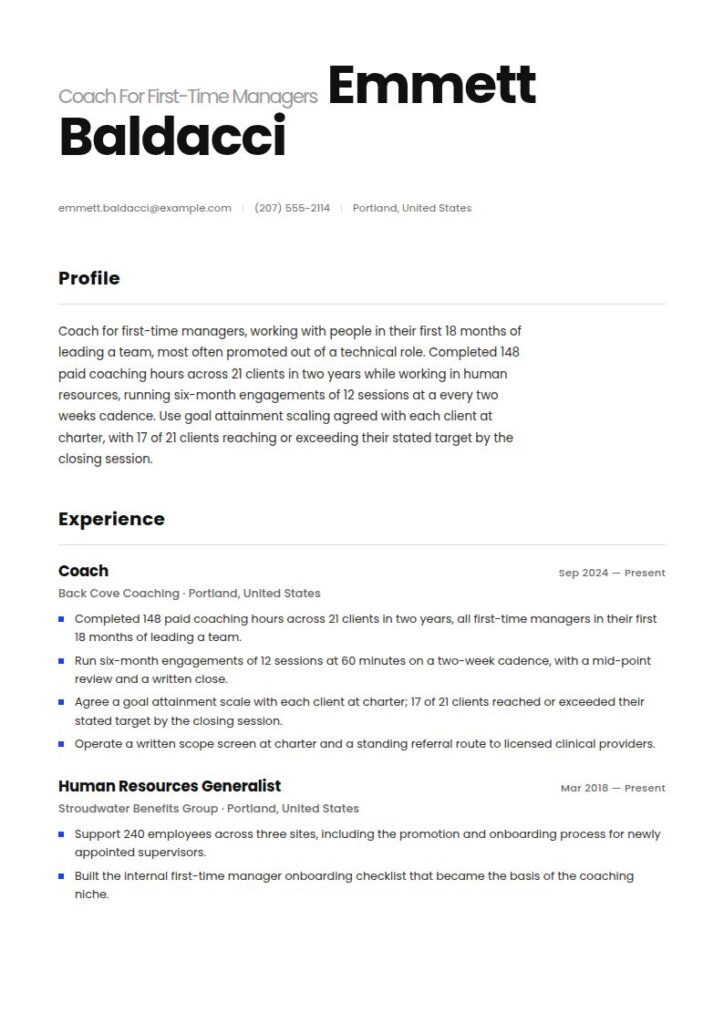
Coach for first-time managers, working with people in their first 18 months of leading a team, most often promoted out of a technical role. Completed 148 paid coaching hours across 21 clients in two years while working in human resources, running six-month engagements of 12 sessions at a every two weeks cadence. Use goal attainment scaling agreed with each client at charter, with 17 of 21 clients reaching or exceeding their stated target by the closing session.
Work Experience
09/2024 - Present, Coach, Back Cove Coaching, Portland, United States
- Completed 148 paid coaching hours across 21 clients in two years, all first-time managers in their first 18 months of leading a team.
- Run six-month engagements of 12 sessions at 60 minutes on a two-week cadence, with a mid-point review and a written close.
- Agree a goal attainment scale with each client at charter; 17 of 21 clients reached or exceeded their stated target by the closing session.
- Operate a written scope screen at charter and a standing referral route to licensed clinical providers.
03/2018 - Present, Human Resources Generalist, Stroudwater Benefits Group, Portland, United States
- Support 240 employees across three sites, including the promotion and onboarding process for newly appointed supervisors.
- Built the internal first-time manager onboarding checklist that became the basis of the coaching niche.
Education
09/2007 - 05/2011, Bachelor of Arts, Psychology, University of Southern Maine, Portland, United States
Coursework in developmental and organizational psychology. Not a clinical degree and not a license; listed because it explains the shape of the practice.
Skills
Three-way chartering, 70
Goal attainment scaling, 70
Contracting and confidentiality boundaries, 75
Referral and scope screening, 80
First-time manager transitions, 80
Delegation and feedback, 75
Engagement measurement and reporting, 65
Languages
English, native
French, conversational
Certificates
04/2025, Associate Certified Coach (ACC), International Coaching Federation
Practice governed by the ICF Code of Ethics. A credential, not a license: coaching is not a licensed occupation in the United States.
06/2024, ICF-accredited coach training program, International Coaching Federation accredited provider
Completed with mentor coaching hours and a recorded performance evaluation.
12/2016, SHRM Certified Professional (SHRM-CP), Society for Human Resource Management
Held through the human resources career that precedes the coaching practice.
Summary
Coaching is not a licensed occupation in the United States, so nothing external vouches for a life coach resume. The page has to carry its own evidence: a named niche, an engagement model with length and cadence, outcomes with the measurement named, and an explicit boundary against psychotherapy. This guide gives you three adaptable versions and the market data that does exist.
Life Coach resume examples by experience level
In short, a life coach resume is a one to two page document that has to do something no other resume in this category has to do: vouch for itself.
Nursing has a license number. Social work has a board. Teaching has an endorsement. Coaching has none of that. Anyone in the United States may call themselves a life coach tomorrow, so every claim on your page is read by a buyer who knows no regulator checked it first. That is not a reason to write louder. Instead, it is a reason to write in facts that can be checked: who you coach, in what structure, over what period, against what measurement, and where you stop and refer out.
Resume guide for a life coach resume
For that reason, this guide and the corresponding life coach resume example will cover:
- First, how to write a life coach resume, section by section
- Then, why an unlicensed occupation needs a different kind of evidence
- Also, three adaptable summaries: new coach, full practice and practice lead
- In addition, how to write the scope boundary against psychotherapy
- Finally, what the job market looks like and what you can expect to earn
How to write a life coach resume
Overall, six sections: contact header, summary, coaching engagements, an evidence block, education and credentials, and skills. Generally, one page for a new practice, two once you hold organizational contracts and several years of engagement data.
In contrast, the structural difference from a licensed occupation is where the weight sits. A licensed resume front-loads the license, because it is the gate. An unlicensed resume front-loads the niche and the engagement model, because those are what let a reader tell you apart from the next file.
| Section | What it is answering | Where it goes |
|---|---|---|
| Niche | Who exactly do you coach, and what problem do they arrive with? | First line of the summary |
| Engagement model | What does buying you actually look like: length, cadence, format? | Its own block, with numbers |
| Outcomes | What changed, measured how, over what period? | Inside each engagement entry |
| Scope boundary | Where do you stop, and what do you do instead? | One line, near the credentials |
Write the engagement model as a specification, not a promise
The ICF Code of Ethics, in the version effective 1 April 2025, requires a coach to communicate before coaching begins with clients and sponsors to explain the nature of coaching and to co-create an agreement covering roles, responsibilities, confidentiality, financial arrangements and other aspects of the engagement (Standard 1.1, International Coaching Federation, coachingfederation.org, retrieved 17 September 2026).
The contents of that agreement are the most useful thing you can put on a resume. Write the structure you actually sell: "Six-month engagements, 12 sessions at 60 minutes on a two-week cadence, chartered with the sponsor and the client together, with a mid-point review and a written close." A buyer reading that knows what they would be commissioning. A buyer reading "helps clients unlock their potential" knows nothing at all.
Run the finished file through the ATS resume checker first. Coaching roles inside organizations are posted through the same applicant systems as every other job.
Choosing the best resume format for a life coach resume
Reverse chronological, single column. One page while your practice is young, two once you have multi-year contracts or a team.
Coaches reach for functional and portfolio-style layouts more often than almost any other occupation on this site, and it is usually a mistake. A functional layout groups skills and hides dates, which in an unlicensed field reads like exactly what a cautious buyer already fears: a page of claims with nothing anchoring them in time.
Most coaches came from another career. Keep the chronology, and let that career be an asset rather than an apology. Ten years managing a contact center is why you can coach first-time managers, and a reader will follow the line if you draw it in one sentence.
Include your contact information
| ✅ Right | ❌ Wrong |
|---|---|
| Emmett Baldacci | Emmett Baldacci |
| Coach for first-time managers, ICF PCC | Certified Life Coach and Transformational Guide |
| Six-month engagements, sponsor-chartered, 60 coaching hours a quarter | Helping people live their best lives |
| (207) 555-2114, [email protected], Portland, ME | (207) 555-2114, [email protected] |
In effect, the second line is the page in miniature: a niche, a credential, a unit of work. Everything after it is proof.
Make use of a summary
In practice, three sentences: who you coach and what they arrive with, the engagement structure and the volume behind it, and one outcome with the measurement named.
Coach for first-time managers, working with people in their first 18 months of leading a team, most often promoted out of a technical role. Completed 148 paid coaching hours across 21 clients in two years while working in human resources, running six-month engagements of 12 sessions at a every two weeks cadence. Use goal attainment scaling agreed with each client at charter, with 17 of 21 clients reaching or exceeding their stated target by the closing session.
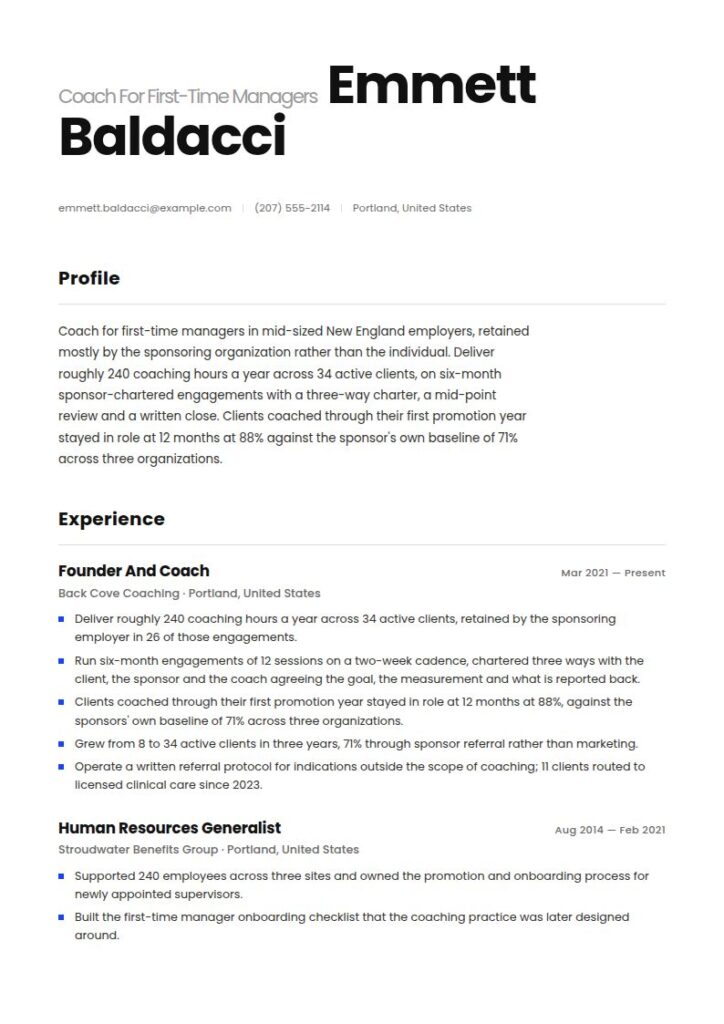
Coach for first-time managers in mid-sized New England employers, retained mostly by the sponsoring organization rather than the individual. Deliver roughly 240 coaching hours a year across 34 active clients, on six-month sponsor-chartered engagements with a three-way charter, a mid-point review and a written close. Clients coached through their first promotion year stayed in role at 12 months at 88% against the sponsor's own baseline of 71% across three organizations.
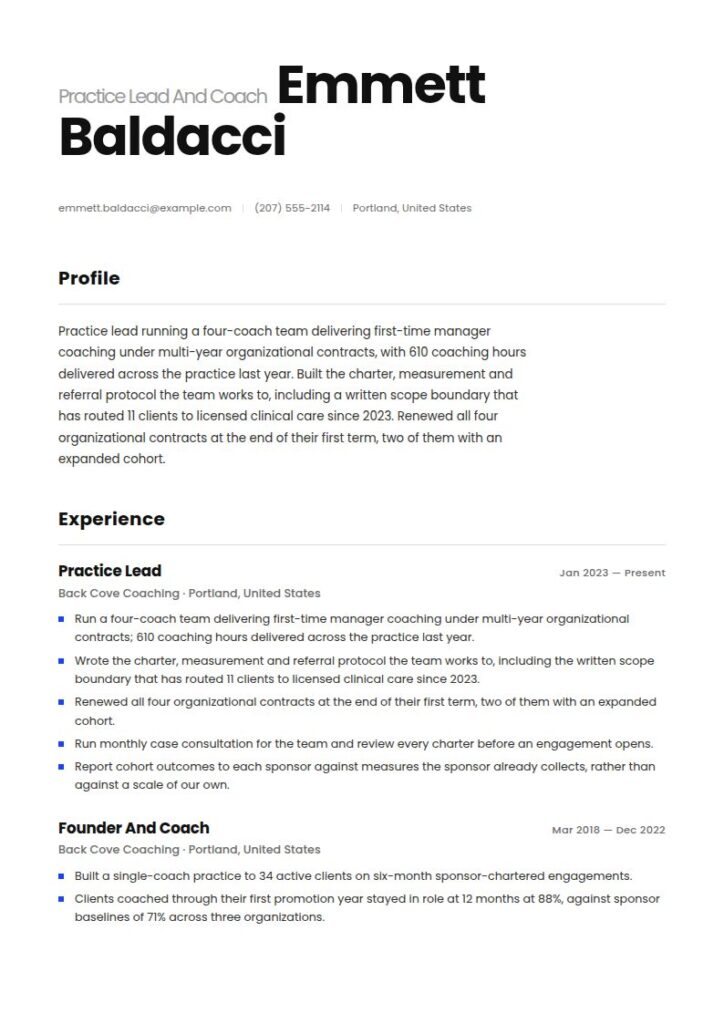
Practice lead running a four-coach team delivering first-time manager coaching under multi-year organizational contracts, with 610 coaching hours delivered across the practice last year. Built the charter, measurement and referral protocol the team works to, including a written scope boundary that has routed 11 clients to licensed clinical care since 2023. Renewed all four organizational contracts at the end of their first term, two of them with an expanded cohort.
Right vs wrong: the same life coach summary, twice
| ✅ Right | ❌ Wrong |
|---|---|
| Coach for first-time managers in their first 18 months of leading a team. | Certified life coach passionate about helping people transform. |
| Six-month engagements, 12 sessions, every two weeks, chartered with the sponsor. | Offers personalized coaching packages tailored to each client. |
| Clients stayed in role at 12 months at 88% against a sponsor baseline of 71%. | Clients report feeling more confident and empowered. |
On the other hand, the right column describes a purchasable thing with a result attached. Meanwhile, the left column could have been written by anyone, about anything, and a buyer who has been pitched by fifteen coaches this year knows it.
Outline your coaching experience
Also, each entry is an engagement or a contract, not a job title. Name the client type or sector rather than the individual, then the structure, the volume, and what changed.
| Instead of | Use |
|---|---|
| Provided one-on-one life coaching to clients | Ran 34 six-month engagements for first-time managers, 12 sessions each on a two-week cadence |
| Helped clients achieve their goals | 17 of 21 clients reached or exceeded the goal attainment scaling target agreed at charter |
| Built a successful coaching practice | Grew from 8 to 34 active clients in three years, 71% through sponsor referral rather than marketing |
| Worked with corporate clients | Held three multi-year organizational contracts, all renewed at the end of the first term |
| Maintained professional standards | Referred 11 clients to licensed clinical care under a written scope protocol since 2023 |
Founder and Coach, Back Cove Coaching, Portland, ME, March 2021 to Present Niche: first-time managers, 0 to 18 months in role. Engagements: six months, 12 sessions, every two weeks, sponsor-chartered.
Deliver roughly 240 coaching hours a year across 34 active clients, retained by the sponsoring employer in 26 of those engagements.
Charter every engagement three ways, with client, sponsor and coach agreeing the goal, the measurement and what will and will not be reported back.
Clients coached through their first promotion year stayed in role at 12 months at 88%, against the sponsors' own baseline of 71% across three organizations.
Operate a written referral protocol for indications outside the scope of coaching; 11 clients routed to licensed clinical care since 2023.
No license means the burden of proof moves to you
To begin with, there is no state board for coaching, no examination, no statutory scope of practice and no registry a buyer can search. As a result, that has one consequence for your resume, and it is not the one most coaches act on. It does not mean assert harder. It means build every claim so a skeptical reader can test it. Specifically, four things carry that weight, and you need all four.
A niche narrow enough to exclude people. "Life coach" is not a niche, and neither is "career and confidence coaching for people in transition". A niche is a population with a problem: first-time managers promoted out of a technical role; physicians in their first two years after residency; founders taking on their first ten employees. If your niche does not exclude most of the people reading it, it is doing no work.
An engagement model with numbers in it. Length, session count, session duration, cadence, who charters it and how it closes. The ICF standard on agreements exists because this is the substance of the relationship, and a coach who can state it in one sentence has already separated themselves from most of the field.
Outcomes with the instrument named. Not "clients report feeling more confident". Say what was measured and by whom: a goal attainment scale agreed at charter, the sponsor's own 12-month retention record for newly promoted managers, a repeat of the organization's 360 feedback survey. Naming the instrument converts a claim into a checkable fact, and tells the reader you did not grade your own homework.
A scope boundary you can point to. This is the one most coaches leave off, and it is the one that most reassures a corporate buyer.
Moreover, the boundary is real, and it is enforceable. For example, state mental health practice acts define psychotherapy broadly. Colorado's, for example, defines psychotherapy as "the treatment, diagnosis, testing, assessment, or counseling in a professional relationship to assist individuals or groups to alleviate behavioral and mental health disorders, understand unconscious or conscious motivation, resolve emotional, relationship, or attitudinal conflicts, or modify behaviors that interfere with effective emotional, social, or intellectual functioning" (C.R.S. 12-245-202(14)(a), retrieved 17 September 2026). The same article makes it unauthorized practice to practice or attempt to practice as a psychotherapist without an active license, registration or certification, voids the contract for the services, and lets the recipient recover all fees paid and sue for damages without proving negligence (C.R.S. 12-245-228, retrieved 17 September 2026).
Similarly, coaching's own standards point the same way. The ICF Code of Ethics defines coaching as partnering with clients in a thought-provoking and creative process that inspires them to maximize their personal and professional potential, requires a coach to disclose when they are acting in a capacity other than that of a coach, and requires them to stay alert to a shift in the value a client is receiving and to explore a different coach, professional or resource when appropriate (Standards 3.7 and 4.3, International Coaching Federation, effective 1 April 2025, retrieved 17 September 2026).
So write the line: one sentence near the credentials, with a number if you have one.
Scope: coaching engagements only. I do not diagnose, treat or provide psychotherapy, and I do not work with presenting mental health conditions.
Referral protocol: written screening at charter and a standing referral route to licensed clinical providers; 11 clients routed to licensed care since 2023, with the engagement paused or closed in each case.
Practice: ICF Code of Ethics, three-way charter with client and sponsor, and a written confidentiality boundary specifying what is and is not reported to the sponsor.
That block does more for a corporate buyer than any testimonial. After all, anyone commissioning coaching inside an organization carries an exposure they are quietly worried about, and a coach who has already thought about it in writing is the lower risk.
Build a snapshot of your key skills
In brief, twelve to eighteen entries in three groups: coaching practice, the domain your niche sits in, and the business of running engagements.
Coaching practice: Three-way chartering, Goal attainment scaling, Contracting and confidentiality boundaries, Mid-point review and written close, Referral and scope screening
Domain: First-time manager transitions, Delegation and feedback, Performance conversations, Team formation, Promotion out of technical roles
Practice operations: Sponsor relationship management, Multi-year contract renewal, Cohort program design, Coach supervision, Engagement measurement and reporting
List your education and certifications
Credentials, then training, then the degree, then the scope line. Therefore, keep them factual and let the engagement data do the persuading.
Professional Certified Coach (PCC), International Coaching Federation, 2024. Associate Certified Coach (ACC), 2020.
Coach training: completed an ICF-accredited coach training program, 2019 to 2020, with mentor coaching hours and a performance evaluation.
SHRM Certified Professional (SHRM-CP), Society for Human Resource Management, 2016.
Bachelor of Arts, Psychology, University of Southern Maine, Portland, ME, 2011.
Scope: coaching only. No diagnosis, treatment or psychotherapy. Standing referral route to licensed clinical providers, with a written screening at charter.
However, the degree line is worth a comment. Coaching has no educational requirement, so a psychology, social science or business degree is neither a qualification nor a disqualification. It can explain the shape of your practice in one line, and that is all to ask of it. In other words, a reader who wants a licensed clinician will go and find one; your job is to be unmistakably the other thing.
Choose the right layout and design
In summary, single column, plain type at 11 or 12 point, clear headings, no photograph, no logo. Coaching sits close to design-led personal branding, and a resume that looks like a brochure invites a buyer to read it as marketing rather than as evidence.
Name a niche narrow enough to exclude most readers. Publish the engagement structure with its numbers. Name the instrument behind every outcome. Write the scope boundary and the referral route as their own block. Say who retained you, the individual or the sponsor, because they buy differently. Keep your prior career visible and explain in one sentence why it qualifies you.
Do not describe yourself as transformational, or promise a breakthrough. Do not use clinical vocabulary such as treatment, diagnosis, healing trauma or therapy for what you sell. Do not put client names, initials or identifying details on a resume, however flattering the story. Do not present unmeasured client feedback as an outcome. Do not imply a credential is a license; coaching has no license to imply.
Life coach job market and outlook
The U.S. Unlike most occupations, life coaches have no Occupational Outlook Handbook profile from the Bureau of Labor Statistics. Consequently, there is no federal employment count, no projection and no median wage for the occupation, and the retired per-occupation wage pages belong to an older cycle too stale to plan against. So this page quotes no life coach wage, and names the published occupations that bracket the work instead.
| Bracketing occupation, BLS published | Median annual wage, May 2025 | Why it brackets life coaching |
|---|---|---|
| Community health workers | $51,850 | One-to-one behavior change work with no licensing requirement and no clinical scope |
| Substance abuse, behavioral disorder, and mental health counselors | $59,350 | The regulated neighbor: same conversation shape, but licensed, and the line you must not cross |
| Health education specialists | $64,070 | Structured programs that change behavior, bought by employers and health systems |
| Training and development specialists | $69,280 | The closest published occupation for sponsor-paid coaching inside an organization |
Source: U.S. Bureau of Labor Statistics, Occupational Outlook Handbook, May 2025 wage data, retrieved 17 September 2026.
Training and development specialists is the most useful reference point, because that is where organizationally retained coaching sits on a payroll:
| Measure, training and development specialists | Value |
|---|---|
| Jobs, 2025 | 472,500 |
| Projected change, 2025-35 | 11% growth |
| Projected annual openings | About 46,000 |
| Median annual wage, May 2025 | $69,280 |
Source: U.S. Bureau of Labor Statistics, Occupational Outlook Handbook, 2025-35 projections as well as May 2025 wage data, retrieved 17 September 2026.
The licensed neighbor is growing three times faster
Substance abuse, behavioral disorder and mental health counselors held 533,400 jobs in 2025, are projected to grow 18 percent through 2035 and have about 50,500 openings a year on average over the decade (BLS Occupational Outlook Handbook, 2025-35 projections, retrieved 17 September 2026). Health education specialists, unlicensed and closer to coaching in shape, are projected to grow 6 percent from a base of 70,400 jobs, with about 6,900 openings a year (BLS, same source).
The gap between those two numbers is the strategic problem for a life coach resume. Demand for help with how people feel and function is growing fast, and the fastest-growing part of it requires a license you do not have.
That is why the scope boundary is positioning rather than defensive housekeeping. A resume that says clearly what you do not do is the only kind that can be trusted about what you do.
What salary you can expect as a life coach
With no published federal wage for life coaches, treat the bracketing occupations above as the band an employed or retained coaching role sits inside, and ignore any number quoted without a source and a date.
For instance, at the lower end, unlicensed one-to-one behavior change work prices near community health workers, median $51,850 (BLS, May 2025). By comparison, structured program work bought by employers and health systems sits nearer health education specialists at $64,070, and coaching retained inside an organization nearest training and development specialists at $69,280 (BLS, May 2025).
Even so, self-employed coaching income is a different question, and an honest resume does not try to answer it. That is because your income is fees times engagements times renewal, and none of the three is published anywhere. What the resume can show is the machinery: active clients, hours per engagement, the share of clients who came from sponsor referral rather than marketing, and the share who renewed. Indeed, a buyer who can see those four numbers can price you without either of you guessing.
The other lever is who pays. For one thing, individual-pay coaching is sold one conversation at a time and is capped by what one person will spend. In contrast, sponsor-paid coaching is bought in cohorts, renews on a contract cycle and is budgeted against something the organization already measures. Every line showing that an organization retained you, chartered with you and renewed with you moves the work toward the second market, which is where the published adjacent medians live.
Key takeaways for a life coach resume
- Nothing external vouches for you, so build every claim to be checkable.
- First, name a niche narrow enough to exclude most of the people reading it.
- Then publish the engagement model: length, sessions, duration, cadence, who charters it.
- Next, name the instrument behind every outcome, preferring one the sponsor already runs.
- Also, write the scope boundary and referral route as their own block.
- In addition, say who retained you, the individual or the sponsor, in every engagement entry.
- Finally, keep the prior career visible, with one sentence on why it qualifies you.
Build your life coach resume in 15 minutes with our AI resume builder.
Related social work resume examples
- Counselor resume
- Social worker resume
- Case manager resume
- Community outreach coordinator resume
- Youth services specialist resume
- Juvenile counselor resume
- Drug and alcohol counselor resume
- Healthcare social worker resume
- Geriatric social worker resume
- Social work resume
- Caregiver resume
- Child care resume
Pair it with a matching life coach cover letter.
Life coach resume questions, answered
How long should a life coach resume be?
One page while the practice is young, two once you hold organizational contracts and have years of engagement data worth showing. Length is not the variable that matters here; checkability is.
Do I need a certification to work as a life coach?
No. Coaching is not a licensed occupation in the United States and there is no legal requirement to hold anything. A credential such as an ICF designation is a signal a buyer recognizes, not a permission, and it belongs in the certifications section rather than the headline. What distinguishes files is the niche, the engagement model and the measured outcome.
How do I write outcomes without breaking client confidentiality?
Aggregate and de-identify. Report across a cohort, never an individual: 17 of 21 clients, 88% retention across three organizations, 11 referrals since 2023. Never use a client's name, initials, employer or any identifying detail, even where they have said you may. A resume is a public document with an unknown readership.
Where exactly is the line between coaching and therapy?
At diagnosis, treatment and the alleviation of mental health conditions. State practice acts define psychotherapy broadly: Colorado's covers treatment, diagnosis, testing, assessment or counseling to alleviate behavioral and mental health disorders or resolve emotional conflicts (C.R.S. 12-245-202(14)(a), retrieved 17 September 2026), and unauthorized practice carries a voided contract and a right to recover fees (C.R.S. 12-245-228). Check your own state, write the boundary in one sentence, and have a referral route ready before you need it.
What do I put on a life coach resume with almost no paid clients?
Whatever is countable. Pro bono and practicum hours with the total, your training program and its evaluation, mentor coaching hours, the niche you have chosen and why your prior career fits it, and the engagement model you sell even if you have sold it four times. A reader can work with four engagements described precisely; they cannot work with a page of aspiration.
Should my prior career be on the resume?
Yes, and not as filler. Most coaches come from somewhere else, and that somewhere else is usually why the niche is credible. Keep the roles in the timeline, compress them to two or three lines each, and add one sentence connecting the old work to who you coach now.