Emmett Baldacci Coach for First-Time Managers, ICF PCC Portland, 04101, United States [email protected] · (207) 555-2114
11 September 2026
Ms. Roslyn Chartier Talent Development Presumpscot Health System Portland, United States
Application for Leadership Coach, Presumpscot Health System
Dear Ms. Chartier,
I am applying for the Leadership Coach post at Presumpscot Health System. I coach first-time managers in their first 18 months of leading a team, usually people promoted out of a technical or clinical role, and I run six-month engagements of 12 sessions at 60 minutes on a two-week cadence, chartered three ways with the client and the sponsor.
Over the last three years I have delivered around 240 coaching hours a year across 34 active clients, 26 of them retained by the sponsoring employer rather than the individual. The outcome I would point at is not a satisfaction score. Across three organizations, clients I coached through their first promotion year stayed in role at 12 months at 88%, against those sponsors' own baseline of 71% for newly promoted managers. The figure is theirs, not mine, which is the reason I use it.
I saw that Presumpscot promotes a high proportion of charge nurses and technical leads into first management roles, and that your talent development team is building a cohort program rather than one-off referrals. Cohorts are where this work holds up best, because the charter and the measurement are set once with the sponsor and applied consistently across the group.
I hold the Professional Certified Coach credential from the International Coaching Federation, which is a credential rather than a license, since coaching is not a licensed occupation. My engagements are coaching only: I do not diagnose, treat or provide psychotherapy, and I work to a written screen at charter with a standing referral route to licensed clinical providers. I am available from January. Thank you for your time.
Sincerely, Emmett Baldacci, PCC
Summary
A life coach cover letter has to do the work a license would otherwise do. It names the niche, describes the engagement model in numbers, gives one outcome with the measurement named, and states the scope boundary against psychotherapy. This guide gives you a full adaptable letter, what changes between an individual and a sponsor, and the openings that get read.
Life Coach cover letter examples by experience level
A life coach cover letter is a one-page letter that has to carry its own credibility, because nothing outside it does.
There is no license number to quote, no board to verify you and no registry to search. The reader knows that. So the letter that works is not the one that sounds most certain; it is the one that is most checkable: who you coach, how an engagement is structured, what changed and how it was measured, and where you stop.
Guide to a life coach cover letter
This guide and the corresponding life coach cover letter example will cover:
- How to structure the letter, paragraph by paragraph
- Why the niche and engagement model belong in the first paragraph
- What counts as evidence when nothing external vouches for you
- How the letter changes between an individual client and a sponsor
- The openings that get a coaching file read rather than skimmed
How to write a life coach cover letter
| Paragraph | Its job | Length |
|---|---|---|
| Opening | The post, the niche, and the engagement structure you deliver | 2 to 3 sentences |
| Evidence | One cohort, one measured outcome, the instrument, the period | 4 to 5 sentences |
| Fit | Something specific about their organization, and what you would run | 3 to 4 sentences |
| Close | Credential, scope boundary and referral route, availability | 2 to 3 sentences |
Say what an engagement is before you say what it achieves
The ICF Code of Ethics, in the version effective 1 April 2025, requires a coach to communicate before coaching begins with clients and sponsors, explain the nature of coaching, and co-create an agreement covering roles, responsibilities, confidentiality and financial arrangements (Standard 1.1, International Coaching Federation, coachingfederation.org, retrieved 17 September 2026).
That agreement is the most concrete thing you own, and most letters never mention it. Open with it instead: "I run six-month engagements of 12 sessions at 60 minutes, chartered three ways with the client and the sponsor, with a mid-point review and a written close."
A talent development director reading that knows what they would be buying and can compare it against the last three coaches they used. One reading "I help people become their best selves" cannot compare it against anything.
A life coach cover letter example you can adapt
Dear Ms. Chartier,
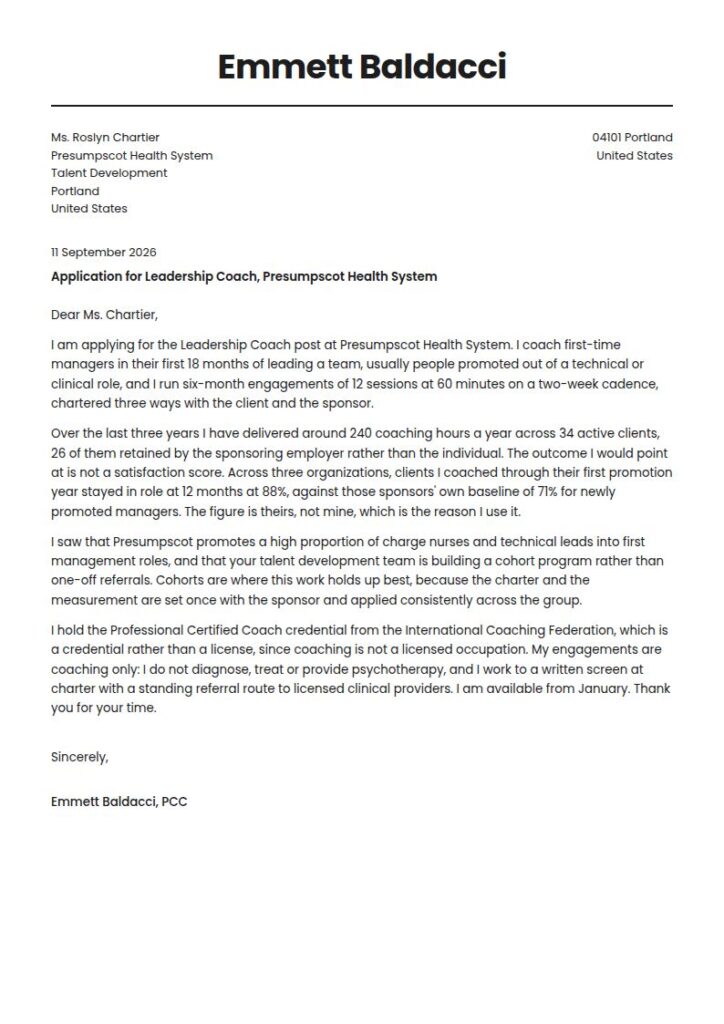
I am applying for the Leadership Coach post at Presumpscot Health System. I coach first-time managers in their first 18 months of leading a team, usually people promoted out of a technical or clinical role, and I run six-month engagements of 12 sessions at 60 minutes on a two-week cadence, chartered three ways with the client and the sponsor.
Over the last three years I have delivered around 240 coaching hours a year across 34 active clients, 26 of them retained by the sponsoring employer rather than the individual. The outcome I would point at is not a satisfaction score. Across three organizations, clients I coached through their first promotion year stayed in role at 12 months at 88%, against those sponsors' own baseline of 71% for newly promoted managers. The figure is theirs, not mine, which is the reason I use it.
I saw that Presumpscot promotes a high proportion of charge nurses and technical leads into first management roles, and that your talent development team is building a cohort program rather than one-off referrals. Cohorts are where this work holds up best, because the charter and the measurement are set once with the sponsor and applied consistently across the group.
I hold the Professional Certified Coach credential from the International Coaching Federation, which is a credential rather than a license, since coaching is not a licensed occupation. My engagements are coaching only: I do not diagnose, treat or provide psychotherapy, and I work to a written screen at charter with a standing referral route to licensed clinical providers. I am available from January. Thank you for your time.
Sincerely, Emmett Baldacci, PCC
Openings that work
| Instead of | Use |
|---|---|
| I am a passionate certified life coach | I coach first-time managers in their first 18 months of leading a team |
| I help clients transform their lives and careers | I run six-month engagements of 12 sessions, chartered three ways with the sponsor |
| I have helped hundreds of clients achieve their goals | Clients stayed in role at 12 months at 88% against the sponsor's own baseline of 71% |
| I would love to bring my energy to your team | You are building a cohort program rather than one-off referrals |
Every replacement swaps an assertion about you for a fact the reader can test.
What counts as evidence when nothing external vouches for you
| Kind of evidence | What it looks like in a sentence |
|---|---|
| Volume | 240 coaching hours a year across 34 active clients, 26 sponsor-retained |
| Sponsor-held data | Retention in role at 12 months of 88% against the sponsor's baseline of 71% |
| Agreed measurement | 17 of 21 clients met or exceeded the goal attainment scale set at charter |
| Renewal | Three multi-year contracts, all renewed at the end of their first term |
| Scope discipline | 11 clients routed to licensed clinical care under a written protocol since 2023 |
The strongest row is the second, because the number belongs to the reader's peer rather than to you. Where you can use a figure a sponsor already collects, use it and say whose it is.
Individual clients and organizational sponsors
For a sponsor, lead with the engagement model, the cohort logic and a measure they already collect, and keep it businesslike. For an individual client, lead with the niche and the problem people arrive with, and put the structure in the second paragraph. In both cases name the scope boundary and the referral route in the closing lines, and name one real thing the reader's organization is doing.
Do not promise transformation, breakthroughs or a new life. Do not use clinical language such as treatment, healing or therapy for what you sell. Do not describe an individual client, even unnamed, in a way that could identify them. Do not imply a coaching credential is a license. Do not send one letter to both a corporate sponsor and a private client; they buy different things.
The demand is growing fastest on the licensed side of the line
The Bureau of Labor Statistics publishes no Occupational Outlook Handbook profile for life coaches, so there is no employment count, projection or median wage. The published neighbors tell the story. Substance abuse, behavioral disorder and mental health counselors held 533,400 jobs in 2025 and are projected to grow 18 percent through 2035, with about 50,500 openings a year; health education specialists, unlicensed and closer to coaching in shape, are projected to grow 6 percent from a base of 70,400 jobs (BLS Occupational Outlook Handbook, 2025-35 projections, retrieved 17 September 2026).
For sponsor-paid coaching the nearest published occupation is training and development specialists: 472,500 jobs in 2025, 11 percent projected growth and a median annual wage of $69,280 as of May 2025 (BLS, same source).
That is the map your letter is read against. The fastest-growing adjacent work needs a license you do not hold, which is why a letter that draws the line clearly is more persuasive than one that blurs it.
Length, format and sending it
One page, four paragraphs, 250 to 400 words. PDF unless the portal says otherwise, named for yourself and the post: emmett-baldacci-leadership-coach-cover-letter.pdf.
Address a person. Talent development and human resources leads are usually named on the site or the posting itself, and a generic salutation on an otherwise precise letter undercuts the precision.
Keep every figure identical to your resume. Our life coach resume example uses the same hours, client counts and retention figures, so the two agree line for line.
Key takeaways
- Name the niche in the first sentence, narrow enough to exclude most readers.
- State the engagement model with its numbers before any result.
- Use one outcome, and say what measured it and who holds the data.
- Name one real thing about the organization, from their own pages.
- Close with the credential, the scope boundary and the referral route.
- Never describe an identifiable client, however good the story.
- Address a named person and keep it to one page.
Write your life coach cover letter in 10 minutes with our AI cover letter builder.
Life coach cover letter questions, answered
How long should a life coach cover letter be?
One page, four paragraphs, 250 to 400 words. Coaching letters run long more often than most, usually because the writer is substituting warmth for specifics. Cut until every sentence carries a fact.
Do I need a cover letter if I am pitching my own practice?
Yes, and it is the same document with a different opening. A practice pitch still needs the niche, the engagement structure, one measured outcome and the scope boundary. What changes is the closing paragraph: a proposal names next steps and a trial cohort rather than availability.
Should I mention that coaching is unlicensed?
Not in those words, but yes in substance. One clean sentence does it: the credential you hold, described as a credential, then what you do not do and what you do instead. That reassures rather than undermines, because the reader already knows there is no license and is watching to see whether you pretend otherwise.
How do I write about results without naming a client?
Aggregate. Report across a cohort with a number and a period: 34 clients, 88% retained in role at 12 months, three organizations. Never a name, an initial, an employer or an identifying detail. A letter is forwarded more often than any other document you write.
What if my only coaching experience is pro bono?
Count it properly and say so: hours delivered, number of clients, engagement structure, and any outcome agreed at the start and measured at the end. Pro bono hours described precisely read as evidence; paid hours described vaguely do not.