Ayotunde Chukwuemeka Home Health Aide Toledo, 43604, United States [email protected] · (419) 555-1912
11 September 2026
Ms. Yolanda Prichard Director of Nursing Oakfield Memory Care Toledo, United States
Application for Caregiver, secured memory care unit, Oakfield Memory Care
Dear Ms. Prichard,
I am applying for the caregiver position on the secured memory care unit at Oakfield Memory Care. I am a home health aide with a 92-hour training program behind me and competency observed with a patient in October 2023, and I take two-person and mechanical lift transfers, sit-to-stand lifts and transfer boards. My nurse aide application is with the Ohio Nurse Aide Registry and I expect to be listed this quarter.
My in-service stands at 14 hours over the last 12 months, against the 12 required by 42 CFR 484.80, and includes 16 hours of dementia care training and 8 hours of safe patient handling. I give medication reminders and container assistance within the scope permitted for an unlicensed aide in Ohio and I do not administer medication; I report missed or refused doses to the supervising nurse the same day.
For the last three years I have carried a panel of seven home care clients across 9 to 11 visits a day, three of whom needed a two-person or mechanical lift. I chart at the point of care and my visit verification compliance has been complete for 18 months with no late documentation. Last year I escalated 11 changes in condition to the supervising nurse, four of which led to a care plan revision, which is the part of the work I would most want to bring to a memory care unit.
I can work either shift including alternate weekends, I drive and I live 15 minutes from the unit. Thank you for your time.
Sincerely, Ayotunde Chukwuemeka
Summary
A caregiver cover letter tells a staffing coordinator what you are credentialed to do, which clients you can be assigned to, and where your scope stops. This guide gives you a full adaptable letter, the openings that get a call back, how to write about clients without breaking confidentiality, and what to send when your only experience is caring for family.
Caregiver cover letter examples by experience level
In short, a caregiver cover letter is a one-page letter that tells a staffing coordinator what you are credentialed to do, which clients they can assign you to, and where your scope stops.
Almost nobody writes it that way. By contrast, the usual caregiver letter is a paragraph about compassion, which the reader has seen four hundred times and cannot act on. Instead, the letter that gets a call back answers the scheduling question in the first four lines.
Guide to a caregiver cover letter
To help, this guide and the corresponding caregiver cover letter example will cover:
- First, how to structure the letter, paragraph by paragraph
- Next, why the credential and the transfer line belong in the opening
- Also, how to write about clients without breaking confidentiality
- Finally, what changes between home care, assisted living and memory care
- What to send when your only experience is family caregiving
How to write a caregiver cover letter
| Paragraph | Its job | Length |
|---|---|---|
| Opening | The post, your credential, and the transfers you can take | 2 to 3 sentences |
| Scope | Training hours, competency date, in-service, where your scope stops | 3 to 4 sentences |
| Evidence | Panel size or residents per shift, one measurable result | 3 to 4 sentences |
| Close | Registry number, shift availability, transport, thank you | 2 sentences |
Open with the credential and the transfer line
A staffing coordinator is holding a list of unfilled visits and a set of clients who are hard to place. The hardest are almost always the ones needing a two-person or mechanical lift transfer.
So write it into the first paragraph: "I am a home health aide with a 92-hour training program behind me, competency observed with a patient in October 2023, and I take two-person and mechanical lift transfers." Then add the sentence that shows you know the rules you work under: "My in-service stands at 14 hours in the last 12 months, against the 12 required by 42 CFR 484.80." That tells a coordinator your file will survive a survey and that you will not need chasing in the spring.
A caregiver cover letter example you can adapt
Dear Ms. Prichard,
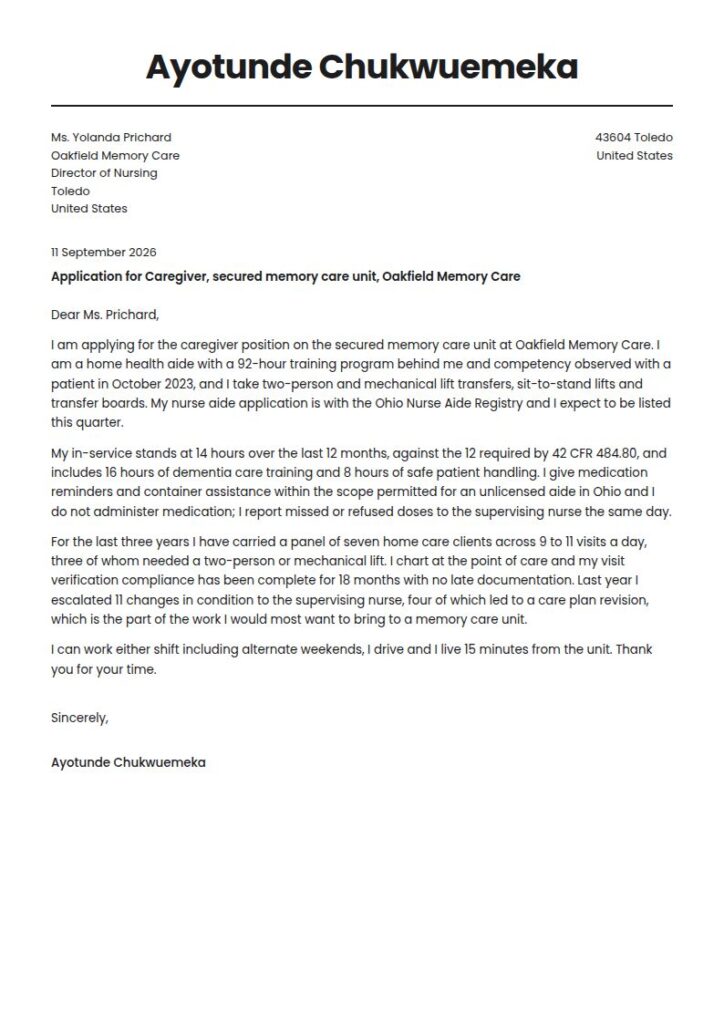
I am applying for the caregiver position on the secured memory care unit at Oakfield Memory Care. I am a home health aide with a 92-hour training program behind me and competency observed with a patient in October 2023, and I take two-person and mechanical lift transfers, sit-to-stand lifts and transfer boards. My nurse aide application is with the Ohio Nurse Aide Registry and I expect to be listed this quarter.
My in-service stands at 14 hours over the last 12 months, against the 12 required by 42 CFR 484.80, and includes 16 hours of dementia care training and 8 hours of safe patient handling. I give medication reminders and container assistance within the scope permitted for an unlicensed aide in Ohio and I do not administer medication; I report missed or refused doses to the supervising nurse the same day.
For the last three years I have carried a panel of seven home care clients across 9 to 11 visits a day, three of whom needed a two-person or mechanical lift. I chart at the point of care and my visit verification compliance has been complete for 18 months with no late documentation. Last year I escalated 11 changes in condition to the supervising nurse, four of which led to a care plan revision, which is the part of the work I would most want to bring to a memory care unit.
I can work either shift including alternate weekends, I drive and I live 15 minutes from the unit. Thank you for your time.
Sincerely, Ayotunde Chukwuemeka
Openings that work
| Instead of | Use |
|---|---|
| I am a compassionate caregiver with a heart for seniors | I am a home health aide with a 92-hour program behind me and competency observed with a patient in October 2023 |
| I am experienced with all activities of daily living | I take two-person and mechanical lift transfers, sit-to-stand lifts and transfer boards |
| I am reliable and always on time | Full visit verification compliance for 18 months with no late documentation |
| I work well with the nursing team | Escalated 11 changes in condition to the supervising nurse last year, four leading to a care plan revision |
In each row, the line on the right tells a coordinator which clients they can assign you to, which is the only decision they make on a first read.
Writing about clients without breaking confidentiality
In practice, describe the care and the acuity, never the person. After all, counts and tasks carry everything useful and identify nobody.
| Instead of | Use |
|---|---|
| I cared for Mrs. Delaney, who had advanced Parkinson's | Three of my seven clients required a two-person or mechanical lift transfer |
| My client on Cherry Street needed help after her stroke | Supported a client through post-stroke rehabilitation at home, including range of motion to the plan of care |
| I looked after a lady with dementia who was often agitated | Provide behavior-first dementia care for six residents on a secured unit |
That means no initials, no room numbers, no addresses, no photographs, and no diagnosis attached to anyone a reader could identify.
What changes between settings
The same person writes three different letters for home care, assisted living and memory care, because each reader is solving a different staffing problem.
Home care. The coordinator is filling visits on a map. Lead with transfer scope, driving radius, shift pattern and your documentation record.
Assisted living. The reader is filling a floor. Lead with residents per shift, medication scope, call-light response and how you handle a resident who declines care.
Memory care. The reader is filling a secured unit. Lead with dementia training hours, redirection and de-escalation, and how you keep the day predictable for residents who cannot tell you what is wrong.
Put the credential and the transfer line in the first paragraph. Give training hours and the date competency was observed. State your in-service hours for the last 12 months. Say where your medication scope stops. Give a panel size or residents per shift and one measurable result. Close with your registry number, shift availability and transport.
Do not open on compassion, which every letter in the pile claims. Do not write "administered medication" unless you hold a credential that permits it. Do not name a client or attach a diagnosis to anyone identifiable. Do not claim an out-of-state credential without saying whether reciprocity or an application is in progress. Do not leave your shift availability to the interview, because it is the second thing the coordinator needs.
Hiring at this volume is triage, and scope is the sort key
Home health and personal care aides are projected to grow 18 percent between 2025 and 2035, adding 847,300 jobs, with about 760,500 openings projected each year (BLS Occupational Outlook Handbook, 2025-35 projections). The occupation employed 4,677,100 people in 2025 at a median wage of $35,800 a year, or $17.21 an hour, with the highest 10 percent above $45,040 (BLS, May 2025).
Hiring at that volume is triage. Nobody is weighing your sincerity against another candidate's; they are sorting files into who can be assigned to a hard client next week and who cannot. A letter that answers that in four lines gets read to the end.
Length, format and sending it
One page, four paragraphs, 250 to 400 words. PDF unless the agency portal says otherwise, named for yourself and the role: ayotunde-chukwuemeka-caregiver-cover-letter.pdf.
Address a person. Agencies and communities list their director of nursing or client services director on their own site. Use the same hours, panel sizes and dates as your resume so the two agree. Our caregiver resume example is written with the figures used here.
Key takeaways
- To start, name your credential and your transfer scope in the first paragraph.
- Then give training hours and the date a nurse observed your competency with a patient.
- State your in-service hours for the last 12 months.
- Also, say plainly where your medication scope stops.
- In addition, give a panel size or residents per shift, plus one measurable result.
- Finally, tailor the lead to the setting: transfers for home care, residents for assisted living, dementia training for memory care.
- Close with your registry number, shift availability and transport.
Write your caregiver cover letter in 10 minutes with our AI cover letter builder.
Caregiver cover letter questions, answered
How long should a caregiver cover letter be?
One page, four paragraphs, 250 to 400 words. Staffing coordinators read these in batches against a list of unfilled shifts, so the useful information has to be in the first four lines. Anything past one page is read by nobody.
Should I mention my credential if it is still pending?
Yes, with the status and the expected date. "My nurse aide application is with the Ohio Nurse Aide Registry and I expect to be listed this quarter" is honest and lets a coordinator plan around it. Never imply you already hold it: registry status is checked before interview and a mismatch ends the application.
What do I write if my only experience is caring for a family member?
Write it as work, with the tasks and the hours. "Provided daily personal care, transfers with a gait belt and meal preparation for a family member at home, roughly 30 hours a week for four years" is real caregiving experience and reads as such. Do not name the person or their condition. Then add whatever training you have completed, because an aide program plus family caregiving is a strong first application.
Do I need to explain gaps in a caregiver cover letter?
One clause is enough. Home care agencies verify employment dates as routine, and an unexplained gap invites a question you will not be there to answer. "Out of the workforce caring for a family member, 2022 to 2023" closes it in seven words.
Should the letter be different for home care and a nursing facility?
Yes. A home care coordinator is filling visits on a map, so lead with transfer scope, driving radius and shift pattern. A facility is filling a floor, so lead with residents per shift, your credential and registry status. The credential belongs in both; what changes is the sentence after it.