Marisol Bettencourt Substance Use Counselor, MA, LCDP Providence, 02906, United States [email protected] · (401) 555-2106
11 September 2026
Mr. Elias Vasquez Clinical Director Seekonk River Recovery Services Providence, United States
Application for Substance Use Counselor, Seekonk River Recovery Services
Dear Mr. Vasquez,
I am applying for the Substance Use Counselor post in the intensive outpatient program at Seekonk River Recovery Services. I am a Rhode Island Licensed Chemical Dependency Professional currently covering Level 2.1 intensive outpatient and Level 1 outpatient continuing care, carrying 38 active clients across nine hours of structured programming a week.
The result I would point to is the completion rate. Over two years it moved from 51 percent to 62 percent, and the two changes that did it were dull ones: intake moved to same-week scheduling, and we added a step-down group for people leaving residential, who had been most likely to disappear in week two. I run motivational interviewing, cognitive behavioral relapse prevention and contingency management groups, with fidelity checked in weekly supervision, and I complete the multidimensional assessment at intake and at every continued stay review. I also led our 42 CFR Part 2 consent rework: a new form, twelve staff trained, every outbound disclosure reviewed for a year.
Your posting mentions an evening track and more referrals direct from the emergency department. Evening intensive outpatient is where the completion gains usually are, because it is the only version working people can attend, and warm handoffs from an emergency department stand or fall on whether consent is handled cleanly at referral. Both are things I would want to work on from the first week.
My license is current and I hold National Certified Addiction Counselor Level II from NAADAC. I can start at three weeks' notice. Thank you for reading.
Sincerely, Marisol Bettencourt, MA, LCDP
Summary
A drug and alcohol counselor cover letter names the level of care you work at, the caseload and weekly program hours behind it, and one retention or completion figure. This guide gives you a full adaptable letter, how the letter changes across residential, outpatient and opioid treatment posts, and the confidentiality line that separates a good letter from a risky one.
Drug and Alcohol Counselor cover letter examples by experience level
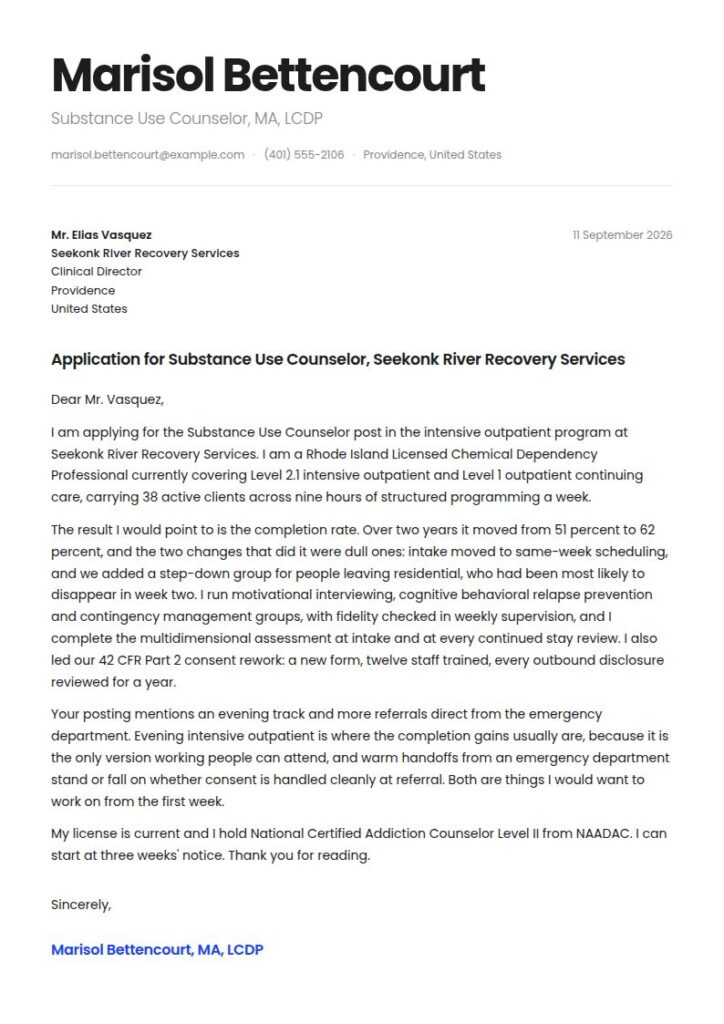
A drug and alcohol counselor cover letter is a one-page letter naming the level of care you work at, the caseload and weekly program hours behind it, and one retention or completion figure.
The reader is a clinical director filling a shift pattern. They assume you care; everybody who applies does. What they cannot assume is whether you have run three groups a day in a building with beds, held an intensive outpatient panel, or scheduled counseling around a dosing window. Those are three different jobs, and the letter should say which you have done.
Guide to a drug and alcohol counselor cover letter
This guide and the corresponding drug and alcohol counselor cover letter example will cover:
- How to structure the letter, paragraph by paragraph
- Why the level of care belongs in the first sentence
- What counts as an outcome when recovery is not yours to claim
- How the letter changes by setting
How to write a drug and alcohol counselor cover letter
| Paragraph | Its job | Length |
|---|---|---|
| Opening | The post, your credential, the level of care, the caseload | 2 to 3 sentences |
| Evidence | Program hours, modalities, one retention or completion number | 4 to 5 sentences |
| Fit | Something specific about their program, and what you would take on | 3 to 4 sentences |
| Close | Credential status, availability, thank you | 2 sentences |
Name the level of care before you name yourself
"I am a Rhode Island Licensed Chemical Dependency Professional covering Level 2.1 intensive outpatient and Level 1 outpatient for a panel of 38" answers most of the screening questions in one line: setting, intensity, credential and volume.
If your program did not use the framework, give the mechanics: bed count and average stay for residential, program hours a week and group count for outpatient.
A drug and alcohol counselor cover letter example you can adapt
Dear Mr. Vasquez,
I am applying for the Substance Use Counselor post in the intensive outpatient program at Seekonk River Recovery Services. I am a Rhode Island Licensed Chemical Dependency Professional currently covering Level 2.1 intensive outpatient and Level 1 outpatient continuing care, carrying 38 active clients across nine hours of structured programming a week.
The result I would point to is the completion rate. Over two years it moved from 51 percent to 62 percent, and the two changes that did it were dull ones: intake moved to same-week scheduling, and we added a step-down group for people leaving residential, who had been most likely to disappear in week two. I run motivational interviewing, cognitive behavioral relapse prevention and contingency management groups, with fidelity checked in weekly supervision, and I complete the multidimensional assessment at intake and at every continued stay review. I also led our 42 CFR Part 2 consent rework: a new form, twelve staff trained, every outbound disclosure reviewed for a year.
Your posting mentions an evening track and more referrals direct from the emergency department. Evening intensive outpatient is where the completion gains usually are, because it is the only version working people can attend, and warm handoffs from an emergency department stand or fall on whether consent is handled cleanly at referral. Both are things I would want to work on from the first week.
My license is current and I hold National Certified Addiction Counselor Level II from NAADAC. I can start at three weeks' notice. Thank you for reading.
Sincerely, Marisol Bettencourt, MA, LCDP
Openings that work, and what counts as an outcome
Recovery is not yours to claim, and a clinical director will not believe a letter that claims it. Replace the claim about who you are with the part of the process you ran.
| Instead of | Use |
|---|---|
| I am passionate about helping people in recovery | I am an LCDP covering Level 2.1 intensive outpatient and Level 1 outpatient for a panel of 38 |
| I am committed to client-centered care | The intensive outpatient completion rate moved from 51 percent to 62 percent over two years |
| Kind of evidence | What it looks like in a sentence |
|---|---|
| Completion | Intensive outpatient completion rate moved from 51 percent to 62 percent over two years |
| Retention | 90-day retention rose from 64 percent to 78 percent across three years |
| Access | Intake moved to same-week scheduling, cutting the wait from 11 days to 4 |
| Transitions | 84 step-down transfers arranged from residential to intensive outpatient |
Confidentiality is a screening test in this field
Substance use treatment records fall under 42 CFR Part 2, which is stricter than HIPAA. A program that holds itself out as providing and provides substance use disorder diagnosis, treatment or referral for treatment may use or disclose patient records only as the regulation permits, and those records may not otherwise be used or disclosed in civil, criminal, administrative or legislative proceedings (Electronic Code of Federal Regulations, 42 CFR 2.11 and 2.13, retrieved 17 September 2026). The February 2024 final rule, with compliance required by 16 February 2026, allows a single consent for treatment, payment and health care operations (Federal Register, retrieved 17 September 2026).
A director who sees any patient detail, even a blurred one, has learned something about how you handle records. Write about the process, the volume and the schedule, never a person.
Name the level of care and your credential in the first sentence. Give caseload and weekly program hours together. Name your modalities and where fidelity was checked. Give one completion or retention figure with a before, an after and a period. Say when you can start; counselor vacancies are covered by overtime until filled.
Do not describe a patient, a substance, a relapse or a family situation in any form. Do not claim sobriety outcomes as your own work. Do not use "clean" or "dirty" about a drug screen. Do not put your recovery status in the letter; disclosure is your decision and an application is the wrong venue. Do not leave the setting vague: residential, outpatient and opioid treatment are three different hires.
How the letter changes by setting
| Setting | What the first paragraph should carry |
|---|---|
| Residential, Level 3 | Bed count, average length of stay, admissions volume, groups a day |
| Intensive outpatient, Level 2.1 | Panel size, weekly program hours, group count, completion |
| Outpatient continuing care, Level 1 | Panel size, visit interval, step-down volume |
| Opioid treatment program | Patient census, medication types, counseling scheduled against dosing, retention |
Opioid treatment programs carry a regulation nothing else does. Under 42 CFR Part 8 such a program must hold current SAMHSA certification and accreditation from an approved body, and must provide adequate counseling and psychoeducation as clinically necessary and mutually agreed, with refusal of counseling not preventing a patient from receiving medication (Electronic Code of Federal Regulations, retrieved 17 September 2026).
Eighteen percent growth, and most of it outpatient
Employment of substance abuse, behavioral disorder and mental health counselors is projected to grow 18 percent from 2025 to 2035, from 533,400 jobs in 2025, with about 50,500 openings a year on average (BLS Occupational Outlook Handbook, May 2025 data and 2025 to 2035 projections, retrieved 17 September 2026). The work sits outside hospitals: offices of other health practitioners hold 20 percent of employment, outpatient centers 16 percent, individual and family services 15 percent, residential facilities 8 percent and hospitals 7 percent (BLS, 2025 employment data).
The median annual wage was $59,350 as of May 2025, from $63,310 in hospitals to $49,660 in residential facilities (BLS, May 2025). A letter that reads as outpatient-ready is aimed at the largest part of that market.
Length, format and sending it
One page, four paragraphs, 250 to 400 words. PDF unless the portal says otherwise, named for yourself and the post: marisol-bettencourt-substance-use-counselor-cover-letter.pdf. Address a person; clinical directors are named on provider sites and in state licensing directories. Keep letter and resume in agreement: our drug and alcohol counselor resume example uses the numbers written here.
Key takeaways
- Name the level of care and your credential in the first sentence.
- Give caseload and weekly program hours together, never one alone.
- Use completion, retention or access figures, not sobriety claims.
- Name your modalities and where fidelity was checked.
- Show you understand consent under 42 CFR Part 2.
- Match the first paragraph to the setting.
- Keep every patient and substance out of the letter.
Write your drug and alcohol counselor cover letter in 10 minutes with our AI cover letter builder.
Drug and alcohol counselor cover letter questions, answered
How long should a drug and alcohol counselor cover letter be?
One page, four paragraphs, 250 to 400 words. Directors read applications between groups and supervision, and a second page does not read as thoroughness.
What do I write with no paid counseling experience yet?
Write the practicum or internship as a job: the program, the level of care, the caseload, the groups you co-facilitated and the hours logged toward credentialing. Then say where you are in credentialing, with the board named. A director hiring at entry level is buying the trajectory.
Should I mention my own recovery in the letter?
No. Whether to disclose is your decision and many excellent counselors do, but an application is the wrong venue: it is read by human resources first, it enters a file you do not control, and it invites judgments unrelated to your competence. A peer recovery credential states the fact without the rest.
How do I write about outcomes without overclaiming?
Use process measures. Completion rate, retention at 30 or 90 days, intake wait time, step-down transfer volume and no-show rate are all tracked by the program, and none ask you to take credit for someone's recovery. Give the before, the after and the period.
Does the letter change if the job is in an opioid treatment program?
Yes. Say plainly that you understand the program operates under 42 CFR Part 8 with SAMHSA certification and accreditation, and describe how you have scheduled counseling around dosing windows. Retention is the measure that program cares about most, so lead your evidence paragraph with it.